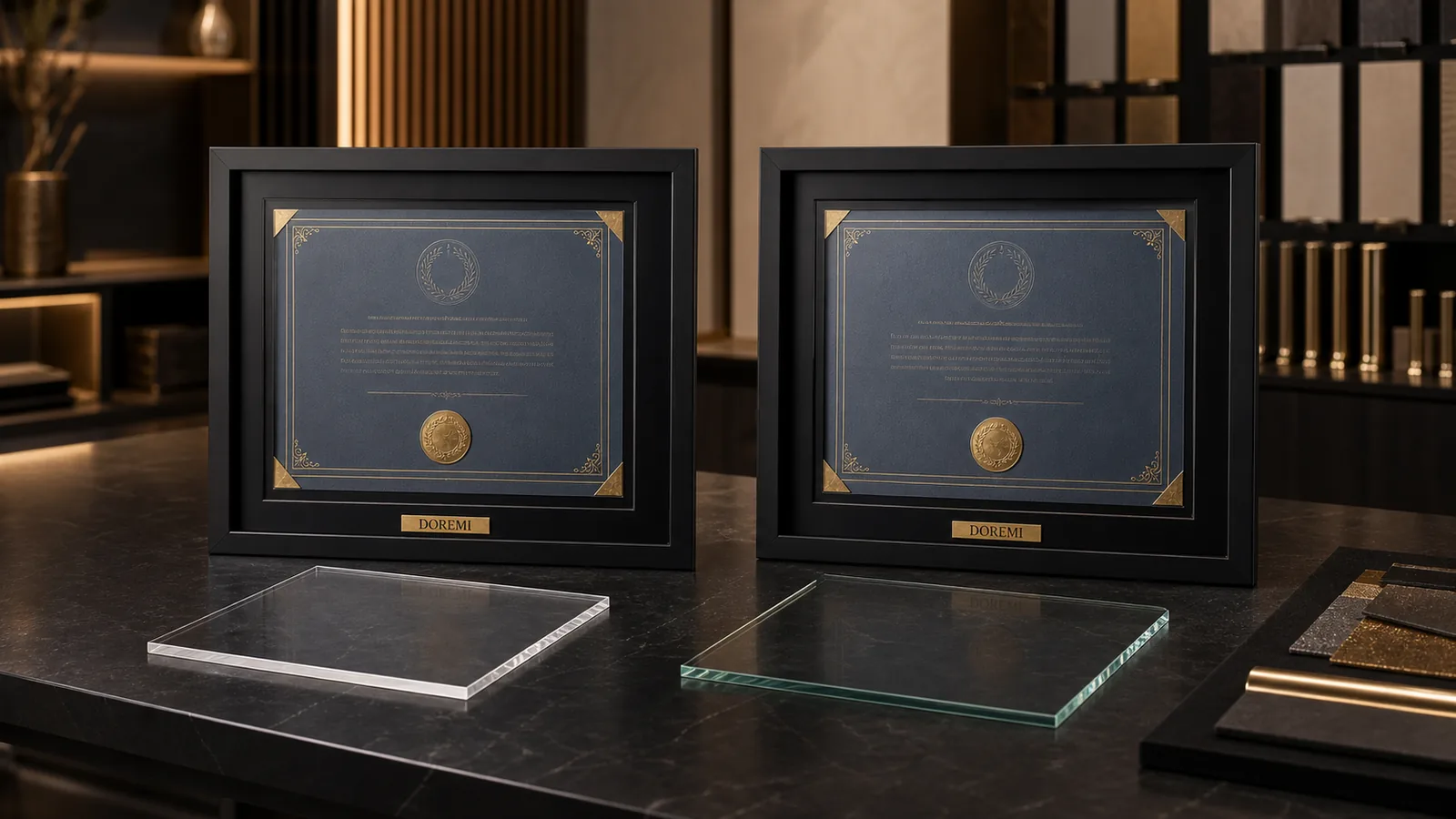
“Is acrylic or glass better?” sounds like a material question. For an importer or programme buyer, it is a route-to-market question. The right glazing depends on what the frame contains, how large it is, who handles it, how it travels, where it hangs and what the customer expects when the box is opened.
This guide is for buyers specifying custom jersey, medal, award, certificate, photo and vinyl record displays. It provides a procurement framework rather than declaring one universal winner. It also explains what a sample and quotation should prove before the glazing choice becomes part of a purchase order.
Why the same buyer question keeps appearing
Current framing search results repeatedly group acrylic and glass questions around safety, clarity, scratching, reflection, UV filtering and large-frame suitability. Those are useful themes, but retail answers often stop at “choose what suits your home.” A B2B buyer must translate the trade-off into measurable consequences: packed weight, damage exposure, protective film, carton design, cleaning instructions, wall hardware, replacement policy and landed cost.
The correct answer can also vary inside one programme. A small tabletop certificate display shipped in bulk to offices may use glass, while an oversized wall display delivered individually may favour acrylic. Procurement should permit a reasoned split when the risk changes rather than force one material across every SKU for administrative simplicity.
Define glazing by a product grade, not a nickname
Terms such as “plexi,” “acrylic,” “non-glare,” “museum glass” and “UV glass” are often used loosely. They do not by themselves identify the substrate, thickness, surface treatment, light-filtering performance or supplier. A purchase specification should name the material type, thickness, finish or coating, edge condition, protective film and any verified performance requested from the material vendor.
If a claim matters to the product listing, request documentation that supports the exact grade supplied. Do not copy a percentage from a different brand or assume all acrylic or all glass has the same filtering behaviour. Likewise, “anti-reflective” and “UV-filtering” describe different functions; one should not be used as evidence for the other.
Start with five programme questions
- What object is being displayed, and can it tolerate contact, static or movement?
- What are the outside dimensions and unsupported glazing span?
- Will units move by pallet, parcel, air, venue handover or local installation?
- Who will unpack, clean, hang and possibly replace the glazing?
- Which visible qualities and documented protection claims are truly required?
Answer these before asking for a price comparison. A supplier can only recommend a construction when the use and route are visible. Otherwise, the lower-cost option may simply shift cost into heavier freight, more protection, customer complaints or a cleaning issue.
Where acrylic usually earns attention
Acrylic is commonly considered when lower weight and shatter resistance are important. Those characteristics can support large formats, wall installations, high-traffic settings and parcel-shipped products. Its fabrication flexibility can also help when a design needs non-standard shapes or a deeper display assembly. For a buyer, the value is not “plastic is better”; it is that the completed frame may be easier to handle and less exposed to glass breakage during ordinary movement.
The trade-offs must remain visible. Uncoated acrylic is more susceptible to surface scratching than glass and can attract dust through static. Protective film, clean assembly, appropriate cloths and customer-care instructions become part of the product system. Acrylic can flex across a large span, so thickness and support should be reviewed against the actual frame size rather than copied from a smaller SKU.
Where glass may remain the right choice
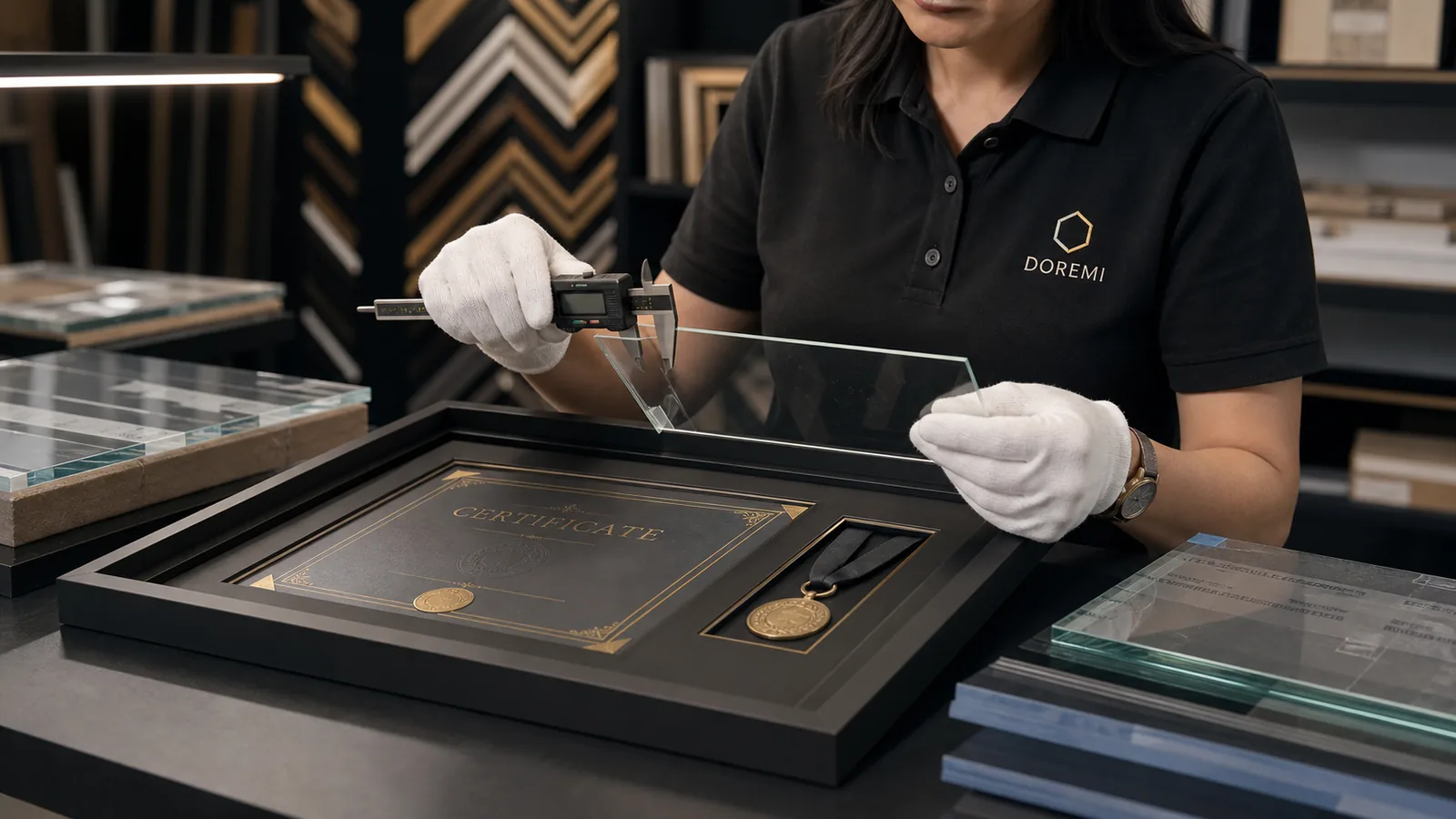
Glass offers a hard, familiar cleaning surface and can provide a traditional sense of finish in small and medium formats. Standard grades may be commercially efficient where frames travel in controlled bulk shipments and are installed in low-risk interiors. Specialist glass can provide advanced reflection or light-filtering characteristics when the programme justifies the cost and the supplier can document the grade.
Its weight and breakage behaviour require deliberate handling. A larger glass front increases the load on the profile, backing, hanging hardware and package. If a pane breaks, the displayed item can also be affected. Those risks do not make glass unsuitable; they mean the frame and carton must be specified as a complete system and evaluated against the actual distribution route.
Compare clarity and reflection with the real sample
Material marketing can make optical comparisons sound absolute. In practice, the buyer sees a finished assembly under room lights, spotlights, windows and camera angles. Ask for side-by-side samples using the actual mat colour and display contents. View them from the front and at an angle, and photograph them in a representative setting.
A matte or reflection-control surface can soften glare but may also reduce apparent sharpness, especially when it sits farther from the displayed object. Coated anti-reflective products behave differently from simply textured non-glare sheets. Specify what matters: clean photography for an e-commerce listing, readability in a bright lobby, or acceptable viewing in an ordinary home. Then review the product in that context.
Do not treat UV filtering as total preservation
Public guidance from the U.S. National Archives recommends ultraviolet-filtering glass or acrylic and using mats or spacers so original paper or photographs do not touch the glazing. MoMA also notes that even UV-filtering acrylic does not remove concern about the intensity and duration of light exposure. The useful procurement lesson is that glazing is one control within a larger display environment.
A responsible product guide should still advise users to avoid direct sunlight, strong heat and damp conditions. For valuable, irreplaceable or highly sensitive objects, the buyer should seek qualified conservation advice. A manufacturer’s commercial display recommendation is not a preservation guarantee.
Consider static, contact and the displayed object
Acrylic can develop static that attracts dust and may affect loose, lightweight media. Glass is heavier and can create greater consequences if it breaks. Neither surface should automatically press against a certificate, photo, textile, jacket or signed item. Use a mat, spacer, recess or secure mounting system appropriate to the object.
For jerseys and medals, usable internal depth and object restraint may matter more than minor optical differences. For paper and photographs, separation and material compatibility deserve more weight. For vinyl displays, heat exposure, jacket contact and disc support must be considered together. Define the object first, then decide what the glazing needs to do.
Translate material choice into packaging requirements
An acrylic-front frame may need protective film retained through assembly, a non-abrasive separator and instructions for removing film without scratching. A glass-front frame may need stronger edge separation, controlled clearance, more robust corner protection and a plan for containing fragments if a break occurs. Both require enough restraint that the frame cannot gain momentum inside the carton.
Ask for packed-unit dimensions and gross weight for each glazing option. Compare the complete packed system rather than sheet price alone. The glazing decision can change carton grade, protection volume, units per master carton, pallet pattern, handling label and last-mile cost.
Build a landed-risk comparison
A practical comparison sheet can use the following columns: sheet grade and thickness, unit material cost, completed frame weight, individual-pack dimensions, master-carton quantity, expected handling route, replacement process, cleaning instruction, required claims documentation and sample status. Add a note for what remains unknown.
Do not insert invented breakage percentages or use one project’s results as a promise for another. If you have historical returns for the same SKU and route, use them internally with clear dates and sample sizes. If you do not, treat the first controlled shipment as a learning batch and define how issues will be recorded.
What the sample approval should include
- Exact glazing grade, thickness and supplier reference recorded
- Front and angled viewing under representative light
- Fit, flatness, edge clearance and frame rigidity checked
- Displayed object separated and secured appropriately
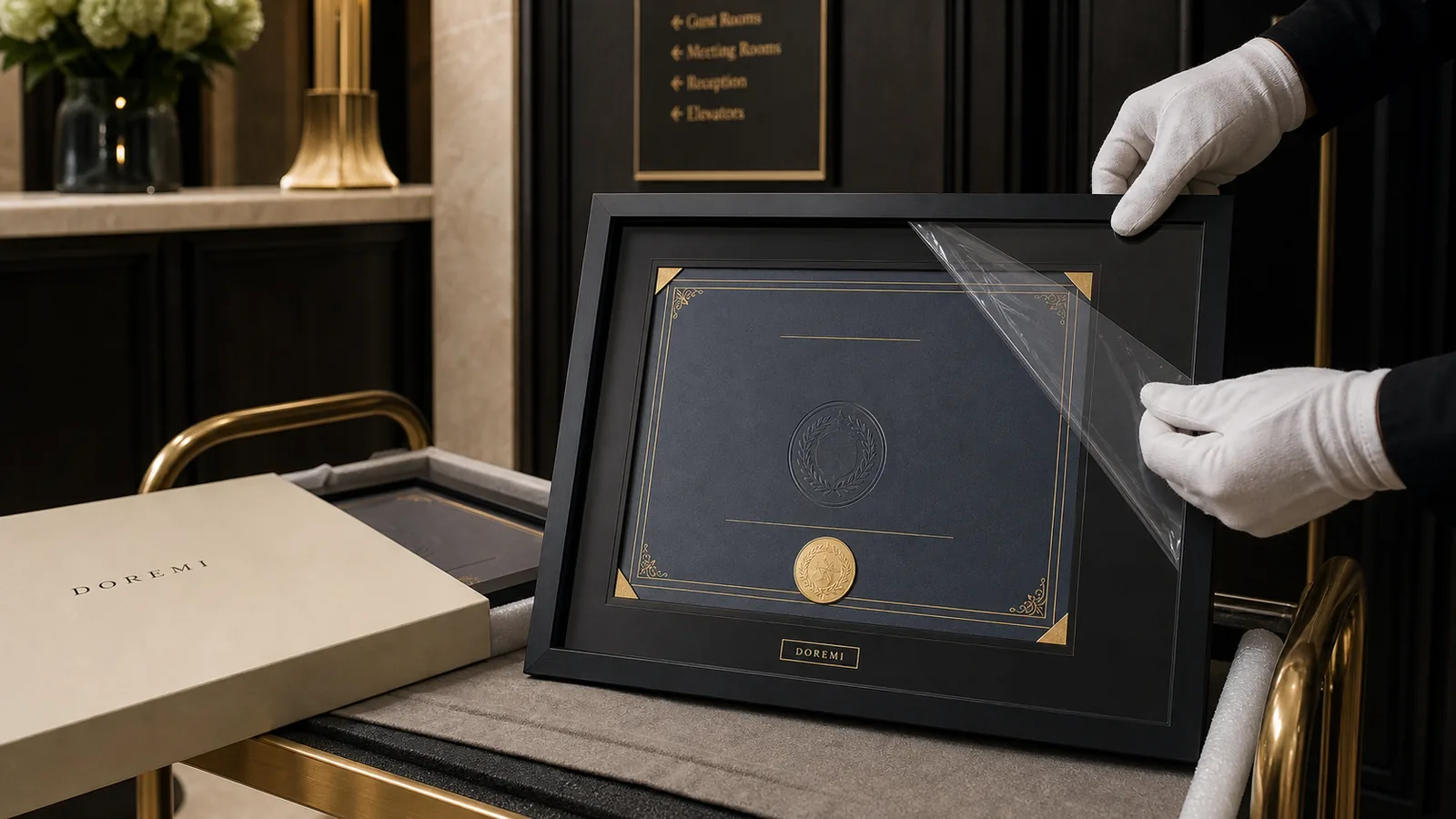
- Protective film and cleaning method demonstrated
- Completed weight and hanging hardware reviewed
- Individual packaging and master-carton method approved
- Any UV or anti-reflective claim supported for the supplied grade
Questions for the supplier quotation
Ask: Which exact acrylic and glass grades are available for this size? Which thickness is proposed, and why? Does the quote include protective film, surface treatment or coating? What changes in frame profile, backboard or hardware between options? What are the packed weights and carton quantities? Which documentation supports any claimed optical or light-filtering performance? How will replacement glazing be identified and supplied?
The answer should be specific to your product. A quotation that says only “2 mm acrylic” or “clear glass” leaves too many assumptions unresolved for an export programme.
Review cleaning and customer instructions as product content
The same surface that looks flawless in a sample room may be cleaned by store staff, hotel maintenance teams or consumers using whatever cloth is nearby. Ask the material supplier for the appropriate care method and translate it into a short, realistic instruction. For acrylic, the instruction may need to warn against abrasive cloths and unsuitable chemicals. For coated glass, it may need to protect the treated surface. Do not invent one cleaning method for every grade.
Show how protective film should be removed and whether it covers one or both sides. A nearly invisible film left in place can be mistaken for a cloudy or scratched surface. If the film has no printed tab, add a simple removable indicator that does not touch the visible area. Review the instruction with someone who did not help design the pack; if that person cannot identify the film and safe opening sequence, the end customer may not either.
Account for installation and wall-hardware consequences
Glazing changes completed weight, and completed weight changes how the frame should be handled and installed. Record the actual finished weight after the production construction is confirmed. Select hanging hardware against the complete frame, intended orientation and installation context. The supplied hardware cannot guarantee suitability for every wall type, so instructions should state that appropriate fixings and competent installation may be required.
For multi-unit hospitality, education or corporate projects, ask the installer to review one sample before the full delivery. Standardise the hanging position and provide a dimensioned back view. A lighter glazing option can make handling easier, but it does not remove the need to check frame rigidity, hardware attachment and wall conditions.
Define replacement and incident handling before launch
If a unit arrives with a marked acrylic sheet or broken glass, who identifies the correct replacement, who installs it and how is the displayed object protected during the change? A replacement policy should distinguish glazing damage, frame damage and carrier damage. Keep the material code, dimensions, edge treatment and film orientation in the product record.
For glass programmes, give recipients a safe instruction not to handle loose fragments and a route to report damage. For acrylic, explain that superficial film marks may disappear when the film is removed, while actual scratches require review. Do not ask customers to perform repairs that expose them or the displayed object to unnecessary risk.
Experience scope and project limits
Editorial review: Jessica, Founder & Project Advisor at DOREMI Display. Updated 12 August 2026. Jessica’s experience scope covers B2B display briefs, sample reviews, practical material trade-offs, packaging coordination and project handover. She is not presented here as a conservation scientist, glazing manufacturer, testing laboratory, structural engineer or destination-market safety authority.
Final decisions should be validated with the actual display object, exact material datasheet, physical sample, packaging sample, installation method, route-specific testing and applicable local requirements. For irreplaceable cultural or archival objects, consult a qualified conservator.