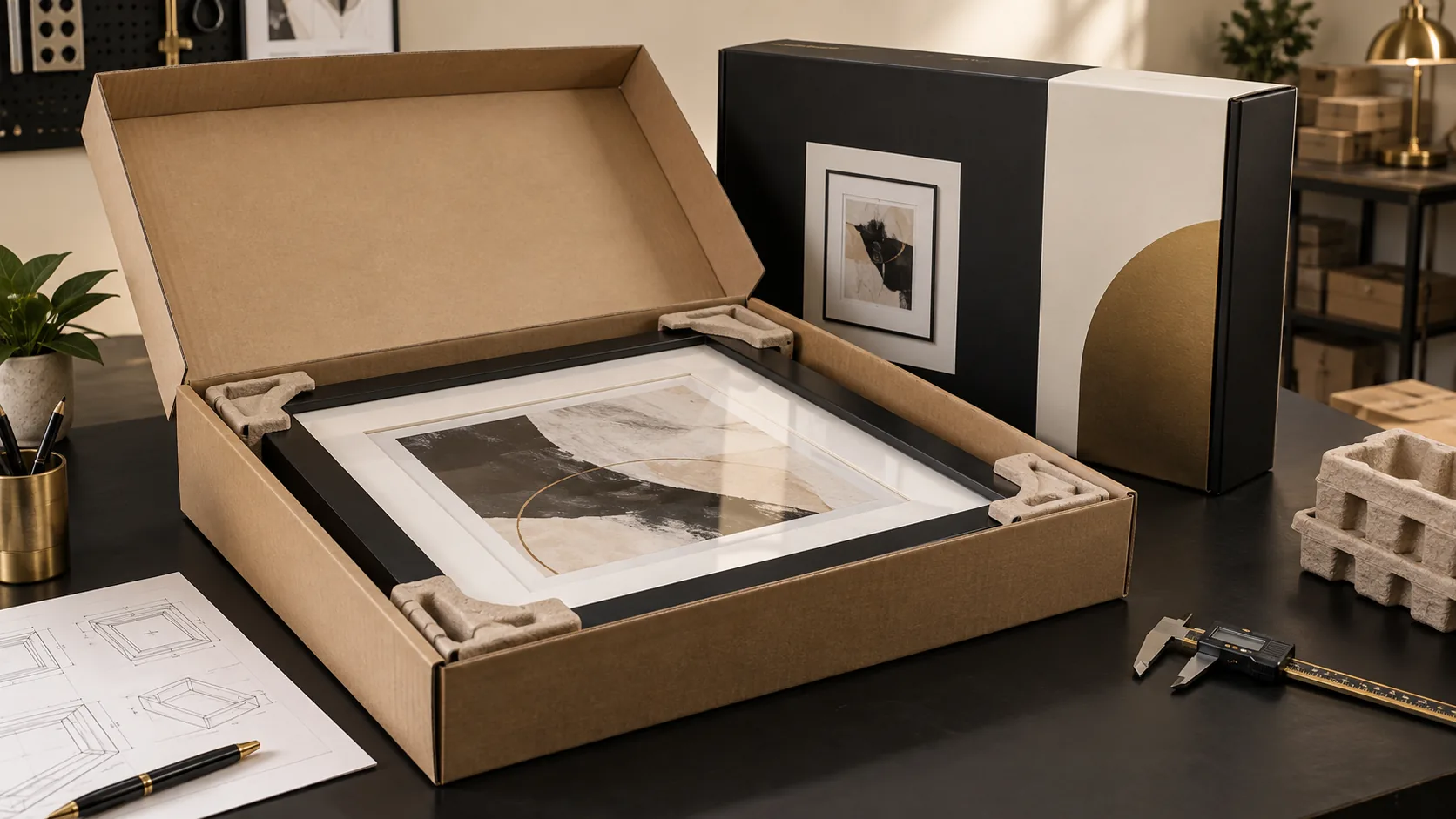
Can a framed product travel through ecommerce fulfilment in its own branded package without an additional Amazon box? That question looks like a carton decision, but the answer depends on the exact frame, glazing, internal mount, accessories, route, pack construction, current programme rules and evidence accepted for the ASIN. A pass on a different size or an attractive retail box does not settle it.
This guide is for private-label frame brands, Amazon sellers and vendors, packaging teams, sourcing managers and OEM suppliers preparing a fragile display-frame programme. It converts the Ships in Product Packaging objective into a buyer-to-supplier handover. It does not certify a package, reproduce a paid test, promise enrolment or replace current instructions from Amazon, ISTA, the responsible account owner and an appropriately equipped laboratory.
Start with the customer and fulfilment question
Amazon describes SIPP as a programme in which eligible products can reach customers in the manufacturer's original packaging without additional Amazon packaging. For a display frame, the commercial attraction is clear: less secondary packaging, a potentially simpler unboxing sequence and a branded pack that performs both retail and transit roles. The risk is equally clear: the same package may face labels, sorting, drops, compression, vibration, weather transitions and doorstep exposure.
Write the objective in operational language. Identify marketplace, fulfilment route, account type, ASIN or planned product family, launch date and whether the pack must conceal the product. Confirm which Amazon workflow applies through the current seller or vendor portal. Public programme pages provide useful context, but the account owner must verify the current enrolment, exception and evidence requirements for the exact product.
Do not treat SIPP, SIOC and FFP as interchangeable
Amazon's current public sustainability pages use Ships in Product Packaging. Older documents and ISTA materials may refer to Ships in Own Container or Frustration-Free Packaging tiers. Those terms can appear together in supplier presentations even though programme names, routes and administrative steps have evolved. Record the terminology shown in the current account workflow and keep older reports labelled by their original programme and date.
The useful question is not whether a supplier has “done SIOC before.” Ask which packaged product was evaluated, which protocol and version were used, what fulfilment route applied, who issued the report and whether Amazon accepted that evidence for the referenced item. Previous experience can demonstrate capability, but it cannot be transferred automatically to a new frame, size, glazing or carton.
Define the packaged product as one controlled system
A display frame and its packaging must be developed together. The controlled system includes profile material, mitres, glazing, mat, mounted object or representative insert, backing, hanging hardware, opening parts, protective films, bags, corner blocks, face pads, retail carton, shipping carton, closures and labels. Record finished dimensions and mass in the configuration intended to ship.
Do not test an empty frame if the sold item contains a medal, plaque, record, jersey support or accessory kit. Internal objects can add concentrated loads and become impact points. Likewise, do not test a glass model and assume the result covers acrylic, or test acrylic and claim the result for glass. Each difference needs a qualified family rationale or its own development evidence.
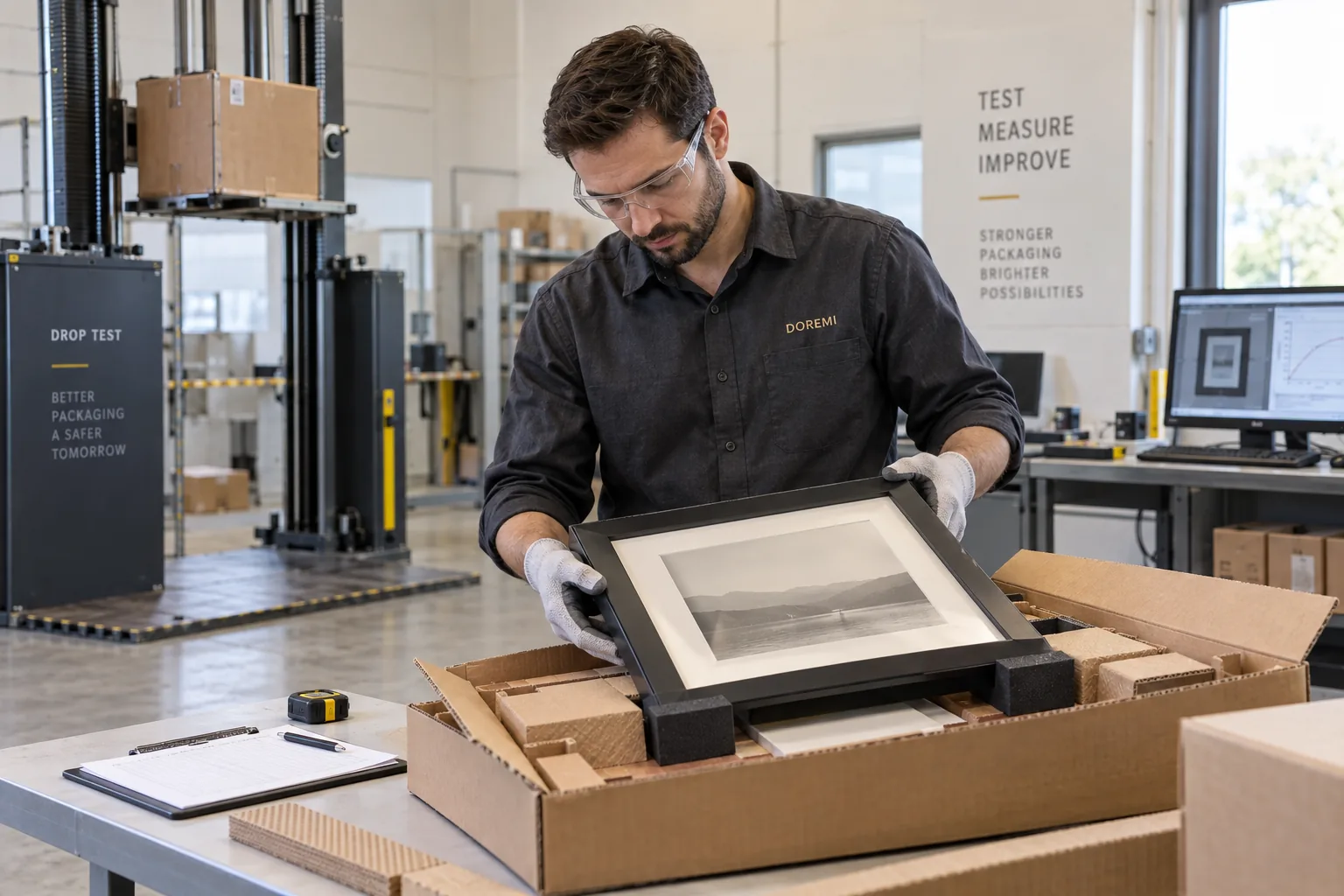
Map the real distribution route before selecting a test
Ask where the unit enters Amazon's network, how it is received, stored, picked and dispatched, and whether it will travel alone or among mixed parcels. Include cross-border transport before fulfilment and any case pack or pallet used to reach the fulfilment centre. The SIPP outbound objective does not remove upstream hazards.
ISTA publishes public overviews for Amazon-developed test projects, but the current full procedure and Amazon instructions should guide the qualified test owner. A general parcel test, a retailer-fulfilment project and an Amazon-specific project do not have identical purposes. Give the laboratory the route, packaged dimensions, mass and fragility details; do not ask it to select a protocol from the phrase “Amazon ready” alone.
Classify fragility from the actual components
Glazing, ceramic plaques, brittle mouldings, protruding hardware and delicate internal mounts can make a frame package fragile even when the outer carton looks conventional. Identify which component can crack, shatter, chip, detach or become hazardous. Record whether a clear panel is glass, acrylic or another material, including its thickness and edge condition.
Fragility also includes functional loss. A record display may arrive without visible exterior damage yet pinch the sleeve; a medal can detach and scratch the glazing; a mitre can open enough to weaken hanging. Define these modes before pack design. The laboratory and buyer need a shared list of critical, major and cosmetic failures rather than a vague requirement that the carton “look okay.”
Separate product design weaknesses from package weaknesses
Packaging cannot reliably compensate for a frame joint, backing or internal mount that is already marginal. Review corner construction, glazing support, back retention, hardware restraint and object mounting before adding cushioning. If a plaque can strike the glazing during normal handling, create clearance or restraint in the product design.
Use pre-test measurements and photographs. Record diagonals, mitre condition, glazing seating, backing flatness, hardware location and internal object position. That baseline helps distinguish manufacturing defects from transport damage. It also prevents a redesign from becoming a cycle of adding more material around an unresolved product issue.
Protect broad faces, edges and corners differently
Frames are often wide and shallow, so the package can flex across a broad face while corners receive concentrated impact. Corner blocks should locate the product and distribute force without rubbing the finish. Face pads or structural panels may be needed to manage bending and glazing load. Empty space is not cushioning; movement inside the carton allows the product to accelerate before impact.
Ask the packaging engineer to show the load path for flat, edge and corner events. Check whether protective films become trapped, whether paper components leave marks and whether the frame can migrate out of its intended position. A successful design should be repeatable by production workers, not dependent on one laboratory technician arranging loose pieces by intuition.
Design the retail experience into the shipper
If the SIPP pack is also the customer-facing package, every shipping mark, closure and protective feature affects the brand experience. Decide where carrier labels can be applied without hiding instructions or damaging decorative surfaces. Create an opening sequence that does not require the customer to cut toward glazing or pull the frame from an unprotected edge.
Privacy can also matter. A surprise gift, recognition award or memorial frame may reveal its nature through printed packaging. Amazon may offer customer-facing packaging choices in some contexts, but the seller must confirm the current experience. Decide whether neutral exterior artwork, tamper evidence or an optional overpack path is needed without making unsupported promises about checkout behaviour.
Verify current programme requirements at project start
Programme names, enrolment screens, incentives, dimensions, exemptions and evidence routes can change. Create a dated screenshot or account note from the authorised Amazon workflow and identify the person responsible for submissions. Do not let an OEM factory rely on an undated PDF found online as the sole administrative specification.
The factory's role is to supply accurate product and package data, production-equivalent specimens, drawings and change records. The seller or vendor owns account actions unless responsibilities are explicitly assigned. A laboratory supplies the agreed test report; it does not guarantee that Amazon will accept an enrolment or keep a programme rule unchanged.
Choose the laboratory and specimen plan deliberately
Confirm that the laboratory can handle the package dimensions and mass and can perform the current required procedure. Agree specimen quantity, conditioning, observation points, report format, photography and treatment of deviations. Provide the laboratory with the actual product bill of materials and packing instruction.
For a size range, ask a qualified packaging professional whether one or more worst-case variants can represent the family. The heaviest item is not always the only risk: the largest shallow frame may flex more, while a smaller glass model may have less protective distance. Document the rationale instead of assuming that one passed carton style covers every SKU.
Set acceptance criteria before the first trial
Critical failures may include broken glazing, exposed sharp parts, released hanging hardware, loss of frame integrity or an object that detaches. Major failures may include open mitres, a bent back, damaged mounting, deep finish marks or a package that no longer protects the product. Cosmetic criteria should reflect what the customer is promised, including presentation-box condition.
State how each item will be inspected: lighting, viewing distance, opening sequence, measurements and comparison with the pre-test reference. Define who can approve a deviation. Testing without product-specific criteria leaves the team debating after the specimen has already been exposed.
Run development trials before formal evidence
Early prototypes can be used to understand weak points, compare corner geometries and refine pack dimensions. Label these as development work. A hand-built pack made from substitute board or foam is not the final evidence, but it can reveal whether the concept deserves production tooling and a formal test.
Capture each iteration: configuration, materials, dimensions, packed mass, observed failure and change made. Avoid changing several variables at once when diagnosis matters. If a corner opens, investigate frame movement, joint condition, local restraint and carton response before simply increasing cushioning thickness.
Control sustainable-material claims separately
Amazon publicly describes its packaging direction in terms of right-sizing, recyclability and avoiding unnecessary packaging. A supplier should still support any claim about recycled content, curbside recyclability or plastic reduction with market-appropriate evidence. Passing a transport test does not prove a sustainability claim, and a paper-looking laminate may not be accepted in every local recovery stream.
Build a pack bill of materials that identifies substrate, coating, adhesive, print, protective film and disposal communication. Have the brand's qualified owner approve claims. Compare material reduction with damage and replacement risk; a lighter pack that increases breakage can undermine the intended outcome.

Translate the tested design into factory instructions
Create a packing drawing and visual work instruction that names each component, orientation, quantity and placement. Include correct and incorrect examples for corner protectors, hardware pouch, face pad, bag, closures and label zone. Give similar-looking components distinct codes so a worker can identify the right size.
Validate the instruction on the actual packing line. Time the sequence, watch how the frame is lifted and confirm that protective parts stay positioned when the carton closes. A laboratory configuration that takes twenty minutes and specialist judgement may drift during mass production unless the design is simplified.
Keep accessories from becoming projectiles
Hanging kits, fasteners, stands, cleaning cloths and instructions should be secured in a defined location away from glazing and finished surfaces. Verify that the accessory pouch remains closed and retained after testing. If a heavy bracket is needed, give it its own structural compartment.
Make instructions easy to find without placing loose paper against a surface that can mark. If the customer must remove transit parts before hanging, identify them clearly and show the sequence. The product should not appear damaged merely because a deliberate transport retainer is misunderstood.
Plan barcode and shipping-label zones
Map the exterior panels used for product identification, regulatory or business labels, fulfilment labels and carrier labels. Keep closures, seams and highly curved surfaces out of the primary scan zone. Confirm the current label content and placement rules through the authorised Amazon workflow rather than copying another seller's carton.
Use a production artwork revision that connects to the approved structure. A design change that moves artwork may also move the available shipping-label area or opening cue. Print a full-size proof on the actual carton construction and scan representative codes before releasing volume production.
Inspect production against the approved configuration
Pre-shipment inspection can confirm carton identity, dimensions, board construction evidence, protective component codes, packing sequence, closure, accessory restraint, packed mass and visual condition. It does not repeat the full laboratory procedure. Its purpose is to detect whether the order matches the validated pack.
Retain an approved packed reference and component samples where practical. Photograph a representative pack before sealing and record lot or production date. If an alternate supplier is proposed for board, molded pulp, tape, adhesive, film or cushioning, route the change through the defined review rather than accepting “equivalent” on the line.
Define retest and change-control triggers
Changes in frame dimensions, mass, glazing, profile, backing, internal object, hardware, carton, protective material, closure or pack orientation can alter performance. The qualified packaging owner should decide whether a document review, engineering assessment, development trial or retest is needed. Record that decision.
Do not hide a structural change inside an artwork revision. Maintain separate but linked revisions for product, pack structure, print and packing instruction. At reorder, request a no-change declaration and compare current samples with the retained reference.
Monitor field evidence after enrolment
Certification or programme acceptance is not a guarantee of zero damage. Track returns, refunds, customer photos, fulfilment route, package revision, SKU, failure location and whether the product or carton was altered after leaving production. Separate manufacturing defects from distribution damage and installation complaints.
Look for patterns: the same corner, one size, one fulfilment path or one production lot. Preserve failed units when possible. Use field evidence to decide whether to improve product construction, protection, instruction or account configuration. A report should begin a control cycle, not end it.
Buyer handover checklist
- Current Amazon account workflow, marketplace and responsible owner recorded
- SIPP objective and customer-facing packaging role defined
- Production-equivalent frame, contents, accessories and pack controlled
- Fragile components and functional failure modes identified
- Actual inbound and outbound distribution routes mapped
- Current procedure selected by a qualified packaging owner
- Laboratory capability, specimen plan and acceptance criteria agreed
- Development trials separated from formal evidence
- Sustainability claims reviewed independently from transport performance
- Label zones, opening sequence and privacy considerations approved
- Factory work instruction reproduces the tested configuration
- Production inspection and change-control triggers documented
- Field returns feed corrective action and future pack reviews
Experience scope and project limits
Editorial review: Jessica, Founder & Project Advisor at DOREMI Display. Updated 16 September 2026. Jessica's practical scope covers B2B display-frame briefs, product and pack samples, factory coordination, quality discussions and buyer handover. She is not presented as Amazon, ISTA, an accredited packaging laboratory, carrier, packaging engineer or marketplace account adviser.
This guide is educational sourcing preparation. It does not reproduce a test protocol, certify a product, determine Amazon eligibility, guarantee enrolment or predict damage-free delivery. Verify the current programme inside the authorised account and use qualified packaging professionals, the selected laboratory, fulfilment partners and Amazon support for the exact ASIN and route.