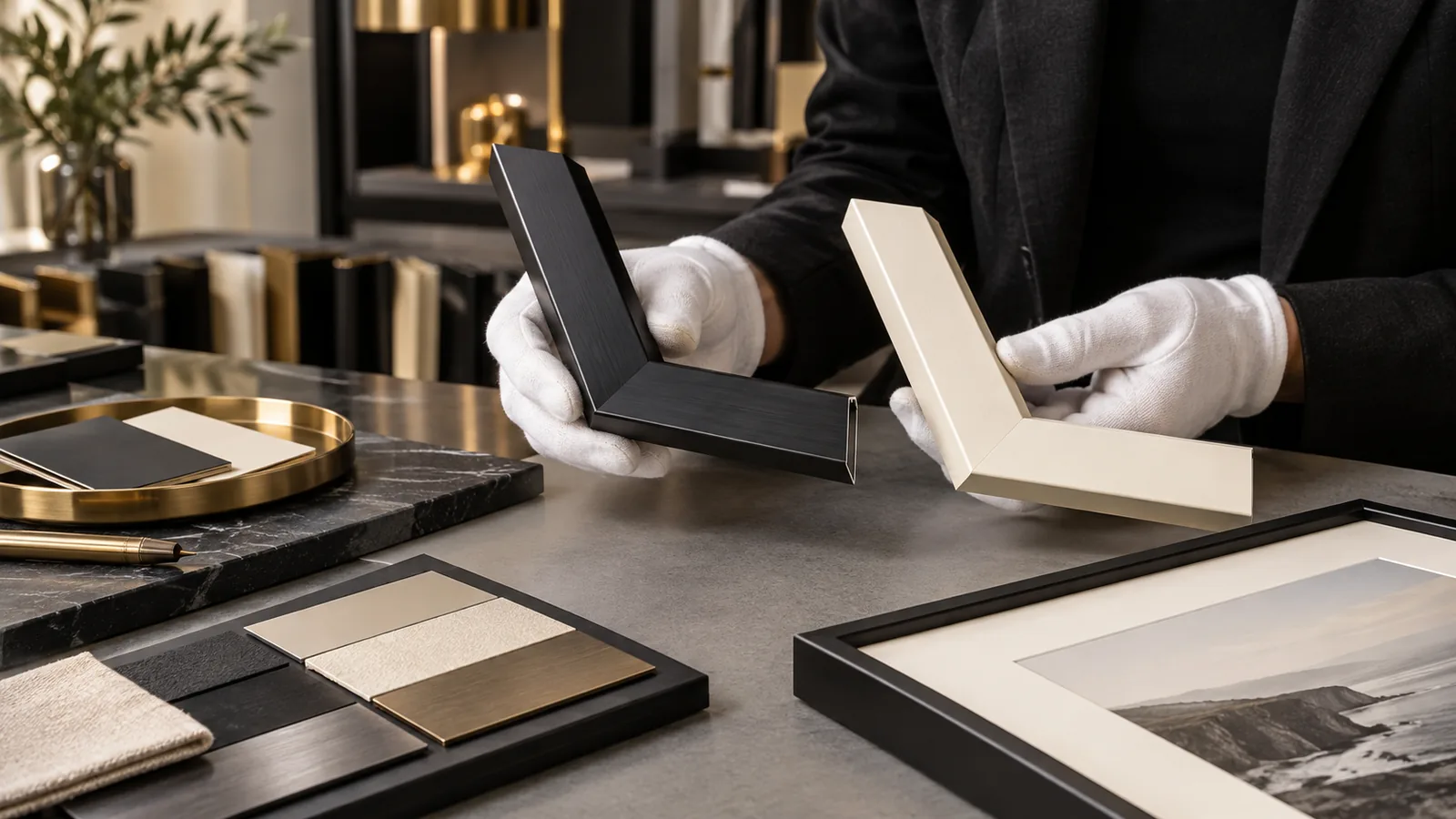
“Matte black aluminium” is not a complete finish specification. It could mean a brushed and anodized extrusion, a chemically etched anodic finish, a smooth black powder coat or a fine-texture organic coating over pretreated aluminium. The samples may look similar under a showroom lamp and behave differently at cut edges, mitres, handling points, reorders and mixed-component assemblies.
This guide helps display-frame importers, private-label brands, hospitality buyers, designers and quality teams choose between anodized and powder-coated aluminium and turn the choice into a repeatable supplier brief. It does not prescribe one universal coating thickness, gloss range, colour tolerance or corrosion test. Those controls depend on the alloy, process, geometry, appearance, environment, applicable standard and qualified technical judgement.
Start with the buyer's use case
Define where the frame will be sold and handled. A slim indoor certificate frame needs consistent colour and clean mitres. A retail display may face frequent touching and shelf abrasion. A hotel installation may require hundreds of matching units under directional lighting. A coastal venue may create a different corrosion basis from an air-conditioned office.
Record the display object, frame dimensions, profile section, wall or tabletop use, handling frequency, cleaning method, expected service environment, packaging route, desired appearance, target quantity and reorder period. Finish selection is a system decision, not a colour swatch choice.
Understand what anodizing changes
Anodizing is an electrochemical conversion of the aluminium surface that forms an aluminium oxide layer. The finish can provide decorative appearance, corrosion resistance and abrasion-related performance, depending on the specified system. The metal remains visually connected to the substrate, so alloy, temper, extrusion condition, mechanical finish, etching and colouring process influence the result.
That substrate visibility can create the refined metallic character buyers want, but it also means differences between lots or component forms can remain visible. An anodized extrusion, sheet backing trim and die-cast accessory should not be assumed to match perfectly without representative samples.
Understand what powder coating adds
Powder coating applies an organic coating that is cured on the prepared aluminium. It can offer a broad colour and texture range and may visually cover more substrate variation than a transparent anodic finish. The final result still depends on cleaning, pretreatment, powder selection, application, cure, film build, geometry and handling.
Do not specify only a colour code. Record the powder manufacturer and product where appropriate, colour, gloss, texture, coating class or relevant performance basis, pretreatment route, approved applicator, cure controls and acceptance sample. A fine-texture cream and a smooth cream can read as different products even if the nominal colour family is shared.
Choose by appearance architecture
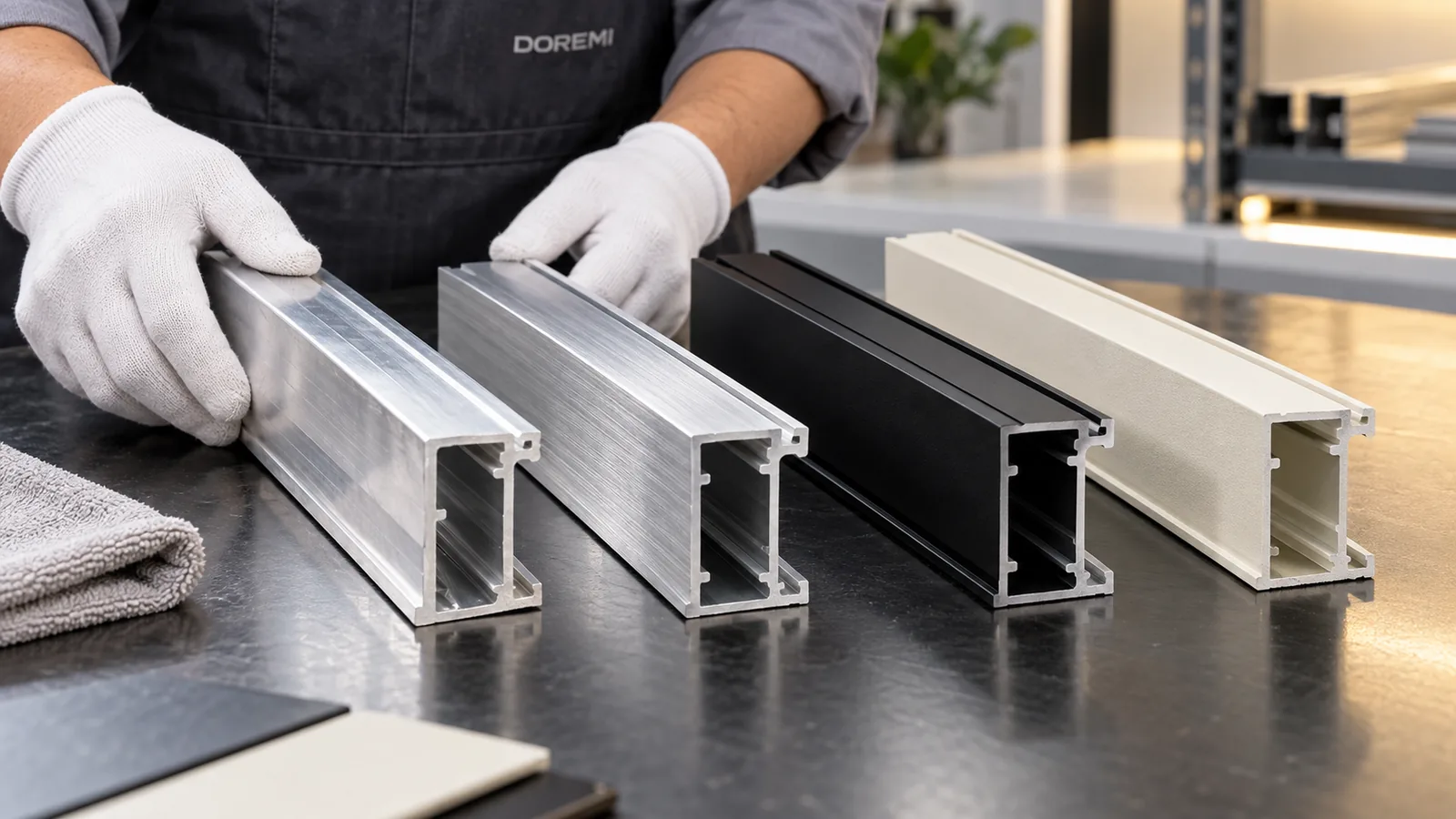
Anodizing often suits a metallic, brushed or satin expression where the aluminium character is part of the design. Powder coating can suit opaque colours, coordinated brand palettes and texture-led surfaces. Neither route is automatically more premium. A disciplined, consistent finish with well-controlled corners will usually feel more valuable than a fashionable finish with visible drift.
Create a small appearance board showing the complete assembly: profile, mat, glazing, plaque or insert, backing and packaging. Review it in the actual brand palette. A warm champagne insert can make a neutral black look cooler; cream powder can reveal contamination or rub marks that disappear on a dark sample.
Lock the alloy, temper and component form
The Aluminum Anodizers Council notes that alloy and temper influence strength and appearance after anodizing. For display frames, record the extrusion alloy and temper, source or approved equivalent, profile revision and any separate sheet, cast or machined parts. If mixed forms meet at a visible corner, sample that exact combination.
Powder coating also needs suitable material and pretreatment, even when the coating hides more of the metal. Require suppliers to notify the buyer before changing extrusion source, recycled-content route where relevant to the specification, profile die, alloy, temper or component form. A same-colour purchase order cannot control a changed substrate by itself.
Specify mechanical appearance before the chemical process
Brushing, polishing, blasting, machining marks and extrusion lines can remain visible through anodizing and can also affect the look beneath powder coating. Define the intended direction and texture on long frame members, plus how cut ends and corner joints should appear.
Use a representative length, not only a small flat chip. Raking light across a one-metre profile can reveal longitudinal lines, gloss differences and handling marks that a small coupon hides. Approve the front face, side face, inner lip and mitre as separate appearance zones.
Do not skip powder-coat pretreatment
QUALICOAT's specification system treats plant, coating materials, pretreatment and finished products as connected requirements. A powder name alone does not prove adhesion or durability on aluminium. The buyer's qualified coating specialist should define the relevant cleaning, etching and conversion route for the application and any environmental constraints.
Ask the coater to record the approved process and change controls. Contamination, delayed coating after pretreatment, poor rinsing or an unsuitable conversion system may not be obvious in the first beauty sample. Keep process evidence connected to finished-product inspection.
Replace colour names with a controlled visual range
Names such as satin black, champagne, bronze or warm white are interpreted differently. AAC guidance recommends precise buyer-finisher agreement and recognises that appearance depends on alloy, temper, gloss, surface structure and colouring process. Use physical range samples that show acceptable light, dark, hue, gloss and texture boundaries.
For anodizing, make critical samples from the actual material lot where exact appearance matters. For powder coating, use the approved powder and representative profile geometry. Sign and date the master and boundary samples, protect them from damage and record the lighting conditions used for approval.
Define viewing conditions and appearance zones
A frame is viewed from the front, at corners and often from an angle. Establish inspection distance, light source, direction, background and sample orientation. Separate high-visibility faces from concealed backs and internal channels, while still defining workmanship and coverage expectations for every relevant area.
A numerical colour measurement can support process control when the method and limits are qualified, but it does not replace visual review of texture, directional brushing, gloss and adjacent-component match. Do not copy a Delta E limit from an unrelated product without agreeing instrument geometry, colour space, illuminant, aperture, sample surface and decision rule.
Design mitres around the finish route
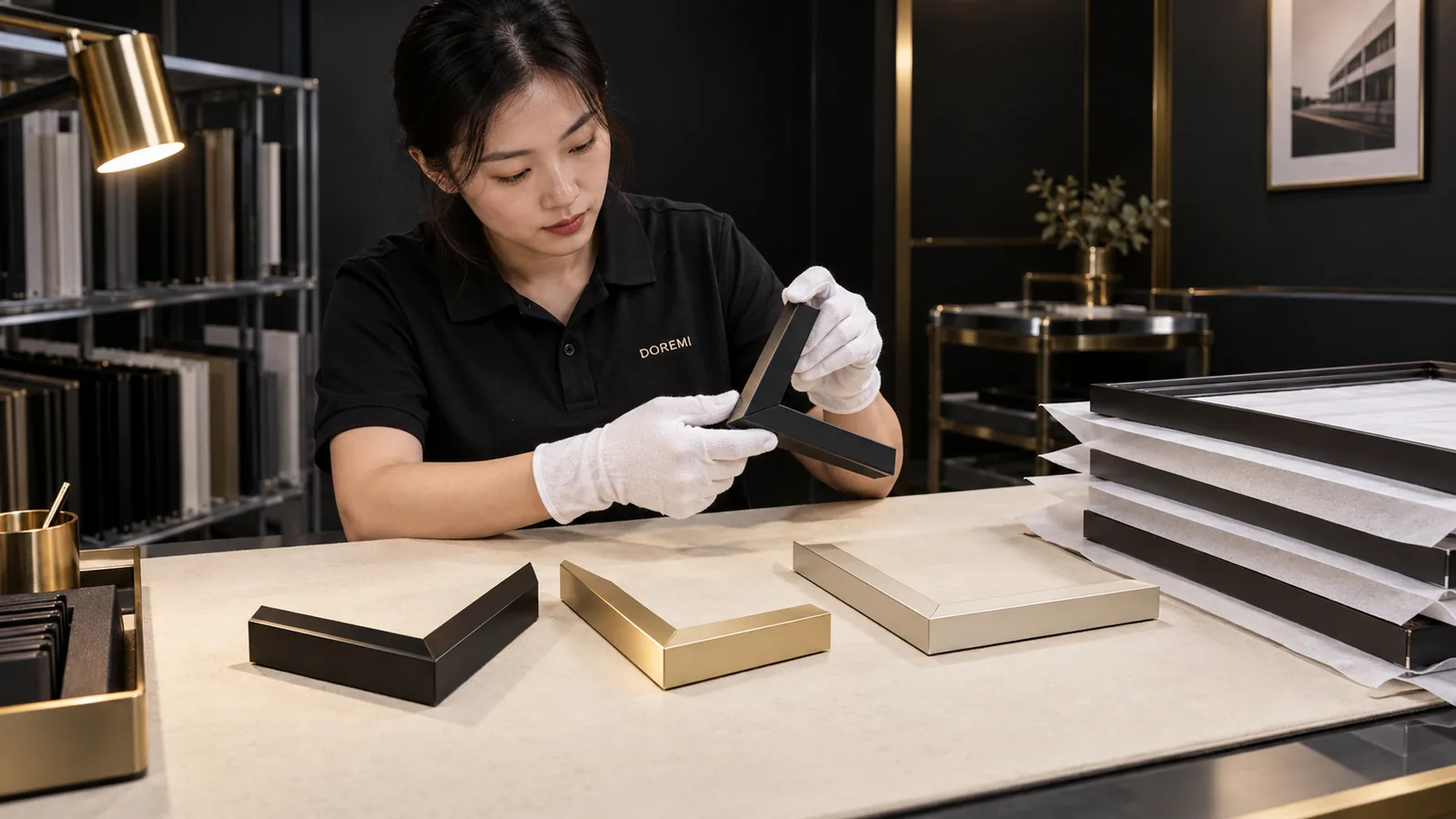
Cutting before or after finishing can change the visibility of raw edges, burrs and colour at a mitre. Corner keys, crimping, adhesives and touch-up methods can also alter appearance. Ask the supplier to explain the production sequence and show the finished corner from the front and side under raking light.
Define whether a slight line is acceptable, whether touch-up is permitted and where, and how the frame is protected during assembly. A perfect flat-profile coupon does not approve chipped cut edges or mismatched corner members.
Consider rack marks, contact points and hidden areas
Anodizing and powder coating require parts to be held during processing. Rack or contact points can affect local appearance or coverage. Identify permitted positions on the extrusion and make sure they remain concealed after assembly without interfering with fit.
Record holes, channels, grooves and tight radii that need functional clearance. Excess coating build in a groove can affect backing or corner hardware, while insufficient coverage at a sharp edge can change protection. The dimensional drawing and finish drawing should be reviewed together.
Match the test plan to the intended risk
Coating thickness, adhesion, sealing, corrosion, abrasion, gloss, colour and weathering tests answer different questions. Choose methods and acceptance criteria with a qualified specialist based on the actual finish system and environment. The existing DOREMI salt-spray guide explains why a duration copied from another product is not a complete corrosion specification.
State whether testing is for qualification, routine production control, change approval or failure investigation. Preserve sample preparation, laboratory identity, method edition, deviations and results. Do not turn one passed coupon into a universal durability claim for every frame size and location.
Review cleaning and customer care
Housekeeping products, alcohol, alkaline cleaners, abrasives and rough cloths can affect finishes differently. Ask the coating or anodizing supplier for care guidance appropriate to the exact system, then validate consumer instructions on a representative sample.
Keep claims realistic. An anodized or powder-coated frame is not maintenance-free, scratch-proof or suitable for every exterior location. Packaging film and paper separation should protect faces without transferring adhesive, trapping contamination or polishing one area during transit.
Inspect production as a complete lot
Sampling should cover different extrusion bundles, racks, coating batches, shifts and carton positions according to the buyer's quality plan. Compare colour, gloss, texture, brush direction, surface defects, edge condition, mitres, coverage and handling marks against the approved range.
Record individual findings and lot identity. A front-facing photograph of one perfect frame cannot represent hundreds of units. If appearance varies within the acceptable range, assemble members thoughtfully so one frame does not combine obvious extremes.
Control reorders and replacement pieces
Finish continuity becomes harder when a programme needs a later batch or a replacement side. Archive the exact profile, material source, process, powder or anodic designation, master range, production photos and supplier lot records. Ask the supplier to compare new material before production rather than promising an invisible match after assembly.
Explain to programme owners that a natural or process-related range may exist, especially for anodized parts from different lots or forms. Where exact future replacement is critical, consider holding finished components or designing replacement at complete-frame level.
Avoid splitting one visible set across uncontrolled finishers
A multi-frame wall, retail assortment or hospitality programme can expose small colour and gloss differences that seem acceptable on isolated units. If separate factories or finishers must contribute, give them the same controlled profile, finish specification, sample range and viewing method, then conduct a combined approval before release.
Record which supplier produced each batch and avoid mixing members from unapproved sources inside one frame. Commercial scheduling should not silently override the finish plan. When capacity requires a second source, treat it as a qualification project with its own representative samples and evidence.
Build a finish specification suppliers can quote
A complete RFQ section should state the substrate and profile, component forms, preparation, chosen finish route, colour and texture reference, visible zones, range samples, expected environment, care basis, relevant standards, qualification and production tests, inspection method, packaging protection, change-notification triggers and reorder expectation.
Ask suppliers to identify assumptions and exceptions. A lower quotation may reflect a different alloy, pretreatment, powder class, oxide thickness, sample process or inspection plan. Normalise the technical offer before comparing unit prices.
Buyer finish release checklist
- Use, environment, handling and reorder horizon are defined
- Anodized or powder-coated route supports the intended appearance
- Alloy, temper, extrusion and component forms are controlled
- Mechanical preparation and brush direction are specified
- Pretreatment or anodizing process has qualified ownership
- Physical master and boundary samples are approved
- Viewing conditions and appearance zones are documented
- Mitres, cut edges, rack marks and grooves are reviewed
- Tests match the actual risk and finish system
- Cleaning and packaging protection are validated
- Production inspection covers representative lots
- Supplier changes and reorder matching trigger reapproval
Experience scope and project limits
Editorial review: Jessica, Founder & Project Advisor at DOREMI Display. Updated 9 September 2026. Jessica's practical experience scope covers B2B display-frame briefs, material and finish discussions, samples, supplier coordination, packaging and buyer handover. She is not presented as a metallurgist, coating chemist, anodizing authority, accredited laboratory or corrosion engineer.
This article is a procurement framework, not a universal engineering specification. The buyer's qualified materials, coating and quality professionals must select the applicable process, standards, tests and acceptance limits for the exact alloy, geometry, finish, environment and service expectation.
Public sources used for this guide
- Google Search Central: optimizing for generative AI features
- Aluminum Anodizers Council: specifying anodized finishes
- Aluminum Anodizers Council: anodic coating specifications
- Aluminum Anodizers Council: aluminum finish designation system
- Aluminum Anodizers Council: range-sample and finish FAQ
- QUALICOAT: current specifications overview
- QUALICOAT UK & Ireland: coating specification guidance