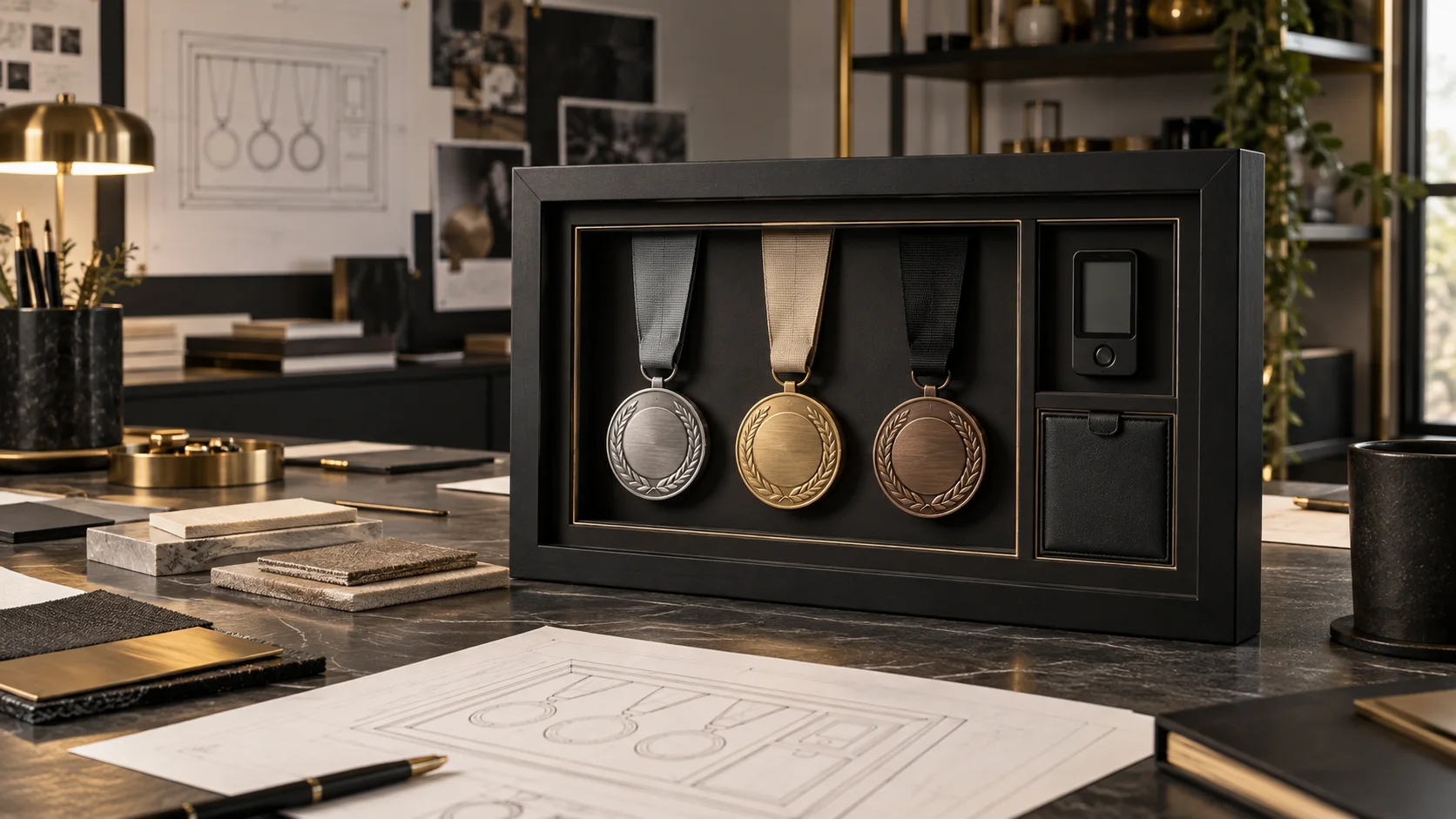
A medal can leave production bright and still change after it enters a display. Fingerprints, residues, moisture, airborne pollutants and emissions from nearby materials can all influence corrosion or tarnish. A deep frame may reduce handling and dust, but the word “enclosed” does not prove that the case controls humidity or pollutants.
This guide is for event organisations, service associations, museums, universities, recognition brands and private-label importers developing repeatable medal displays. It turns conservation questions into a buyer brief for materials, samples, service access and maintenance. It does not promise that a commercial frame will prevent tarnish, prescribe one environment for every alloy, or replace a conservator’s assessment of valuable or unstable objects.
Start with the medal, not the box
Record what will be displayed before choosing fabric, foam or frame depth. Identify the medal base metal and plating if known, its coating, ribbon or textile, previous polishing, visible residues, existing corrosion and replacement value. Photograph both faces, the edge, suspension point and any sensitive finish. A newly manufactured plated medal and an historic mixed-metal award are not the same conservation problem.
Note whether the medal will arrive clean from the maker, be handled at an event, or come from a recipient after years of wear. Skin oils, polishing compounds and salts can remain on the surface. The Canadian Conservation Institute advises careful handling and appropriate support for metal objects; silver should not be handled with latex gloves because sulphur can contribute to tarnish. Let a qualified conservator decide whether cleaning is appropriate. A frame supplier should not polish an irreplaceable object by default.
Define the promise in measurable language
“Anti-tarnish,” “museum quality” and “airtight” are often used as broad marketing labels. Replace each with a project decision. Does the buyer want reduced direct handling, a dust barrier, a monitored microclimate, a replaceable sorbent, low-emission contact materials, or all of these? State the intended display period, opening frequency, location and maintenance owner.
An enclosure can slow air exchange without being hermetic. Canadian Conservation Institute guidance on display-case airtightness shows why leakage rate, room climate and maintenance determine whether passive humidity control is practical. Do not approve a case as airtight from a gasket photograph. Ask which performance is being claimed, how it was assessed on the production-equivalent case, and what happens when the rear panel is opened.
Map every material near the medal
Create a section drawing and bill of materials that follows the path from medal to room: mounting thread or support, visible fabric, padding, adhesive, board, liner, glazing, frame profile, gasket, rear panel, hardware, coating and packaging used before installation. Mark direct-contact materials separately from enclosed but non-contact materials. A component can affect the case even when it never touches the medal.
Natural wood products, paints, sealants, foams, rubbers and adhesives can emit volatile compounds. Suitability depends on the exact formulation, cure, amount, enclosure volume and metal. Ask for current supplier identity and documentation, but do not treat a generic safety data sheet or the word “acid-free” as a complete corrosion assessment. If the medal is historic, highly valuable or compositionally uncertain, have a qualified conservation professional review the material system and any screening or testing plan.
Separate support from decorative appearance
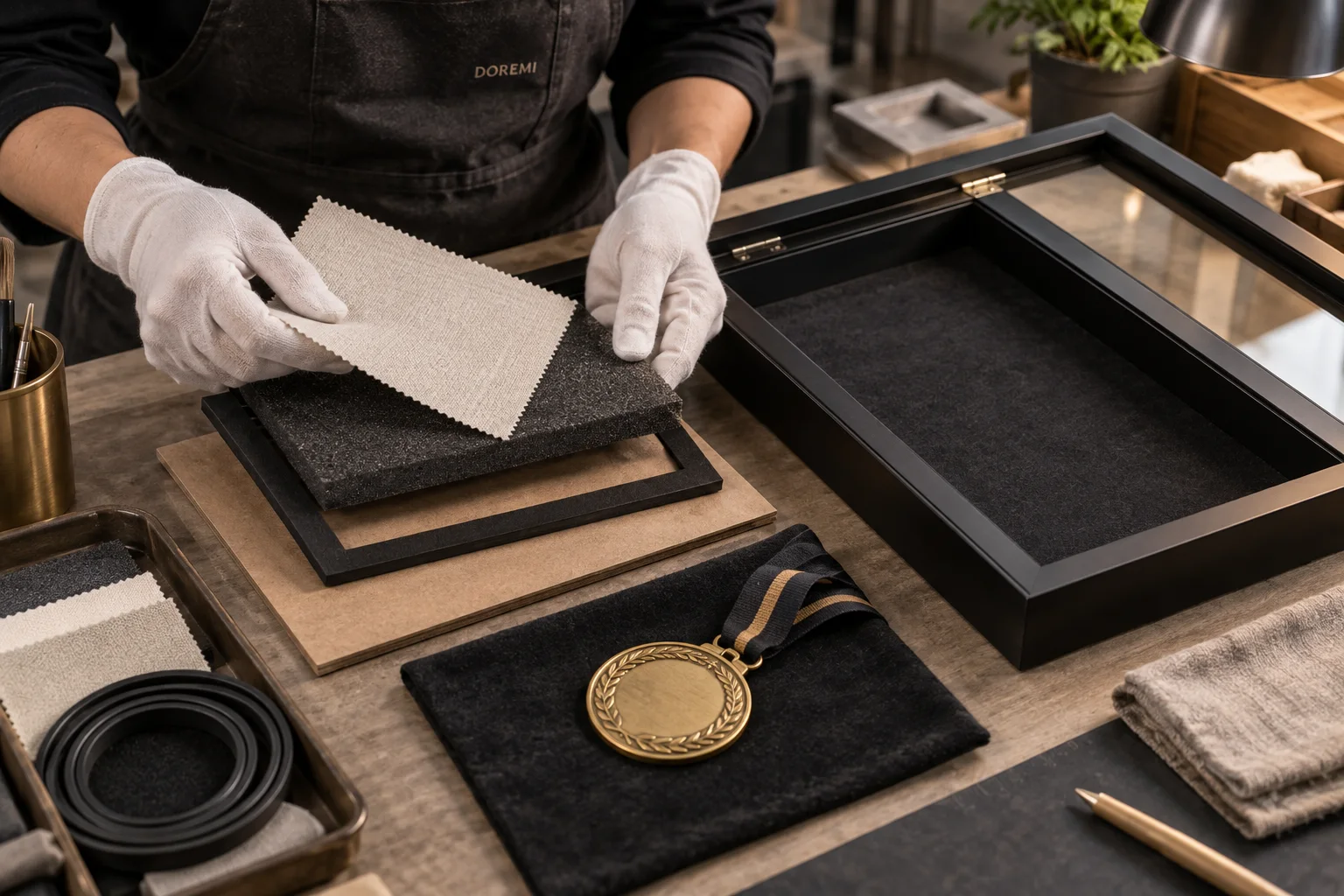
The medal needs a secure support that does not place damaging stress on the ribbon, pin, loop or plated edge. Define the displayed orientation, allowable contact points, load path and removal method. If the ribbon carries weight in the concept image, verify that it can do so without stretching, creasing or transferring dye. For heavy medals, design a concealed support that carries the metal independently.
Specify how visible fabric is attached and whether fasteners, wires or adhesives can contact the object. The sample review should include front, side and back views plus a removal demonstration. “No visible fixing” is an appearance request, not a method. The approved drawing should show what actually holds the object after the display is vertical and after representative handling.
Choose an environmental strategy for the actual object
Humidity affects corrosion, but a single target copied from another collection can be unsafe or impractical. CCI notes that metals generally benefit from drier conditions, while mixed objects may include ribbons, paper, wood or coatings with different needs. Existing active corrosion, chloride contamination and sensitive alloys can require specialist conditions. Define the project with a conservator when the object warrants it.
For an ordinary recognition programme, the commercial objective may be to reduce dust, fingerprints and rapid room-air exchange rather than create a museum microclimate. Record that boundary honestly. For a monitored enclosure, identify the room range, desired internal range, case volume, expected leakage, opening schedule and maintenance interval before anyone chooses a desiccant quantity. Those inputs are more useful than putting an unverified humidity claim on the carton.
Treat desiccant as a maintained system
Silica gel does not make a poorly sealed case self-regulating. CCI Technical Bulletin 33 explains that sorbent performance depends on enclosure air exchange, target conditions, room climate and the buffering characteristics of the chosen product. The quantity and conditioning state must be designed for the case, then checked in use. A small packet added for appearance is not evidence of control.
If passive control is part of the brief, provide a dedicated compartment that can be reached without touching the medals. Identify the product, mass, initial conditioning method, containment pouch or tray, replacement or reconditioning route and safe handling instruction. The compartment must allow air interaction with the display volume while preventing loose beads or dust from reaching the object. Assign the maintenance decision to a named owner rather than assuming the end user will know when service is due.
Plan pollutant control separately
Lower humidity and pollutant sorption address different risks. CCI guidance discusses activated charcoal and other sorbents for gases that can promote corrosion, but selection must match the object and environment. Do not substitute a generic odour absorber or claim universal protection. The wrong material, insufficient quantity or exhausted product can create a false sense of security.
Ask a conservation specialist whether a pollutant sorbent is appropriate, how it should be contained and how service life will be assessed. Keep it separate from the displayed object and label the internal service record rather than the public-facing artwork. If the display is for a replaceable contemporary medal, the buyer may choose a simpler dust-and-handling strategy. Record that commercial decision without borrowing museum terminology.
Design service access before sealing the back
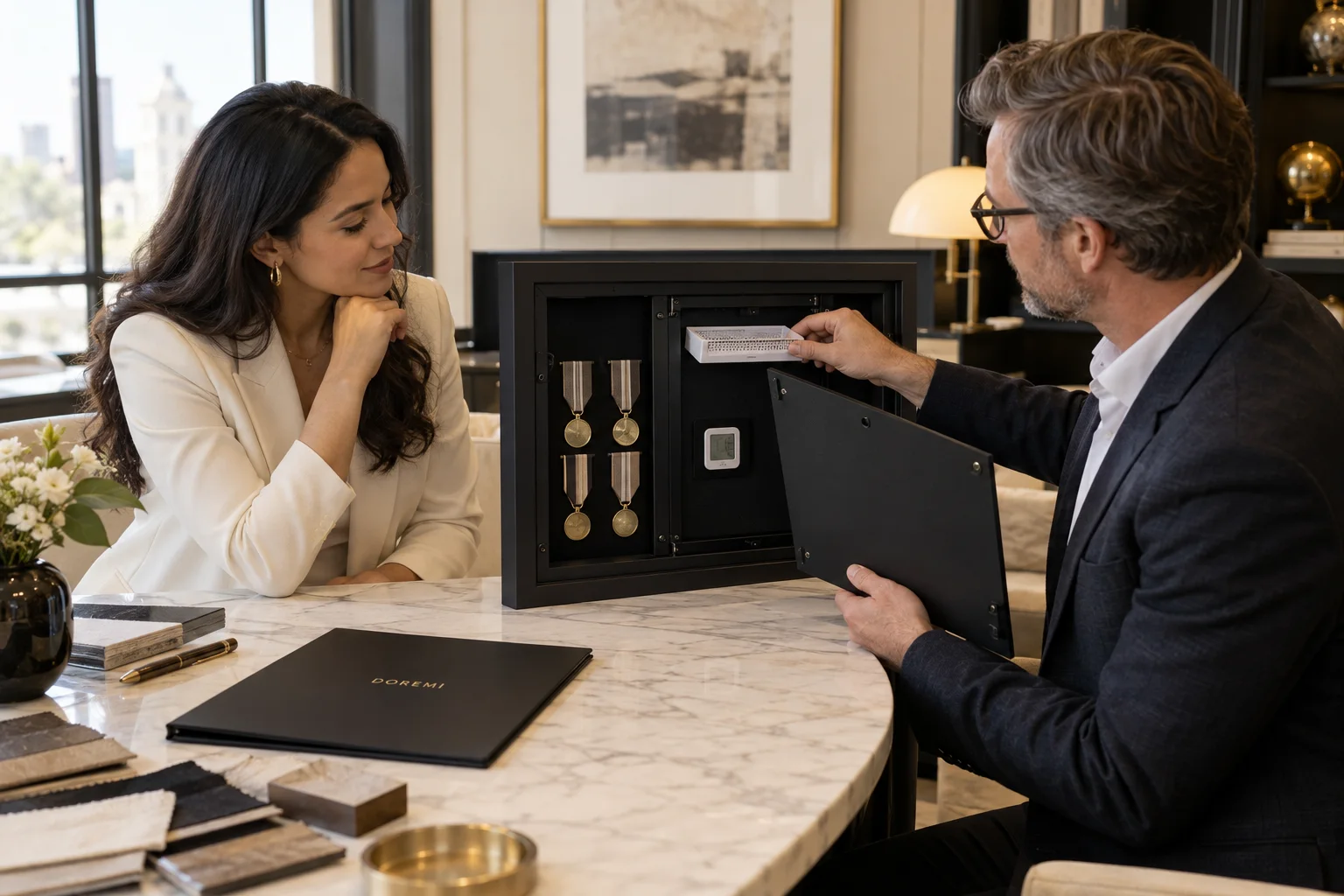
A maintainable case needs a controlled opening sequence. Decide whether it is consumer-openable, technician-serviceable or managed only by collections staff. Show the fasteners, tool, lifting points and order of removal. The user should be able to reach the monitor or sorbent without dragging a panel across ribbons, dropping hardware into the display or disturbing the mounting layout.
Review the gasket after repeated opening. Check corners, compression, joins, fastener spacing and whether cables or hanging hardware interrupt the seal. A lock can control access but does not prove environmental performance. If tamper evidence is required, distinguish the disposable seal from the reusable case parts and state how a service event is recorded.
Make monitoring visible to the maintenance owner
A compact humidity indicator or data logger can support decisions only when its accuracy, location and reading process are understood. Define the device, calibration or verification route, sampling interval, acceptable uncertainty and position in the enclosure. Avoid placing it where it merely records a local pocket beside the sorbent or is unreadable without opening the case.
Set an action plan before collecting data: who reviews readings, what pattern triggers inspection, who can open the case, and when specialist advice is required. A display should not carry a preservation claim simply because a sensor is present. Monitoring provides evidence about conditions; it does not correct a leak, exhausted sorbent, unsuitable material or already-corroding medal.
Build the sample review around evidence
The physical sample should use production-equivalent frame, glazing, backing, fabric, support, gasket, finishes and service components. Record the enclosed volume and finished weight. Review medal insertion, vertical support, glazing clearance, rear opening, reassembly and hanging. Photograph the material stack and part codes before it is closed.
If the project needs environmental performance, agree a qualified test or monitoring protocol for the exact enclosure. Record room conditions, case configuration, opening events, sensor and result interpretation. A one-hour reading in a showroom does not demonstrate long-term control. Keep development observations separate from formal evidence, and retain the approved sample with a revision-controlled bill of materials.
Connect packaging and installation to the care plan
A well-designed enclosure can still arrive contaminated or damaged. Define whether medals ship already mounted, in a separate clean pouch, or are inserted at destination. Protect glazing, frame finish, service compartments and loose accessories. Avoid packing materials that leave fibres, plasticiser residue or odour inside the display. Let any coating or adhesive cure under its documented process before the case is closed for shipment.
Installation records should state completed weight, hanging points, wall assumptions and service clearance. The facilities team needs enough access to remove or open the case safely. Do not select wall fixings from the article or from frame weight alone; substrate, dynamic loads, public setting and local requirements matter. Use qualified installers for heavy or high-value displays.
Control production and reorders
Inspection should confirm medal orientation, permitted contact points, support security, ribbon condition, interior cleanliness, material codes, gasket continuity, service component identity, rear closure, glazing clearance and pack configuration. Critical defects can include an unapproved adhesive touching a medal, a loose object, trapped debris, a missing barrier or the wrong sorbent. Give inspectors approved photographs and the current revision. Check the first completed unit in its normal vertical orientation before the remainder of the lot is packed, and preserve that comparison record with the batch identity.
For reorders, require disclosure of changes to fabric, foam, board, adhesive, coating, gasket, glazing, monitor, sorbent, frame profile or closure. Visually similar substitutions can change emissions, fit or leakage. The project owner should decide whether a documentation review, new sample, monitoring repeat or conservation review is required. Archive the decision even when no new test is needed.
Buyer specification checklist
- Medal identity, known materials, condition, coating and handling history recorded
- Ribbon and mixed-material needs considered separately from the metal
- Intended display period, room, access frequency and maintenance owner defined
- Every direct-contact and enclosed material identified by supplier reference
- Mounting load path, prohibited contacts and removal sequence approved
- Environmental and pollutant-control claims limited to documented evidence
- Enclosure volume, gasket, service panel and opening sequence documented
- Desiccant or sorbent design reviewed by an appropriate specialist
- Monitoring device, location, review interval and action plan assigned
- Production-equivalent sample and material stack photographed
- Installation and packaging protect the approved condition
- Reorder substitutions trigger controlled review
Experience scope and project limits
Editorial review: Jessica, Founder & Project Advisor at DOREMI Display. Updated 19 September 2026. Jessica’s practical scope covers custom display-frame briefs, material and mounting coordination, physical samples, manufacturing communication, packaging and buyer handover. She is not presented as a metals conservator, museum environmental specialist, corrosion scientist, accredited laboratory or structural engineer.
This article is educational procurement guidance, not a conservation treatment, environmental specification or guarantee against tarnish. Final materials, relative-humidity strategy, pollutant control, cleaning, sorbent quantities, monitoring and maintenance must be validated for the actual medal, case, room and risk level by qualified professionals. Existing corrosion, historic value or irreplaceable objects should be escalated before framing.
Public sources used for this guide
- Google Search Central: optimizing for generative AI features
- Canadian Conservation Institute: caring for metal objects
- Canadian Conservation Institute: storage of metals
- Canadian Conservation Institute: basic care of coins, medals and medallic art
- Canadian Conservation Institute: silica gel and passive RH control
- Canadian Conservation Institute: airtightness measurement of display cases