“Inspect to AQL” is not a complete quality plan. It does not say what counts as a lot, which current standard and inspection mode apply, how frames are selected, what a critical defect is, how appearance is judged or who can release a failed shipment. A sampling table cannot repair an undefined product specification.
This guide is for importers, private-label brands, sourcing teams, quality managers and third-party inspectors buying custom jersey, certificate, medal, vinyl record and mixed memorabilia frames. It uses the current ISO 2859-1:2026 framework as a reference point but does not reproduce the copyrighted tables, prescribe universal AQL values or replace a qualified statistician, quality professional or licensed copy of the standard.
Confirm that the sampling reference is current
ISO published the third edition of ISO 2859-1 in January 2026. ISO’s official page states that it replaces the 1999 edition and its amendments and introduces updated guidance, including skip-lot procedures. Purchase orders, inspection manuals and third-party forms that simply say “MIL-STD” or “ISO 2859” may therefore be ambiguous or outdated.
Name the exact standard, edition, language and any contractual supplements. Ensure the buyer, supplier and inspection provider can legally access the information they need. Do not copy an unidentified internet table into a quality manual. If a retailer or customer requires a different sampling system, record that requirement and resolve conflicts before production.
Understand what AQL does—and what it does not do
ISO describes AQL as an acceptance quality limit used to index sampling schemes for lot-by-lot inspection. It supports an acceptance decision based on a random sample; it is not permission for the factory to intentionally ship a fixed percentage of defective frames. A lot that passes can still contain defects, and a good lot can sometimes fail because sampling involves risk.
Management should understand producer and consumer risks with qualified support. The sampling plan is one control among specification, process controls, in-line checks, testing, final inspection and corrective action. Treating AQL as the entire quality system encourages the wrong behaviour: finishing a lot first and hoping a small sample does not reveal its problems.
Define a homogeneous lot before choosing a sample
A lot should represent units produced under conditions that make the sampling decision meaningful. Mixing different frame sizes, moulding sources, finishes, glazing types, backing systems, factories or widely separated production periods can hide variation. A single purchase-order number does not automatically create one statistically sensible lot.
Write the lot boundaries: SKU, construction, colour, production site, line, time window, material batch where relevant and quantity presented for inspection. If several SKUs share a process but have different risks, ask a quality professional whether to inspect separately or use a justified stratified approach. Do not allow the supplier to combine a small difficult SKU with a large easy one merely to reduce sample size.
Freeze the lot before random selection
Pre-shipment inspection should occur when the agreed proportion is complete and packed, the quantity can be counted and the inspector can access the full lot. If the factory is still producing, repairing or packing while samples are selected, the inspected population may not match the shipment. Record completion status and carton count on arrival.
Define who may open cartons, whether replacement packing materials are available and how selected units return to the lot. The inspector should control selection across pallet positions and carton layers, not accept a prepared row of “inspection samples.” If access is restricted, record the limitation and decide whether the result is valid before calling the lot passed.

Separate inspection level from AQL
Buyers often ask for “AQL 2.5” as if that determines the sample by itself. In an AQL-indexed system, lot size, inspection level, inspection type and plan all matter. Single, double and multiple sampling schemes can lead to different workflows. The current standard and the buyer’s quality professional should determine the correct combination.
State the general or special inspection level for each check and explain why. Visual workmanship, measurements, functional operations and destructive tests may not use the same sample. A lower special-level test for a time-consuming operation should not silently replace the broader visual inspection. Put each check in a table with its population, method, sample basis and decision rule.
Build a frame-specific defect taxonomy
Critical, major and minor categories only become useful when they contain actual display-frame conditions. A critical defect may involve an immediate safety or regulatory concern, but the classification must be reviewed for the exact product and market. Major defects can prevent intended use or create likely rejection; minor defects can depart from the approved standard without materially preventing use.
Create entries for sharp edges, insecure hanging hardware, broken or loose glazing, open mitres, finish contamination, scratches, colour mismatch, incorrect mat opening, object-mount failure, backing gaps, missing instructions, wrong artwork, barcode errors and carton damage. This list is a starting point, not a universal severity assignment. The buyer’s qualified team must decide the class and limit for each programme.
Use photographs with words and measurement methods
“Scratch,” “gap” and “colour difference” are too subjective. For each recurring condition, show an approved example and a rejected example, state the viewing distance and lighting, identify the surface zone and provide a measurement method when practical. A tiny rear blemish and the same blemish across a high-gloss front face do not have equal customer impact.
Keep physical golden samples where colour, grain or sheen cannot be judged reliably from photographs. Record the approved sample code and storage condition. If the buyer accepts a deviation during one order, label it as a dated concession rather than silently changing the permanent defect standard.
Control safety-critical features independently
Sampling may be inappropriate as the only control for certain features. Hanging hardware security, sharp glass, electrical components, child-oriented use, product labelling or another safety-relevant characteristic may need process validation, testing, full checks or a different plan determined by qualified experts. Do not assign an arbitrary “critical AQL” and assume risk has been resolved.
Map applicable law, intended installation, frame mass, wall hardware, glazing and user interaction. Define evidence from design verification, component control and production checks. The final inspection should confirm required evidence and obvious condition without pretending that a quick visual sample replaces engineering or laboratory work.
Inspect appearance under controlled conditions
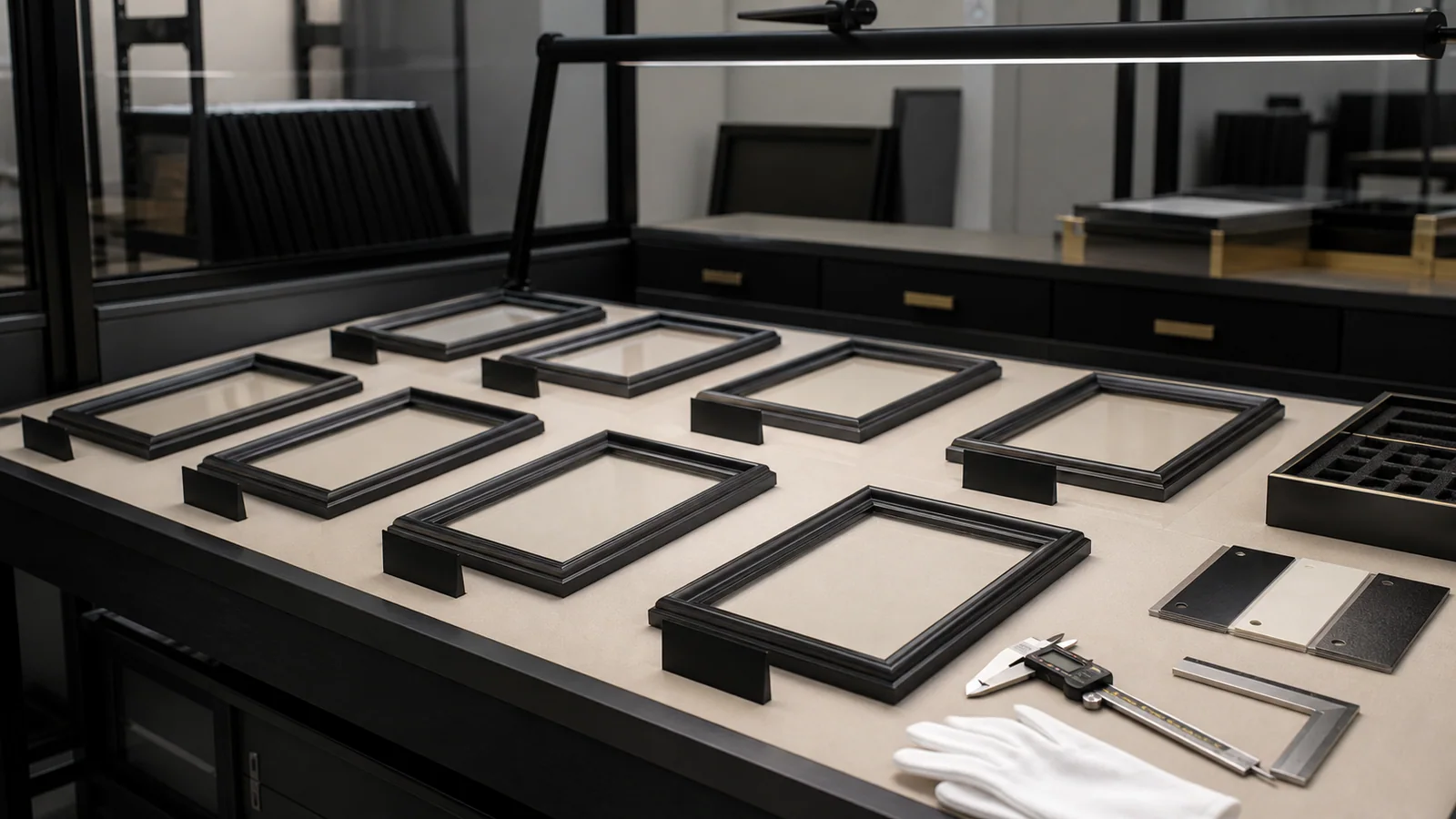
Black and gold display frames reveal dust, fingerprints, fine scratches and coating variation differently under diffuse and raking light. Define clean lighting, viewing distance, angle, background and inspection time. If the retail customer will see the product under bright store lighting, a dim warehouse check may miss important appearance defects.
Inspect front, corners, inner opening, edges, back and hardware. Remove protective film only where the approved method permits and replace it correctly. For natural wood, define acceptable grain and colour range separately from workmanship. Do not classify every natural variation as a defect or use natural variation to excuse poor matching and finish damage.
Measure the complete assembly
A frame specification can include outside dimensions, visible opening, mat overlap, diagonals, depth, glazing clearance, backing fit, hardware position and hanging-point symmetry. State the tool, reference points, orientation and tolerance. Measurements taken from different edges or from a frame forced flat on a bench are not comparable.
Use the production-equivalent assembly. Glazing, mat, mounted object, backboard and hardware can influence fit and geometry. Select measurement samples according to the approved plan rather than measuring only the best-looking unit. Record individual results, not only “within tolerance.”
Check function as the user experiences it
Open and close tabs or turn buttons, fit the intended certificate or record, test the jersey-mount layout, operate stands, verify wall-hardware contents and follow the supplied instructions. A frame can meet outside dimensions and still be frustrating or unsafe to use. Functional checks should reflect the actual sales configuration.
For personalised frames, compare names, dates, logos and plaques to approved source data using a controlled proof. Do not ask an inspector to judge spelling from memory. When personal data is involved, follow the buyer’s privacy and handling policy and avoid including unnecessary recipient information in the general inspection report.
Sample packaging without replacing packaging validation
Final inspection can check carton construction, protector placement, contents, label accuracy, seal, cleanliness and pack pattern. It cannot by itself prove that packaging will survive the distribution route. Keep formal package validation and transport trials in their own evidence file while using inspection to verify that production follows the approved pack.
Open samples across pallet locations and note damage before unpacking. Check whether opened units can be restored to saleable condition. If the inspection requires destructive carton or seal checks, define replacement materials and quantities in advance. Never return a poorly repacked inspected frame to the shipment without control.

Record defects by unit and category
A defect count and a defective-unit count are not the same. One frame can contain several defects. The selected standard and plan define how the acceptance decision is made, so the report should preserve both unit-level observations and classified results. Do not add all minor marks across a frame and convert them into a major defect without a written escalation rule.
Photograph the unit identifier, overall view and close condition with scale where useful. Link every measurement and image to the selected carton or unit. Use neutral language: what was observed, where, how it was measured and which approved criterion was applied. Avoid diagnosing the root cause during a short final inspection unless evidence supports it.
Predefine the pass, fail and pending workflow
The report should name who has authority to release the shipment. An inspector may calculate the result, but the buyer must define what happens after acceptance, rejection or an inconclusive condition. If essential drawings or golden samples are missing, “pending buyer review” can be more honest than forcing a pass/fail judgment without a standard.
Set communication deadlines, evidence needed for a concession and rules for split shipment. A logistics booking should not pressure an inspector to reclassify defects. Commercial urgency is a buyer decision, but the quality record should remain accurate and show who accepted any risk.
Do not cherry-pick after a failed result
After rejection, the supplier may propose sorting, rework, replacement or reinspection. Define how the failed lot is controlled, how affected units are marked and whether the entire lot receives appropriate screening. Removing only photographed defects does not address similar conditions in uninspected units.
A reinspection plan should be approved by the buyer’s quality professional and should not be improvised from the original sample. Preserve the first report, corrective actions, sorting records and new lot definition. If reworked units are mixed back into stock without traceability, the second sampling decision may not represent a controlled population.
Use switching rules as a system, not a negotiation
ISO notes that the 2026 standard includes rules for movement among normal, tightened, reduced and skip-lot inspection based on performance. These mechanisms should be applied through the current standard and an agreed quality system. They are not discounts offered because a supplier requests fewer inspections or punishments added after an argument.
Maintain a lot-by-lot history by product and process. Record accepted and rejected results, major changes, concessions and corrective actions. A supplier with stable results may become eligible for a different mode under the applicable rules, while deterioration should trigger more control. Reset assumptions when the factory, material, line or construction changes.
Connect final inspection to process controls
Use defect trends to improve incoming material checks, cutting, joining, finishing, glazing cleaning, mounting, backing, hardware installation and packing. A repeated open mitre is not solved by photographing more finished frames. The corrective action should identify the process point, responsible owner, change, verification and effectiveness review.
Ask for in-line records on high-risk features and compare them with final findings. If final inspection is consistently discovering wrong mat openings, the artwork and cutting-file release process needs attention. Sampling is most valuable when it feeds a production system, not when it serves as the only gate minutes before a truck arrives.
Manage mixed-SKU and small orders deliberately
Custom frame orders may contain many low-volume variants. Standard sampling tables can produce impractical or misleading results if procurement treats the whole purchase order as one lot. Group only products with a defensible common process and risk profile, and use full inspection or another justified method where a tiny personalised quantity requires it.
Identify worst-case variants for depth, weight, glazing, finish, artwork and pack. Even when statistical sampling is shared, ensure each SKU receives basic identity and workmanship coverage. A rare variant should not pass unseen simply because the largest standard SKU dominated random selection.
Prepare the inspection pack before production ends
The inspector needs the purchase order, SKU list, lot definition, current drawing, bill of materials, approved samples, artwork, defect library, measurement methods, sampling instruction, packaging reference and report template. Send controlled files, not a chat history. Mark superseded revisions clearly.
Run a pre-inspection call for new programmes. Resolve questions about lighting, tools, destructive checks, access, sample restoration and authority. If the buyer cannot explain how a condition will be judged, the supplier cannot reliably manufacture to it and the inspector cannot fairly reject it.
Buyer inspection checklist
- Exact current sampling standard and edition named
- Lot boundaries match SKU, construction, site and production period
- Lot completion and accessibility required before selection
- Inspection level, mode and plan defined by check type
- Critical, major and minor defect library approved
- Photographs, viewing conditions and measurement methods controlled
- Safety-critical features have appropriate independent controls
- Random selection covers pallet and carton locations
- Appearance, dimensions, function, artwork and packing reviewed
- Defects recorded by unit, condition, category and criterion
- Pass, fail, pending, concession and release authority defined
- Failed-lot sorting, rework and reinspection rules agreed
- Switching rules use performance history and current standard
- Findings feed corrective action and process control
Experience scope and project limits
Editorial review: Jessica, Founder & Project Advisor at DOREMI Display. Updated 16 August 2026. Jessica’s practical scope covers B2B display-frame briefs, sample reviews, materials, branded details, manufacturing coordination, packaging and buyer handover. She is not presented as a statistician, ISO representative, accredited inspection body, product-safety engineer or destination-market authority.
This guide supports procurement planning. Final sampling schemes, AQLs, inspection levels, defect classifications, safety controls, tolerances, tests and shipment decisions must be selected for the exact product, lot, contract, market and risk by qualified quality and technical professionals using an authorised current standard. DOREMI does not claim that an inspection can guarantee a defect-free shipment.