
A finished wooden picture frame can look like a low-risk retail product and still require a careful Australian biosecurity handover. The question is not answered by the word “frame” alone. The importer needs to know whether the product contains solid timber, plywood, veneer, reconstituted board, bamboo, bark or other plant material; how those components were processed; how the goods were stored; and whether the carton also uses regulated timber packaging or dunnage.
This guide is for Australian importers, private-label brands and procurement teams buying wooden photo frames, certificate frames, jersey displays, medal frames and shadow boxes. It converts the material conversation with an overseas manufacturer into a practical supplier file. It does not select a BICON pathway for an unseen shipment. Australian conditions can change, and the importer or broker should run the exact product, origin, end use and arrival scenario in the live BICON system before production and again before dispatch.
Why buyers ask this question late
Frame quotations often describe a product as “wood,” “MDF,” “timber look” or “solid wood” without separating the visible profile from the backing, spacer, internal fillet and decorative parts. That language may be adequate for a mood board, but it is not a material declaration. A painted solid-pine profile with an MDF back is different from a profile made entirely from reconstituted board. A veneered MDF profile is different from a solid-wood moulding. A rustic bark edge adds another pathway question.
The risk appears late when the customs broker requests evidence, the supplier cannot identify the botanical material or an inspection finds bark, insect holes, sawdust or contamination. At that point the buyer may face document repair, treatment, delay, re-export or destruction costs. DAFF states that importers are responsible for meeting BICON conditions and that non-compliance may cause delays, extra cost and, in some cases, re-export or destruction at the importer’s expense.
Start with a component-level bill of materials
Create one row for every plant-derived component, even when it is hidden in the finished display. Typical rows include the outer profile, inner spacer, mat or mount board, backboard, easel leg, wooden plaque base, hanging rail, corner key, decorative veneer and any loose accessory. Record the material as specifically as the supplier can support: solid timber, plywood, veneer, MDF, HDF, particle board, OSB, bamboo, cork or another product.
Add columns for species where relevant, country of growth if known, country of manufacture, thickness, finish, presence of bark, manufacturing process and percentage or dimensions used. Keep glass, acrylic, metal, textile, paper and plastic in the same product bill of materials because a composite article may need the conditions relevant to each regulated component. The purpose is not to create an ornamental specification. It is to let the importer and broker see what the product actually is.
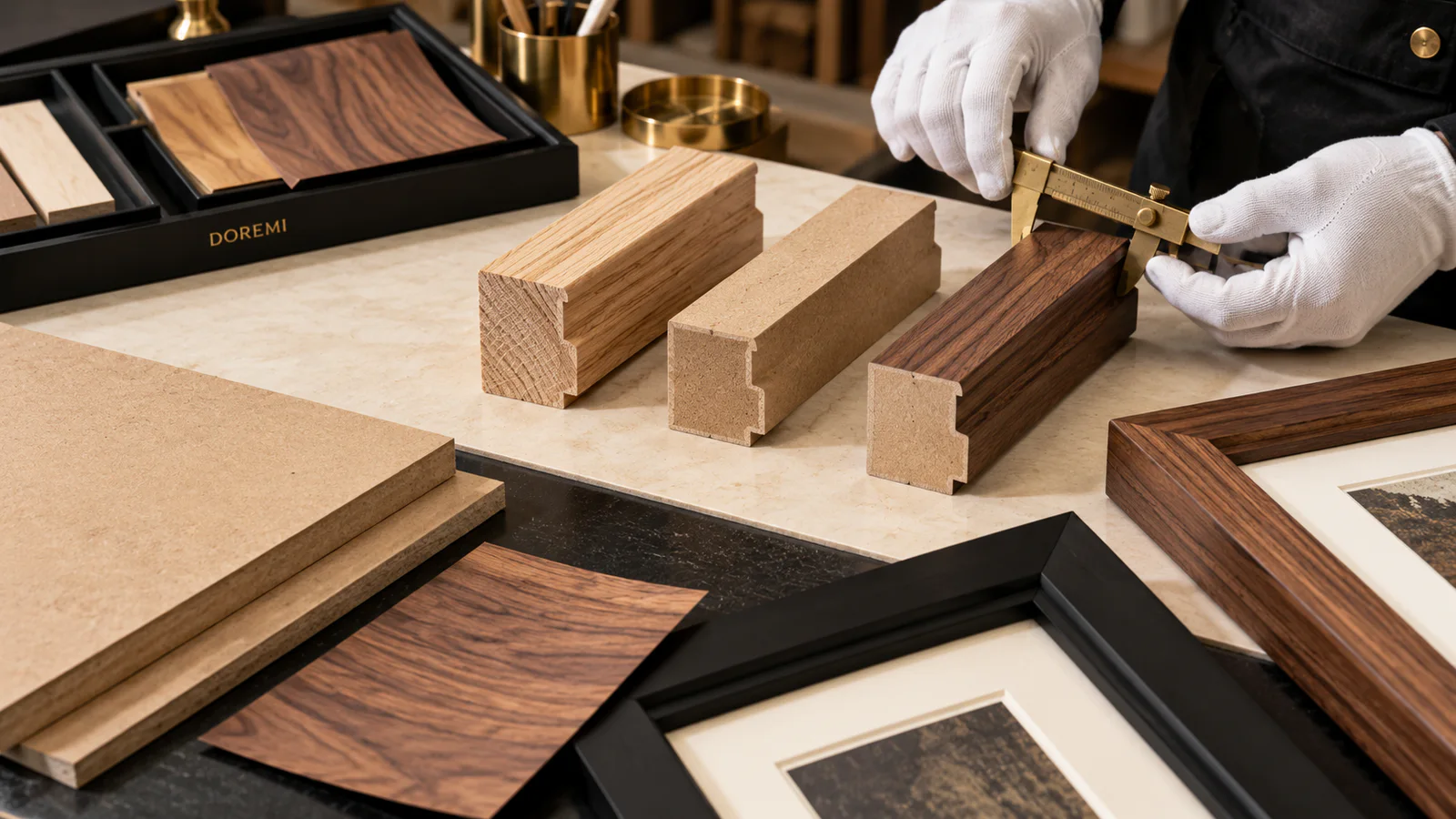
Separate solid wood from highly processed boards
DAFF’s public product guide distinguishes finished wooden manufactured articles from reconstituted wood and wood-plastic composite products. It lists MDF, HDF, particle board, OSB and similar boards as reconstituted products when they contain no solid timber components. It also says that products containing solid wood components must be imported as wooden manufactured articles. This is why “MDF frame” should not be accepted without checking the profile, decorative insert, easel or hanging strip.
Plywood and veneer need their own description. DAFF notes that products consisting wholly of plywood, LVL or combinations of plywood, veneer and reconstituted wood may sit in the relevant highly processed table, while products containing solid wood components move to the wooden-manufactured-article pathway. A thin veneer over MDF is not the same construction as a solid timber core. Ask the factory for a section photograph or offcut when the quotation language is unclear.
Treat bark as a visible decision point
Rustic live-edge frames, branch-style profiles and decorative bark inserts should be flagged at concept stage. DAFF explicitly identifies picture frames among the products that may contain bark and explains that bark can conceal insects, plant pathogens, spores and seeds. A supplier’s statement that a piece is “dried” or “decorative” does not by itself resolve the current import pathway.
If bark is not essential to the design, removing it before sampling may simplify the project and improve finish consistency. If it is essential, identify it in the RFQ and ask the Australian importer to review the current “wooden manufactured articles containing bark” case before a purchase order is issued. Do not let a production team add bark texture after the compliance review as an unrecorded styling change.
Map the manufacturing process, not only the final coating
A lacquer, paint or wrap can make a frame look sealed while leaving the underlying material and storage history unknown. Record the major manufacturing steps: sawing or moulding, kiln drying where applicable, sanding, joining, gluing, wrapping, painting, curing, assembly and packing. If treatment is used to meet a selected pathway, record the treatment type, provider, date, parameters and certificate reference exactly as required by the current BICON conditions.
Do not invent a treatment just because a previous shipment used one. The acceptable option can depend on the material, origin, pathway and timing. Some routes rely on evidence that manufacturing has sufficiently reduced risk; others may require an approved treatment and supporting documents. The factory should produce evidence against the importer’s selected pathway, not work backwards from whichever certificate is easiest to obtain.
Make storage history part of the production file
A frame can be clean when it leaves the finishing line and then sit beside untreated timber, open doors or contaminated packaging. Australian guidance for manufactured wooden articles has long connected storage declarations to post-treatment or post-manufacture protection. A useful supplier file identifies where the goods were stored, the relevant dates, how they were separated from untreated materials and how packing protected them from reinfestation or contamination.
For a multi-factory programme, record transfers between the profile factory, assembly workshop, print supplier, consolidation warehouse and port. The entity issuing a declaration must be able to support the statements it makes. A generic letter copied from another consignment is weaker than a dated declaration linked to the actual SKU, quantity, invoice and shipment.
Keep product conditions separate from timber packaging
The wooden display frame is the commodity. Pallets, crates, blocking and dunnage are packaging. These can create two separate evidence tracks. A frame made from highly processed board may still travel on a solid-wood pallet. Conversely, a solid-wood frame may be packed in a carton without any solid-wood packaging. The product pathway does not automatically prove the pallet pathway, and an ISPM 15 mark on a pallet does not prove the frame itself meets its conditions.
List every timber item used in the shipping system. For pallets and dunnage, confirm the applicable ISPM 15 and Australian arrival requirements with the logistics provider. For the product, retain its material, manufacture, treatment and storage evidence. Ask the packing team to avoid improvised scrap-wood braces that were not included in the approved packing drawing.
Build documents around the real consignment
The commercial invoice and packing list should describe the goods consistently enough that the broker can connect them to the reviewed file. Avoid a bare description such as “home décor” if the working file describes wooden certificate frames. Include SKU references and quantities that match the declaration and any treatment evidence. Where the live BICON pathway requires a manufacturer’s, supplier’s or exporter’s declaration, use the prescribed wording and document rules rather than paraphrasing from memory.
Check names, addresses, invoice number, treatment date, export date, container or shipment reference and product description across the documents. A technically correct statement attached to the wrong SKU or old invoice does not create a dependable handover. Keep signed originals or accepted electronic versions in the importer’s record set and send the broker the complete pack early enough to question it before cargo cut-off.
Create a one-page index for the shipment file. List the current BICON review, bill of materials, invoice, packing list, declarations, treatment evidence, storage history, cleanliness photographs and timber-packaging record. Mark each item as final, pending or not applicable, with the owner and revision date. This helps the buyer catch a missing declaration without treating a folder full of unrelated certificates as a complete file.

Plan the pre-shipment cleanliness check
DAFF’s public guidance tells importers to ensure wooden articles are clean and free from bark, insects, soil and other contaminants, while looking for signs such as holes and sawdust. Translate this into a final inspection line: clean surfaces and recesses; no loose bark unless specifically reviewed; no live insects; no frass, soil, seeds, leaves or plant residues; dry cartons; and no unapproved timber blocking.
Photograph a representative sample of fronts, backs, profile recesses, inner corners, cartons and pallet base. Photographs do not replace required documents or inspection, but they provide a dated link between the approved specification and the packed goods. If contamination is found, stop and escalate. Cleaning a visible surface without finding the source may leave the underlying risk unresolved.
Do not merge biosecurity and illegal-logging due diligence
Australia’s biosecurity controls and illegal-logging laws address different questions. BICON deals with pest and disease risks at import. Illegal-logging due diligence asks whether regulated timber products may contain illegally logged timber and requires importers in scope to gather information, assess risk and keep records. Passing one process does not automatically satisfy the other.
The importer should determine whether the tariff classification and product fall within the illegal-logging regulated list and apply its own due-diligence system. The supplier can support this by identifying timber species, harvest country, supplier chain and available legality evidence, but the buyer should not label a product “legal,” “sustainable” or certified without the records needed for that exact claim.
Use a change-control trigger before reorders
A reorder is not automatically the same biosecurity scenario. Trigger a review if the profile substrate changes, a new veneer is introduced, the wood species or country changes, bark is added, the factory or storage location changes, treatment timing changes, packaging moves from cartons to crates or a new consolidation warehouse is used. Ask the supplier to declare “no material or process change” rather than assuming continuity from a matching product photograph.
Also recheck the live BICON conditions. The public DAFF pages route users into a scenario-based system because product type, origin and other answers determine the applicable conditions. Save the date and result of the importer’s pathway review with the purchase file, but do not present a screenshot from an old shipment as a permanent rule.
Supplier handover checklist
- Component-level bill of materials covering profile, backing, spacer, accessories and pack
- Clear separation of solid timber, plywood, veneer and reconstituted board
- Species and origin information where requested for the selected pathway or due diligence
- Explicit declaration of any bark, natural edge or plant material
- Manufacturing and treatment description matched to the actual SKU
- Storage locations and dates from manufacture or treatment to export
- Consignment-specific invoice, packing list, declarations and certificates
- Separate confirmation for pallets, crates and dunnage
- Pre-shipment cleanliness evidence and change declaration
- Importer or broker confirmation against the live BICON scenario
Experience scope and project limits
Editorial review: Jessica, Founder & Project Advisor at DOREMI Display. Updated 29 September 2026. Jessica’s practical scope is B2B frame-project briefing, material and finish discussion, sample coordination, packaging review and supplier-document handover. This article does not present her or DOREMI as an Australian biosecurity officer, customs broker, treatment provider, timber-legality auditor or legal adviser.
Use this guide to collect a clearer manufacturing file. The Australian importer remains responsible for checking the current BICON pathway and all other destination requirements with qualified advisers. Final acceptance depends on the real goods, documents and arrival inspection; it cannot be guaranteed by an article or supplier checklist.
Public sources used for this guide
- Google Search Central: optimizing for generative AI features
- Australian DAFF: importing timber, wooden articles, bamboo and related products
- Australian DAFF: types of timber, bamboo and related products
- Australian BICON import-condition search
- Australian DAFF: illegal-logging responsibilities for importers