
A personalised certificate frame or made-to-order medal shadow box may be difficult to resell after a customer changes their mind. That commercial reality does not mean every problem can be labelled “no returns on custom goods.” Australian Consumer Law distinguishes a simple change of mind from a product that may fail a consumer guarantee, description, sample, disclosed purpose or express promise.
This guide is for Australian importers, retailers, awards businesses, universities, event organisers, private-label brands and overseas OEM/ODM suppliers. It turns current ACCC and legislation material into a product handover. It does not decide whether a buyer is a consumer, whether a failure is major or minor, what remedy is legally required, how liability is allocated, or replace advice from the ACCC, state agencies and qualified Australian counsel.
What are custom-frame buyers and sellers asking?
Practical questions include: “Can we refuse all returns because the name was personalised?”, “What if the frame matches the signed sample but not the online description?”, “Does a promised scratch-resistant finish become a warranty?”, “Who pays when the retailer replaces a faulty unit?”, “Does a colour variation count as a defect?”, “Must warranty wording be inside the carton?” and “How should we investigate a cracked corner without promising a refund before seeing the product?”
These are editorial inferences from current ACCC business guidance and common OEM handovers. Google Search Central advises publishers to create useful, original, people-first content with clear structure and relevant media for generative search. It does not offer a guaranteed AI Overview question dataset, and DOREMI does not claim direct access to or measurement of AI Overview or AI Mode results.
Separate change of mind from a possible product failure
ACCC guidance says businesses generally do not have to provide a remedy when a customer simply changes their mind, although the business must follow any change-of-mind policy it offers. The same policy conditions cannot be used to deny rights where goods have a major or minor problem under consumer guarantees.
Create two intake paths. A change-of-mind request records that the customer received what was ordered but no longer wants it. A product issue records the alleged defect, mismatch, safety concern, damage, missing part or failure to meet a disclosed purpose or promise. Do not let the word “personalised” close the second path. Train customer service to gather facts without deciding the legal outcome in the first message.
Define who may be a consumer before assuming the programme is B2B
ACCC's 2026 small-business guidance explains that a business can sometimes be a consumer, including where relevant price or ordinary-use tests are met, while exclusions can apply for resupply or use in production. A university, awards retailer or event company purchasing frames is therefore not automatically outside every consumer-guarantee question merely because it has an ABN.
Map the sales route: importer to distributor, distributor to retailer, direct sale to an institution, or direct online sale to an individual. Record who supplies the goods, who imports or manufactures them and who provides any written warranty. Ask Australian counsel which transactions are covered and how contracts may lawfully allocate commercial responsibility. Do not write consumer-facing copy from a broad “B2B only” assumption.
Translate acceptable quality into frame-specific evidence
Australian Consumer Law describes acceptable quality through factors including fitness for common purposes, appearance and finish, freedom from defects, safety and durability, viewed in context. For a display frame, those facts can involve mitre gaps, coating consistency, glazing scratches, backing rigidity, plaque alignment, hanging hardware, sharp edges, stability and whether normal handling causes the object to shift.
Build an approved defect catalogue for the programme, but do not present factory tolerances as a way to remove statutory rights. Show acceptable and unacceptable examples, inspection method, viewing distance and the response when the issue is uncertain. Keep the catalogue aligned with consumer-facing claims. A premium close-up photograph can create a different appearance expectation from a generic commodity listing.

Make the description match the product actually supplied
The ACCC states that goods must match their description, including relevant website, packaging or label information. A listing that says solid wood, glass glazing, archival board, a specific finish or included wall hardware should be verified against the supplied unit. Avoid translating a factory shorthand into a stronger retail claim without evidence.
Create a claim register. For each material, performance or included-feature statement, identify the source, approver, affected SKU and evidence. If the factory changes MDF thickness, glazing, coating, mount fabric or hardware, review the listing and pack before shipment. The product team should not update the BOM while the marketing team continues to sell the old specification.
Control samples and demonstration models as legal and production evidence
Australian Consumer Law includes guarantees relating to goods supplied by reference to a sample or demonstration model, and where goods are supplied by both sample and description both can apply. A golden sample is therefore not merely a factory quality tool. It may also shape what the customer or business buyer reasonably expects.
Record what the sample approves: construction, colour, texture, printed artwork, plaque, packing or all of these. Photograph and seal it, give it a revision number and state any known natural or hand-finished variation accurately before sale. Do not use a premium prototype in sales photography if production intentionally uses a visibly different material. If a demonstration model is not the supplied configuration, make the distinction clear.
Capture the customer's disclosed purpose without overpromising
Goods may need to be reasonably fit for a purpose disclosed to the supplier in circumstances covered by the law. In frame projects, a customer might say the unit will hold a heavy medal set, display an original certificate near daylight, fit a particular jersey, be shipped individually or hang in a public corridor. Those facts can influence product selection and the promises made.
Use a structured brief and confirm the recommended construction. If the requested method is unsuitable, document the warning and alternative rather than silently producing it. Avoid unsupported load, UV, conservation, moisture or durability claims. When specialist advice is required, say so. The OEM should receive the purpose facts that materially affect construction, packaging and instructions.
Treat extra product promises as controlled claims
ACCC guidance explains that promises about quality, condition, performance, characteristics, duration, parts or servicing can be express warranties. A salesperson's message, product page, carton or insert may create a promise even when it is not titled “warranty.” Statements such as “will never tarnish,” “lifetime finish” or a precise load capacity need evidence and approval.
Require claims review before publication. Record the exact wording, evidence, exclusions and owner. Use qualified, accurate descriptions rather than impressive absolutes. If the manufacturer provides a performance statement, the Australian supplier or importer should verify how it will be supported in the market. Deleting an old web page does not erase promises already made to customers.
Review written warranties against defects before printing
ACCC guidance says a warranty against defects is an extra promise about what a business will do if something goes wrong. It is additional to consumer guarantees. Written warranties must be transparent and include required business, claim, duration, expense and mandatory consumer-guarantee information. The required information must be available with the actual product; a website reference alone is not enough.
Have Australian counsel approve the exact warranty document and mandatory wording before carton production. Keep business contact details current. Map which entity gives the warranty and who receives the first claim. Do not let the overseas factory insert its own card without review, and do not translate a voluntary factory replacement promise into consumer-facing wording that conflicts with Australian requirements.
Align retailer remedies with manufacturer reimbursement evidence
When a supplier provides a consumer remedy, ACCC guidance describes circumstances in which it may seek reimbursement from a manufacturer for costs caused by certain failures. A practical importer–OEM agreement should define notice, evidence, inspection, quarantine, replacement parts, freight, credits and escalation without attempting to remove consumer rights.
For each claim, preserve purchase record, SKU, batch, photographs, customer description, assessment, remedy, cost and suspected cause. Send the OEM enough information to investigate but protect unnecessary personal data. Track whether the issue is isolated or recurring. A monthly credit note without claim-level evidence may resolve finance temporarily while leaving the production problem open.
Design a neutral claim intake and assessment process
Customer service should acknowledge the issue, request proportionate evidence and explain the next assessment step. Avoid scripts that say “contact the manufacturer,” “warranty expired,” “custom goods are non-refundable” or “original packaging required” as automatic answers to a possible consumer-guarantee failure. Also avoid promising a particular remedy before the business has enough facts.
Create routes for transit damage, manufacturing defect, incorrect personalisation, description mismatch, missing component, installation issue and misuse. Record whether the customer supplied incorrect artwork or data, whether the approved proof was followed and whether the product was used as instructed. The legal reviewer, not the script, should decide disputed major/minor questions.
Separate personalisation error from product construction failure
A named certificate or engraved plaque contains two evidence streams. One is the customer-approved data and artwork. The other is the physical product and workmanship. If the buyer approved a misspelling that the supplier reproduced exactly, the fact pattern differs from a factory transcription error. Neither scenario automatically answers every contractual or consumer-law question.
Preserve the submitted data, proof, approval timestamp, production file and final-unit photograph. Use secure transfer and access controls for recipient information. At claim intake, check the approval trail and physical construction independently. A correctly spelled name does not excuse a cracked frame; a strong frame does not excuse production that failed to follow the approved name.
Use packaging and delivery evidence to identify the real failure point
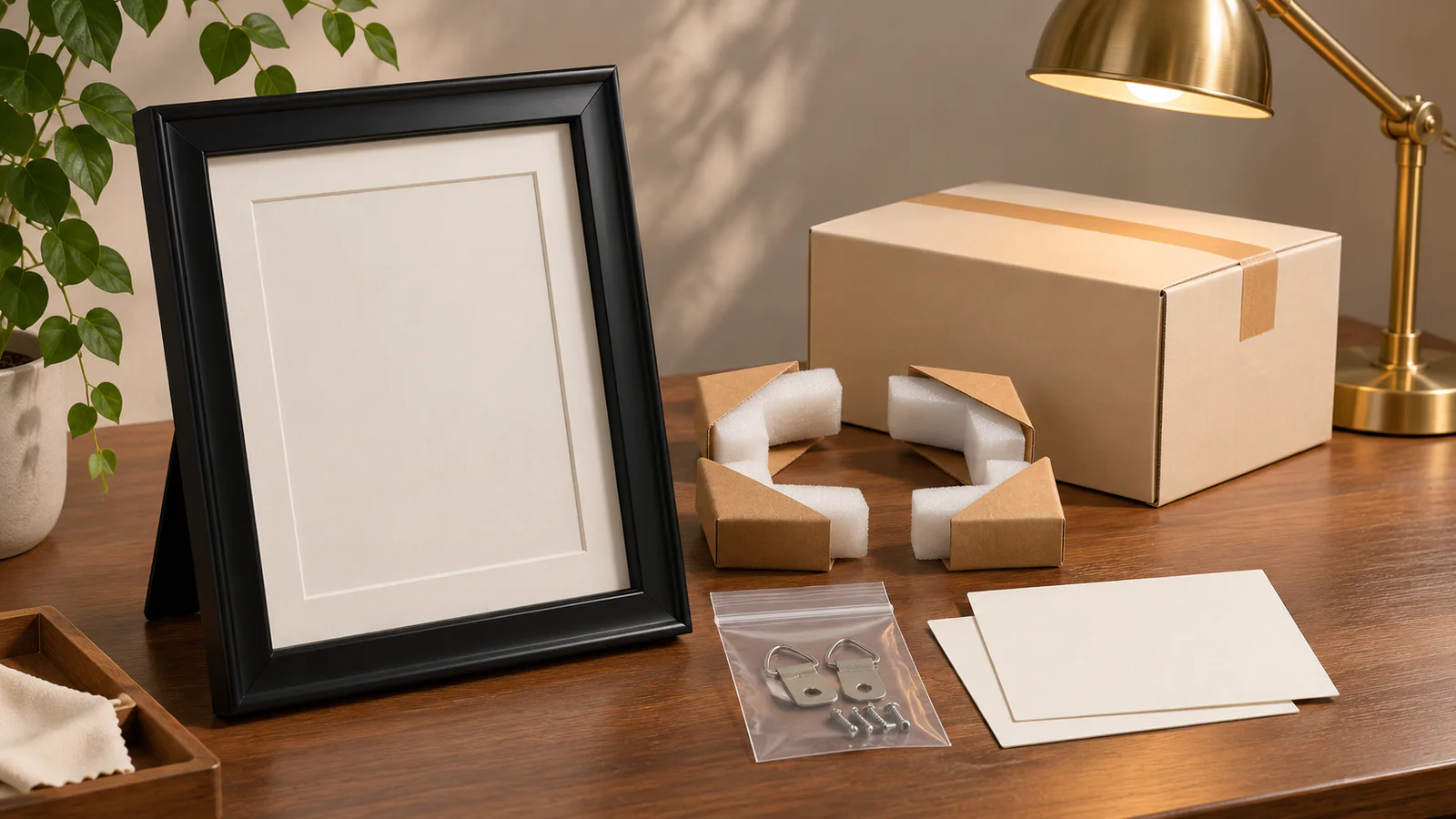
Glass or acrylic damage, open mitres and shifted objects can result from production, packaging, carrier handling or customer installation. Approve packaging with the product, including corner protection, front and back restraint, carton fit, opening method and any individual parcel route. Keep packed-sample photographs and specifications.
When a claim arrives, record outer-carton condition, internal protection and damage pattern. This helps the retailer provide a customer response while the importer and OEM investigate responsibility. Do not require excessive evidence as a barrier to a lawful remedy. Use the information to improve design, packing or carrier instructions and to support commercial recovery separately.
Control changes across listing, sample, warranty and production
A change becomes risky when one system updates and the others do not. New glazing may alter care instructions; a revised profile may change appearance; different hardware may affect the disclosed purpose; a new importer may change warranty contact details. Use one change request that asks whether product claims, samples, labels, instructions, warranty documents and claim codes need revision.
Set an effective batch and sell-through plan. Preserve the old listing and warranty version for earlier units. If stock with different specifications is sold simultaneously, identify it accurately. Never backdate a revised document to make old goods appear compliant. A clean version history supports both customer service and supplier accountability.
Buyer–OEM consumer-guarantee handover checklist
- Change-of-mind and product-failure requests use separate intake paths
- The sales route and potentially covered buyer are mapped
- Appearance, finish, safety and durability evidence is frame-specific
- Listings and packaging match the real material and features
- Golden samples state exactly what they approve
- Disclosed customer purposes reach product and factory teams
- Performance and durability claims have evidence and approval
- Written warranties against defects receive Australian legal review
- Required warranty information accompanies the actual product
- Retailer and importer remedy workflows do not defer customers improperly
- OEM reimbursement files retain claim-level evidence
- Personalisation data and physical construction are assessed separately
- Packaging evidence supports root-cause review
- Changes update specification, listing, sample and warranty together
- No guide or factory policy is treated as a legal remedy decision
Experience scope and project limits
Editorial review: Jessica, Founder & Project Advisor at DOREMI Display. Updated 8 November 2026. Jessica's practical scope covers custom display-frame specifications, OEM/ODM quotations, artwork and personalisation coordination, samples, packing, production communication and buyer–supplier handovers. She is not presented as the ACCC, an Australian consumer-law adviser, regulator, claims adjudicator or lawyer.
Australian suppliers, importers and qualified advisers must determine whether the law applies, whether goods fail a guarantee, whether a problem is major or minor, what remedy is required, whether reimbursement rights arise and what warranty wording is lawful. This guide prepares product and process evidence; it is not legal advice or a claim outcome.
Public sources used for this guide
- Google Search Central: optimizing for generative AI features
- ACCC: small business rights and responsibilities
- ACCC: warranties
- ACCC: repair, replace, refund or cancel
- Federal Register of Legislation: Competition and Consumer Act 2010, Schedule 2
- Federal Register of Legislation: Competition and Consumer Regulations 2010