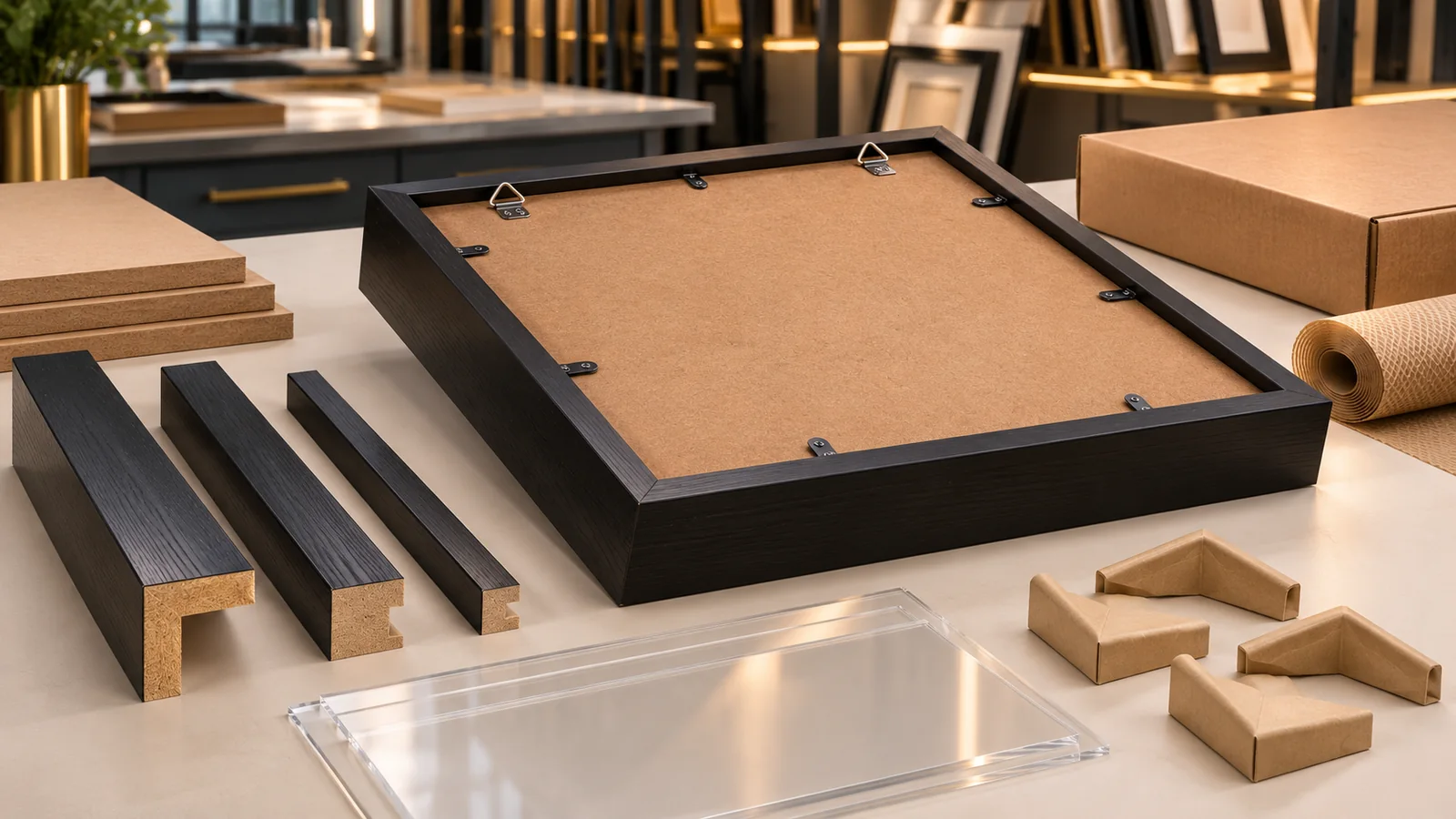
A black display frame may look like one finished article, but its material file can contain several different wood stories: wrapped MDF moulding, a thin MDF back, particleboard spacers, hardwood-plywood inserts and solid-wood details. For products sold or offered for sale in California, the California Air Resources Board's composite-wood requirements can reach finished goods such as picture frames. The practical buyer task is to connect the actual frame construction to compliant panel evidence, a correct finished-good label and records that remain traceable after export.
This guide is for California retailers, U.S. importers, private-label brands, sourcing teams and OEM/ODM display-frame suppliers. It translates CARB publications and frequently asked questions into a product handover. It does not determine whether a particular material is regulated, approve a panel mill or third-party certifier, interpret an exemption, perform emissions testing, replace federal TSCA Title VI analysis or provide legal advice.
What are display-frame buyers asking?
Commercial teams commonly ask: “Does the thin backboard count?”, “Is the moulding solid wood or wrapped MDF?”, “Can the carton carry one label for every model?”, “Is a TSCA Title VI statement enough in California?”, “Who keeps the panel invoices?”, “Can an importer place its own name on the label?”, “What changes if we drill, laminate or relabel the frame after import?” and “How do we prove that a reorder used the same board source?” These questions are difficult because the visible finish can hide the regulated substrate.
The questions are editorial inferences from CARB's current composite-wood publications, enforcement and labelling FAQs, and display-frame production handovers. Google Search Central says generative-search visibility still depends on useful, original, crawlable, people-first content. It does not provide a guaranteed AI Overview question feed, and DOREMI does not claim direct access to or measurement of AI Overview or AI Mode output.
Start with a component map, not a “wood frame” description
CARB's programme focuses on hardwood plywood, particleboard and medium-density fibreboard, including thin MDF, and its publications expressly identify picture frames among finished goods that can contain regulated composite wood. Natural solid wood, hardboard and other materials may have different treatment, but appearance alone cannot establish the category. A black wrap, veneer or painted edge can make MDF look like solid timber in a product photograph.
Build a model-level bill of materials showing the frame profile substrate, back panel, spacers, mat board, object-mounting panel, internal shelf, decorative insert and replacement parts. For each wood-based component record the supplier's material name, thickness, panel producer, production lot or invoice reference, finish process and country of manufacture. Mark conclusions as “supplier-described”, “document-confirmed” or “requires qualified review” rather than turning a quotation phrase into a compliance decision.

Keep California CARB and federal TSCA Title VI in separate rows
CARB publishes a comparison table because the California ATCM and the U.S. EPA TSCA Title VI programme are similar but not identical in every administrative detail. A supplier statement that addresses one framework should not be silently copied into the other. The responsible U.S. business should confirm which labels, invoices, certifications, records and exemptions apply to the actual finished good and transaction.
Use two columns in the compliance matrix: one for the California requirement and one for the federal requirement. Record the source document and reviewer for each conclusion. If a small component, no-added-formaldehyde resin, ultra-low-emitting-formaldehyde resin or other special status is claimed, preserve the document supporting that status and obtain qualified confirmation rather than applying a catalogue-wide shortcut.
Map the regulated roles before artwork is approved
CARB materials describe responsibilities for panel manufacturers, third-party certifiers, importers, distributors, fabricators and retailers. One company may hold more than one commercial role. An overseas factory that cuts MDF and assembles a frame is doing different work from a U.S. importer that receives finished goods, a warehouse that modifies backs, and a retailer that offers the frame online in California.
Create a responsibility map naming who buys regulated panels, who fabricates the finished frame, who controls the label, who places the order, who imports, who holds purchase records, who performs any U.S. modification and who sells to the California customer. Add a named escalation owner for missing statements or changed material. The map prevents a retailer from assuming the factory has every record and prevents the factory from assuming the importer will create a label after arrival.
Make panel-purchase evidence proportionate to production
CARB's labelling FAQ says fabricators need records of panel purchases and should be able to show that the amount of compliant composite wood purchased reasonably supports the quantity of finished goods produced. For a frame programme, that means the evidence chain should connect panel or moulding inputs to a production period and model family. A single undated certificate image forwarded through a message app is not an adequate batch story.
Ask for supplier invoices or equivalent purchase records, panel descriptions, producer identity, lot or date references and the compliance statement carried through the commercial documents. Reconcile expected material use with output: the number and size of backs, profile length, scrap assumptions and units produced. This is not a request for the buyer to invent an emissions calculation. It is a practical check that the cited compliant material could plausibly be the material used for the order.
Control the finished-good label as production artwork
CARB's current FAQ explains that a finished-good label generally identifies the fabricator, the production date and a clear statement denoting compliance with the applicable California requirement. The label does not turn the finished frame into a third-party-certified article, and a third-party-certifier number on a finished-good label does not mean that the certifier tested the finished frame. Buyers should avoid adding seals, approval badges or claims that the source documents do not support.
Treat the label as controlled artwork. Define the responsible company name, date format, exact approved compliance statement, placement, permanence, carton relationship, languages and model coverage. Review a photograph at normal size rather than only a PDF. If several frame models or production dates share a master carton, confirm whether the labelling arrangement remains correct for each finished good. Do not assume one visible carton label cures mismatched model or batch information.
Carry the compliance statement through invoices and shipping records
CARB fact sheets and FAQs discuss statements on invoices or bills of lading for regulated composite-wood products and finished goods. The label and transaction records perform different functions: the label travels with the product or its packaging, while the commercial record helps trace who supplied what and when. A buyer should not treat one as a substitute for the other.
Add required document language to the purchase-order checklist, then inspect the commercial invoice, packing list or bill of lading before shipment. The model description and quantity should match the approved production list. If the factory consolidates multiple products, the statement should not create ambiguity about which goods it covers. Preserve final documents in searchable form with the purchase order and receiving record.

Understand what changes when an importer relabels or modifies goods
CARB guidance permits certain importer or distributor labelling arrangements but warns that replacing the original finished-good label with the importer's or distributor's name can carry fabricator responsibility. The regulation also distinguishes unmodified imported goods from goods modified by the importer. Drilling, cutting, laminating, gluing, replacing backs or assembling components after import should therefore trigger review before work begins.
Write a warehouse change-control rule: no composite-wood component substitution, relabelling or fabrication without approval from the responsible compliance owner. Record the original state, proposed work, material source, revised label owner and affected quantity. A repair or kitting step that looks minor operationally can break the evidence chain if the team cannot identify the new component or responsible fabricator.
Keep records for the required period and make them retrievable
The CARB regulation and retailer materials describe purchase and supplier records and a minimum two-year retention period for relevant regulated-party records. A business may choose a longer corporate retention period, but it should not promise a duration based only on this article. The important operational point is that records must be available when requested, not buried in an employee's mailbox after a supplier change.
Index the purchase order, approved BOM, panel evidence, invoices, transport documents, label artwork, production photographs, receiving checks and any corrective action by model and batch. Preserve original files rather than screenshots where practical. Limit access to commercially sensitive mill or supplier information, but make sure the authorised compliance team can retrieve the complete path promptly.
Build a receiving inspection that checks identity, not emissions
Retailers and importers should verify that received goods and cartons carry the approved identity and that quantities align with the documents. Photograph representative labels, backs, profiles and cartons; compare production dates and model codes with the shipping file; and quarantine unexplained substitutions. This is a documentary and identity check, not a claim that a visual inspector can confirm formaldehyde emissions.
If CARB or a qualified laboratory collects samples, preserve chain-of-custody information and the exact model configuration. Do not sand, expose or prepare a sample based on an improvised internet method. CARB's testing FAQ explains that composite wood within finished goods may be prepared for emissions testing, but the responsible authority or qualified laboratory determines the method and interpretation.
Use change control for reorders and alternate sources
A reorder should not inherit compliance evidence only because the exterior colour and dimensions are unchanged. Panel mill, profile substrate, backboard, adhesive process, fabrication site or importer label may change. Require the supplier to disclose changes before material purchase and identify whether existing records and label artwork still apply.
Compare the new BOM with the approved baseline. Obtain fresh purchase and production evidence where the source or date changes. If a supply interruption requires an alternate panel, pause the release until the compliance owner has reviewed the actual material. A golden sample is valuable for appearance, but it cannot prove the origin of material used months later.
Give purchasing a simple release status for every model: approved source, conditional source or blocked source. Link that status to the current material record and expiry or review date. This prevents an urgent replenishment order from bypassing the same evidence controls used for the first launch.
Buyer–supplier CARB handover checklist
- Every frame component has a material identity and supplier source
- Regulated composite-wood conclusions are separated from solid wood, hardboard and other materials
- California CARB and federal TSCA Title VI requirements are tracked separately
- Panel purchases can be connected to the finished-good production period
- The fabricator, importer, distributor and retailer roles are named
- Finished-good label artwork has an owner, date logic and approved statement
- Invoice or bill-of-lading compliance language is checked before shipment
- Relabelling, drilling, laminating and component replacement trigger review
- Receiving checks model, batch, label and quantity identity
- Records are searchable and retained under the responsible business's policy
- Alternate board sources require new evidence before use
- Unsupported seals, test claims and certification language are excluded
Experience scope and project limits
Editorial review: Jessica, Founder & Project Advisor at DOREMI Display. Updated 6 November 2026. Jessica's practical scope covers display-frame BOMs, material questions, OEM/ODM handovers, samples, label artwork coordination, packing, production communication and supplier change control. She is not presented as CARB, the U.S. EPA, a third-party certifier, laboratory, regulator or lawyer.
Applicability, material status, exemptions, labelling, document language, testing, liability and enforcement consequences must be confirmed for the actual product and role using current rules and qualified advice. This guide is a project-preparation framework, not a CARB determination, emissions report, certification or legal opinion.
Public sources used for this guide
- California Air Resources Board: composite-wood publications and regulated-party materials
- California Air Resources Board: composite-wood labelling FAQ
- California Air Resources Board: composite-wood enforcement FAQ
- California Air Resources Board: CARB ATCM and EPA TSCA Title VI comparison table
- California Air Resources Board: composite-wood ATCM regulation order
- Google Search Central: optimizing for generative AI features