
What should a display-frame brand prepare before California's SB 54 programme reaches its 1 January 2027 participation milestone? Start by identifying the legal producer for the actual sales route, inventorying every covered packaging configuration and building controlled material and mass data that can support the chosen Producer Responsibility Organization or independent-compliance path. A statement that the carton is recyclable is not a substitute for this work.
This guide is for California-facing private-label brands, importers, distributors, packaging developers and procurement teams selling certificate, jersey, medal, vinyl-record, photo or mixed-memorabilia frames. It translates current CalRecycle resources into a supplier handover. It does not decide producer status, covered-material classification, registration, exemption, reporting, fee, source-reduction or recyclability treatment for a particular business.
Why 2026 changed the planning conversation
CalRecycle states that the permanent SB 54 regulations were approved and became effective on 1 May 2026. Its current producer guidance, PEPRS portal information, January 2026 Covered Material Categories list and source-reduction reporting guidance give businesses more concrete implementation material than they had during earlier rulemaking. Waiting for 2027 to map packaging can leave little time to resolve ownership and data gaps.
Use a dated implementation register. Record which official page or regulation supports each decision, who reviewed it and what may still change. Do not rely on an old presentation or supplier summary when CalRecycle has published updated guidance. The legal owner should monitor programme updates, the PRO plan and requirements that affect the company's chosen route.
Identify the producer through the actual California route
Producer status is not determined simply by who converts the carton or exports the finished frame. CalRecycle's 2026 situational screening tool uses a tiered analysis involving location, manufacture of the good, ownership or licensing of the brand or trademark, exclusive rights and the first party selling, offering or distributing the product in or into California. The facts of the commercial route matter.
Draw the route for each brand and channel: overseas manufacturer, U.S. importer, California brand owner, exclusive licensee, distributor, retailer, marketplace and consumer. Record the legal entity and its location. Have qualified counsel or the responsible compliance team apply the current statute and regulations. Do not copy the producer decision from another state or from an EU packaging file.
Separate the product from its packaging
A display frame can include glazing film, corner protectors, tissue or paper wrap, a protective sleeve, foam pads, a retail carton, printed inserts, a grouped carton, a master carton, stretch wrap, strapping, pallet protection and reusable transport equipment. Some elements clearly package the product; others may require analysis because they also perform a lasting product function.
Create a visual pack map showing every element as sold and shipped. State whether it is primary, secondary or tertiary packaging and whether it is removed by the consumer, retailer, distributor or warehouse. If an insert is intended to remain permanently in the frame, document that fact and obtain product-specific advice rather than treating all paper or plastic around the frame as packaging.

Inventory every packaging configuration, not one ideal pack
The same frame may ship in bulk to a distributor, in a retail box to a store, as a direct-to-consumer parcel or as part of a corporate award kit. Different sizes may share cartons with additional fillers, while a retailer programme may add branded sleeves. These are not necessarily one data record.
Give each approved pack configuration a code and revision. Record the frame SKU, sales route, units per pack, dimensions, components, closure, printed materials and pallet pattern where relevant. Include seasonal or promotional versions. If a warehouse repacks imported master cartons for California orders, include that added packaging and assign its data owner.
Build a component-level packaging bill of materials
For each component, record a neutral description, material or material combination, form, supplier, part reference, unit mass, quantity per configuration, recycled-content evidence if relevant, colour or coating, adhesive, printing, intended function and disposal stage. Use production measurements rather than estimates from a digital drawing whenever possible.
Keep a photograph and specification with the line item. A description such as “paper corner” can hide laminates, coatings, labels or plastic reinforcement. A protective bag may be polyethylene, a multilayer film or another material. Procurement should ask the packaging converter for facts and source documents without asking it to make the final California legal classification.
Map components to the current Covered Material Categories
CalRecycle's Covered Material Categories combine material type and form within classes that include glass, ceramic, metal, paper and fibre, plastic, wood and other organics. The list and its recyclability or compostability evaluations are updated. A business needs the current category definitions and reporting guidance when classifying actual packaging.
Create a controlled mapping table from each packaging BOM line to the proposed CMC, the official version used, decision owner and unresolved questions. Do not classify from colour or appearance alone. A paper-looking material with a coating, a fibre insert with adhesive or a multilayer sleeve may require more supplier detail and qualified review.
Measure mass with a repeatable method
Supplier quotations often show carton gross weight, while packaging reporting needs component-level information. Weigh the finished pack and individual components using a documented method and appropriate equipment. Record sample size, unit, date, moisture or conditioning considerations where material variability matters and the person responsible.
Reconcile the sum of component masses to the complete empty packaging configuration. Investigate material differences rather than adjusting numbers to force agreement. If estimates are unavoidable, mark the assumption and replacement date. Maintain conversion logic for units per carton, shipments, sales and California allocation so finance and compliance can reproduce the reported quantity.
Distinguish California sales from total production
A Chinese factory may produce one private-label frame batch for the United States, Canada and several retailers. Total packaging purchased does not automatically equal packaging used for products sold or distributed in California. The producer needs a controlled allocation method grounded in its actual commercial and logistics records.
Connect production orders to U.S. receipts, destination warehouses, retailer shipments, direct-to-consumer orders and returns. Define how transfers, damaged stock, samples and packaging added after import are treated under qualified advice. Preserve the source data and version of any calculation. A percentage copied from a sales forecast should not silently become the final compliance record.
Choose the PRO or independent path with the legal owner
CalRecycle's producer guidance states that producers must apply to participate in the PRO plan, submit an independent producer application or obtain a small-producer exemption. Circular Action Alliance is the approved PRO identified on CalRecycle's current pages. PEPRS supports registration, applications, data submission and compliance tracking.
The appropriate path depends on the legal producer and current eligibility. Assign an internal owner for registration, PRO communication, PEPRS access, invoices, reporting and record retention. Do not ask the overseas frame supplier to register the U.S. brand without a confirmed legal role and authority. Supplier data supports the process; it does not replace the producer's application or participation.
Treat exemptions and exclusions as decisions, not assumptions
CalRecycle publishes information on small-producer exemptions and exclusions for certain materials or circumstances. A business should apply the exact conditions and process in the current rules and guidance. Low sales volume, mostly paper packaging or use of a marketplace does not automatically prove that an exemption or exclusion applies.
Document the legal entity, calculation period, revenue or quantity evidence where relevant, packaging facts, application or notice and approval status. Set a review trigger if sales grow, ownership changes or a new material is introduced. Until a decision is confirmed, maintain the underlying packaging records so the programme is not forced to recreate history.
Connect source-reduction work to the official baseline
CalRecycle's source-reduction reporting guidance describes concepts and methods for reporting under the programme. A product-development team should not turn those requirements into an informal claim that it used less packaging than a competitor. The producer needs a controlled baseline, method and evidence that align with the applicable instructions.
Preserve historical packaging drawings, component masses, sales data and configuration changes. Record whether a reduction comes from light-weighting, elimination, reuse, refill or another qualifying strategy only after the responsible owner validates the treatment. Marketing should not publish a percentage until its scope, denominator, period and legal basis are approved.
Reduce packaging without increasing frame damage
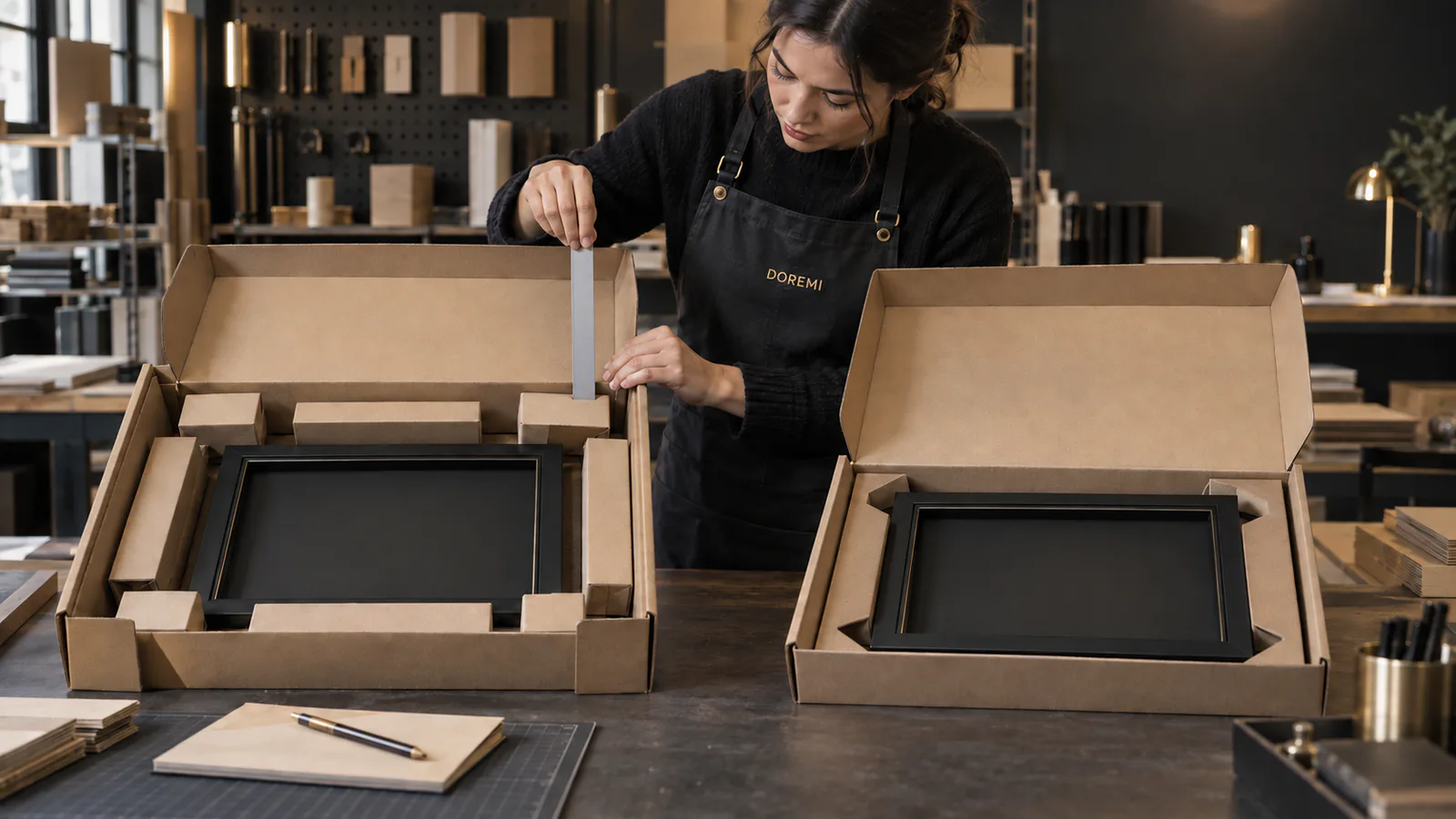
Display frames are fragile, dimensional products. Removing a corner protector, reducing board grade or eliminating a sleeve can increase glazing breakage, finish abrasion or opened mitres during parcel and pallet routes. Source reduction and damage prevention should be reviewed together, but their evidence streams remain distinct.
Use production-equivalent frames, final components and real distribution routes in a validation plan selected by qualified packaging specialists. Compare component mass, packed volume, breakage observations, handling and opening experience. Do not claim that a new pack meets a legal source-reduction goal because it survived one informal drop. Conversely, do not preserve unexplained empty space merely because the product is fragile.
Control recycled-content and recyclability statements
The CMC list includes official evaluations that should be read in their current form. A converter's statement that kraft paper or clear film is recyclable does not by itself establish the treatment of the complete printed, coated, taped or laminated component in California. Recycled-content percentages also require defined scope and evidence.
Keep material data, legal classification and marketing claims in separate approved fields. Ask suppliers for specifications and credible evidence, then have qualified owners validate what can be reported or communicated. Remove absolute environmental wording from artwork and product pages unless the claim has a documented basis that fits the exact packaging and current law.
Give every data field an owner and source
A packaging dataset often crosses procurement, engineering, finance, logistics, sustainability, sales and suppliers. Without ownership, the same carton can have different material names and masses in the purchase order, factory sheet and reporting workbook. Build a data dictionary that states each field's definition, unit, source system, approver and update rule.
Use one controlled configuration record as the bridge. Procurement owns supplier documents, engineering owns drawings, quality owns measured samples, logistics owns packing patterns, sales owns channel data and the producer's compliance owner approves reporting treatment. Access should be practical but change history protected.
Require supplier change notification before substitution
Packaging converters may change board, resin, film thickness, coating, adhesive, ink or source while keeping the same part number. Those changes can affect category mapping, mass, source-reduction calculations, claims and physical protection. A price-saving substitution should not bypass the producer's data and compliance review.
Define controlled characteristics and approval thresholds in the purchase specification. The supplier should state old and new material, reason, effective order, mass difference, supporting evidence and sample availability. Quarantine or separately identify changed packaging until the responsible team updates the BOM, physical validation and reporting record.
Link packaging records to production and sales
The factory should record which packaging revision was used for each production order and quantity. The importer should connect that order to receipts and sales routes. A carton purchase invoice can support quantity reconciliation, but it does not prove that every purchased component was used in California-bound product.
Retain pack photographs, component samples, supplier lots and packing-line records at a level that supports the producer's methodology. Define treatment for scrap, unused packaging, rework and replacements with qualified advice. When a retailer adds its own fulfilment packaging, establish whether and how those data enter the programme rather than assuming the first pack is the only one.
Prepare for the 2027 participation milestone now
CalRecycle's implementation materials state that producers must participate in an approved PRO plan by 1 January 2027 or follow an approved independent path, subject to the current law and programme details. A brand should confirm its status and deadlines directly from current official sources. Registration, data preparation, contracting and internal approval can take longer than expected.
Work backwards from the applicable milestone: producer decision, route selection, account authority, packaging inventory, CMC mapping, mass validation, historical data, source-reduction information, internal sign-off and submission readiness. Mark unresolved items honestly. Do not treat a supplier's promise to send data later as completion.
Run a production-equivalent packaging handover
Place the final frame, each packaging component, BOM, CMC mapping, mass record, drawings, supplier evidence and sales-route map in one review. Procurement confirms sources; packaging engineering confirms construction; quality confirms the sample; logistics confirms pack patterns; compliance confirms the legal treatment and open questions.
Repeat the review after printed and production materials arrive. Photograph the approved pack and record the revision. If the factory uses a protective element that is absent from the BOM, stop and identify it. The best reporting file is not the most elaborate spreadsheet; it is the one that matches the physical packaging actually placed into commerce.
Buyer and supplier handover checklist
- Permanent-regulation and guidance versions recorded
- Producer screened for each California brand and route
- Primary, secondary, tertiary and attached packaging mapped
- Every pack configuration has a code and revision
- Component BOM includes material, form, mass, quantity and supplier
- Proposed CMC mapping uses the current official list
- Mass method and production-to-California allocation documented
- PRO, independent or exemption path assigned to the legal owner
- PEPRS and reporting access has named administrators
- Historical baseline and source-reduction evidence preserved
- Protection validation accompanies packaging reductions
- Recyclability and recycled-content claims separately approved
- Supplier substitutions require change notification
- Packaging revisions link to production and sales records
- Production-equivalent handover completed before reporting
Experience scope and project limits
Editorial review: Jessica, Founder & Project Advisor at DOREMI Display. Updated 12 September 2026. Jessica's practical scope covers B2B display-frame briefs, materials, samples, packaging development, production coordination, quality discussions and supplier-to-buyer handover. She is not presented as CalRecycle, Circular Action Alliance, a California lawyer, environmental claims verifier, recycler, laboratory or authority that determines producer status, categories, fees or reporting.
This guide is educational procurement guidance. The responsible business and qualified California advisers must determine the applicable producer, covered materials, categories, exemptions, PRO or independent path, registration, reporting, source-reduction treatment, claims and deadlines for the exact legal entities and routes. Confirm current programme pages and regulations before acting; other state, federal and destination packaging rules require separate review.
Public sources used for this guide
- CalRecycle: SB 54 Plastic Pollution Prevention and Packaging Producer Responsibility Act
- CalRecycle: Producer Guidance
- CalRecycle: Are You a Producer? situational screening tool
- CalRecycle: Covered Material Categories List
- CalRecycle: Covered Material Categories Reporting Guidance
- CalRecycle: Source Reduction Reporting Guidance
- CalRecycle: Packaging Extended Producer Responsibility System
- CalRecycle: SB 54 permanent regulations status