
A Canadian display-frame importer may buy wood, aluminium and glass, yet still need a disciplined plastics file. Protective film, foam corners, bags, cable ties, moulded fittings and retail packaging can all carry plastic. A digital frame can also contain plastic in electronic and electrical equipment. Canada's Federal Plastics Registry turns those small components into a supplier-data question: who can identify each resin, source, mass and calculation method before the reporting owner signs a submission?
This guide is for Canadian brand owners, importers, retailers, marketplace sellers and their overseas frame suppliers. It translates the current Phase 1 requirements into a practical OEM handover. It does not decide whether a particular company must report, calculate a legal threshold, repair a late filing or replace Environment and Climate Change Canada, legal or environmental advice.
Start with the 2026 rule change, not an old phase chart
Environment and Climate Change Canada states that reporting for Phases 2 and 3 has been postponed. The March 14, 2026 Canada Gazette amendment keeps Phase 1 reporting for the 2025 and 2026 calendar years. For frame programmes, the continuing Phase 1 categories that matter most are plastic packaging and, where the product is electronic or electrical, plastic in EEE. A planning deck built from an older phase timeline can therefore assign the wrong data request.
Record the source, access date and reporting year on the compliance brief. Separate 2025 data due in 2026 from 2026 data due in 2027. Do not copy a prior-year workbook and only change the date: products, suppliers, resin sources, quantities and Canadian commercial roles may have changed.
Identify the Canadian reporting owner first
The Registry's guidance uses a hierarchy that can make a resident brand owner, importer, manufacturer, retailer, marketplace facilitator or seller the producer, depending on the facts. An overseas factory with no Canadian address does not file merely because it made the product. The Government of Canada says foreign exporters should support the Canadian importer with resin identities, sources and quantities.
Create a one-page responsibility map naming the Canadian resident brand owner, importer of record, first supplier to the consumer, marketplace arrangement and any reporting agent. Ask Canadian counsel or a qualified FPR adviser to confirm the obligated person. The supplier should provide product facts, not select the legal reporter.
Separate the frame from everything that protects it
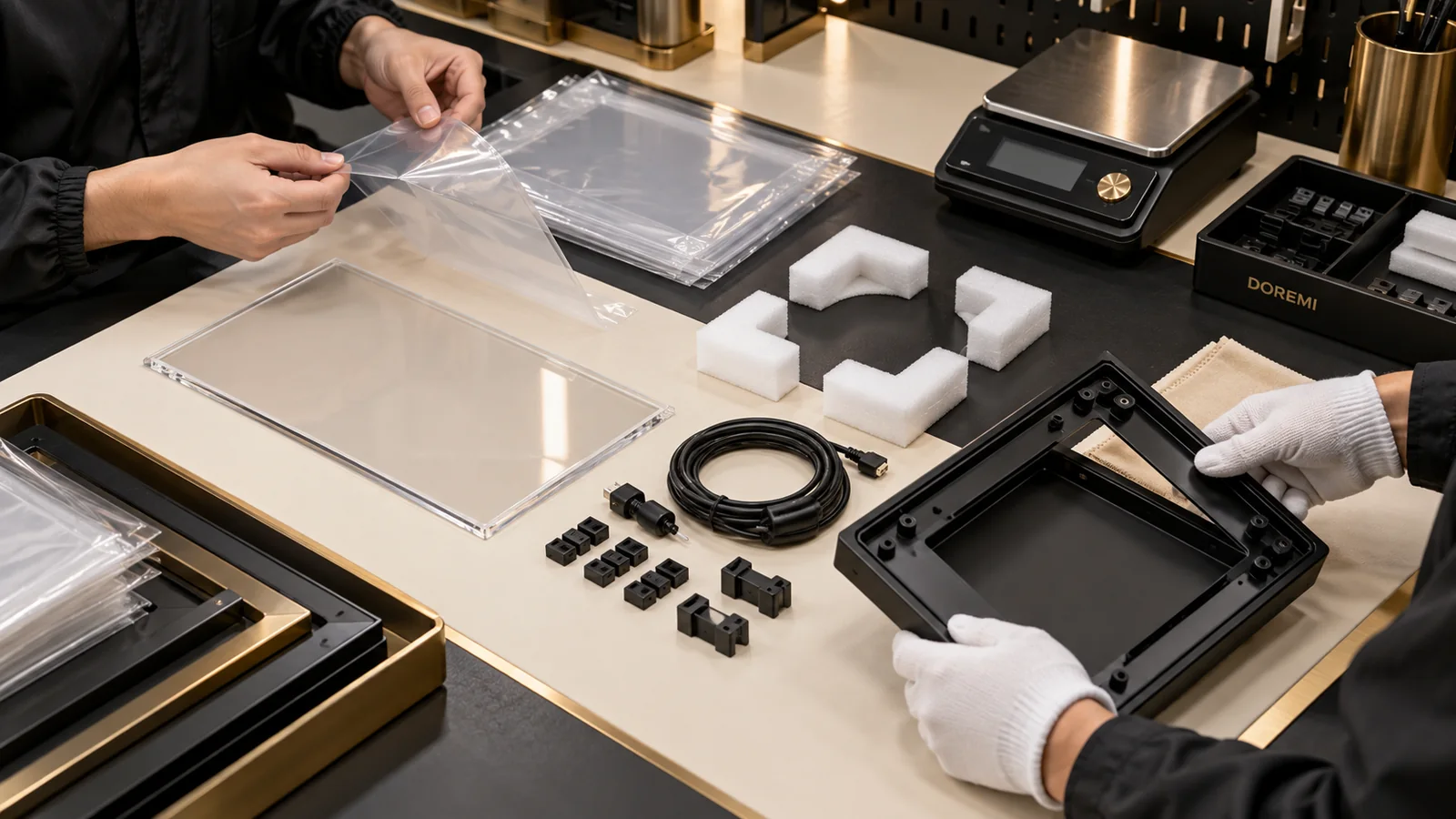
A passive wooden or metal frame may contain plastic glazing, clips, films, wall plugs, coatings, labels or mixed-material accessories. Its packaging may include shrink film, polybags, bubble wrap, expanded foam, plastic corner guards, tape, strapping and laminated pouches. A digital display frame adds enclosure resin, internal carriers, cable jackets, adapter housings and other plastic in EEE.
Map four layers for every SKU: product, included accessories, retail packaging and transport packaging. Note which layer is placed on the Canadian residential market and which is only used for export or business-to-business transport. Do not assume that plastic disappears from the data request because it is a small fraction of a mostly wooden product.
Build a component-level plastics bill of materials
A useful supplier file has one row per plastic-bearing component. Record the SKU, version, component name, packaging level, supplier part number, resin family, resin source, component mass, units per saleable product, calculation method and evidence reference. Include a field for unknown information so gaps remain visible instead of being silently converted into estimates.
Keep the frame BOM connected to the packaging specification. If the supplier changes a foam density, replaces a bag with film wrap or adds a moulded stand, the plastics file should receive a revision. The reporting team cannot reconcile annual quantities if the commercial SKU and supplier BOM use different version names.
Use the Registry's resin categories
The Phase 1 guide lists resin types used for reporting, including common categories such as polyethylene, polypropylene, polystyrene, PET, PVC, ABS and other resins. A commercial description such as “clear plastic,” “foam” or “nylon-like clip” is not enough. Ask the component or packaging supplier for the actual polymer identification and retain the supporting specification.
Multi-layer materials need special care. A laminated pouch, coated label or composite corner protector may contain more than one polymer. The Canadian guidance says each resin type in a multi-resin product must be reported. Where the supplier cannot separate layer weights, document the calculation method and escalate the uncertainty rather than inventing a single resin.
Record resin source without turning assumptions into facts
The Registry distinguishes sources such as virgin fossil-based, post-consumer recycled and post-industrial recycled resin. A recycled-content sales claim is not a substitute for source evidence. Ask for a supplier declaration tied to the component, resin purchase record or other controlled evidence that the Canadian reporting owner accepts.
If source information is genuinely unavailable, follow current ECCC guidance and the reporting owner's approved method. Do not market a component as recycled because a spreadsheet needs a source value. Product claims, supplier evidence and Registry data should agree, but each has a different purpose and review owner.
Measure plastic mass with a reproducible method
Mass data can come from direct weighing, controlled component specifications, packaging-converter records or documented calculations. A whole packed frame weight does not reveal the plastic contribution. For lightweight films, use a calibrated method capable of resolving the mass or weigh a known batch and divide by the counted quantity.
Save the scale identifier, date, sample count, unit conversion and photographs of the separated components. For film calculated from area, thickness and density, retain each input and its source. A reporting file should let another reviewer reproduce the result without guessing which sample or unit was used.
Connect unit data to annual Canadian quantities
The supplier can provide grams of plastic per product and packaging configuration. The Canadian organization usually controls imported, manufactured and placed-on-market quantities. Join those datasets by SKU, reporting year and revision. Returns, exports, samples, replacement parts and repacking can affect the commercial quantity file and need a consistent treatment set by the reporting owner.
Do not ask the factory to certify Canadian sales it cannot see. Its role is to maintain reliable unit-level composition and mass. The Canadian team applies those facts to its own transactions and the definitions in the notice.
Screen the residential-stream and threshold questions carefully
Phase 1 is directed at specified products and packaging destined for the residential waste stream. The Registry also describes a de minimis exemption below 1,000 kilograms, based on the combined relevant activity described in the guidance. A single lightweight frame does not prove that a business is exempt; the assessment is annual and organization-wide.
Give qualified Canadian advisers the product channels, customers, quantities and packaging flows they need. Keep the factory's component data neutral. Labels such as “retail,” “hospitality” or “corporate gift” may not, by themselves, resolve the applicable waste stream or reporting status.
Treat passive and digital frames as different data families
For a passive wooden award frame, Phase 1 may focus on packaging even when the product itself is outside the listed product categories. For a digital photo or information frame, plastic in the EEE product may also be relevant. One family should not inherit the other's template merely because both are sold under the same brand.
Create separate BOM views for passive frames, illuminated displays and connected digital frames. Identify the electrical configuration, accessories and packaging for each. Qualified Canadian reviewers should confirm category and subcategory selections against the current notice.
Avoid double counting while preserving both data views
The official guide distinguishes unfilled packaging and filled packaging as separate data points in relevant contexts. Within a company's own workflow, duplicate supplier rows can also arise when a master carton, retail carton and product file each name the same polybag. Use stable component IDs and a packaging hierarchy so totals can be traced without accidental duplication.
Keep a raw supplier BOM, a controlled per-SKU calculation and a reporting-year aggregation. Do not overwrite raw measurements with final annual totals. A reviewer should be able to move from the submitted kilogram value back to the component evidence.
Respond to a missed or incomplete 29 September deadline
The 2025-calendar-year report was due in 2026 under the Phase 1 schedule. If a team discovers a gap after the deadline, it should identify the legal reporting owner, preserve the current evidence, document what is missing and contact ECCC or qualified Canadian counsel promptly. This guide cannot predict enforcement or prescribe how a late submission will be treated.
Do not solve urgency by entering unsupported resin or weight figures. Create a dated gap log: affected SKUs, quantities, missing supplier fields, estimation method under review, responsible person and next contact. A defensible correction process begins with knowing which facts are confirmed and which are not.
Use the Government's foreign-supplier request route
ECCC provides a foreign supplier letter in several languages, including simplified Chinese. Canadian importers can use that official communication as a starting point, then attach a product-specific template that explains the required fields, units and evidence. The request should name the exact SKUs and reporting year.
A generic request for “plastic information” invites inconsistent answers. Ask for resin by component, source category, net plastic mass, calculation method, effective revision and contact person. Set a change-notification requirement for future orders.

Put plastics data into sample approval
A spreadsheet prepared months after shipment is vulnerable to memory and substitution errors. During sample approval, photograph and weigh the actual packaging set, note resin specifications and sign off the BOM revision with the product sample. This is especially useful where several suppliers make visually similar films or foam parts.
At pre-shipment inspection, verify the approved packaging structure and plastic-bearing accessories. Sampling does not prove every resin claim, but it can reveal an unapproved substitution, added film or different corner protector that requires the data owner to review the file.
Control changes across reorders
Packaging improvements can change FPR data. Replacing EPS foam with moulded pulp, reducing film gauge, changing an acrylic glazing sheet or adding a cable retainer changes the plastics BOM. Require a supplier engineering or packaging change notice before production and state when updated mass and resin evidence is due.
Maintain effective dates and affected order numbers. Annual reporting may include more than one version of the same commercial SKU, so deleting the previous BOM can make aggregation impossible.
Buyer handover checklist
- Canadian resident reporting owner and any reporting agent identified
- Current March 2026 amendment and applicable reporting year recorded
- Passive frames, digital frames, accessories and packaging mapped separately
- Residential-stream assessment assigned to a qualified Canadian owner
- Every plastic-bearing component has a stable ID
- Resin type and source supported by supplier evidence
- Plastic mass and calculation method are reproducible
- Unit data links to SKU, revision, order and Canadian annual quantities
- Multi-resin materials are not collapsed without review
- Unknowns and estimates are visible and approved
- Foreign-supplier request names exact fields, units and due dates
- Sample and pre-shipment checks reconcile the packaging configuration
- Change notices update the plastics BOM before future shipments
- Raw evidence and reporting calculations are retained separately
Questions to send the supplier
Ask: Which product and packaging components contain plastic? What is each resin type and source? What is the net plastic mass per unit, and how was it measured or calculated? Which revision and production date does the data cover? Are there multi-layer films, adhesives, coatings or mixed-resin parts? Which component supplier supports the declaration? What changes require a revised file?
Then ask the Canadian adviser: Who is the obligated producer for each sales channel? Which frame and packaging categories apply? Does the residential-stream condition apply? How is the 1,000-kilogram exemption assessed for this organization? How should estimates, late information or corrections be handled in the current reporting platform?
Experience scope and project limits
Editorial review: Jessica, Founder & Project Advisor at DOREMI Display. Updated 30 September 2026. Jessica's practical scope is B2B display-frame briefing, material and packaging discussion, sample coordination, supplier BOM handover and production-change control. This article does not present her or DOREMI as Environment and Climate Change Canada, a lawyer, an FPR reporting service or an environmental auditor.
Use this workflow to make supplier facts reviewable by the Canadian reporting owner. The legal notice, guidance, platform and business facts control the filing. Verify the current official requirements for the relevant reporting year before submitting data.
Public sources used for this guide
- Google Search Central: optimizing for generative AI features
- Environment and Climate Change Canada: Federal Plastics Registry
- ECCC: Guide for reporting to the Federal Plastics Registry — Phase 1
- Canada Gazette: 14 March 2026 amendment to the FPR notice
- Canada Gazette: original Federal Plastics Registry notice
- Government of Canada: Federal Plastics Registry reporting platform