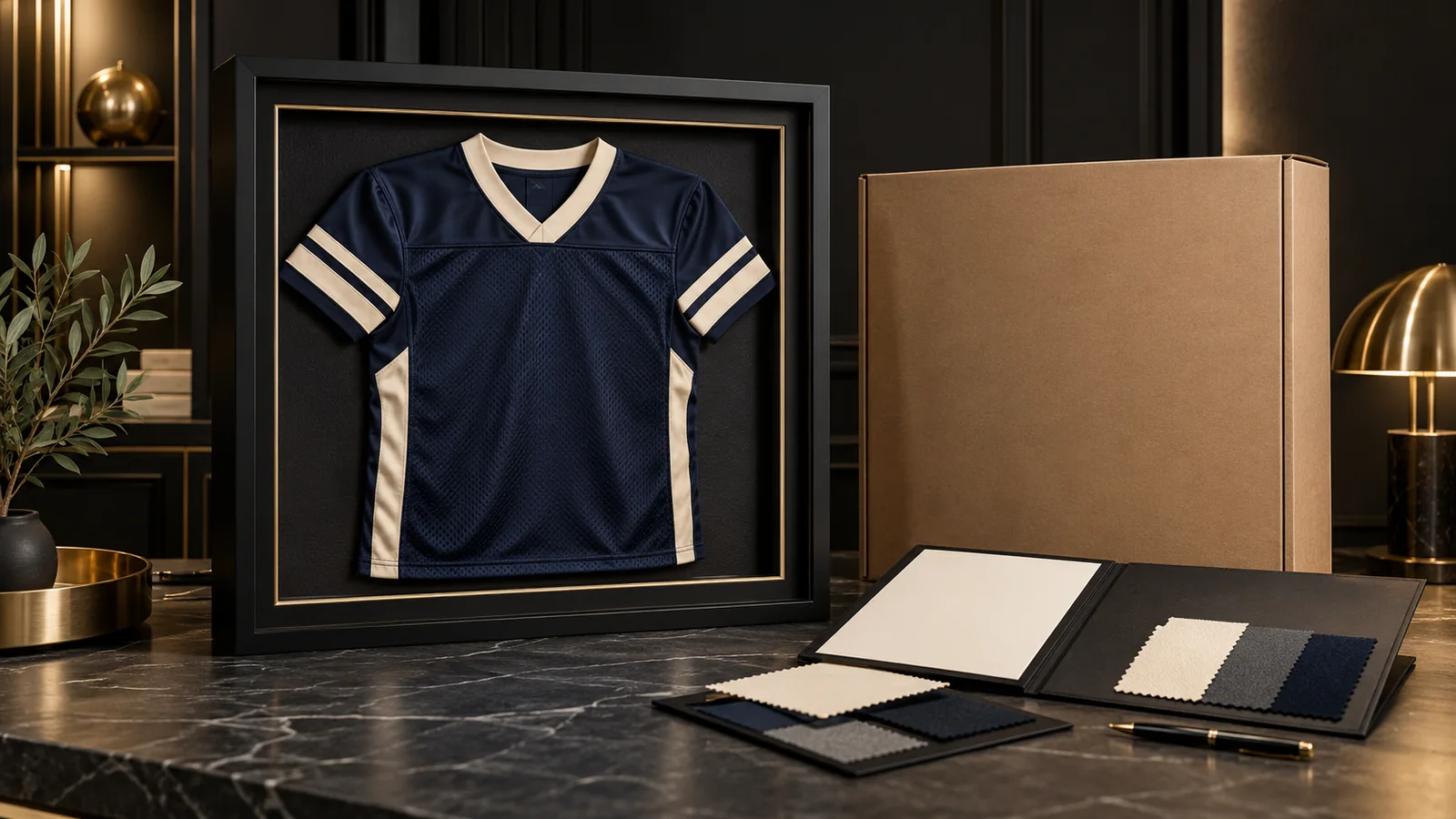
A collegiate jersey display frame can contain several independent rights in one product: an NCAA championship mark, a university name or crest, a conference identity, an athlete's name or image, a photograph, a signature and the frame brand's own packaging. Approval for one element does not automatically clear the others.
This guide is for universities, alumni programmes, retailers, sports-merchandise brands, licensing teams and display-frame OEM buyers. It maps rights ownership, licence routes, generic quality samples, artwork approvals and production controls. It does not grant permission, determine whether a specific use is infringing, clear athlete NIL or photography, or replace the NCAA, an institution, conference, CLC, rights owner, licensing counsel or the responsible licensee.
What are buyers really asking about collegiate frames?
The common question is “Can we put a college logo on a jersey frame?” The commercial job is larger. Is the product for internal university use, a donor gift, a retail shelf, direct-to-consumer sale or a championship promotion? Does it use an NCAA mark, school mark, conference mark or several? Is the jersey generic, authentic, replica, signed or athlete-specific? Who owns the photograph and signature rights?
Google Search Central recommends useful, original, people-first content that resolves connected questions. This page organizes the licensing-to-production handover instead of suggesting a universal licence. Search intent is an editorial inference from public licensing sources and frame-project experience; DOREMI does not claim direct access to AI Overview or AI Mode output.
Start with the exact commercial use
Write one sentence describing who will make, buy, receive and resell the product. A frame purchased by a university department for internal recognition is not automatically the same licence category as merchandise sold through a campus bookstore. A promotional gift linked to a sponsor can introduce additional rights and approval routes.
Record sales channels, territories, launch period, quantity, price positioning, customer, event connection and whether the item will be advertised online. Licensing teams need the real programme, not only a product rendering. If the route changes from internal to retail, pause artwork and recheck permission.
Separate NCAA marks from school and conference marks
The NCAA states that use of its name or logo on a product or in advertising requires a licence. It also explains that an NCAA merchandise licence covers NCAA championship events, while the NCAA does not manage conference or member-institution licensing. A buyer therefore should not treat one “college licence” as a blanket permission.
Create a rights matrix with one row per visible or marketed element: NCAA word mark, championship name, event logo, institution name, athletics logo, conference mark, colours, mascot, slogan and any ticket or venue imagery. Name the owner and licensing administrator for each row. Leave the status pending until written approval exists.
Choose the CLC route from the distribution model
CLC's public information distinguishes retail and internal licences for its partner institutions. Retail licensing permits approved products bearing collegiate trademarks to be sold through approved channels and direct to consumers. Internal licensing is for products supplied to university departments and related entities for internal consumption and does not authorize retail or direct-to-consumer sale.
CLC also describes a separate route for NCAA, bowls, conferences and “hot market” events. The buyer should ask the relevant licensing administrator which programme covers the exact product, institution and event. Do not quote old fee schedules or assume every institution uses identical approval criteria.
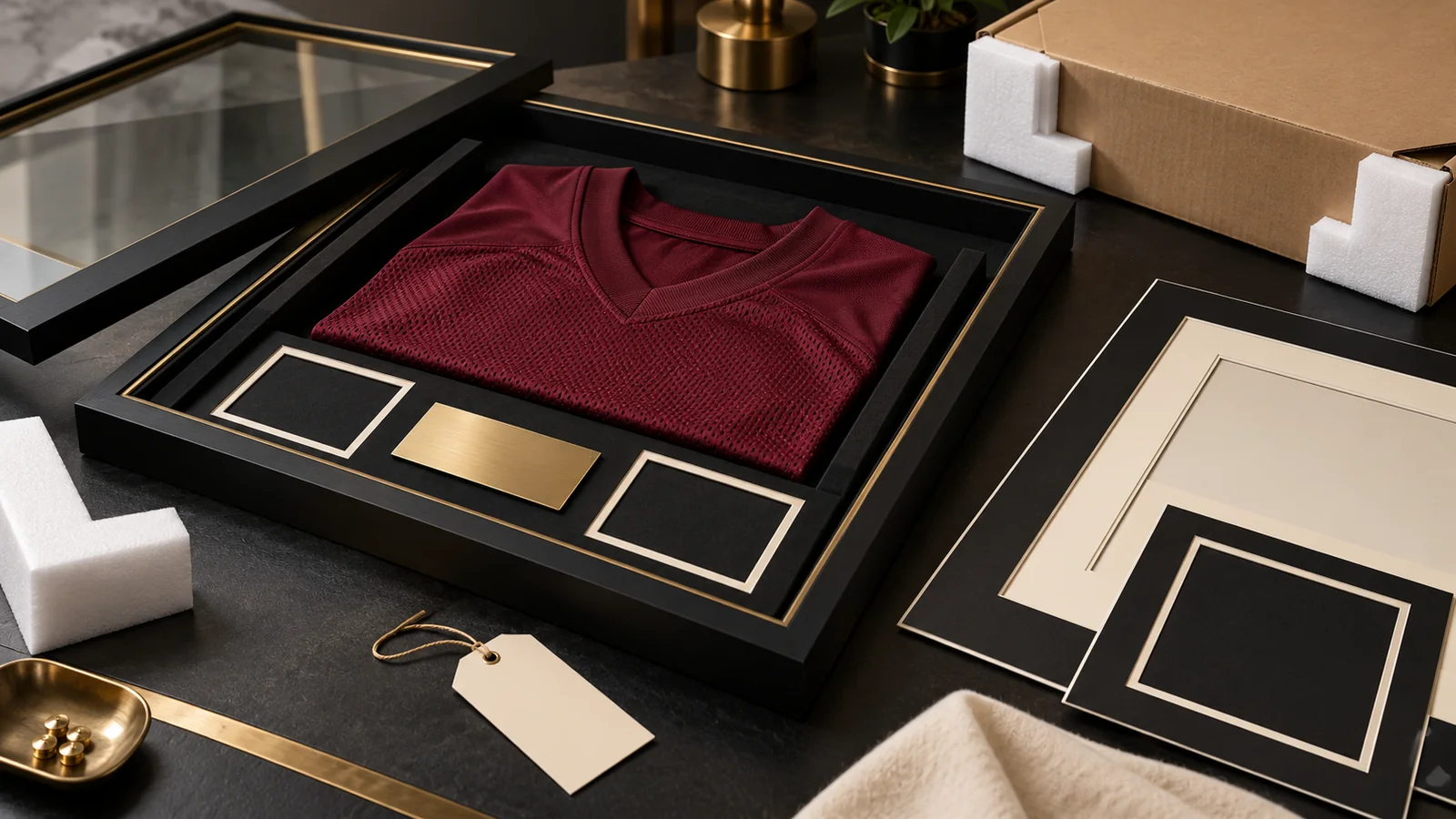
Do not manufacture before the licence is active
CLC's published application sequence includes account creation, application, review, possible quality samples, institution decision, phase-two requirements, fees and agreement. Its process states that artwork is submitted for approval and product is manufactured after the licence is active. Treat the order of those steps as a control, not an administrative suggestion.
The OEM can develop dimensions, materials, blank mats and generic samples before protected artwork is available. It should not copy a logo from the internet, print speculative packaging or create “approval samples” using marks that the buyer has not been authorized to share.
Design a generic quality sample that proves the right things
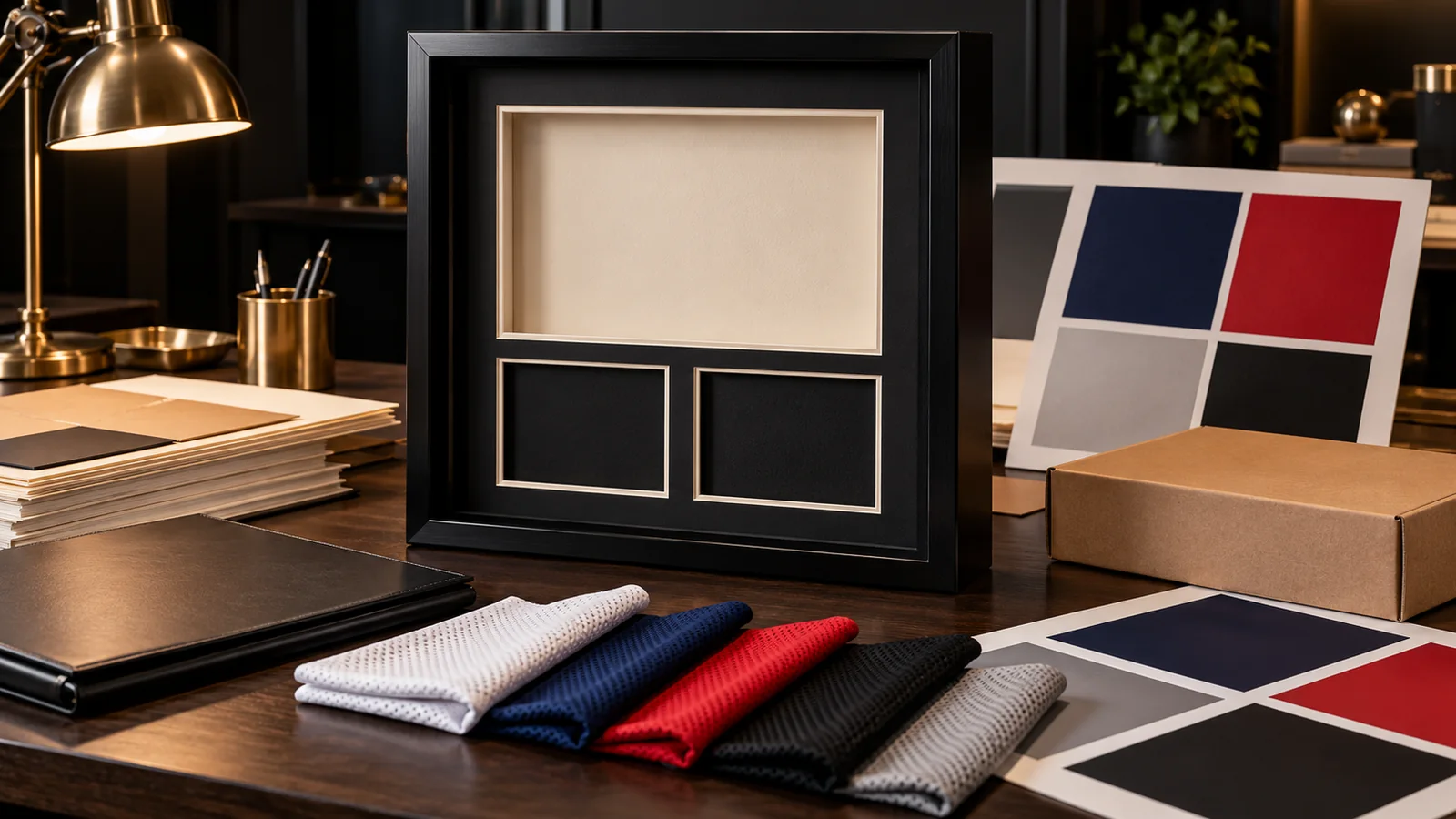
CLC says retail applicants must submit at least one quality sample of each product type on which they plan to apply collegiate logos; the sample can be generic but should show the proposed application method. For a jersey frame, that means the sample should demonstrate the frame profile, depth, mat openings, plaque treatment, mounting approach, glazing, hanging hardware and packaging.
Use neutral artwork blocks and unbranded fabric. Show whether a mark would be printed, engraved, embroidered, applied as a plaque or supplied as an insert without reproducing a protected design. Label the sample revision internally so later licensed artwork does not hide an unapproved construction change.
Keep athlete NIL separate from team licensing
A school or NCAA licence does not automatically grant the right to use an athlete's name, image, likeness, signature, jersey number in an identifying context or endorsement. Athlete-specific programmes need a documented NIL route appropriate to the parties, competition rules and applicable law. Group licensing, school involvement and third-party deals can have different requirements.
Build a separate NIL sheet naming the person, rights granted, product, territory, channel, term, compensation or royalty administration, approval rights and permitted imagery. Licensing and legal owners should approve it. The frame OEM should receive only the final production instructions and evidence needed to manufacture, not negotiate rights on the buyer's behalf.
Clear photographs and signatures independently
Owning a physical photograph or signed jersey does not necessarily grant commercial reproduction rights. A photograph can carry copyright; a signature or athlete identity can raise publicity, endorsement and authenticity questions. A display that mounts the buyer's lawfully acquired original object may be different from a mass-produced product that reproduces the image or signature.
Record the image source, photographer or agency, licence, permitted crop, print quantity, territory, channel, credit line and expiry. For signatures, distinguish an original signed object from a reproduced facsimile and document the approved claim. Do not ask the factory to create authenticity language, certificates or holograms unless the authorized programme supplies exact instructions.
Control official artwork files
Authorized artwork should come from the licensing administrator or approved brand portal, not search results or a buyer's old slide deck. Record file name, version, colour standard, minimum size, clear space, background, permitted lockup and approval reference. Keep working files access-controlled and do not send a full logo library when only one mark is needed.
The OEM should return a production proof showing actual size, placement, colour callout, application method and substrate. The licensee or designated approver owns the decision. A factory email saying “looks okay” is not brand approval.
Plan around colour, material and production reality
Licensed artwork may be specified in brand colour systems that do not translate directly to foil, anodized metal, fabric, digital print or wood finish. Build a physical colour standard and approve the appearance under realistic lighting. If metallic gold or silver is proposed, decide whether the licensor permits that treatment.
Record tolerances and inspection method without claiming a universal delta. A sampled plaque, printed insert and retail carton can use different processes. Match each component to the approved reference and keep supplier changes behind a new proof.
Build labels and authentication into the pack
CLC's public process requires retail licensees to provide a company-name label example and states that retail licensees must order and apply Officially Licensed Collegiate Products hologram labels after approval. The current programme instructions control exact placement and use.
Create a packaging drawing that identifies the licensee name, product identity, required authentication device, country-of-origin marking, consumer information and any retailer fields. Do not generate a fake hologram, licence number or approval badge for a sample. Use blank reserved areas until authorized material is issued.
Disclose the manufacturing chain accurately
CLC's application information includes supply-chain manufacturer disclosure and corporate-responsibility requirements in the licensing process. The buyer should identify the legal factory and relevant subcontractors before approval. If printing, engraving, mat cutting, jersey mounting or packing occurs at different sites, disclose the chain through the required route.
State that no licensed production can move to another site without review. Protect artwork from unauthorized overruns, seconds and scrap leakage. Agree how defective branded components are counted and destroyed or returned, with evidence appropriate to the programme.
Connect royalties and reporting to SKU data
The licence agreement and administrator determine royalties, advances, guarantees, reporting periods and deductions. The factory should not estimate those obligations. It can support accurate reporting by giving the buyer stable SKU, quantity, production, shipment and destination records.
Use one approved SKU master showing product name, institution or property, artwork approval, channel, territory and effective dates. Keep samples, replacements, donations and internal units separately coded if the licence requires different treatment. Finance and licensing owners should reconcile sales and royalty reports.
Review online listings and advertising
The NCAA says online commercial use of its trademarks requires authorization. A product approval does not automatically approve every marketplace title, sponsored advertisement, lifestyle image or keyword. Submit listing artwork and marketing copy through the applicable process.
Make sure the photograph shows the approved configuration and authentication details without exposing confidential approval documents. Avoid suggesting the product is “official” in a broader sense than the licence permits. Hold pages until the licence, artwork and launch timing are confirmed.
Control reorders, events and programme changes
A championship, rivalry, athlete roster or institutional brand system can change. Confirm that the licence, artwork and event permission remain active before every reorder. A previous purchase order is not permanent permission to use an old championship mark or retired school identity.
Review quantity, territory, channel, institution list, product construction and artwork version. If a new athlete, image, signature, sponsor or event is added, reopen the relevant rights row instead of assuming the base frame approval covers it.
Write an OEM production release gate
The release pack should contain the active licence confirmation or buyer authorization reference, approved artwork proof, generic construction sample, colour and material references, SKU and territory, label/hologram instructions, approved sites, packaging drawing, inspection criteria and effective production quantity.
Mark protected files and limit access. The buyer's licensing owner should give the final release. The OEM should stop if the artwork, mark owner, quantity, site or approval reference conflicts with the purchase order.
Buyer checklist
- The commercial use and sales channel are written
- NCAA, conference and institution marks are separated
- Retail and internal licence routes are not confused
- Event or hot-market permissions are reviewed separately
- A licence is active before protected production begins
- The generic quality sample proves construction and application
- Athlete NIL has a separate documented route
- Photography, signatures and authenticity claims are cleared
- Official artwork comes from an authorized source
- Physical colour and application samples are approved
- Company labels and authentication devices follow current instructions
- Manufacturing sites and subcontractors are disclosed
- SKU data supports royalty reporting
- Listings and advertising receive required approval
- Reorders recheck rights, dates, artwork and territory
Questions for the licensee and OEM
Ask the licensee: Which marks and rights owners are involved? Is the route retail, internal, promotional or event-specific? Who clears NIL, photos and signatures? Which administrator approves artwork, labels and marketing? What quantities, channels, territories and dates are authorized?
Ask the OEM: Which generic sample proves the construction? Which sites print, engrave, assemble and pack? How are protected files controlled? What method and material reproduce the approved mark? How are overruns, defects and scrap controlled? Which change triggers a new proof?
Experience scope and project limits
Editorial review: Jessica, Founder & Project Advisor at DOREMI Display. Updated 23 October 2026. Jessica's practical scope covers jersey-frame RFQs, mounting layouts, materials, samples, artwork handovers, packaging, inspection and change control. DOREMI is not presented as the NCAA, CLC, a university, conference, NIL collective, photography licensor, authentication service or legal adviser.
Use this guide to prepare a licensing-to-OEM file. The rights owners, current licensing administrators, licence agreement, approved artwork, athlete and image rights, actual sales route and qualified advice control permission, production and marketing.