
A private-label digital photo frame can contain solder, circuit boards, connectors, fasteners, stands and power components sourced through several supplier tiers. When a listed company or its customer asks for a Conflict Minerals Reporting Template, the OEM needs more than a declaration that its factory is “conflict free.” It needs a controlled component, supplier and smelter-data process.
This guide is for brand owners, SEC-reporting-company supply teams, importers, electronics buyers and frame OEM/ODM factories. It explains how to prepare product facts and supplier outreach. It does not decide whether a company must file Form SD, whether due diligence is adequate or whether any mineral or smelter meets a legal or customer standard.
Why are buyers asking for CMRT data?
Large brands often extend responsible-minerals questionnaires through their supply chain, including to smaller suppliers that are not themselves SEC issuers. A frame factory may receive a CMRT request because metal hardware or electronic components contain tin, tantalum, tungsten or gold—the four minerals commonly called 3TG.
These buyer questions are editorial inferences from SEC and RMI resources and normal OEM evidence handovers. They were not captured from Google AI Overviews or AI Mode. The practical task is to identify the requesting organisation’s scope, map relevant components and avoid turning incomplete supplier data into a categorical product claim.
Start with the reporting-company scope
The SEC rule applies to companies that file reports under specified Exchange Act sections and use conflict minerals necessary to the functionality or production of products they manufacture or contract to manufacture. A small frame importer may not be the regulated issuer, but it may be a supplier to one or may have contractual reporting commitments.
Ask who requested the template, the reporting period, due date, product scope and whether the request is regulatory, customer-policy or voluntary. Do not tell a supplier it is legally required to file with the SEC when the actual request is a commercial data flow.
Assess contract-manufacturing influence carefully
SEC guidance says “contracting to manufacture” depends on facts and the company’s influence over manufacturing. Merely placing a brand on a generic product or negotiating terms unrelated to manufacturing does not automatically create that status. Custom materials, circuit design, performance requirements or manufacturing decisions may present different facts.
Document what the brand specifies: housing, display module, main board, wireless module, power supply, stand, fasteners, finish and supplier nominations. Let securities counsel determine the issuer’s scope. The OEM supplies the manufacturing record; it should not decide the customer’s filing obligation.
Identify where 3TG may be present
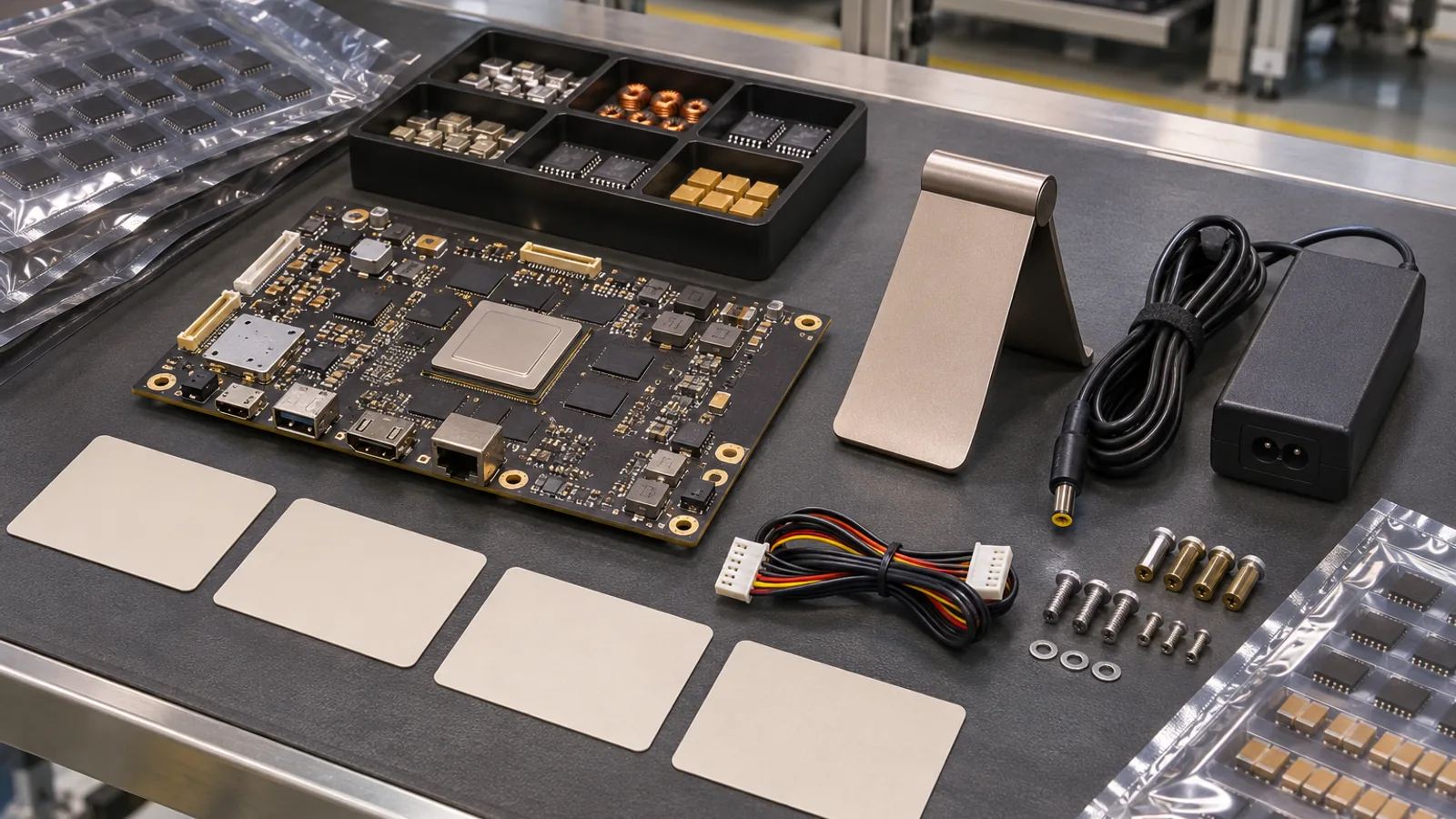
Common screening points include solder containing tin, gold-plated contacts, tantalum capacitors, tungsten in specialised components and metal finishing or fasteners whose composition is not fully known. Presence cannot be inferred reliably from colour or part name. Use component declarations, material specifications and supplier responses.
Begin with the approved bill of materials, not a generic electronics checklist. Record manufacturer part number, supplier, function, suspected mineral, evidence source and reporting scope. For a non-electronic award or picture frame, hinges, clips, plated fittings or decorative metal may still prompt a customer question, but the analysis remains fact-specific.
Generic components are not automatically excluded
SEC staff guidance explains that generic components included in a product are not automatically outside the inquiry. If a relevant conflict mineral is present in a generic component incorporated into the product, the reporting company may still need origin information.
Do not stop the review because the OEM buys an off-the-shelf board, adapter or connector. Trace the request to the component supplier and preserve the relationship between the finished frame BOM and the supplier’s response. If the supplier cannot provide smelter data, record the gap honestly.
Treat packaging separately
SEC staff FAQs state that packaging or containers used to display, transport or sell another product are generally not treated as part of that product for this rule, even when packaging preserves usability. Packaging sold independently can be a product in its own right.
Keep the digital frame BOM separate from cartons, inserts and retail display packaging. Do not inflate the CMRT scope with every packaging fastener unless the requesting customer specifically asks for a broader policy review. Conversely, do not use the packaging answer to exclude metal parts that remain with the frame during use.
Use the correct reporting template
The Responsible Minerals Initiative describes the CMRT as the template for tin, tantalum, tungsten and gold. Its EMRT covers a different mineral scope, including cobalt, copper, natural graphite, lithium, natural mica and nickel. The AMRT is intended for additional minerals defined by the user.
A completed EMRT is not a substitute for a requested CMRT. Confirm which template, version and mineral scope the customer requires. Preserve the original workbook structure and validation logic rather than copying answers into an unofficial spreadsheet.
Check the current version before every cycle
RMI’s template introduction says the latest CMRT and EMRT versions with functional changes were released on 17 April 2026; later unbranded versions released on 30 October 2026 are functionally identical to the April versions. The template page is the source to check before issuing a request.
Record template version, reporting period, date received and preparer. Do not merge answers from different versions without review. When a customer mandates its own deadline or version, document that instruction separately from RMI’s current release.
Define product-level or company-level scope
A supplier may answer for its entire company, a business unit, a product family or named products. A broad company-level response can contain smelters unrelated to the digital frame, while a narrow product-level response may require more supplier mapping. State the declaration scope exactly as the template allows.
Connect the scope to named frame models and BOM revisions. If the OEM cannot isolate product-level data, do not relabel a company-wide response as product-specific. Explain the limitation to the customer and agree whether a broader declaration is acceptable.
Build a tier-one supplier campaign
Group suppliers by component risk and business importance. Send a consistent request with template version, reporting period, product or company scope, due date, contact and escalation route. Ask suppliers not to alter hidden sheets, formulas or standard questions.
Track sent, acknowledged, received, validated, corrected and overdue status. A high response count is not the same as complete smelter coverage. Prioritise circuit boards, display modules, power supplies, cables, connectors, soldered assemblies and relevant metal parts.
Validate answers before aggregation
Check that the supplier identifies its declaration scope, completes mandatory questions, provides a responsible contact and uses recognised smelter names where possible. Look for contradictions, such as declaring no 3TG while listing smelters, or answering at company level while claiming product-specific completeness.
Return clear correction requests. Do not silently rewrite a supplier’s conclusion. Keep the original file and corrected version so the evidence history remains visible.
Handle unknown smelters without inventing certainty
Multi-tier electronics chains may not immediately identify every smelter or country of origin. Record unknowns, supplier outreach and the plan for follow-up. An incomplete answer should not be converted into “DRC conflict free,” “responsibly sourced” or “no covered-country origin” without the required basis.
Separate data quality from commercial approval. A buyer may allow a conditional sample stage while requiring improved information before mass production. The decision and deadline should be documented rather than hidden in a green/red dashboard.
Map smelter data to the reporting period
Supplier lists can change as components and factories change. Freeze the dataset used for a reporting cycle and record the date. Do not assume a smelter list from a prior model year describes the current board or power adapter.
Where the customer performs due diligence against RMI or other recognised programmes, provide the smelter identifiers and source files without making the customer’s determination. The issuer owns its reasonable country-of-origin inquiry and any further due diligence.
Keep CMRT work connected to engineering change control
Trigger review when the board, wireless module, display module, adapter, cable, connector, solder process, metal stand, fastener supplier or assembly factory changes. A substitute described as “equivalent” for performance may have a different mineral supply chain.
Add responsible-minerals evidence to the change request alongside safety, EMC, reliability and cost review. Do not wait for the annual reporting deadline to discover that a critical component was changed months earlier.
Set reasonable supplier contract language
Contracts can require timely, accurate template responses, cooperation with clarifications, change notification and retention of supporting records. They should not force a small supplier to guarantee facts beyond its knowledge or promise that every upstream smelter will remain unchanged.
Define escalation for material misstatements and persistent nonresponse. Combine commercial leverage with supplier training; some component makers need help understanding scope, version and smelter naming before they can provide usable data.
Separate 3TG reporting from other due-diligence programmes
Conflict-minerals reporting, forced-labour due diligence, sanctions screening, battery-mineral policies and environmental material declarations can use overlapping supplier information, but they are not interchangeable. A CMRT does not prove labour compliance, product safety, REACH conformity or recycled content.
Create a master supplier-evidence register with distinct fields and owners. Reuse verified legal-entity and component data where appropriate while preserving each programme’s scope and conclusion.

Avoid unsupported product labels and sales claims
The CMRT is a supply-chain data tool, not a consumer certification mark. Do not add a “conflict-free” icon to the frame, carton or product page simply because a supplier returned a workbook. Marketing claims require separate substantiation and legal review.
Sales teams can state the process factually when approved, such as participating in a customer reporting programme or collecting supplier templates for a defined period. Avoid claims about countries, armed groups or smelter conformance that the brand has not verified.
Retain a reproducible reporting file
Keep the finished-product BOM, supplier list, request log, original and corrected templates, validation notes, smelter aggregation, scope decisions, customer instructions, approval record and change history. Protect confidential supplier data and limit access to the responsible teams.
At the next cycle, start from the live BOM and supplier list, not merely last year’s workbook. Compare changes and explain material differences. A reproducible file is more valuable than a polished percentage with no traceable source.
Treat every response as a dated snapshot
A CMRT describes the declaration scope and supplier knowledge for a reporting period; it is not a permanent property of the frame. Date the customer-facing response and identify the component list it covers. When the buyer asks whether information is “current,” answer with the last supplier refresh and unresolved-response status rather than a timeless yes.
For long-running programmes, set a scheduled refresh and an event-driven refresh. The schedule supports annual customer cycles, while event triggers capture new factories, boards, adapters or metal components. Archive superseded files so the team can explain which evidence supported units produced in each period.
CMRT supplier-handover checklist
- The requesting company, reason and reporting period are known
- Regulatory scope and customer-policy scope are separated
- Named products and BOM revisions define the declaration
- Potential 3TG components are screened with supplier evidence
- Generic components remain in scope when relevant
- Packaging is handled according to the correct boundary
- The current requested CMRT version is used
- Company-level and product-level answers are not confused
- Supplier files are validated without rewriting conclusions
- Unknown smelters and data gaps remain visible
- Engineering changes trigger a refresh
- No unsupported conflict-free claim is published
Experience scope and project limits
Editorial review: Jessica, Founder & Project Advisor at DOREMI Display. Updated 21 November 2026. Jessica’s practical scope covers private-label frame specifications, digital-frame component handovers, OEM/ODM samples, packaging and supplier communication. She is not presented as the SEC, RMI, securities counsel, an auditor or a smelter-assurance body.
The reporting company, customer, counsel and responsible-minerals specialists must determine legal scope, necessary minerals, inquiry design, due diligence, smelter status and disclosures. This guide organises product and supplier facts; it is not Form SD, a Conflict Minerals Report, an audit, certification or conflict-free conclusion.