
A custom display-frame project can combine a brand logo, licensed jersey image, event artwork, certificate template, profile drawing, plaque layout, packaging dieline, sample photographs and supplier manufacturing know-how. If every file is simply placed in one shared folder, nobody can tell which party owns what, what may be used, or what must be returned when the order ends.
This guide is for brands, importers, clubs, events, universities, award programmes and procurement teams commissioning OEM or ODM display frames. It turns current WIPO supplier-IP guidance into a practical frame-project handover. It is not a contract, rights clearance, infringement opinion or advice for any jurisdiction. Use qualified IP and commercial counsel before disclosing valuable material or signing supplier terms.
Create an asset register before requesting a quotation
List every input the buyer expects to share: logo, word mark, colour standard, photographs, jersey or medal imagery, certificate copy, recipient data, industrial design, frame drawing, profile section, plaque format, packaging artwork, barcode, instructions and reference sample. Record owner, creator, source, file name, permitted project use, territory, term, confidentiality and approval contact.
Do not label the whole folder “buyer IP.” A club may own its mark but only license a player's image for one campaign. A university may provide a certificate template that cannot be reproduced outside an approved programme. A design agency may retain rights unless its agreement assigns them. The register exposes missing permission before a supplier produces a sample.
Separate background IP from project results
WIPO's July 2026 supplier guidance recommends clarifying what each party brings and who owns what is created. Background IP exists before the engagement or is developed outside it: the buyer's brand, the supplier's standard frame construction, a licensed event photograph or an existing packaging system. Foreground IP is produced during the project: a new profile, mounting layout, artwork adaptation, jig, CAD drawing or test fixture.
Define both categories in writing. If the supplier adapts a standard frame around a buyer logo, the parties may need different rights in the underlying construction and the branded appearance. “Custom” and “ODM” are commercial labels, not ownership rules. Counsel should state assignment, licence or retained ownership for each result and country.

Confirm the buyer has rights to every supplied element
Access to a photograph, badge, certificate or album cover does not mean it may be printed, displayed, modified or sold. WIPO's copyright guidance tells businesses to obtain rights that match their needs when using third-party content. The buyer should clear intended products, quantity, channels, markets, duration, edits and promotional use with the rights holder.
Do not ask the frame supplier to decide whether the buyer's file is licensed. Instead, the buyer supplies approved artwork and a written instruction identifying allowed use. The supplier confirms it will use the file only for that purpose and flags any subcontractor that needs access. If permission is still pending, watermark the concept and do not release production-ready assets.
Define the supplier's permitted use narrowly
A production licence can state which entity may use an asset, for which SKU, order, quantity, territory and period. It can prohibit sales to other customers, portfolio display, marketplace listings, trade-show samples, training datasets or factory social media unless separately approved. It can also control modification, translation and subcontracting.
Keep the permission operational. Give each approved file a revision and expiry or order reference. A factory should not have to guess whether yesterday's logo remains valid for a reorder. Equally, a buyer should not rely on a broad confidentiality promise when it needs a specific restriction on branded overrun or promotional photography.
Use confidentiality for information that is actually controlled
Identify confidential drawings, unreleased campaign dates, recipient files, pricing, customer identity, material specifications and sample photographs. State who may access them, approved transfer systems, storage, permitted copies, disclosure exceptions, incident notice and return or destruction. Marking every email confidential without access control is weak practice.
WIPO notes that confidentiality should remain clear even when an NDA already exists. Align the NDA with purchase orders, development terms and factory instructions. If a subcontractor engraves plaques or prints packaging, decide whether it signs equivalent terms and whether the buyer must approve it before files are shared.
Distinguish assignment from licence
An assignment transfers ownership of defined rights, while a licence gives permission to use rights under stated conditions. WIPO advises businesses to identify the IP, scope and compensation when using these tools. A buyer may seek assignment of the unique consumer-facing frame design while licensing a supplier's existing joining method, or it may prefer a broad exclusive licence rather than ownership.
The right choice depends on leverage, cost, continuity, supplier know-how and enforceability. Do not write “all IP belongs to buyer” and assume it resolves standard components, general skills, third-party software, tooling or improvements. Ask counsel to describe what is included, what is excluded and which further documents or signatures are required.
Control industrial-design disclosure timing
A distinctive frame profile, arrangement, ornamental plaque or packaging appearance may raise industrial-design questions. WIPO warns that disclosure before filing can affect protection in some systems. Agree with IP counsel whether applications, confidentiality and launch timing are needed before sending designs to factories or exhibiting samples.
Use staged disclosure. Early RFQs can show functional requirements and redacted visuals. Shortlisted suppliers receive controlled details after terms are signed. The selected factory receives production files after rights and approval responsibilities are clear. This reduces unnecessary circulation without preventing competitive sourcing.
Separate tooling ownership from design ownership
A mitre fixture, profile die, cutting template, print plate, embossing tool or plaque jig has a physical owner, a payer, a storage site and an allowed use. The drawing embodied in it may have separate IP rights. Record tool number, cost, custodian, products, maintenance, access, exclusivity, transfer, insurance and end-of-life.
Do not assume that paying a tooling invoice transfers every design right, or that owning a drawing gives immediate possession of factory equipment. The purchase order and development agreement should work together. The importer may also need separate customs-valuation treatment for buyer-provided tools or design assists; keep that analysis with customs advisers rather than hiding it in an IP clause.
Define ownership of adaptations and improvements
During sampling, the supplier may change a wall-mount bracket, profile section, assembly sequence or packing structure. The buyer may revise artwork, opening proportions or a plaque system. Record who proposed each change and what rights the parties receive. Decide whether general manufacturing improvements remain with the supplier while product-specific appearance belongs to the buyer.
Joint ownership can be complex and jurisdiction-specific. Do not accept it by silence. WIPO's supplier guidance highlights the risk of unclear foreground IP and improvements. Qualified counsel should decide assignment, licence-back, field restrictions and each party's right to register, enforce or use the result with others.
Make artwork approval a rights and quality gate
Use a controlled proof showing file name, revision, dimensions, colours, logo clear space, plaque text, language, variable fields and approver. The buyer confirms rights and content; the supplier confirms reproduction feasibility; the brand owner approves use of its mark. These are different approvals and should not be collapsed into one thumbs-up message.
For trademarks, quality control matters to brand value and can matter legally. Define sample submission, inspection, correction and rejection for goods bearing the mark. A licence should connect permitted use with the approved product standard. Do not allow failed goods or factory seconds to retain branded parts without a documented disposition agreed by counsel.
Control variable and personal content separately
Recipient names, award text, dates and serial information can create privacy and accuracy obligations beyond IP. Share only the data necessary for production through an approved route. Define format, access, proofing, correction deadline, retention and deletion under the buyer's policy and applicable law.
Do not mix a live recipient list with reusable logo and template assets. The supplier may need the template for future orders but not the old names. A closeout record should distinguish files retained for continuity from personal data that must be deleted or returned.
Address subcontractors and production locations
Identify which site cuts profiles, prints inserts, engraves plaques, makes cartons, assembles and stores finished goods. State whether subcontracting is allowed, which functions require advance approval and what equivalent IP and confidentiality obligations apply. Ask who can download the artwork and whether access is removed after the order.
A supplier relationship can be trustworthy while still using specialists. The objective is visibility and controlled permission, not a claim that all work must stay under one roof. If production moves, update the asset register, licence scope, samples and approval path before releasing files to the new site.
Protect against overruns and unauthorised samples
Define production quantity, approved reserve, spoilage handling, replacement units and destruction or de-branding of rejects. Reconcile branded plaques, printed inserts and finished frames. Photograph or document disposition where proportionate to risk.
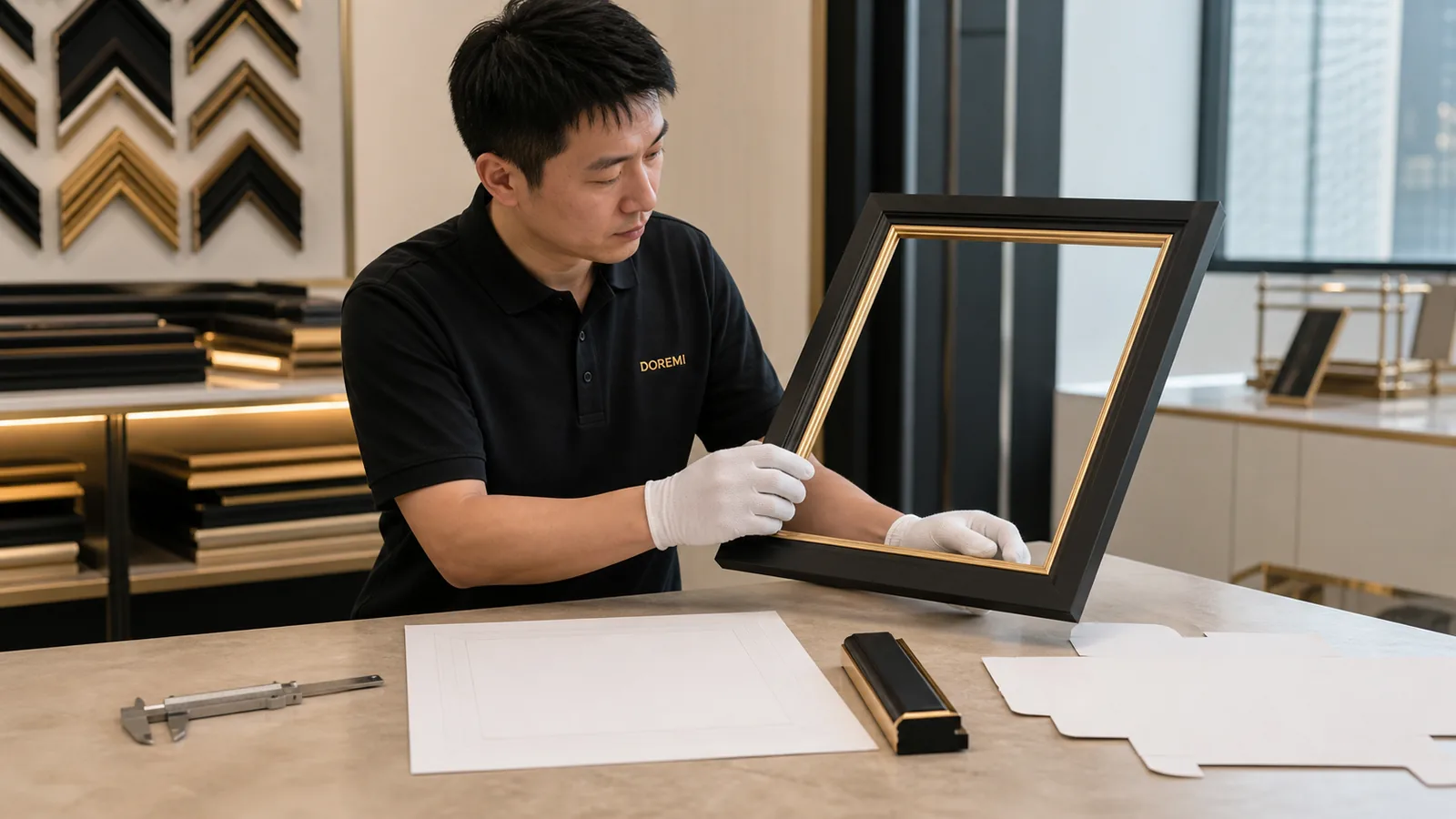
Clarify whether the supplier may retain one reference sample and whether it may be shown privately, publicly or not at all. A natural DOREMI mark on a uniform is different from publishing a customer's licensed artwork. The factory should obtain permission before using customer products in a portfolio, exhibition or social post.
Secure copies of the deliverables needed for continuity
WIPO recommends asking for physical or digital copies of what is created. Define the deliverable package: editable artwork, outlined print file, CAD and neutral export, profile drawing, bill of materials, colour references, approved sample photographs, packaging dieline, inspection method, tool register and supplier-specific process notes that the buyer is entitled to receive.
Do not discover at supplier exit that the buyer owns a design but lacks usable files. Name formats, software version, passwords, fonts, linked images and transfer date. Check that files open and correspond to the approved product. Rights to receive a file and practical ability to manufacture from it are separate acceptance points.
Plan termination before the relationship begins
The agreement should state what happens on expiry, breach, insolvency, failed delivery or supplier change. Address licence termination, work in progress, paid material, branded stock, tooling access, file return, data deletion, reference samples, outstanding improvements and cooperation with transfer. WIPO highlights termination and return of materials as core supplier-IP terms.
Set a closeout timetable and responsible contacts. Emergency access to tools or files may require advance escrow, duplicates or transfer rights rather than a promise made after a dispute. Counsel should balance continuity with the supplier's retained know-how and legitimate confidential information.
Use an approval and access matrix
- Asset or result name, owner and creator.
- Background or foreground IP category.
- Assignment, licence or permission basis.
- Product, quantity, territory, channel and term.
- Approved users, sites and subcontractors.
- Confidentiality level and transfer method.
- Artwork, brand, technical and legal approvers.
- File revision, physical sample and production lot.
- Tool owner, payer, custodian and permitted use.
- Copies and formats due to the buyer.
- Overrun, reject and reference-sample disposition.
- Expiry, return, destruction and closeout evidence.
Reconcile the file before production release
Compare the signed agreement, asset register, rights clearances, artwork proof, product specification, tooling record, sample approval, purchase order, subcontractor list and production quantity. Every asset used in the sample should have a permission path. Every promised deliverable should have a due date.
Stop release when a third-party image is unlicensed, ownership is disputed, a new factory is undeclared or the supplier cannot identify the final artwork. A missed launch is costly, but producing unauthorised branded goods can create larger legal and reputational risk.
Maintain the handover through reorders
At each reorder, confirm that licences, campaign rights, territory, product scope, supplier sites and brand guidelines remain valid. Check whether the buyer or supplier improved the design and whether that change needs a new ownership record. Replace obsolete recipient files and revoke access for departed team members.
Archive a dated decision log instead of relying on the memory of a buyer or factory merchandiser. The best long-term supplier relationship is not one with no paperwork; it is one where both parties know which assets they may use, how quality is approved and what happens when the project changes.
Experience scope and project limits
Editorial review: Jessica, Founder & Project Advisor at DOREMI Display. Updated 31 August 2026. Jessica's practical scope covers custom display-frame briefs, artwork and sample coordination, manufacturing communication, packaging handover and supplier records. She is not presented as an IP lawyer, trademark agent, copyright specialist, data-protection officer or court.
This guide cannot determine ownership, validity, registrability, infringement, licence scope, confidentiality enforceability, subcontractor liability or remedies. Buyers and suppliers should use qualified IP and commercial counsel in the relevant jurisdictions and clear every third-party asset for the intended product and market.