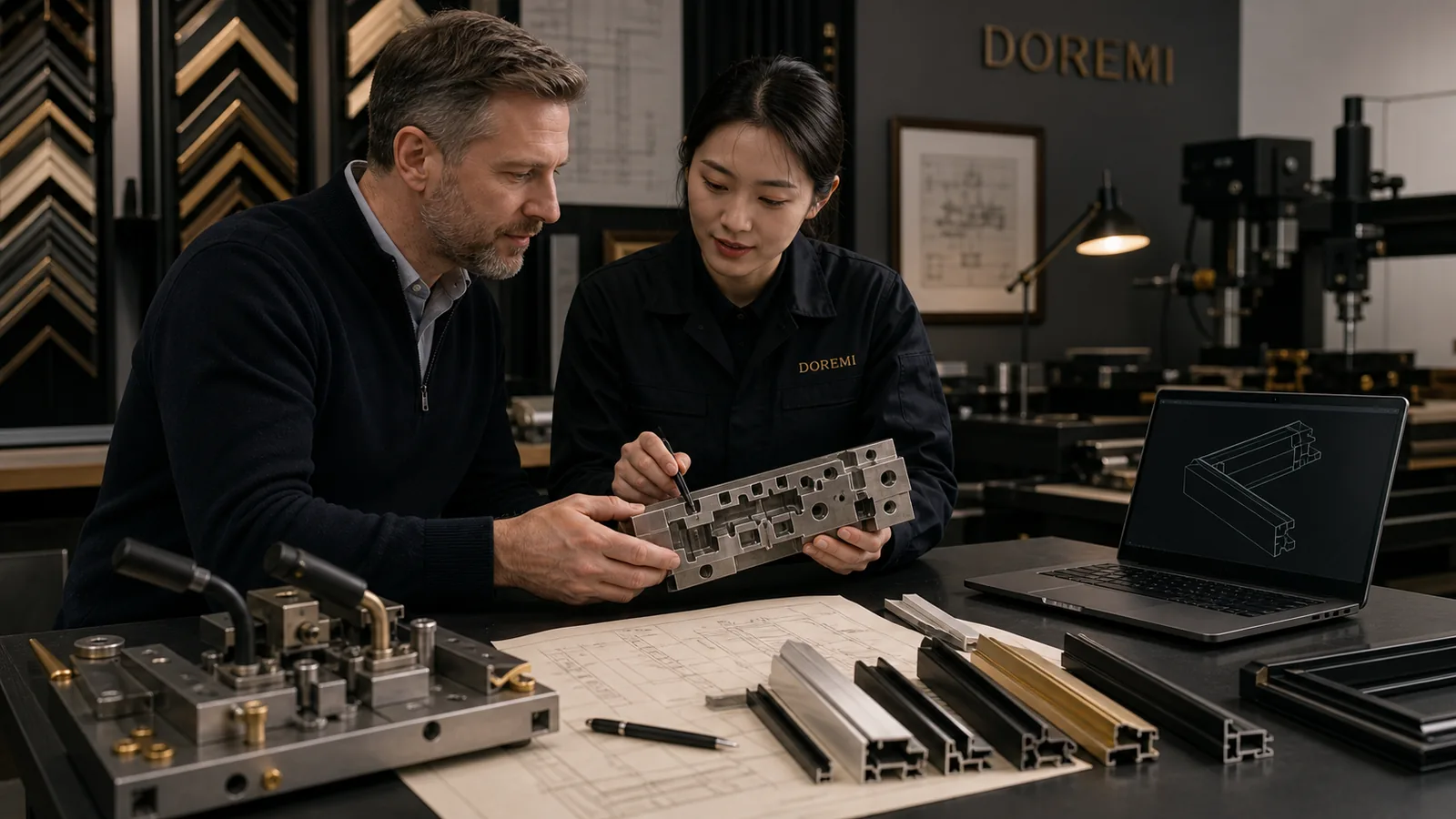
A custom display-frame unit price may exclude the cost of the extrusion die, corner jig, embossing plate, packaging tool or overseas design work that made the product possible. For U.S. imports, excluding a cost from the supplier’s piece-price invoice does not necessarily exclude it from customs value.
This guide is for U.S. importers, private-label brands, procurement, finance, product-development and logistics teams funding OEM display-frame tooling or design. It explains how to build a handover for the customs professional before entries are filed. It is educational, not a valuation decision, entry instruction, prior disclosure recommendation or substitute for a customs broker, trade counsel or CBP ruling.
Open the tooling conversation before the purchase order
Ask whether the project needs an extrusion die, injection mould, stamping die, drilling fixture, corner-joining jig, cutting template, print plate, embossing die, gauge, test fixture, special software, artwork or engineering. Record who designs it, who pays, who owns it, where it is located, which products use it and whether any cost is built into unit price.
This early register serves commercial and customs purposes. It prevents an importer from discovering after entry that a capital purchase sat in an engineering budget while the broker received only the finished-goods invoice. It also exposes ambiguous supplier phrases such as “free tooling after order” or “refundable mould fee” that need factual clarification.
Understand the transaction-value starting point
CBP describes transaction value as the price actually paid or payable for merchandise when sold for exportation to the United States, plus specified additions. One addition is the value, apportioned as appropriate, of any assist. The analysis begins with the actual sale and payments, not with the accounting label used by the buyer or supplier.
A tooling payment made to the seller may be part of the price actually paid or payable, while a tool or service supplied by the buyer free of charge or at reduced cost may meet the statutory assist definition. The customs professional needs contracts, invoices, payment flows and production facts to distinguish the routes.
Know the assist categories that can touch a frame project
CBP materials identify categories including materials or components incorporated in the imported merchandise; tools, dies, moulds and similar items used in production; merchandise consumed in production; and certain engineering, development, artwork, design work, plans and sketches undertaken outside the United States and necessary for production.
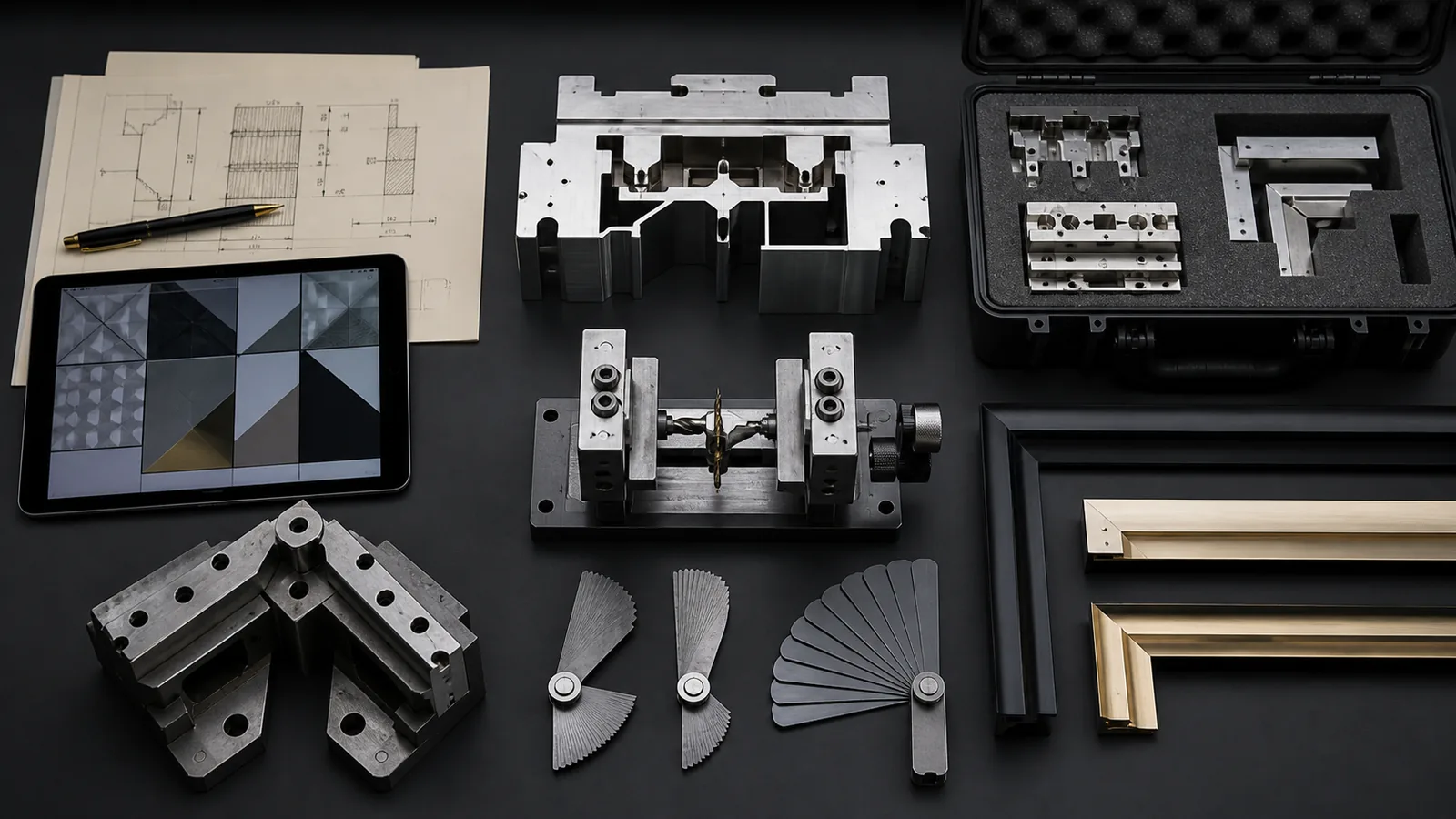
In a frame programme, potential facts can include buyer-provided metal profile, specialised corner mould, logo embossing die, alignment fixture, retail-package cutting die, foreign-developed CAD or artwork, or a master supplied at reduced cost. This is a question list, not a conclusion that every item is an assist.
Do not confuse ownership with customs treatment
A contract saying “the buyer owns the mould” is important for transfer, maintenance and intellectual-property rights, but ownership alone does not settle customs value. The reviewer asks who supplied the item, at what cost, to whom, for which production and how the related payment fits the imported merchandise.
Likewise, tooling stored at the overseas factory does not disappear from the analysis because it never crosses the U.S. border. It may be used in producing the imported frames. Preserve the commercial ownership agreement, but provide separate customs facts rather than asking the contract title to answer both questions.
Map every payment and benefit
Create a payment map showing purchase order, payee, amount, currency, date, refund or rebate conditions and connection to production. Include payments to the frame factory, a third-party toolmaker, a design studio, a buyer affiliate and suppliers of materials delivered to the factory. Identify credits applied to later orders.
A “deposit returned after 10,000 units” may function differently from a non-refundable tool purchase. A supplier-funded tool recovered through the piece price may already be reflected differently from a buyer-provided tool. Do not net values or choose a customs category without professional review of the complete arrangement.
Separate U.S. and foreign design work
The statutory definition treats certain engineering, development, artwork, design work, plans and sketches undertaken elsewhere than in the United States and necessary for production as potential assists. CBP rulings examine where work occurred and how it relates to the imported goods. Record the person, entity, work location, deliverable, cost and necessity for production.
If a U.S. team creates the concept and a foreign engineer completes production drawings, do not label the whole project “U.S. design” without support. Break the stages apart. If work spans countries, preserve time, invoices and statements of work so counsel can determine the appropriate value, if any, added outside the United States.
Build the initial value from reliable records
CBP regulations distinguish the value of an assist based on how it was acquired or produced and can include relevant transport to the place of production. For a purchased tool, acquisition records are central. For a buyer-produced item, production cost records may be needed. Used, repaired or modified tools introduce additional facts that counsel should review.
Do not substitute the supplier’s estimated replacement price for available purchase evidence or declare a nominal dollar because the tool is not sold separately. Capture currency and conversion date treatment with the customs team. The register should show source documents and any adjustments, not only a final number.
Include delivery and modification costs
If the buyer ships a die, fixture, material or master to the overseas production location, record freight, insurance, duties and other delivery costs. If the factory modifies or repairs a buyer-provided tool, keep invoices and explain whether the work extends life, adapts another SKU or restores ordinary condition. These facts may affect value.
For digital design, identify licences, third-party development, translation to production drawings and foreign engineering changes. The aim is not to capitalise every email. It is to give the customs reviewer a transparent record of paid or supplied value necessary to make the imported merchandise.
Choose apportionment with the customs professional
CBP regulations allow the value of assists to be apportioned in a reasonable manner appropriate to the circumstances and consistent with generally accepted accounting principles. Depending on the facts, methods can include charging the first shipment, production up to the first shipment or anticipated production. Other reasonable methods may be considered with documentation.
There is no universal instruction to divide tooling by the first purchase-order quantity. The accepted method depends on production plans, U.S. share, records and consistency. Obtain the method before entry and record who approved it. Procurement’s MOQ is not automatically the anticipated production quantity for customs purposes.
Document the anticipated production basis
Where the method uses anticipated production, save the dated forecast, approved business case, retailer commitments, tooling life assumptions, markets and product families included. CBP rulings have examined the parties’ intent and evidence around expected production. A round number chosen after goods arrive is less credible than a contemporaneous forecast.
Identify whether the same die produces several frame sizes or profiles, whether cavities or inserts are shared, and whether output goes to the United States and other countries. Explain the allocation unit—pieces, machine cycles, profile length or another supported base. Finance and customs should agree how actual activity will be tracked.
Handle U.S. and non-U.S. production explicitly
If an assist supports merchandise sold globally, the full value should not be assigned casually to U.S. imports or omitted entirely. CBP guidance states that where anticipated production is partly for the United States or the assist is used in several countries, the method depends on the importer’s documentation.
Create a market allocation with source data and a review date. If production shifts between regions, update the forecast and ask the customs professional whether entries or allocation should change. Preserve evidence for non-U.S. output rather than relying on a manager’s recollection.
Prevent duplicate additions
Before adding a tooling amount separately, confirm whether it is already included in the price actually paid or payable. The supplier may amortise a mould charge into unit price, invoice a separate fee, or use both a deposit and a per-unit recovery. A duplicate addition overstates value; an omitted external payment understates it.
Request a supplier statement that explains commercial treatment, but reconcile it to contracts, invoices and general-ledger records. Customs and finance should be able to trace the declared unit adjustment to the same costs procurement approved.
Keep commercial tooling amortisation separate
A commercial quotation may spread tooling across units to show break-even, set a refund threshold or negotiate price. That commercial model is not automatically the customs apportionment. Use separate fields for supplier price recovery, buyer accounting depreciation and customs value allocation, then reconcile them.
This separation prevents a later unit-price reduction from silently removing the customs adjustment while the assist still has unallocated value. It also lets procurement negotiate tooling ownership and maintenance without rewriting entry logic each time the supplier changes its commercial presentation.
Create stable tool and design identifiers
Assign each die, mould, fixture, plate, gauge and foreign-design package an identifier. Link it to the physical photograph, drawing revision, supplier, factory location, products, purchase records, useful production basis and customs status. Mark whether it is active, modified, transferred, scrapped or returned.
Place the identifier on change requests and supplier production records without exposing confidential commercial data on retail packaging. When an invoice references “tooling,” the importer should be able to identify which asset and which U.S.-bound SKUs are involved.
Connect the register to product revisions
A new corner construction, profile width, logo position or packaging format may require a new insert, die or fixture. Record whether the change creates a new assist, adds value to an existing tool or retires one. A golden sample captures appearance; it does not show the funding and allocation history of the equipment used to make it.
For repeat orders, include an assist-status field in the purchase-order review: unchanged and fully allocated, unchanged with remaining allocation, new or modified, or not applicable after review. Give the result to the broker before entry data is prepared.
Plan for under- and over-production
Actual volume may differ from the forecast. A product can be discontinued early, exceed plan or move to a second factory. CBP rulings address under-amortised tooling in fact-specific circumstances. The importer should set a periodic reconciliation and escalation route with counsel rather than allowing a spreadsheet to stop at the forecast quantity.
Record accumulated U.S. imports, value allocated, actual global output, remaining forecast and changes in intent. Ask the customs professional what adjustments, tenders, entry actions or prospective changes are appropriate. This guide does not prescribe a corrective filing.
Control transfers between factories
If a tool moves to another supplier or country, record the transfer date, transport, repair, ownership and new production products. Confirm whether the receiving factory pays, receives it free or shares its use. A commercial transfer certificate is useful, but customs review still needs value and allocation history.
Before moving a tool, verify physical compatibility, maintenance condition and access to drawings. Contract and intellectual-property protections are separate from customs valuation, yet both rely on the same accurate asset identity. Keep confidential files controlled while giving the broker the facts needed for entry.

Assign work across functions
Procurement identifies supplier payments and contract terms. Product development lists tools, materials and foreign design used. Finance provides acquisition or production cost records and accounting treatment. Logistics identifies U.S.-bound quantities and shipment timing. The customs broker or counsel determines entry treatment and documentation.
Name one importer-side owner who reconciles the register. Without ownership, each team may hold a correct fragment while the entry remains wrong. Add assist review to new-product approval, purchase-order release, first shipment and periodic compliance review.
A copy-ready assist handover
- Finished SKU, HTS review status, seller and production location.
- Tool, die, mould, fixture, material or design-package identifier and description.
- Who created, purchased, supplied, owns and physically holds it.
- Payment flow, acquisition or production cost, currency and supporting records.
- Delivery, repair, modification and foreign development costs.
- Products, markets and factories using the item.
- Dated anticipated production and proposed allocation basis.
- Amount already in unit price or separately invoiced.
- Prior U.S. imports and value already allocated.
- Changes, transfers, retirement and reconciliation owner.
Run a pre-entry reconciliation
Before the first shipment, compare supplier invoice, tool and design register, purchase orders, payments, product codes, forecast, proposed apportionment and broker instructions. Confirm there is no duplication between unit price and separate additions. Resolve unknown ownership, foreign design location and shared-market use.
For every later entry, verify that the supplier, product, tool status and allocation remain consistent. Keep the decision memo and records available for the importer’s retention obligations. When facts change, seek advice before silently continuing the old factor.
Keep valuation, ownership and confidentiality distinct
The tooling contract should address ownership, maintenance, storage, permitted use, confidentiality, access, transfer, end-of-life and dispute handling. Those protections matter even if customs counsel concludes that a particular payment is handled through price rather than as an assist. Do not weaken intellectual-property controls to simplify the customs file.
Conversely, an NDA does not justify withholding relevant facts from the importer’s authorised customs professional. Use controlled access, summaries and confidential supporting records so the valuation decision can be made without broadcasting proprietary drawings.
Experience scope and project limits
Editorial review: Jessica, Founder & Project Advisor at DOREMI Display. Updated 29 August 2026. Jessica’s practical scope covers custom frame briefs, profile and fixture discussion, sample approval, supplier handover and production records. She is not presented as a customs broker, trade lawyer, appraiser, accountant or CBP official.
This workflow cannot determine whether a payment is an assist or part of price actually paid or payable, establish the correct value, approve an apportionment method or prescribe a post-entry correction. Apply current law and product-specific facts with the importer of record, qualified customs counsel and broker, and seek a CBP ruling where appropriate.