
A connected digital photo frame is no longer only a screen, enclosure and power supply. It may also create status logs, storage records, usage events, device identifiers, network diagnostics and service data across firmware, an app and a cloud platform. Under the EU Data Act, a buyer needs to know which of those data are accessible, who controls them and how a user can request or share them.
This guide is for importers, private-label brands, retailers and institutional buyers planning Wi-Fi or app-connected photo-frame programmes for the EU. It converts the public Data Act text into an OEM handover. It does not decide the legal scope of a particular service, replace privacy or cybersecurity analysis, or treat customer photographs as ordinary product telemetry.
Start with the buyer question, not the regulation name
The useful commercial question is not simply “Does the Data Act apply?” A connected-product programme needs to ask what the device generates when it is used, what the related service generates, what the manufacturer or platform can retrieve, what the user can obtain directly and which party can answer a request. Those answers affect architecture, contract terms, support and retail information before a purchase order is released.
Map the actual model and service rather than a generic digital frame. A frame that only reads a local memory card creates a different data relationship from one that synchronises albums, reports hardware health and receives remote updates. A white-label app operated by a platform vendor creates a different responsibility chain from software owned by the brand.
Use the application dates as a model-control gate
The Data Act generally applies from 12 September 2025. Article 3(1), the design obligation for easy and secure access by default, applies to connected products and related services placed on the market after 12 September 2026. For a buyer working in October 2026, this is a current product-release question, not a distant roadmap item.
Record the first EU placing-on-the-market date for each model and service configuration. Do not assume that an old hardware model remains outside the design question when firmware, app ownership, branding or the commercial route changes. Ask qualified EU counsel to review the exact transition facts and keep the conclusion with the model file.
Confirm whether the frame is a connected product
The Regulation describes a connected product as an item that obtains, generates or collects data concerning its use or environment and can communicate product data through an electronic communications service, physical connection or on-device access, while its primary function is not data storage, processing or transmission on behalf of another party.
A Wi-Fi frame that creates retrievable device or usage data may fit that concept, but connectivity alone is not a complete legal conclusion. Document local functions, network functions, generated data and the service relationship. If the product is mainly a content-storage or cloud-processing endpoint, the exclusions and definitions need closer review.
Separate user content from product data
Photographs, videos and other content that a user uploads, transmits, displays or plays are not automatically the same as product data. The Regulation's recitals distinguish content, often protected by intellectual-property rights, from data generated by use of a connected product. This distinction is essential for photo frames because the most visible material on the screen may not be the data covered by the connected-product access rules.
Create separate rows for customer content, account data, product data, related-service data, diagnostics and inferred analytics. Then assign the privacy, security, rights and retention review appropriate to each row. Do not promise that a user-data export covers every photograph merely because a telemetry export exists.

Build one data inventory across device, app and cloud
Ask the OEM, firmware developer, app provider and cloud operator to identify data generated by the use of the product or related service. Practical rows may include device identifier, firmware version, temperature or power status where generated, storage availability, connection events, error codes, synchronisation status, update history and service interactions. The list must reflect the real build rather than a template.
For every field, record source, format, frequency, estimated volume, storage location, retention, access method, recipient, purpose and security sensitivity. Note whether the data are directly accessible on the device, available in the app or only retrievable by a data holder. A blank inventory is an engineering issue, not something the legal team can solve with wording.
Identify the user and the data holder
A user can be a person or organisation that owns the connected product, has temporary rights to use it, or receives a related service. In a hotel, university or corporate programme, the purchaser, administrator and everyday user may be different. The account model should anticipate who can make a valid request and how shared or reassigned devices are handled.
The data holder is the party entitled or obliged to use and make available certain data. It may be the brand, platform vendor or another service operator depending on the contracts and technical control. Put a named party and response owner beside each relevant dataset. “The factory” is not a sufficient role when several vendors provide the stack.
Prepare the pre-contract information
Before a contract for purchase, rent or lease is concluded, Article 3 calls for clear information including the type, format and estimated volume of product data; whether data are generated continuously and in real time; whether they are stored on-device or remotely and for how long; and how the user can access, retrieve or, where relevant, erase them. Related-service information has additional requirements.
Translate that obligation into a controlled content pack for the product page, quotation, terms and onboarding flow. Do not let marketing invent “real-time access” or “full data ownership.” The approved statements should come from the data inventory and explain material limits in language a buyer can understand before checkout or signature.
Design a simple access route
Where users cannot directly access the data from the product or service, the Data Act provides for access to readily available data on a simple electronic request, without undue delay, free of charge and in a comprehensive, structured, commonly used and machine-readable format. The same quality available to the data holder is the reference point, subject to the Regulation's conditions.
Define the request route, identity check, export format, response owner, delivery channel and status record. Test it with a real production account. A support mailbox that cannot identify the device, dataset or data holder is not an operational process. Keep the flow proportionate and avoid collecting unnecessary identity documents.
Plan third-party sharing without exposing the account
Users may request that accessible data be made available to a third party under the Regulation's framework. This is different from giving a repairer the customer's password or sending an unfiltered database. Specify how a user authorises the recipient, which fields are transferred, how the recipient is identified and how the transfer is logged.
Keep service credentials, photographs, contact data and trade-secret material out of the transfer unless another lawful basis and instruction covers them. Ask the platform provider whether an API, download or secure file exchange is available and which rate or security controls apply. The manufacturer should not improvise a transfer from a production database.
Treat trade secrets as a controlled exception
The Data Act contains safeguards for trade secrets, including possible technical and organisational measures. It does not support labelling every dataset confidential and refusing all access. Where disclosure could create serious economic damage, the data holder needs the evidence, process and notification required by the Regulation.
During development, identify genuinely sensitive fields such as diagnostic logic, security material or manufacturing parameters. Separate them from ordinary status data. Record proposed controls, responsible decision-maker and escalation route. Legal and security specialists should approve any restriction; a customer-service agent should not make that judgment during a ticket.
Align privacy and security reviews
The Data Act does not displace the GDPR or other privacy law. A dataset can be accessible under the Data Act and still contain personal data that requires identity, purpose and security controls. A connected frame may reveal household routines, account relationships, network information or the presence of uploaded media even when the export excludes the media itself.
Run the data inventory through privacy and security owners. Minimise fields, restrict access, set retention, protect exports and plan device reassignment. If the brand cannot explain why a field is collected or who needs it, challenge the requirement before mass production.
Write the supplier responsibilities into the contract
The product contract should identify who maintains the inventory, preserves access capability, answers requests, supports third-party transfers, protects trade secrets, fixes export defects and gives notice before data fields or service ownership change. App and cloud vendors need to be included; a hardware-only purchase order cannot control the full user experience.
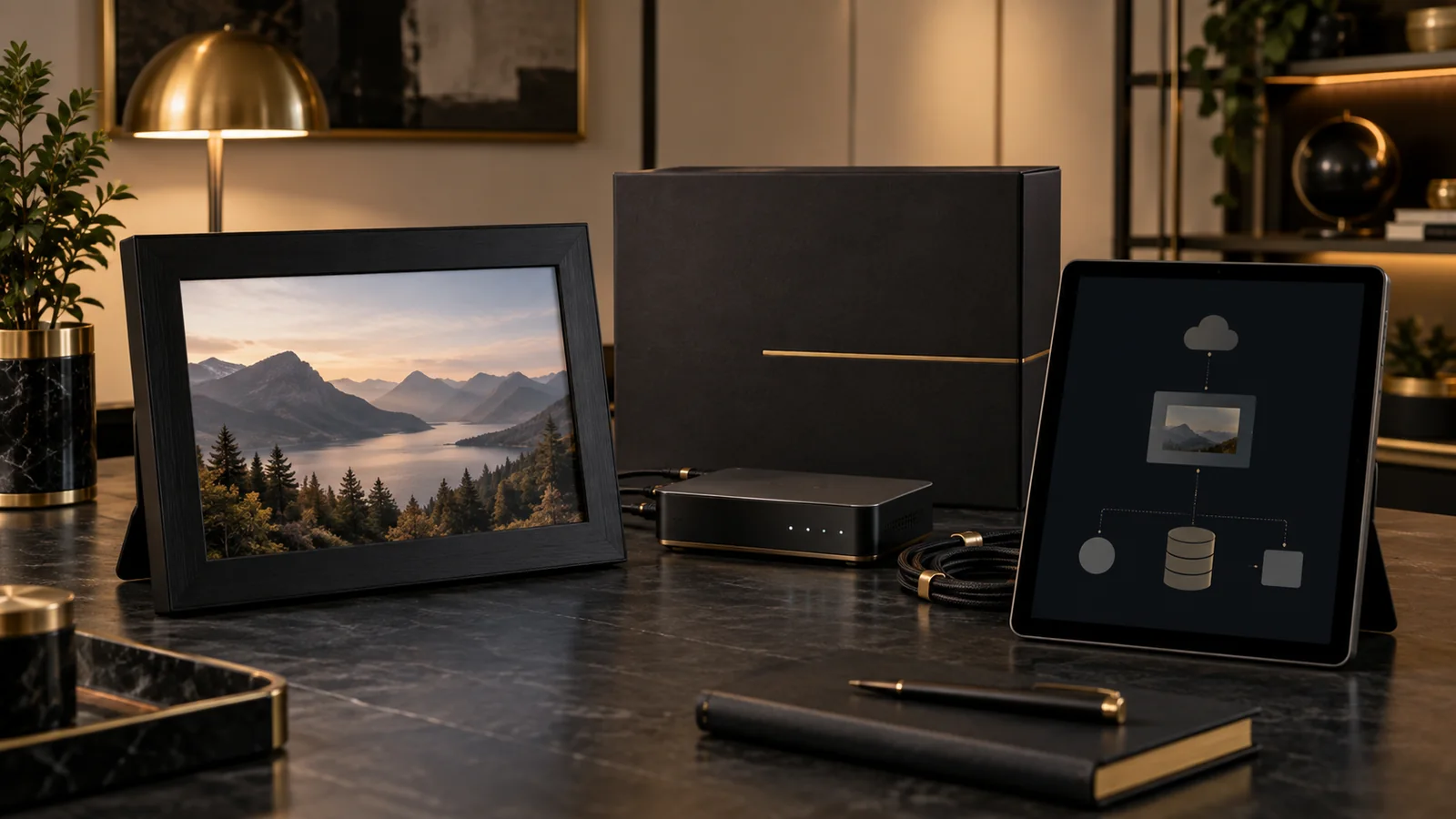
State which documentation is delivered at sample approval and shipment. Useful items include data dictionary, architecture diagram, retention table, user-access instructions, support matrix, subprocessor or service-provider map where appropriate, firmware/app versions and change log. Legal drafting belongs to qualified counsel, but the operational facts must come from the project team.
Control firmware, app and platform changes
A new analytics SDK, storage region, sensor use, export endpoint or account model can change the inventory and customer information without changing the frame enclosure. Require a change notice for data-generation, access, retention, recipient and security changes. Link the approved version to the production lot and the published terms.
For reorders, ask the supplier to declare whether firmware, wireless module, app provider, cloud provider, data fields or service terms changed. Do not accept “same model” as evidence. A visual golden sample cannot prove the connected-product behaviour.
Make the sample prove the user journey
Test account creation, device pairing, ordinary use, data export, deletion where offered, account transfer, factory reset, offline behaviour and error handling on the production-intent sample. Confirm that help content matches the real interface. Capture screen records and version identifiers without retaining a tester's personal photographs.
Include a failure test: expired link, offline frame, changed email or unavailable service. The objective is not to certify legal compliance in a factory review. It is to prove that the promised route exists and to give the responsible EU team evidence for its assessment.
Create a buyer approval checklist
- Exact hardware, firmware, app and cloud configuration named
- EU placing-on-the-market timing reviewed
- Connected-product and related-service scope assessed
- User content separated from product and service data
- Data inventory includes format, frequency, volume and retention
- User and data-holder roles assigned
- Pre-contract information approved
- Direct access or request route tested
- Third-party transfer process defined
- Trade-secret and security controls reviewed
- Privacy review completed by the responsible owner
- Supplier contract covers ongoing access and change notices
- Production-intent sample and support flow tested
Questions to send the OEM and platform provider
Ask: What data does this exact model generate during use and standby? Which fields can each party retrieve? Where are they stored and for how long? Which data are directly accessible to the user? What export format and request route are supported? Who is the data holder for each field? Can a user authorise a third-party transfer? What changes require notice?
Then ask the EU legal, privacy and security owners: Is the product and service within scope? Which application date and contract route apply? Does the pre-contract copy accurately describe the build? Which personal-data and trade-secret controls are required? Who owns customer requests after launch?
Experience scope and project limits
Editorial review: Jessica, Founder & Project Advisor at DOREMI Display. Updated 2 October 2026. Jessica's practical scope is B2B digital-frame briefing, hardware and packaging coordination, sample review, supplier handover and production change control. This article does not present her or DOREMI as an EU authority, lawyer, privacy adviser, cybersecurity laboratory, data holder or cloud-service auditor.
Use this workflow to make the product and service facts reviewable. The current Regulation, contracts, technical architecture, actual data flows and advice from responsible EU specialists control the final decision.