An EU buyer can hear that digital photo frames are excluded from the electronic-display energy label and conclude that the entire electronic-display ecodesign regime is irrelevant. That shortcut is unsafe. Delegated Regulation (EU) 2019/2013 excludes digital photo frames from its energy-labelling scope, while Regulation (EU) 2019/2021 defines them and disapplies only specified groups of ecodesign requirements. The European Commission explains that some requirements, including material-efficiency measures, still apply.
This guide is for EU importers, private-label digital-frame brands, product managers, repair and spare-parts teams and overseas OEM factories. It translates the current official scope into a model, disassembly and information handover. It does not classify a particular product, test energy use, create an energy label, complete EPREL registration or replace a market-surveillance authority, laboratory or qualified EU ecodesign adviser.
What are digital-frame buyers asking?
High-intent questions include: “Does our still-image frame need an A–G label?”, “Is a digital photo frame completely exempt from ecodesign?”, “What if it also plays video?”, “Do we register it in EPREL?”, “Which spare parts and repair information must the OEM prepare?”, “Does a wooden decorative surround change the product?” and “What should we do while the electronic-display rules are under review?”
Google Search Central's current guidance says generative-search visibility still relies on ordinary SEO and valuable, original, expert-led content. This guide therefore connects the scope question to a practical supplier file. Search intent is an editorial inference from current Commission and EUR-Lex material and buyer–OEM handovers. DOREMI does not claim direct access to or measurement of Google AI Overview or AI Mode output.
Start with two different EU regulations
Commission Regulation (EU) 2019/2021 establishes ecodesign requirements for electronic displays. Commission Delegated Regulation (EU) 2019/2013 establishes energy-labelling and supplementary product-information requirements for electronic displays. The two acts interact, but their scope exclusions are not identical in effect.
Build two rows in the compliance matrix rather than a single “energy” checkbox. Record the legal act, product definition, applicable or excluded provisions, evidence owner and current consolidated version. Do not use an energy-label conclusion to close the ecodesign workstream.
Confirm that the product is a digital photo frame
Both regulations define a digital photo frame as an electronic display that displays exclusively still visual information. The word “exclusively” matters. A product marketed as a photo frame but capable of video playback, live feeds, signage, conferencing, monitoring or another dynamic display function may require a different analysis.
Document actual functions, not only the retail name. Record file formats, apps, cloud services, ports, firmware features, default modes and functions that can be enabled after sale. Ask the OEM to demonstrate the released software rather than answering “photo only” from a sales sheet.
Measure screen area and review other exclusions
Regulation 2019/2021 also contains exclusions for specified categories, including displays with a screen area at or below 100 square centimetres and certain integrated or component displays. The energy-labelling regulation has its own complete exclusion list. A model should be screened against the exact current text, not only the digital-photo-frame label.
Retain the viewable dimensions and calculation method with product drawings. Do not confuse outside frame dimensions with screen area. If decorative matting masks part of the panel, ask the qualified reviewer which viewable area and configuration control the analysis.
Understand the energy-label exclusion
Article 1 of Delegated Regulation 2019/2013 excludes digital photo frames from the electronic-display energy-labelling regulation. For a product that truly meets the definition, this means the television/monitor-style A–G electronic-display label route under that act does not apply simply because the product has a screen.
Do not create a look-alike label, QR code or efficiency class for marketing. An unsupported label can confuse dealers and consumers. Record the exclusion decision with the model facts and legal version so a retailer can understand why the product file does not contain that label.
Do not turn the exclusion into an EPREL claim
EPREL supports products covered by EU energy-labelling requirements. If the exact digital photo frame is excluded from Regulation 2019/2013, the buyer should not assume it must be registered as a labelled electronic display. At the same time, do not generalise the conclusion to a video-capable display or another product category.
Have the EU responsible business confirm the database route for the actual model. Keep retailer onboarding forms aligned. If a marketplace requests an energy label by default, provide a reviewed scope explanation rather than inventing a registration or uploading a television label.
Read the ecodesign scope separately
Regulation 2019/2021 includes digital photo frames within its electronic-display framework but states that specified Annex II requirement groups do not apply to them. The Commission's product page summarises the result: digital photo frames need only meet some requirements, such as those relating to material efficiency, including ease of repair and recycling.
The exact applicable points and dates belong in a current legal review. Use the Commission summary as orientation and the consolidated regulation as the controlling source. Do not rely on a supplier's one-line “exempt” declaration.
Map applicable Annex II requirements point by point
Create a requirements table using the current Annex II headings and the product's classification. Mark each point as applicable, not applicable, conditional or awaiting advice, with a citation and evidence file. This avoids two opposite errors: applying a television energy label to an excluded frame or ignoring material-efficiency and information duties that remain relevant.
Assign an owner for design evidence, service information, spare parts, software, recycling data and importer records. A legal scope note without an operational owner will not survive product launch or after-sales support.
Design for non-destructive access where required
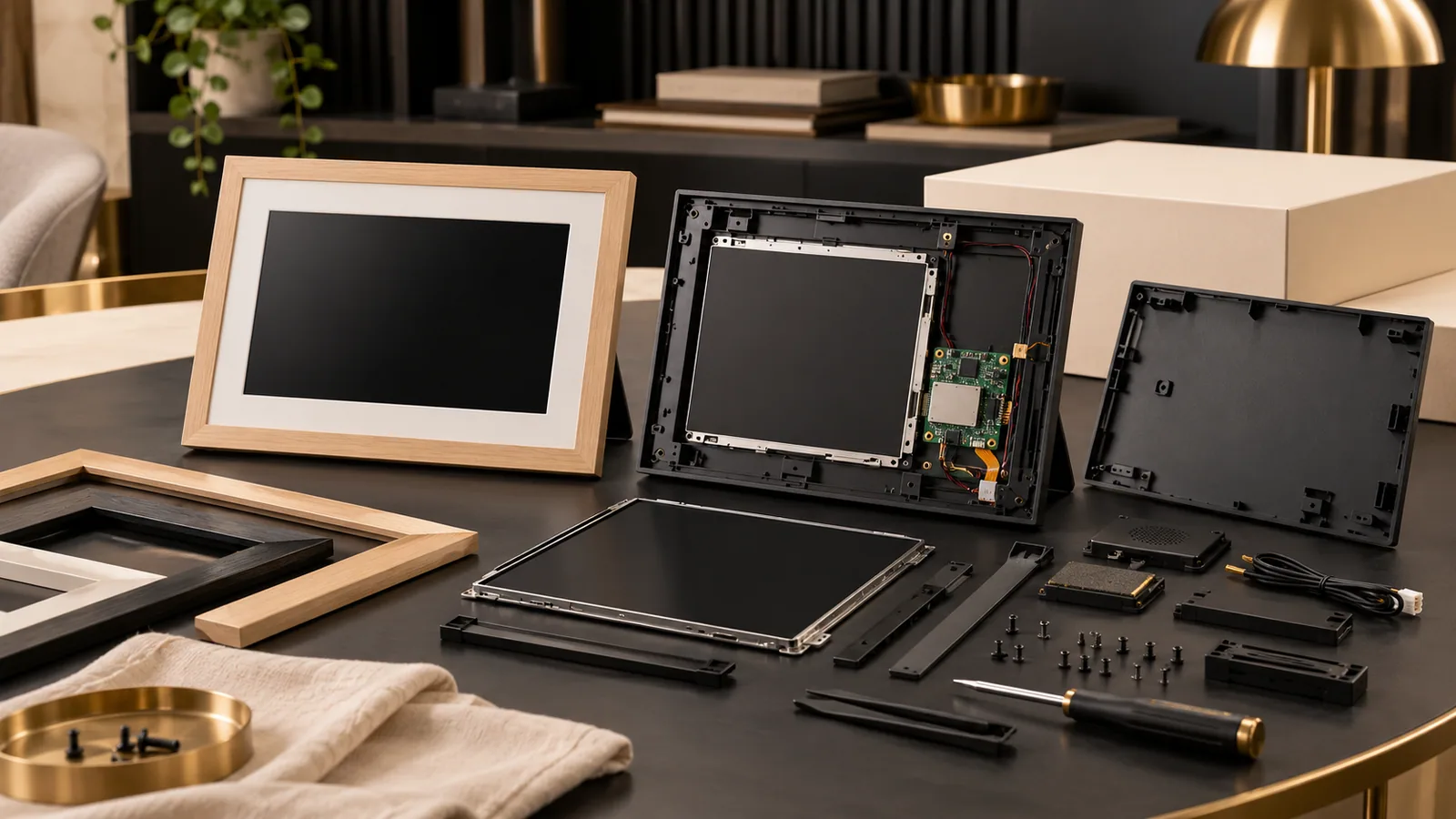
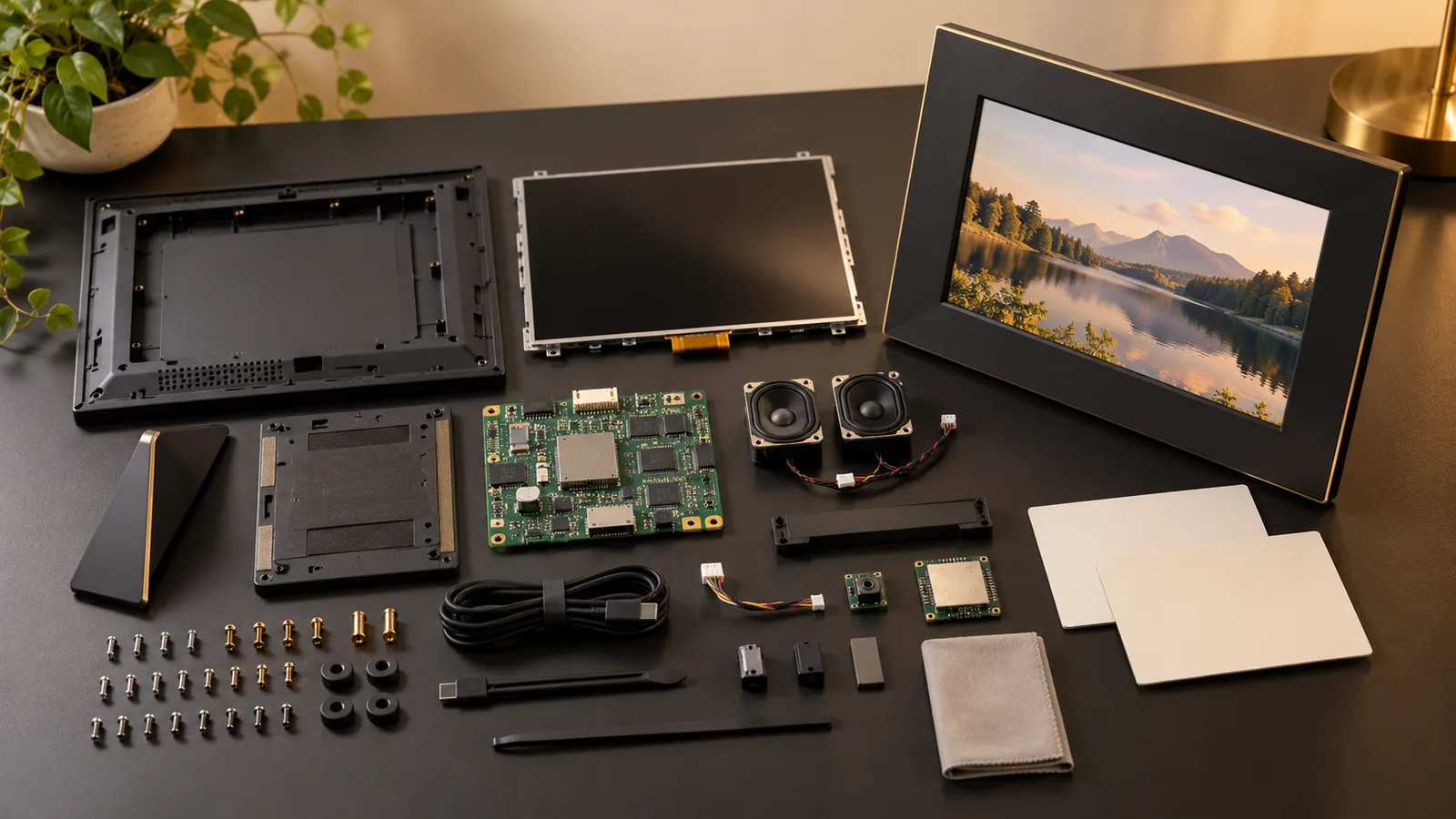
Material-efficiency rules for electronic displays address access to components and the ability to disassemble with appropriate tools. For a digital frame, likely practical records include rear-cover fasteners, stand attachment, screen module, boards, speakers, cables, power components and any battery. The applicable legal list and access conditions must be checked for the model.
Ask the OEM for a disassembly sequence and photographs from a production-equivalent unit. Avoid glue, hidden clips or decorative trims that make required access impossible unless the reviewed design and rules support them. A premium appearance can coexist with a controlled service path.
Control fasteners and tools
A repair or recycling instruction should name the fastener types and tools needed without forcing destructive improvisation. Standardise screws where practical and show their locations. If adhesive, welds or snap features are used, document how the relevant component is accessed and what damage occurs.
Do not publish unsafe service steps to consumers when the law or product design limits access to professional repairers. Separate professional information from user instructions, and include electrical, battery and glass-handling warnings reviewed for the actual product.
Build a spare-parts decision file
Where applicable requirements establish spare-part availability, delivery and access conditions, the brand needs more than an OEM promise. Create a parts list with component name, supplier code, compatible models, availability period, ordering owner, lead time and replacement instruction. Include boards, power assemblies, stands or other listed parts as the actual rules require.
Do not promise a fixed availability period in marketing until the responsible EU business has confirmed the legal requirement and secured the supply arrangement. If a part changes, maintain backward compatibility or document the model split.
Prepare repair and maintenance information
Service information can include diagnosis, disassembly, component replacement, software or firmware access, safety precautions and reassembly checks. The regulation controls which information is required, for whom and under what access conditions. The OEM should provide source material early enough for the brand to review and maintain it.
Keep diagrams and model references accurate. A generic manual that covers six platforms but does not identify connector or fastener differences can create unsafe repairs and weak compliance evidence. Version the service file with the host hardware and firmware.
Separate the digital frame from its external power supply
An external adapter can have its own ecodesign obligations under a separate EU measure. The digital-photo-frame energy-label exclusion does not automatically exclude the adapter, and adapter compliance does not complete the frame's electronic-display obligations. Treat the adapter as a named critical component in a separate evidence lane.
Link adapter brand, model, electrical ratings and reports to each frame SKU. Block substitutions until both electrical and ecodesign implications are reviewed. The existing DOREMI guide on EU external power supplies covers that separate handover in more detail.
Keep standby and networked functions in a separate workstream
A Wi-Fi frame can remain connected after the display is dark, receive content, synchronize cloud services or wait for remote activation. Energy-label exclusion is not permission to ignore applicable off-mode, standby or networked-standby requirements under the relevant measures. The exact route depends on product functions and current law.
Record power states, wake triggers, network availability, default settings and user controls. Give laboratories production firmware and the intended adapter. Do not use a still-image content test to hide background network activity.
Control model identity across legal and commercial files
The same saleable unit should have one model identity across technical documentation, BOM, software, packaging, dealer data and service information. Decorative frame colours can create retail variants while sharing an electronic platform; screen, board, adapter or feature changes can create a different technical model.
Build a family matrix with all differences and a qualified conclusion about shared evidence. Do not let a retailer shorten the model name in a way that prevents matching the product to the technical file.
Prepare packaging and dealer information carefully
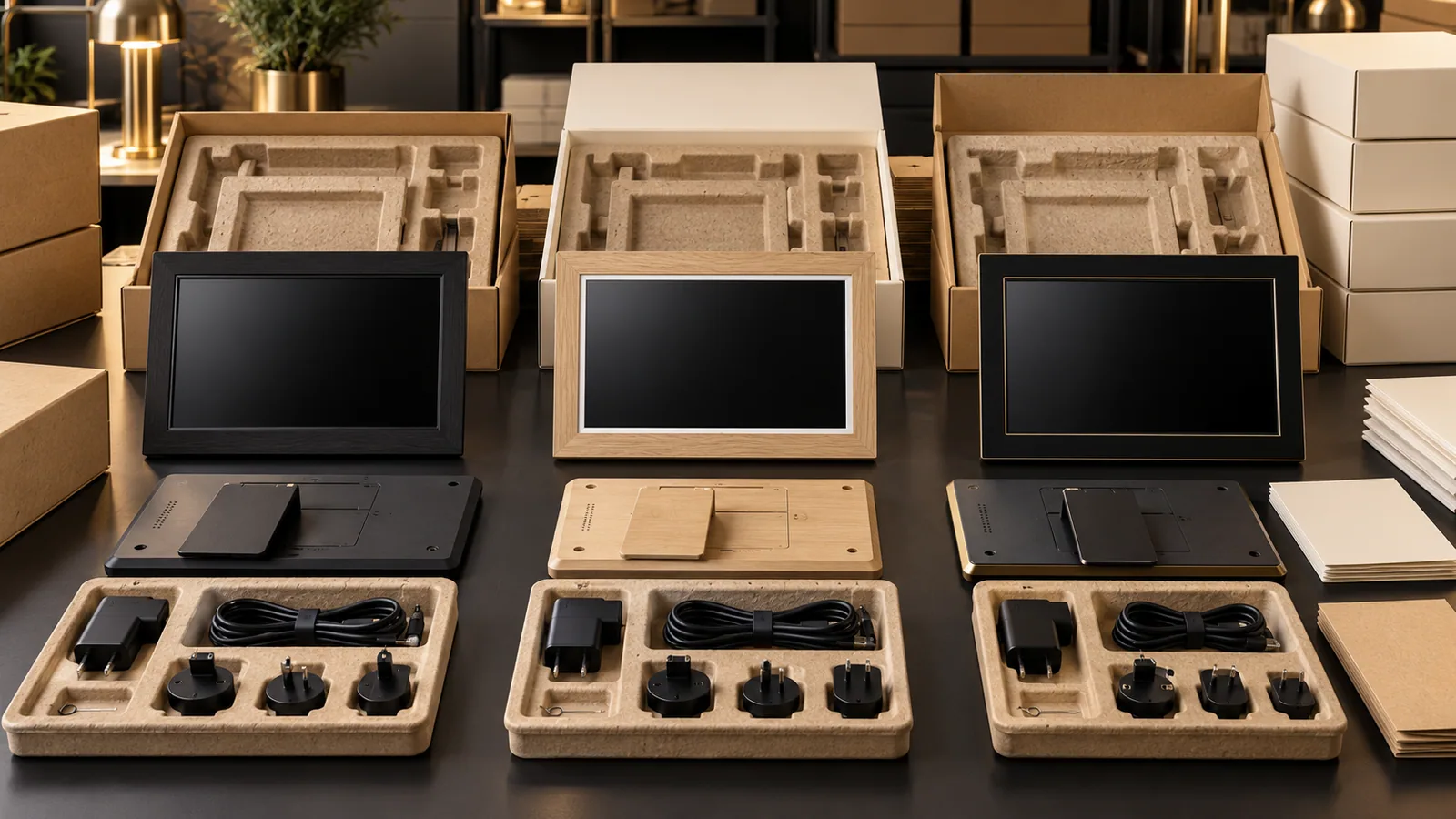
For an excluded digital photo frame, the package should not imitate the electronic-display A–G label. It can still carry accurate product, electrical, safety, recycling and commercial information required by other laws. Keep legal artwork layers separate so a country-specific mark is not copied into every market pack.
Give dealers a concise scope note, model facts and the information they actually need. Train marketplace teams not to substitute a generic television energy-label image when an upload field appears mandatory.
Coordinate ecodesign with WEEE, RoHS, GPSR and radio files
Material efficiency is only one workstream. A connected digital frame can also require WEEE producer registration, RoHS substance evidence, product-safety and traceability records, radio conformity, cybersecurity, battery review, packaging responsibility and consumer-information controls. Keep each conclusion and owner distinct.
Reuse the model master, BOM and change log across workstreams, but do not treat one declaration or registration number as universal compliance. A complete handover shows which evidence supports which legal obligation.
Track the ongoing electronic-display review accurately
The European Commission is reviewing the electronic-display ecodesign and energy-labelling measures. A study, consultation or draft is not adopted law. Record the current in-force requirements separately from possible future changes, and give one person responsibility for checking the Official Journal and Commission updates.
Do not market a product as “future compliant” based on consultation material. Instead, design for change: maintain modular records, repair access, software control and supplier notice so the programme can respond if scope or requirements change.
Run a design-change assessment
Trigger review when the product adds video, streaming, signage, touch control, monitoring, conferencing or another function that may affect its definition. Also review screen area, enclosure, display panel, board, software, adapter, battery, fasteners, service access and spare-part strategy.
Use a before-and-after table and identify affected legal files. Hold launch and artwork updates until the responsible EU entity confirms the revised scope. A firmware update can change the product's practical function even when the hardware looks identical.
Buyer–OEM checklist
- The released model's functions are documented, including hidden or updateable features
- The screen area and other scope facts are recorded
- Regulations 2019/2021 and 2019/2013 are assessed separately
- The energy-label exclusion is supported for the actual model
- No unsupported A–G label or EPREL claim is used
- Applicable Annex II ecodesign points are mapped individually
- Disassembly, fasteners and service access are documented
- Applicable spare parts and information routes have owners
- The external power supply is handled in its own evidence lane
- Standby and networked functions are separately reviewed
- Packaging, dealer data and model identity reconcile
- Future rule reviews and product changes have a monitoring gate
Experience scope and project limits
Editorial review: Jessica, Founder & Project Advisor at DOREMI Display. Updated 29 October 2026. Jessica's experience scope covers private-label digital-frame specifications, product and packaging records, samples, supplier handovers, artwork coordination and production change management. She is not presented as the European Commission, a market-surveillance authority, laboratory, repair-law specialist or EU legal adviser.
The product definition, exclusions, applicable ecodesign provisions, energy-label and EPREL route, testing, spare-parts duties, information access and market obligations must be confirmed for the actual model under current consolidated law. This guide is a project-preparation framework. It does not declare a model exempt or compliant.