
A digital display frame can look unchanged while its power system changes completely. One order ships with a fixed-voltage barrel adapter; another uses USB-C; a private-label version adds a longer cable; a supplier substitutes a higher-output power unit. Under the EU's new external-power-supply regulation, those choices affect more than the accessory list. They shape scope, efficiency, interoperability, surge and information evidence that buyers need to control before 14 December 2028.
This guide is for EU importers, private-label brands, digital-signage buyers and OEM/ODM teams preparing products powered by an external adapter. It converts Regulation (EU) 2025/2052 into a supplier handover workflow. It does not determine whether a specific unit is in scope, certify conformity, select a test method or replace a notified laboratory, market-surveillance authority, engineer or EU legal adviser.
Put the correct date on the launch plan
Commission Regulation (EU) 2025/2052 applies from 14 December 2028. It replaces the current external-power-supply ecodesign regime and adds broader requirements across covered external power supplies, certain battery chargers, wireless chargers, wireless charging pads and USB Type-C cables. A project launching in 2027 may still need to plan for inventory sold after the application date.
Article 9(3) also creates an early-compliance bridge: an EPS placed on the market between 14 December 2025 and 14 December 2028 that meets the new regulation is considered compliant with Regulation (EU) 2019/1782. Record which route the responsible EU team intends to use. “Future rule” is not a sufficient design decision.
Separate the frame, adapter and cable as controlled products
The digital frame is the primary load; the external adapter converts mains power and supplies the frame; the cable or detachable lead connects them. Each has its own manufacturer, model, electrical rating, construction and evidence. A single retail SKU can therefore contain several controlled identities.
Build a power-system page in the product specification. Record the frame model and revision, input range, connector, load profile, peak demand, standby behaviour, supplied adapter, detachable cable and regional plug. Include photographs and label artwork. Do not describe the whole system only as “12 V EU plug.”
Screen whether the supplied unit is an EPS
The regulation defines an external power supply by technical criteria. Commercial words such as charger, wall plug, adapter or power brick are not decisive. Some products and power arrangements are excluded. An adapter bundled with a digital frame may appear likely to need review, but the responsible manufacturer and qualified specialist must apply the actual definitions to the actual unit.
Document where AC-to-DC conversion occurs, whether the enclosure is separate, how the output connects, what product it powers and whether it serves another primary function. If the frame uses a built-in power supply, a wireless pad or a battery charger, start a separate scope analysis rather than forcing it into the EPS template.
Freeze the intended power architecture before testing
A frame designed around a proprietary barrel connector creates a different interoperability path from one designed for USB Type-C. A USB-C label does not prove USB Power Delivery behaviour or correct cable capability. Define the architecture, voltage profiles, current, connector orientation, cable length and any negotiation protocol before the evidence plan is approved.
Ask engineering to identify the worst-case combination of frame load, display brightness, wireless activity, speaker output and peripheral use. A low-load marketing demo may not represent the electrical demand used to select or validate the adapter.
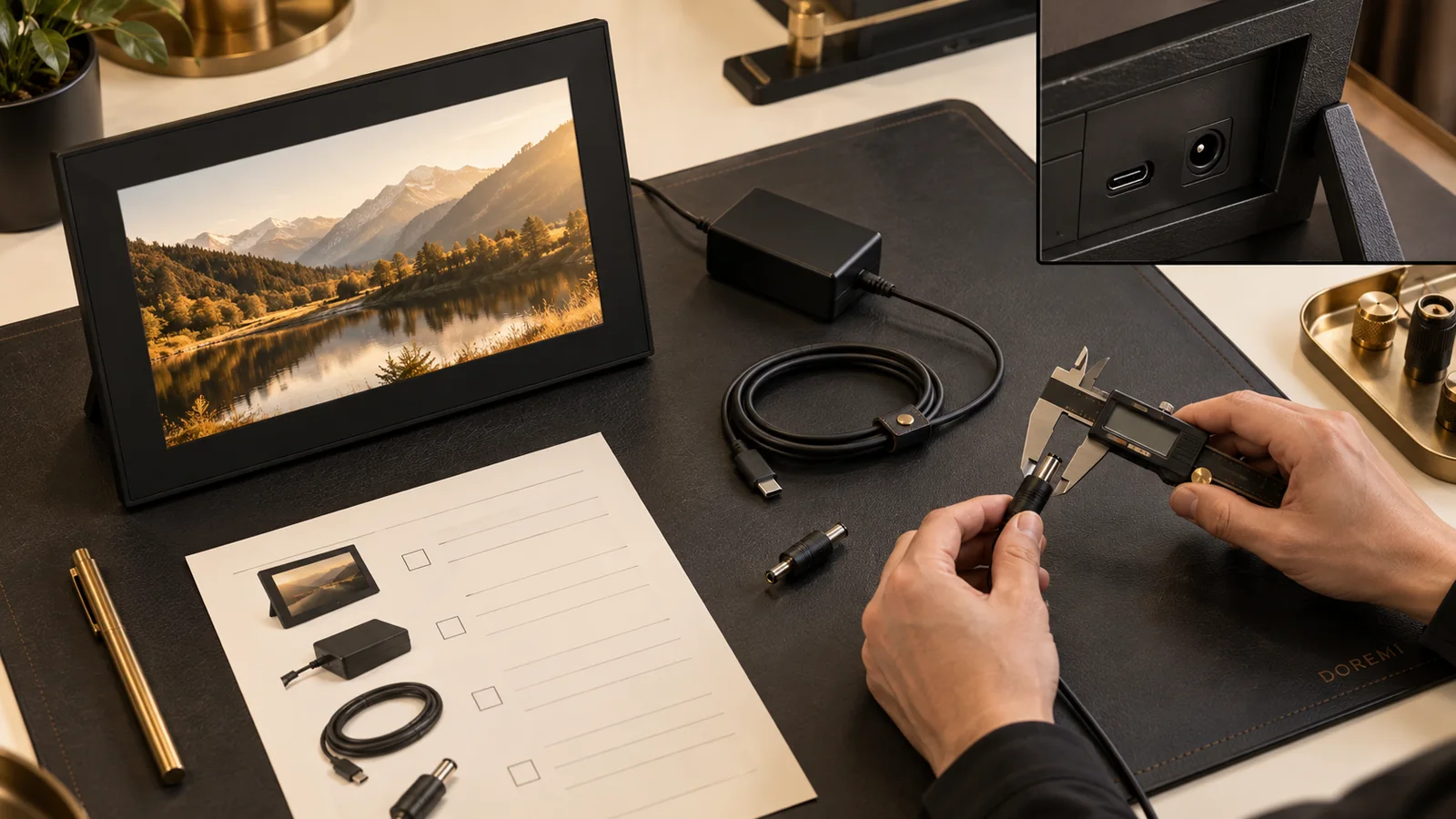
Translate requirements into an evidence matrix
The European Commission summarises the new areas as energy efficiency, power-output performance, interoperability, surge resistibility and information provision. Create one row per applicable requirement with the clause, product identity, test method, sample, report, responsible party, artwork output and change triggers.
Do not treat a general safety or EMC report as automatic evidence for ecodesign. It may support the product file, but the applicable metrics, conditions and reporting format need their own review. The importer should be able to see which requirement is covered and by which controlled document.
Verify efficiency and no-load performance
External adapters consume energy both while powering the frame and when connected without delivering useful output. The regulation sets performance requirements by EPS category and output conditions. Ask the laboratory or responsible engineer to identify the correct limits and test points for the final adapter.
Keep raw measurements, calculation sheets, equipment information, sample serial number and final report together. If the adapter firmware or control IC changes, do not assume the prior efficiency curve still represents production. Link component substitutions to a documented technical review.
Review output behaviour under real frame loads
Voltage stability matters when the frame changes brightness, starts Wi-Fi, decodes media or powers an attached device. The new regulation includes output-performance requirements. The frame engineering team should provide a representative load profile rather than asking the adapter supplier to test an abstract rating only.
Record start-up current, steady operation, low-power state and any peak conditions relevant to the design. This engineering work also supports product reliability, but regulatory conformity and product performance remain separate conclusions.
Handle interoperability as a system decision
The new regulation includes common-charger and USB Type-C provisions with defined scope and exemptions. A buyer should not print a common-charger logo because the frame happens to accept USB-C. Qualified specialists must confirm whether the adapter and powered product meet the relevant definitions and technical conditions.
If interoperability applies, freeze the port, cable, power profiles and communication behaviour. Test with production-representative hardware and firmware. Avoid a private-label variant that changes only the packaging claim while retaining an incompatible cable or disabled negotiation profile.
Plan surge resistibility for covered interoperable units
The Commission's overview identifies surge resistibility for interoperable EPS as a requirement area. This is not a reason to invent an IP rating or “lightning proof” claim. It is a defined technical assessment for applicable units, using the relevant method and production-representative construction.
Ask what protective components, clearances, PCB layout and enclosure are present in the tested sample. A cheaper substitute in a later order can change performance without changing the outside shape. Require change notice and qualified review before approving the batch.
Build the required information outputs early
The regulation contains nameplate, manufacturer website, common-charger logo, port-marking and USB-C cable information requirements where applicable. These outputs touch industrial design, label space, packaging and web operations. Leaving them until the final artwork week can force an unreviewed layout or a product delay.
Create an information schedule with exact approved symbols, values, locations, dimensions, contrast and linked web page. The legal owner should approve it against the final technical evidence. The factory should reproduce the controlled artwork, not decide which regulatory mark belongs on the product.
Keep online information aligned with the shipped model
A free-access manufacturer page is an operational asset, not a one-time PDF upload. It needs the correct product identity, output information and any applicable compatibility details. Assign an owner, publication date, retention period and change process.
Use stable URLs where possible and test them from EU markets. Archive each released version with the product technical file. A page that silently changes for a later adapter can make it difficult to reconstruct what information accompanied an earlier shipment.
Control adapter families conservatively
Several frame sizes may share one adapter, or one frame may use alternate approved suppliers. Build a family matrix showing input, outputs, topology, components, enclosure, cable, connector, firmware and production site. Ask the qualified test owner which differences are covered by the evidence.
Visual similarity is not a family rationale. A different factory, transformer, control IC, cable gauge or connector can affect performance. Approve alternatives before the purchase order rather than during a shipment shortage.
Connect the power file to broader EU obligations
The EPS regulation does not replace product safety, EMC, radio, RoHS, WEEE, battery, GPSR or cybersecurity work that may apply to the digital frame. Keep those workstreams linked through the same controlled model and revision, while preserving separate legal conclusions and evidence.
For example, a new adapter may affect safety and EMC review, while a firmware update may affect CRA or RED evidence without changing the adapter. A shared change-control board prevents each file from drifting to a different product identity.

Write the purchase order around the approved system
Name the adapter manufacturer, model, revision, factory, input and output ratings, connector, cable, plug, artwork version and applicable evidence pack. Prohibit substitution without written approval. Require production records and representative label photographs before shipment.
For multiple EU countries, confirm plug, instructions and language needs without assuming the same package serves every market. The power-system definition should survive a distributor or retailer rename.
Inspect what actually ships
Pre-shipment checks should compare the frame input, adapter model, electrical ratings, plug, cable, connector, port markings, package contents and instructions with the approved configuration. Photograph representative labels and packed sets. Quarantine unexplained substitutions.
Inspection is not laboratory testing and does not establish conformity, but it can prevent a valid report from being paired with a different production unit. Treat traceability as part of release, not paperwork completed after loading.
Plan spare and replacement adapters
After-sales units can be placed on the market separately and may have their own information and transition considerations. Decide whether replacements are identical approved models, a later compatible design or a service-only configuration. Keep the powered frame models and adapter compatibility list controlled.
Do not ship a generic adapter based only on connector fit. Voltage, current, polarity, protocol, cable and safety conditions must match the qualified system. Product support should know which revision was originally supplied.
Include replacement demand in the launch plan. Record how long the approved adapter will remain available, where its evidence is retained and how customer service verifies the frame revision before dispatch. A service substitute should pass the same controlled review as an original packed accessory.
Buyer handover checklist
- Application date and early-compliance route recorded
- Frame, EPS, cable, plug and connector have controlled identities
- Scope and exclusions reviewed for the actual power architecture
- Representative load profile supplied by frame engineering
- Efficiency and no-load evidence maps to the final adapter
- Output-performance requirements and test conditions documented
- Interoperability and USB-C applicability confirmed by a qualified owner
- Surge requirement, sample and evidence identified where applicable
- Nameplate, port, cable, packaging and website information approved
- Family coverage and alternate suppliers have a written rationale
- Safety, EMC, radio, RoHS, WEEE, battery and cybersecurity files remain linked
- Purchase order prohibits unapproved adapter or cable substitution
- Pre-shipment inspection reconciles the actual power set
- Replacement-adapter compatibility and records are controlled
Questions to send the supplier
Ask: Who manufactures the adapter and at which site? What exact model, topology, output profiles, connector, cable and plug are supplied? Which Regulation 2025/2052 requirements were assessed, against which sample and test method? Is early compliance claimed? Which markings and website information are required? What changes trigger reassessment?
Then ask the EU specialist: Is the unit an EPS under the regulation? Which clauses, limits, interoperability provisions and exemptions apply? Does the evidence cover every frame and adapter variant? Which economic operator owns the information and technical documentation? How should legacy, spare and replacement units be handled across the transition?
Experience scope and project limits
Editorial review: Jessica, Founder & Project Advisor at DOREMI Display. Updated 30 September 2026. Jessica's practical scope is B2B digital-frame briefing, component and adapter discussion, sample coordination, packaging/artwork handover and supplier change control. This article does not present her or DOREMI as an EU regulator, conformity-assessment body, accredited laboratory, electrical engineer or legal adviser.
Use the workflow to make the power system visible to qualified technical and compliance owners before tooling and orders are frozen. Verify the current official text and guidance for the exact product and placing-on-market date.