
A display frame arrives as one finished SKU, but its supply chain can include aluminium or timber profiles, backing board, textile mount, acrylic or glass, hardware, coatings, adhesives, paper protection and packaging. Regulation (EU) 2024/3015 prohibits products made with forced labour from being placed or made available on the EU market or exported from it. It applies from 14 December 2027 and reaches products made in whole or in part with forced labour at any stage of extraction, harvesting, production or manufacturing.
This guide is for brands, importers, distributors and institutional procurement teams building a product-level evidence file before application. It does not rate a country or supplier, determine that forced labour exists or certify that a frame is compliant. Authorities make enforcement decisions under the Regulation; buyers need current legal and human-rights expertise, meaningful due diligence and supplier facts that can be connected to the actual product.
Start with the product prohibition, not a certificate request
The Regulation is product-based and sector-neutral. It covers products of any origin, including imported goods, and can apply where only part of the product was made with forced labour. It also covers relevant online or distance-sale offers targeted at EU end users. A buyer therefore needs to understand the finished product and its upstream inputs rather than collect one generic factory statement.
Do not create a homemade “EU forced-labour compliant” badge. The Regulation does not turn a social audit into a product certification. Build a due-diligence system that identifies, prevents, mitigates, ends and where appropriate remediates risks, then preserve evidence of how it operates. Declarations can support a file, but their value depends on scope, knowledge, verification and whether they remain true for the lot supplied.
Use the 2027 date as a supply-chain preparation horizon
The rules apply from 14 December 2027, including to products made available from that date even when components were produced or goods imported earlier. That makes long-lived inventory and forward orders relevant. A 2026 or early-2027 production run could still be in an EU warehouse or online offer after application begins. Buyers should not wait until the first authority request to discover who made a backing board.
Build a dated plan for policy review, product mapping, supplier engagement, worker-information channels, contract updates, traceability trials and response simulation. Monitor Commission guidance, the forced-labour database and competent-authority arrangements. Record what is confirmed today and what remains under development. A preparation file should be updateable rather than built around one frozen interpretation.
Map the display frame beyond tier one
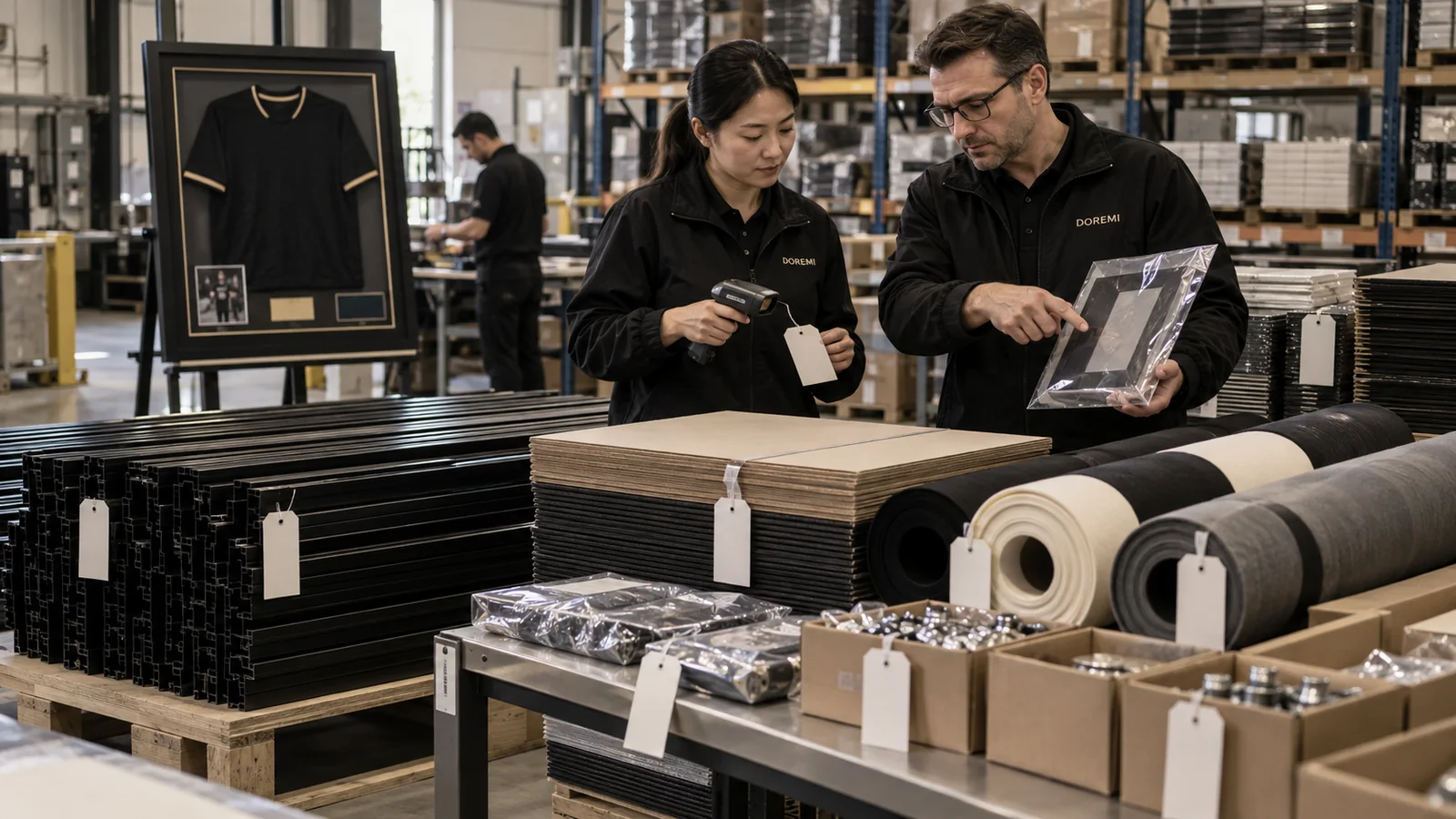
Begin with the finished-frame assembler, then map suppliers for frame profiles, backing, mount textiles, glazing, hardware, coatings, adhesives, paper products and packaging. Identify processing steps such as extrusion, anodising, powder coating, board production, fabric finishing, cutting, assembly and packing. The required depth should be risk-based; a list of company names with no component or process link is not enough.
Use stable supplier and facility identifiers, country and region, component code, process, approval status and effective dates. Distinguish a trader from the manufacturing facility. If the tier-one factory buys through an agent, retain both roles. Ask which inputs are made to specification and which are commodity purchases. The goal is to locate credible risk and leverage, not to demand an unrealistic map that encourages invented answers.
Prioritise risk without turning risk into guilt
The Regulation describes a risk-based approach and Commission guidance points to the scale and severity of suspected forced labour, quantity or volume, share of the product likely affected and proximity or leverage in the supply chain. Public risk information, sector patterns, recruitment models, geography and credible stakeholder reports can guide attention. They do not by themselves prove that a named product was made with forced labour.
Write a decision record for why one component, facility or recruitment channel receives deeper review. Keep the source, date, scope and limitations visible. Avoid scoring a supplier as “safe” forever after one audit. Risk can change with labour brokers, peak-season subcontracting, new facilities or material substitutions. Reassess when sourcing, ownership, workforce or production routes change.

Use forced-labour indicators as inquiry prompts
ILO indicators include abuse of vulnerability, deception, restriction of movement, isolation, violence, intimidation, retention of identity documents, withholding of wages, debt bondage, abusive working and living conditions and excessive overtime. No single checklist item should be applied mechanically. Context, worker experience, severity and combinations matter, and qualified human-rights practitioners should guide assessments.
For display-frame sourcing, ask how workers are recruited, whether fees or deposits are charged, who holds documents, how overtime is agreed and paid, how people can leave, how dormitories operate, and whether complaints can be raised without retaliation. Include temporary, migrant, dispatch, contract and subcontracted workers. Management documents alone may not reveal how the system works in practice.
Make worker information credible and safe
Worker perspectives can be essential, but careless interviewing can expose people to retaliation. Do not ask a factory supervisor to select workers and translate every answer. Use competent independent channels where risk and scale justify them, protect confidentiality and explain how information will be used. A brand hotline that workers cannot access, understand or trust should not be counted as effective evidence.
Record participation limits and conflicting signals honestly. A clean payroll sample does not cancel a credible allegation, and an anonymous allegation is not automatically a proven finding. Define who triages reports, protects affected people, commissions deeper assessment and decides remediation. Buyers should avoid publishing worker stories or photographs as marketing proof without informed consent and appropriate safeguards.
Trace recruitment and subcontracting routes
Labour brokers, temporary agencies, homeworking and unauthorised subcontracting can change the risk profile even when the approved factory remains the invoicing supplier. Map recruitment agencies, fee policies, contract language, wage-payment routes and where production actually occurs. Compare capacity, order volume and working hours for signs that hidden production may be used during peaks.
Put subcontracting approval and labour-provider disclosure into the purchase agreement, but support the rule with realistic lead times and forecasting. Buyers can create pressure through late changes, impossible prices or compressed deliveries. Purchasing practices do not excuse forced labour, yet responsible prevention requires examining how commercial decisions affect supplier behaviour. Escalate unexplained capacity gaps rather than accepting a paper promise.
Ask for evidence by process and period
A useful request specifies the facility, process, workforce and production period. Examples include recruitment contracts, fee-repayment policy, anonymised wage and hour evidence, agency lists, grievance operation, subcontractor approvals, worker-channel results and corrective-action follow-up. The buyer or specialist should decide what is necessary and lawful. Do not collect passports or unnecessary personal data into a general sourcing folder.
Label every document with source, date, facility, scope, language and reviewer. Note whether it is supplier-created, independently assessed, worker-provided or public information. Translation should preserve meaning. Evidence expires in practical value when management, labour agencies or production routes change, so assign review triggers instead of a decorative annual upload deadline.
Connect upstream evidence to product lots
Due diligence must reach the product actually sold. Link approved component suppliers and facilities to purchase orders, incoming lots, production orders and finished-frame batches. If black aluminium profiles from two extruders are mixed, the finished lot may inherit both evidence routes. If backing board changes mid-order, capture the transition instead of updating only the master BOM.
Keep physical labels neutral and operational; do not print human-rights claims on product packaging without substantiation and approval. The traceability system can use internal codes that map to restricted supplier details. Test whether the importer can take a finished carton code and retrieve the component and facility history within a reasonable response time.
Manage material substitutions as sourcing changes
A substitution can introduce a new upstream chain even when performance and colour match. Require prior notice for changes in profile source, board mill, textile producer, hardware facility, coating subcontractor and packaging converter where relevant. The change request should include reason, first lot, remaining old stock, new facility details and due-diligence review status.
Procurement, quality and responsible-sourcing teams should share a release gate. A material should not be approved solely because it passes dimensional inspection if required supply-chain review is unfinished. Equally, avoid forcing a factory to conceal emergency changes by giving no realistic approval route. Fast escalation with documented temporary controls is stronger than a contractual rule that operations routinely ignore.
Prepare an authority-response file before it is needed
Under the framework, the Commission or a lead national competent authority may assess substantiated concerns and request information about actions taken to identify, prevent, mitigate, end or remediate risks. A buyer should have a response owner, legal review route, translation capacity and document index. The exact scope and deadline depend on the case; do not send an uncontrolled data dump.
Organise the file around product, economic operators, supply chain, risk assessment, due diligence, findings, remediation, traceability and current stock. Preserve raw records separately from summaries. Mark uncertainty and gaps rather than filling them with assumptions. If an upstream supplier refuses information, record the request, leverage used, alternative evidence considered and decision taken.
Plan remediation around affected people
When serious concerns arise, the goal is not to make evidence disappear. Immediate termination can sometimes worsen harm by removing income or leverage without remedy. Qualified specialists should assess how to protect workers, stop coercive practices, repay recruitment fees or withheld wages where appropriate, restore documents and verify that corrective actions are effective.
Define escalation levels and decision rights before a crisis. Some circumstances may require suspension or disengagement; others may support time-bound remediation with independent verification. Document why the chosen approach addresses the harm and complies with law. A supplier's successful corrective action should not be turned into an invented public success story without consent and evidence.
Align contracts, purchasing and governance
Contracts can require truthful disclosure, approved facilities, no unauthorised subcontracting, responsible recruitment, record access, change notice, remediation cooperation and product traceability. Avoid clauses that merely shift all responsibility upstream. The EU economic operator still needs its own risk assessment, governance and response capacity. Contract leverage is useful only when buyers are willing and able to use it responsibly.
Assign executive oversight, day-to-day ownership and cross-functional roles across sourcing, legal, quality, logistics and sales. Include responsible-sourcing effects in supplier selection and change approval. Track meaningful indicators such as closed recruitment-fee issues, worker-channel access and lot coverage rather than just audit counts. Senior review should address unresolved severe risks, not only dashboard completion.
Buyer readiness checklist
- 2027 application date and inventory exposure are in the project calendar
- Finished products are mapped to components, processes and facilities
- Risk sources are dated, scoped and not treated as proof by themselves
- Recruitment, fees, documents, wages, movement and overtime are assessed
- Temporary, migrant, agency and subcontracted work is included
- Worker-information channels have confidentiality and anti-retaliation safeguards
- Evidence requests identify facility, period, source and reviewer
- Component suppliers connect to incoming and finished-product lots
- Material and facility changes trigger responsible-sourcing review
- Authority-response records are indexed and legally reviewed
- Remediation decisions focus on affected people
- Purchasing practices and governance support the policy
Experience scope and project limits
Editorial review: Jessica, Founder & Project Advisor at DOREMI Display. Updated 23 September 2026. Jessica's practical scope covers custom display-frame BOMs, supplier coordination, samples, production-lot records, change handovers, packaging and buyer project files. She is not presented as an EU authority, human-rights investigator, social auditor, worker representative or legal adviser.
This guide is educational procurement material, not legal advice, a forced-labour finding, country or supplier rating, audit protocol or compliance certificate. Economic operators should use current EU guidance, credible risk information, safe worker engagement and qualified legal and human-rights support. The absence of a known allegation is not proof of absence, and a declaration is not a guarantee.
Public sources used for this guide
- Google Search Central: optimizing for generative AI features
- Regulation (EU) 2024/3015 prohibiting products made with forced labour
- Commission guidelines on Regulation (EU) 2024/3015
- EUR-Lex summary: ban on forced-labour products
- ILO indicators of forced labour
- OECD Due Diligence Guidance for Responsible Business Conduct