
A custom display frame can bring together an aluminium or wooden profile from one country, acrylic glazing from another, a textile mount from a third and final cutting, joining, finishing and packing somewhere else. A supplier may confidently place one country on the invoice, yet the EU importer still needs to understand why that country is the non-preferential origin declared at import.
This guide is for EU importers, private-label brands, sourcing teams, customs brokers and OEM/ODM frame suppliers. It turns public European Commission origin material into a practical product and production handover. It does not determine the origin of a real frame, confirm a CN code, apply a list rule, assess anti-circumvention, issue a Binding Origin Information decision or replace advice from customs authorities and qualified specialists.
What are display-frame buyers asking about origin?
Commercial questions often sound simple: “Is origin where the moulding was made or where the frame was assembled?”, “Does cutting four imported profiles and joining the corners count?”, “What if the plaque and artwork are added later?”, “Does repacking change anything?”, “Can we use the factory's certificate?”, “Will the answer change if we switch from glass to acrylic?” and “Is preferential origin the same as the origin on the customs entry?”
These questions are editorial inferences from current EU customs guidance and recurring multi-country manufacturing handovers. Google Search Central says content for generative search should be original, useful, well structured and supported by relevant media. It does not provide a guaranteed feed of AI Overview questions, and DOREMI does not claim direct access to or measurement of AI Overview or AI Mode output.
Keep non-preferential and preferential origin separate
The European Commission describes non-preferential origin as the economic nationality used for matters such as the Common Customs Tariff, trade-policy measures, statistics, public tenders and origin marking. Preferential origin is a different system tied to a particular trade arrangement and may support reduced or zero duty only when its product-specific rule and proof requirements are met.
A frame can therefore have one non-preferential-origin analysis while a separate preferential claim requires another analysis. A generic supplier statement that the goods are “made in” a country does not automatically prove either one. Start the project file with a clear label: non-preferential origin for the EU import declaration, preferential origin under a named agreement, or a commercial marking question. Mixing the three creates instructions that no broker or supplier can safely follow.
Classify the finished frame before choosing the origin rule
The Commission identifies tariff classification as an essential input because the applicable legally binding or non-binding list rule follows the finished product's CN classification. A wooden picture frame, a metal shadow box, a frame sold with a jersey, a digital photo frame and a presentation set may not start from the same heading. Marketing language is not a classification method.
Give the classifier a complete product record: exterior and visible opening dimensions, profile material, glazing, backing, mount, object included, electronic functions, packaging and how the goods are presented at import. If classification is uncertain, resolve that question before building a confident origin conclusion. A Binding Tariff Information decision and a Binding Origin Information decision answer different questions; one does not substitute for the other.
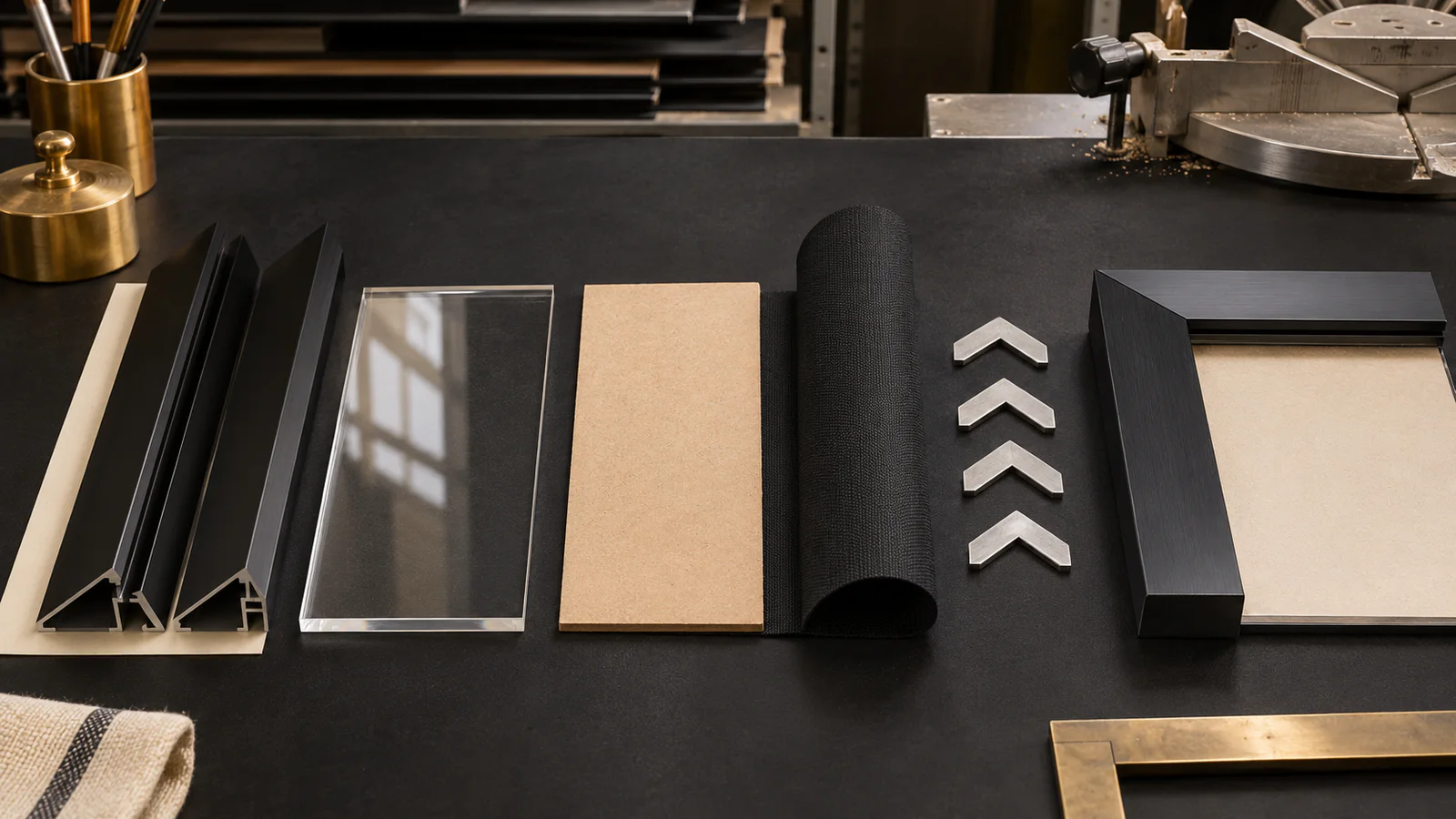
Map every country, component and manufacturing step
Create a component-and-process matrix for the imported SKU. Record each profile, glazing sheet, backing board, mount fabric, plaque, fastener, insert, electronic module and retail pack. For each line, show supplier, manufacturing country, material, value or weight basis where relevant, shipment route and the evidence supporting the fact. Do not assume the country of the immediate supplier is the country where its component was produced.
Then add the manufacturing sequence: extrusion or moulding, coating, cutting, mitre preparation, corner joining, glazing conversion, backing cutting, printing, mounting, electrical assembly, inspection and packing. Identify the plant, equipment, skill and output at each stage. The purpose is not to label one stage “substantial” in a spreadsheet. It is to give the responsible origin specialist the complete facts needed to apply the correct rule.
Test the last substantial transformation with the actual operation
Article 60 of the Union Customs Code states that goods produced in more than one country originate where they underwent their last substantial, economically justified processing or working, in an appropriately equipped undertaking, resulting in a new product or an important stage of manufacture. Those words are a legal test, not a checklist that a sourcing team can answer with one photograph.
Describe what physically and commercially changes at the last plant. Does it transform raw profile lengths into a dimensionally controlled frame body? Does it create the structural enclosure, finish visible surfaces and integrate the mount? Or does it only attach a label, insert a finished product into a box or perform simple assembly? Preserve routing sheets, work instructions, machine lists and production photographs so the conclusion rests on the real operation rather than a broad statement such as “assembled locally.”
Recognise operations that cannot confer origin on their own
EU Delegated Regulation Article 34 lists minimal operations that are not considered substantial processing for origin. These include simple packaging changes, putting up goods for sale, affixing labels, simple assembly and combinations of listed minimal operations. A frame programme that moves finished units only to add a branded sleeve, barcode sticker or promotional insert should not assume that the destination country becomes the origin.
“Simple” is a legal characterization that depends on the facts and applicable guidance; the buyer should not improvise it. Still, the rule is an operational warning. If the last-country story consists mainly of relabelling, repacking or combining completed items into a set, escalate the origin analysis before approving markings or customs data. Do not ask a supplier to perform cosmetic work solely to obtain a desired origin.
Document why the processing is economically justified
Delegated Regulation Article 33 addresses operations intended to avoid trade measures. The purchasing file should therefore show the commercial reason for the manufacturing arrangement: available plant capability, quality system, capacity, lead time, proximity to inputs, finish expertise, labour, logistics or an established supplier relationship. A real business rationale does not itself confer origin, but it helps explain why the production route exists.
Record the decision when the route is chosen, not after customs asks. Keep sourcing comparisons, factory capability evidence, approved process flows and change requests. If production is moved shortly after a new anti-dumping, safeguard or sanctions measure, obtain specialist review rather than relying on the old origin statement. The relevant concern is the actual arrangement and law, not the wording placed in an internal memo.
Treat sets, included objects and accessories as classification-sensitive
A jersey display sold empty is not factually identical to one imported with a garment, plaque and printed story card. A medal presentation may include a metal award, ribbon, frame and stand. A vinyl display can hold a record and sleeve or be sold as the enclosure alone. These configurations can change classification and therefore the origin analysis.
Define the imported condition for every SKU. Show which contents are permanently mounted, removable, separately usable or packaged together. Do not reuse the origin conclusion for an empty shadow box when the next shipment includes a licensed object. Ask the classifier and origin adviser how set rules, accessories and packaging are treated for the exact goods. The supplier's job is to make the imported configuration reproducible in evidence.
Do not treat a certificate as a substitute for production facts
The Commission states that the declarant is responsible for correctly determining non-preferential origin and should have information on processing in the last country of production. Outside specific arrangements, customs should not systematically require a third-country non-preferential certificate, yet authorities may request evidence supporting the declared origin. A stamped commercial certificate may be one document, but it does not explain the manufacturing transformation.
Ask the supplier for a signed origin statement that references the SKU, factory, production route, period and supporting records. Keep it with the bill of materials, component-origin evidence, manufacturing flow and classification analysis. If a chamber-issued certificate is commercially requested, align its data with the customs file. Conflicting documents create more risk than an honest open question.
Use Binding Origin Information when legal certainty matters
The European Commission describes Binding Origin Information, or BOI, as a customs decision on preferential or non-preferential origin. A valid BOI is binding on the holder and EU customs authorities for goods and circumstances matching the decision, generally for up to three years. It is not mandatory and applies to future imports or exports after issuance.
Consider BOI when volumes are material, the production route spans several countries, a trade measure makes origin decisive, or internal and professional views differ. Prepare a stable product and process description before applying. If the supplier, component structure or decisive operation changes, test whether the goods and circumstances still correspond in every respect. A BOI is not a blanket approval for a changing product family.
Translate the analysis into purchase and production controls
Once the responsible adviser approves the origin position, write the factual assumptions into the sourcing file. Identify the approved manufacturing site, key component sources, decisive operations and evidence that must be retained. The purchase order can require notice before a profile, glazing supplier, coating plant, assembly site or bill of materials changes.
Do not instruct the supplier to promise a customs result it cannot control. Require accurate facts, traceability and timely change notice. Assign the importer or its qualified adviser to decide the declaration. This division keeps the factory accountable for production truth while keeping the legal conclusion with the party responsible for EU customs compliance.

Build change control around origin assumptions
Origin can require reassessment even when the finished frame looks unchanged. A profile may be cut and coated in a new country, a finished subassembly may replace local fabrication, the mount may arrive pre-cut, or a second plant may perform only packing. Procurement teams often see these as cost or lead-time changes; customs teams need to see their effect on the manufacturing facts.
Create triggers in the supplier change form: new factory, new country for a major component, new classified configuration, outsourced processing, reduced local operations, trade-remedy change and new bundled object. Hold the revised customs instruction until the origin reviewer closes the question. Apply the decision by SKU and effective shipment date so entries can be reconciled later.
Keep the evidence usable at entry and during verification
The entry file should connect the customs declaration to the approved origin version. Preserve the commercial invoice, packing list, product specification, classification record, process matrix, supplier statements, supporting component records and professional conclusion according to the importer’s retention policy. Restrict confidential cost and supplier details without making the result impossible to reproduce.
Use stable identifiers. A filename such as “origin letter final” is weak; a record tied to supplier, plant, SKU, revision and effective date is much stronger. If customs asks for proof, the importer should be able to show which facts existed for that shipment and who assessed them. Later evidence should not silently replace the record that supported an earlier declaration.
Buyer–supplier origin handover checklist
- The imported configuration and CN classification are identified
- Non-preferential and preferential origin are not mixed
- Each component has a supplier and production-country fact
- The manufacturing sequence identifies every plant and operation
- The last-country processing is described with equipment and output
- Relabelling, packing and other minimal operations are not overstated
- The commercial rationale for the production route is recorded
- Empty frames, sets and frames imported with objects are separated
- Supplier certificates link to underlying production evidence
- BOI is considered where certainty is commercially important
- Purchase orders require notice of origin-relevant changes
- The importer or adviser owns the legal conclusion
- Each entry links to the approved origin revision
- No guide or supplier statement is treated as a customs decision
Experience scope and project limits
Editorial review: Jessica, Founder & Project Advisor at DOREMI Display. Updated 8 November 2026. Jessica's practical scope covers display-frame BOMs, OEM/ODM quotations, material and finish coordination, samples, packing, production communication and buyer–supplier handovers. She is not presented as an EU customs authority, customs broker, origin specialist, trade-remedies adviser or lawyer.
The declarant and qualified customs advisers must determine classification, non-preferential and preferential origin, applicable list or residual rules, evidence, trade measures, marking and whether BOI is appropriate for the actual goods. This guide prepares manufacturing facts; it is not a binding origin decision or legal opinion.