
A wooden moulding report does not automatically answer whether a finished display frame can be placed on the EU market. A frame can combine solid wood or engineered moulding, MDF backing, paper mat, adhesive, coating, glazing and metal hardware. REACH Annex XVII Entry 77 addresses formaldehyde released from the article under specified chamber conditions, so the buyer must connect the legal question to the exact product offered for sale.
This guide is for EU importers, private-label frame brands, retailers, award and certificate programmes, clubs and institutional procurement teams buying custom display frames. It explains how to organise a supplier handover after the 6 August 2026 application date. It is not a classification, exemption decision, laboratory protocol, conformity approval or legal opinion. The importer should use qualified REACH, product-safety and testing advisers for the actual SKU and market.
Start with the rule that took effect on 6 August 2026
Commission Regulation (EU) 2023/1464 added Entry 77 to REACH Annex XVII. The entry states that, after 6 August 2026, covered articles shall not be placed on the market when formaldehyde released under the conditions in Appendix 14 exceeds 0.062 mg/m3 for furniture and wood-based articles or 0.080 mg/m3 for articles other than furniture and wood-based articles. These are chamber-release concentrations, not raw-board content limits.
The distinction matters for sourcing. A supplier may show a board certificate, an adhesive specification or an internal material declaration, yet the legal limit is framed around release from the article. Keep the official text, access date and product revision in the launch file. Do not convert a supplier's old national standard, ppm value or “E0” marketing description into an EU Entry 77 conclusion without a qualified comparison.
Define the article that will actually be placed on the market
Describe the product as imported and sold. Is it a complete frame with glazing, mat, backing and hardware, an empty finished frame, a set of mouldings, a flat-packed kit or replacement components? Record the outside dimensions, depth, component masses, material families, coatings, adhesives, intended indoor or outdoor use, sales channel and expected user. Photographs and a revision-controlled drawing help prevent the compliance review from drifting to another configuration.
A certificate frame and a deep jersey case may share a black moulding but differ substantially in backboard area, adhesive quantity, internal volume and exposed surfaces. Likewise, a product that is assembled after import can require a different analysis from the profile alone. Ask advisers which marketed article, sample and test boundary are appropriate rather than choosing the cheapest component report first.
Screen the category and exclusions without guessing
Entry 77 provides different limits for furniture and wood-based articles and for other articles. It also lists exclusions, including articles in which formaldehyde or formaldehyde-releasing substances occur exclusively naturally in the materials, certain outdoor or construction uses, some exclusively industrial or professional uses, specified regulated product groups and second-hand articles. The exact language and facts control.
Do not label every wall frame “furniture” because it hangs in a room, and do not assume a wooden appearance proves a wood-based article. A wrapped polystyrene profile, aluminium frame with MDF back, solid-wood profile and composite shadow box can raise different questions. Record the proposed category, the person making the decision, the evidence used and any unresolved point. When an exclusion is relied upon, document why every condition is met.
Separate Entry 77 from other chemical and wood rules
REACH Entry 77 is not the same as an SVHC communication review, a SCIP database decision, the U.S. TSCA Title VI composite-wood programme or a voluntary emissions label. Each system has its own scope, trigger, method, responsible party and documentation. Evidence created for one may still be useful, but it must not be relabelled as proof for another.
For example, a TSCA Title VI panel label can help identify a composite-wood source, while an SVHC declaration can map substances in components. Neither alone establishes the chamber release of the EU article under Appendix 14. Build a compliance matrix with one row per requirement and link each report only to the conclusion it genuinely supports.
Build a frame-specific bill of materials
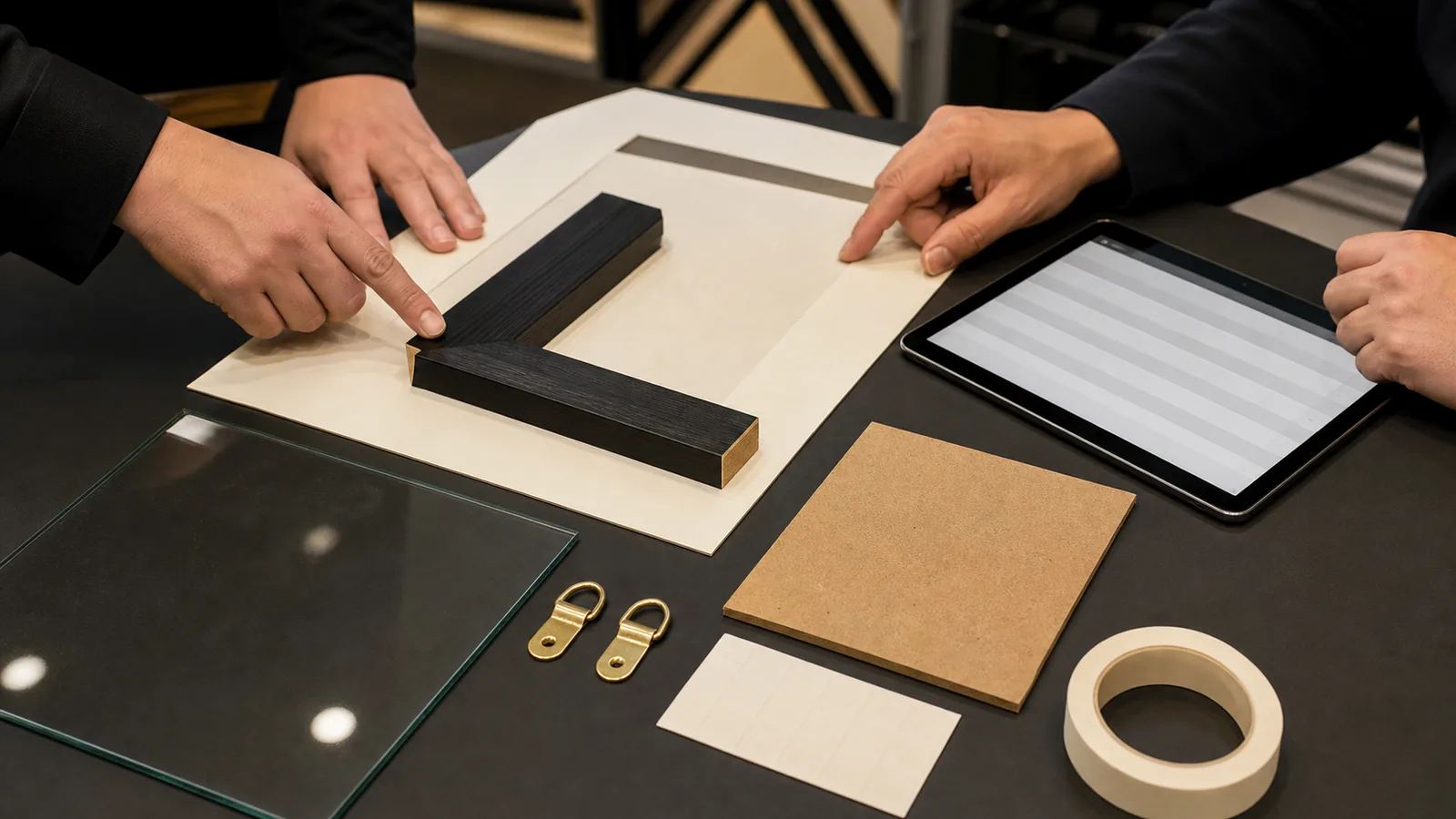
List the moulding substrate and wrap or coating, corner joining material, glazing, mat, insert, backing board, stand, hanging hardware, dust cover, adhesives, printed inks, decorative plaque and packaging components. Include supplier, production site, grade or internal material code, thickness, surface area where useful, and approved alternative. Mark substances or formulations that are confidential but still need a controlled verification route.
The bill of materials should match the golden sample and purchase order. A broad line such as “wood frame” hides the difference between solid wood, finger-jointed wood, MDF moulding, veneer-wrapped board and paper-wrapped plastic. A broad line such as “glue” hides multiple applications. The objective is not to publish a recipe; it is to let the importer and laboratory understand which components can affect the article assessment.
Ask the supplier for facts, not a blanket promise
A useful request asks whether formaldehyde or formaldehyde-releasing substances are intentionally used in each relevant component or process, what material and formulation revisions are current, which upstream evidence exists, and whether the supplier has assessed the complete article. It asks for report identity, sample description, production site, dates, method, conditions and result where disclosure is authorised.
Avoid asking the factory to sign “REACH compliant” without defining the product, entry, market or evidence. The factory can support accurate material and production information; the EU importer and its advisers own the market decision. If an upstream supplier will not disclose a formulation, agree whether an independent laboratory, confidential review or alternative material is needed.
Define the tested configuration before requesting a quotation
State the SKU, dimensions, depth, frame profile, backboard, mat, glazing, adhesive system, coating, hardware, assembly state and production site represented by the sample. Explain whether the laboratory should assess a complete article, a family representative or another configuration approved by the responsible adviser. Do not let a laboratory quote become the first document that defines the product.
If a product family has several sizes, materials or factories, ask the technical team to justify any grouping. The largest surface area is not automatically the worst case, and the darkest coating is not automatically representative. A risk-based family plan should consider component identity, ratios, emissions sources, construction and manufacturing variability. Preserve the written rationale behind representative selection.
Use the Appendix 14 conditions as the reference point
Entry 77 directs measurement to the chamber conditions in Appendix 14 and allows data from other conditions only where a scientifically valid correlation to the reference conditions exists. Buyers should therefore send the legal text and intended article category to the laboratory and ask it to state how its method and report relate to the required reference conditions.
Do not choose a familiar national method solely because a supplier already has that report. Ask the laboratory to identify sample conditioning, loading factor, temperature, humidity, air exchange, test duration, analytical method, uncertainty and any conversion or correlation. Qualified specialists must decide whether the data are fit for the legal purpose. The buyer should not invent a conversion in a spreadsheet.
Check laboratory capability and report scope
Confirm the laboratory's competence for the selected method, article type and reporting need. Ask which accreditation scope applies, how the sample will be received and conditioned, whether subcontracting is used, how deviations are handled and what photographs or identifiers will appear in the report. A logo on a laboratory website is not enough; the relevant capability should be verified for the work ordered.
The final report should identify the submitted sample precisely enough to connect it to the product file. Check model, dimensions, construction, photos, production site or batch where available, receipt date, test dates, method, conditions, result, units, uncertainty or reporting conventions, deviations and authorised signatory. A clean number without a traceable sample description is difficult to use at shipment release.

Do not treat a passing report as permanent product approval
A report describes the tested sample under stated conditions. It does not guarantee every later unit, factory, size, colour, adhesive lot or substitute material. The importer still needs supplier controls that keep production aligned with the assessed configuration. Link the report to the bill of materials, approved sample and change-notice rules.
Define retest or technical-review triggers with competent advisers. Typical triggers can include a new moulding substrate, backing-board supplier, adhesive formulation, coating system, production site, construction ratio or product category. A packaging change may also matter if the sample conditioning or emissions behaviour is affected. Record the decision even when review concludes that new testing is unnecessary.
Control wood-based boards and mouldings by source
For MDF, particleboard, plywood or engineered moulding, identify the actual producer where possible, product grade, thickness, resin system, production location and lot linkage. A distributor's generic declaration may not distinguish mills or revisions. Ask how incoming material identity is preserved through cutting, wrapping, assembly and stock rotation.
Solid wood also needs an honest review. The natural-occurrence exclusion has conditions, and a finished solid-wood profile can still use finger joints, adhesives, fillers, primers, stains or topcoats. Do not claim an exemption from the words “solid wood” alone. Map everything added during production and let qualified advisers apply the legal language.
Include adhesives, coatings and printed elements
Frame production may use corner glue, lamination adhesive, paper wrap adhesive, backing tape, hot melt, printed inserts, sealants and surface finishes. Ask which are present in the marketed article and which are process aids no longer present. Keep safety data sheets and technical data sheets as supporting material, but do not treat them as finished-article chamber evidence by themselves.
When formulations are proprietary, use supplier codes and controlled version numbers. Require notice before a code or manufacturer changes. A visually identical black coating or clear adhesive can have a different chemistry. The buyer's change-control system should recognise formulation identity, not rely only on appearance at golden-sample inspection.
Connect reports to factory and batch records
The production file should show which moulding, backing, adhesive and coating lots were used, where final assembly occurred, and when the goods were made. It should connect the laboratory sample to a pilot or production batch without claiming that a single report tested every shipped unit. Keep purchase records and supplier declarations for the retention period set by the importer's compliance system.
For mixed-SKU orders, avoid attaching one report to every line automatically. Create a matrix of covered models, evidence and open gaps. If the same material source supports several frames, document the grouping rationale. If one SKU uses a deeper box, different back or alternative lining, give it a separate row and decision.
Write the purchase order around deliverables
Specify the approved bill of materials and revision, manufacturing site, evidence package, sample responsibilities, change-notice period, access to underlying reports, record retention and action if a controlled input changes. Define whether testing cost is included, which party owns samples and reports, and the date by which gaps must close before shipment.
Do not use a one-line warranty as a substitute for operational controls. Legal counsel should draft the allocation of responsibility, confidentiality, audit rights, indemnities and remedies. The technical schedule should make those terms usable by naming real materials, files, approvals and milestones.
Plan for stock produced around the application date
Record manufacture date, import date, placing-on-the-market facts, ownership and location for stock made or ordered before 6 August 2026. The regulation's application wording and any relevant transitional analysis should be reviewed by qualified EU counsel for the actual distribution model. Do not assume manufacture before the date creates a universal sell-through right.
Second-hand articles are listed among the exclusions, but unsold new inventory is not made second-hand by sitting in a warehouse. Keep new stock, returns, refurbished goods and genuine second-hand items distinct. If rework or material replacement is considered, document the new configuration and whether it needs a new assessment.
Assign responsibilities before sample approval
Product development owns the construction and golden sample. Procurement obtains controlled supplier facts and notices. Quality links incoming and production records. The laboratory performs the agreed work. The EU importer and compliance adviser decide scope and release. Logistics keeps the final product and evidence aligned with the import line. Legal counsel handles contractual and regulatory interpretation.
Name one importer-side owner for reconciliation. Without that role, the supplier may send a board report to procurement, the laboratory may test another size, and logistics may ship a revised backing before compliance sees the change. A short release table with owner, evidence, status and date is more reliable than scattered attachments.
Use a copy-ready importer handover checklist
- Exact SKU, dimensions, intended use and import/sales configuration.
- Proposed Entry 77 category and qualified decision owner.
- Any exclusion considered, with facts and adviser conclusion.
- Revision-controlled bill of materials and approved alternatives.
- Moulding, board, adhesive and coating supplier identities.
- Complete-article versus representative-sample rationale.
- Laboratory scope, method, Appendix 14 relationship and sample photos.
- Report number, dates, conditions, result, units and deviations.
- Golden sample, production site and batch linkage.
- Material, formulation, site and construction change triggers.
- Purchase-order evidence dates and record-retention owner.
- Shipment release status and unresolved questions.
Recheck the file at every reorder
Ask the supplier to confirm that controlled materials, formulations, sources, site and construction remain unchanged. Compare the current bill of materials with the assessed revision, not merely the product photograph. Review current ECHA and EUR-Lex sources because restrictions, guidance and enforcement expectations can evolve.
When a change occurs, pause only the affected decision and obtain a technical review. The answer may be updated documentation, targeted component evidence, a new representative assessment or a full article test. The purpose of change control is not automatic retesting; it is preventing an unreviewed substitute from inheriting an old conclusion.
Experience scope and project limits
Editorial review: Jessica, Founder & Project Advisor at DOREMI Display. Updated 1 September 2026. Jessica's practical scope covers display-frame materials, sample coordination, manufacturing communication, packaging, purchase-order handover and supplier records. She is not presented as an EU regulator, toxicologist, accredited laboratory, REACH lawyer or conformity-assessment body.
This guide cannot classify a specific frame under Entry 77, approve an exclusion, select a universal laboratory method, validate a correlation, define a representative family or release goods to the EU market. The importer and qualified legal, chemical, laboratory and product-safety advisers must apply the current official rules to the actual article and supply chain.