
A U.S. brand may need Wi-Fi digital photo frames before the final FCC grant: engineers need test units, a retailer needs packaging prepared, a distributor needs launch inventory, or a trade show needs a prototype. Those are not one legal route. Federal rules distinguish testing and evaluation, demonstration, conditional marketing and controlled pre-sale activity, with different quantities, notices, ownership and records.
This guide is for U.S. importers, connected-frame brands, distributors, fulfilment teams, customs brokers, laboratories and overseas OEM/ODM factories. It turns 47 CFR sections 2.803 and 2.1204 into a buyer handover. It does not select an import condition, authorise operation or sale, or replace the responsible party, TCB, broker, FCC or qualified U.S. advisers.
Why is “Can we ship samples?” the wrong first question?
The word sample can describe an engineering board, a complete prototype, a sales sample, a trade-show unit, a retailer photography unit or a customer pilot. FCC rules care about the device, authorization procedure, quantity and intended activity. A carton marked “sample” does not decide any of those facts.
These buyer questions are editorial inferences from the current eCFR, FCC orders and launch operations. They were not captured from Google AI Overviews or AI Mode. Google Search Central favours reliable, specific answers; the correct starting point is therefore a route decision for each batch rather than a generic sample declaration.
Freeze the radio configuration before choosing a route
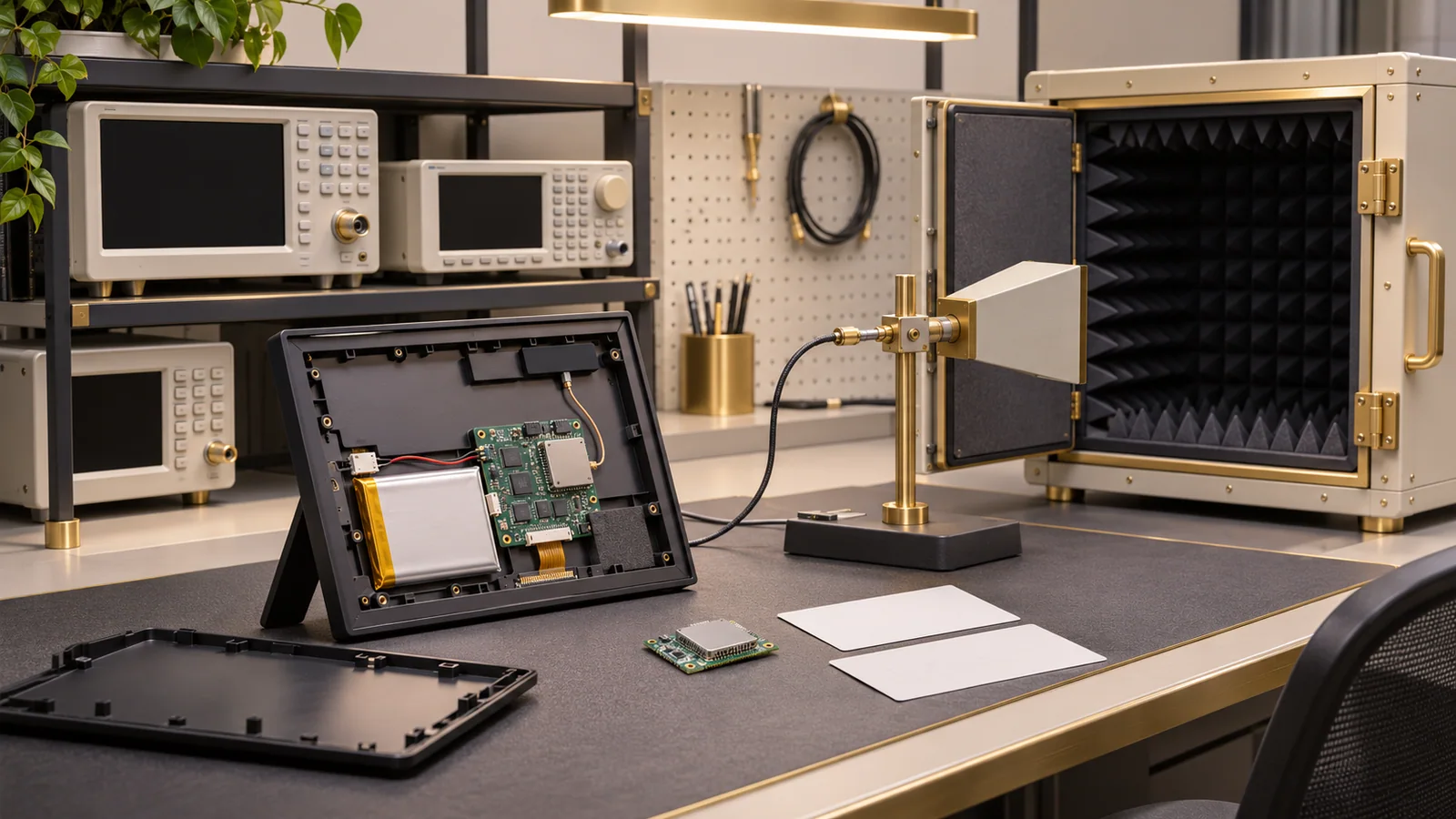
Record the Wi-Fi and Bluetooth module, antennas, main board, enclosure, power supply, firmware, enabled bands and intended final model. Determine whether the final device uses Certification, Supplier’s Declaration of Conformity or more than one authorization obligation. A certified module does not automatically settle host integration, unintentional-radiator or labelling questions.
Give the lab and responsible party the production-equivalent configuration. If the imported unit uses an engineering module or antenna that will change, state that explicitly. The import basis should follow the unit entering the country, not a future configuration imagined for retail.
Separate testing and evaluation from commercial launch inventory
Section 2.1204 allows up to 4,000 radiofrequency devices for testing and evaluation, product development or suitability-for-marketing work, provided they are not offered for sale or marketed. Distinct models and separate generations are treated separately under the rule. Larger quantities require written OET approval before importation.
Use this route only for genuine development work. Identify the lab, engineering owner, location, purpose, quantity and final disposition. A retailer’s sellable stock does not become evaluation inventory because staff plan to inspect it.
Treat trade-show demonstration as its own condition
The import rule separately permits limited quantities for demonstration at industry trade shows. The current text defines the ordinary limit as 400 or fewer devices and prohibits offering them for sale or marketing them. Section 2.803 also specifies conspicuous notices for displaying unauthorized devices.
Prepare a show-unit list, booth control plan, required notice, operation review and post-show disposition. Do not remove notices for photography or let attendees leave with units. Confirm with qualified advisers whether and how the device may be operated at the event.
Understand the 12,000-unit pre-sale route
For devices subject to Certification, section 2.1204 provides a route for 12,000 or fewer units per FCC ID for pre-sale activity. It is not an early-retail exception. Pre-sale activity includes packaging and physical transfer to distribution centres and retailers, but excludes display or demonstration.
The quantity is determined by devices with the same FCC ID. A brand should not split one model across purchase orders, ports or warehouses and treat each shipment as a fresh limit. Assign an owner to aggregate the total.
Do not move pre-sale units before the technical gate
The pre-sale route becomes available only after compliance testing by an FCC-recognised accredited laboratory is completed and an application for Certification is submitted to an FCC-recognised Telecommunication Certification Body. A booked test or draft application is not the same milestone.
Collect the completed-test confirmation, TCB submission evidence, expected FCC ID and configuration reference before release from the factory. The compliance owner should sign a route sheet that the logistics and warehouse teams can understand.
Keep unauthorized devices away from end users
Before Certification is granted, pre-sale units cannot be delivered to end users, displayed, operated or sold under the pre-sale import condition. Physical possession may move to distribution centres and retailers for the limited preparation purpose, but the launch hold must survive every handoff.
Block consumer allocation in the order system. Use warehouse status codes, segregated locations and release permissions. A future on-sale date in a retailer system is not sufficient if staff can accidentally fulfil an order.
Apply the prescribed temporary notice correctly
Each device or its packaging imported through the pre-sale route must carry the visible, temporary, removable FCC notice specified in the rule. The expected FCC ID may be present only under the rule’s conditions, such as being obscured by that notice or unavailable through electronic labelling before authorization.
Have counsel or the responsible compliance party approve the exact notice and placement from the current eCFR. Do not let a factory paraphrase it, replace it with a general “engineering sample” sticker or print a permanent FCC claim before the grant.
Preserve legal ownership and physical control
Under the pre-sale rule, legal ownership remains with the manufacturer, developer, importer, ultimate consignee or designated customs broker. Physical possession can move for the permitted activity, but that does not convert the unit into retailer-owned sale stock before the grant.
Make the commercial terms match the regulatory position. Invoices, warehouse receipts and retailer agreements should not contradict the ownership plan. Ask counsel and the broker to review title, risk-of-loss and customs documentation together.
Create a real retrieval process
The controlling party must be able to retrieve the devices if certification is not successfully completed and must act immediately after that determination. A sentence in the compliance file is not enough when units are spread across several distribution centres.
Maintain recipient contacts, quantities, locations, quarantine instructions, return labels, transport ownership and decision authority. Test the process with a desktop exercise before importation. Include units sent to photography studios, packaging vendors and retailer warehouses.
Retain the required records for 60 months
For pre-sale imports, the rule requires records identifying recipients, device name and product identifier, quantity, authorization-application date, expected FCC ID and recipient contact information. The records must be maintained for 60 months and provided to Commission personnel on request.
Use one controlled register rather than disconnected supplier and warehouse spreadsheets. Preserve corrections and movements. Link the register to the import entry and final grant without exposing sensitive engineering documents to every logistics user.
Document the ultimate consignee’s basis
Section 2.1204 says the ultimate consignee must be able to document compliance with the selected import condition and the basis for choosing it. Give the consignee a concise route pack: device configuration, purpose, quantity, rule paragraph, supporting milestone, restrictions, owner and disposition.
A broker may transmit data, but the business should not expect the broker to invent the technical basis. Resolve unclear authorization status before the shipment reaches the port.
Align customs papers with the domestic-control plan
Use a consistent product description, model, quantity, consignee and intended purpose across the commercial invoice, packing list, broker instructions, warehouse receipt and compliance register. A vague description such as “photo sample” can hide the distinction between an evaluation device and controlled pre-sale inventory.
Tell the warehouse which cartons remain under hold, which party retains legal ownership and where units may move. If a shipment is divided after entry, update the recipient register before transfer. Customs clearance is not the same event as FCC release for display, operation, sale or end-user delivery.
Keep SDoC devices out of the Certification pre-sale route
Section 2.803 distinguishes physical transfer rules for devices under Supplier’s Declaration of Conformity from devices under Certification. Physical transfer to other entities before successful completion is prohibited for SDoC equipment under the conditional-marketing provision described there. The 12,000-unit import route is written for devices subject to Certification.
A digital frame can contain both an intentional transmitter and digital circuitry. Have the responsible party map every authorization obligation. Do not treat the presence of a Wi-Fi FCC ID as permission to move an unfinished host product.
Control conditional marketing separately from importation
Section 2.803 contains conditional marketing and sales provisions, including disclosures and restrictions before authorization. Importation remains subject to subpart K. Satisfying a marketing condition does not by itself create an import condition, and a valid import condition does not automatically permit retail advertising or delivery.
Create separate approval columns for import, marketing, physical transfer, display, operation, sale and end-user delivery. The launch manager should release each activity only after the responsible legal and compliance owners approve it.
Plan photography without turning it into display or operation
Retail teams often want images before certification. Decide whether photography is packaging preparation, evaluation or another activity, and whether the device must be powered. Use an authorised configuration and approved route. A studio should receive written restrictions and return instructions.
Where possible, photograph the enclosure without activating radios or showing unsupported screens. Do not add an FCC ID, grant language or compliance badge in post-production before the evidence exists.
Prevent component substitution during the hold period
A factory may replace a radio module, antenna, oscillator, display cable or power supply between the tested sample and production batch. That change can invalidate the route assumptions and expected FCC ID. Require written change approval before shipment.
At receiving, compare the lot with the submitted configuration using controlled photographs, part numbers and firmware identifiers. Quarantine discrepancies. Do not wait for the final grant to discover that warehouse stock is a different build.

Release inventory against the actual grant
When certification is granted, verify the grantee code, product code, model relationship, authorised frequencies, equipment class and exhibits against the held units. Confirm that required permanent labelling, user information and online listing data match the grant.
Remove temporary controls only through an approved work instruction. Record the release date, responsible person and affected quantities. If the grant differs from the expected configuration, keep the hold and obtain direction.
Design the launch calendar around uncertainty
Place accredited testing, issue resolution, TCB submission, import decision, customs transit, warehouse preparation, grant review and retail release on one calendar. Include time for a failed test, changed antenna or request for additional information. Do not promise an end-user delivery date that assumes a grant outcome.
Use a smaller development shipment when commercial timing does not justify the operational burden of pre-sale inventory. The best route is the one that matches the real activity and can be controlled, not the one with the largest numeric allowance.
FCC pre-authorization handover checklist
- The exact radio and host configuration is frozen
- Testing, trade-show and pre-sale batches are separated
- The applicable authorization procedure is confirmed
- The import condition and quantity are documented
- Accredited testing and TCB submission evidence exist where required
- Temporary notices use the current prescribed language
- End-user delivery, display, operation and sale are blocked
- Legal ownership and warehouse possession are aligned
- A recipient-level retrieval process can be executed
- Records are retained for 60 months
- Component changes trigger a new route review
- Final release is tied to the actual FCC grant
Experience scope and project limits
Editorial review: Jessica, Founder & Project Advisor at DOREMI Display. Updated 23 November 2026. Jessica’s practical scope covers digital-frame specifications, OEM/ODM samples, component handovers, packaging, production and buyer–supplier coordination. She is not presented as the FCC, OET, a TCB, accredited laboratory, customs broker or U.S. telecommunications lawyer.
The responsible party, importer, ultimate consignee, broker, laboratory, TCB and qualified advisers must select the authorization procedure, import condition, notices, permitted activity and release point. This guide organises handover evidence; it is not an equipment authorization, import approval or permission to market, operate, display, sell or deliver a device.
Public sources used for this guide
- Google Search Central: AI features and your website
- eCFR: 47 CFR § 2.803, marketing before equipment authorization
- eCFR: 47 CFR § 2.1204, import conditions
- FCC: Report and Order 21-72 on pre-authorization importation and conditional sales
- FCC: equipment authorization procedures
- FCC: Equipment Authorization System search