
A display frame supplied to a hotel, university, awards organiser or corporate buyer may never pass through a household retail shelf, but it still arrives with sales, grouped and transport packaging. France has created a distinct extended-producer-responsibility route for packaging used or consumed by professionals. In July 2026, the French Ministry for Ecological Transition announced that operational implementation would begin on 1 January 2027 rather than 1 July 2026.
This guide is for importers, distributors, brands and institutional programme teams buying certificate frames, jersey displays, medal shadow boxes, vinyl record displays and related OEM products for the French professional market. It converts the current public framework into a supplier-data handover. It does not decide who is legally the producer, select an eco-organisation, calculate contributions or replace the current French rules and qualified advice.
Use the new start date as a preparation window
The changed operational date is not a reason to ignore the project. The Ministry explained that the conditions were not ready for an efficient launch, including uncertainty about which economic operators would contribute and late publication of pricing information. A buyer should use the additional time to resolve its entity map, packaging inventory, contracts and data ownership rather than wait for the first invoice or portal request.
Set a dated readiness plan with legal review, eco-organisation monitoring, supplier-data collection, finance ownership and artwork approval. Separate confirmed obligations from open questions. If official guidance, approved operators or fee structures change, update the decision record instead of rewriting the physical packaging evidence. A reliable BOM, measured weights and sale-route map remain useful even when the reporting vocabulary evolves.
First determine whether the frame pack is household or professional
Start with the expected end use and waste route. A boxed photo frame sold through a consumer retailer can sit in the household-packaging stream. A batch of recognition frames delivered to an employer, university or hotel can involve packaging used by professionals. The same product design may travel through both channels, so a product name alone does not answer the question.
Draw separate routes for consumer retail, direct ecommerce, wholesale distribution and institutional projects. Identify who opens the retail box, grouped carton and pallet wrap, and where each layer is likely to become waste. Do not describe all export packaging as “B2B” merely because the buyer is a company. Record the actual recipient, channel and packaging function, then let the responsible French entity and its adviser apply the current definitions.
Map every legal and operational party
List the overseas frame manufacturer, packaging converter, commissioning brand, EU importer, French distributor, marketplace, fulfilment provider and final professional customer. Use legal names and show who owns the trademark on the product, who specifies the pack, who imports it, who first makes the packaged product available in France and who adds shipment packaging. A brand name on a carton is useful evidence, but it is not the whole producer analysis.
Attach contracts and invoice routes to the map. If a distributor buys finished frames from an importer, show where title and physical control move. If a foreign seller ships directly to French business users, record that route separately. The factory should not be asked to declare the buyer’s French status; it should provide accurate product, packaging and shipment facts that the buyer can use in the determination.
Classify packaging by function before material
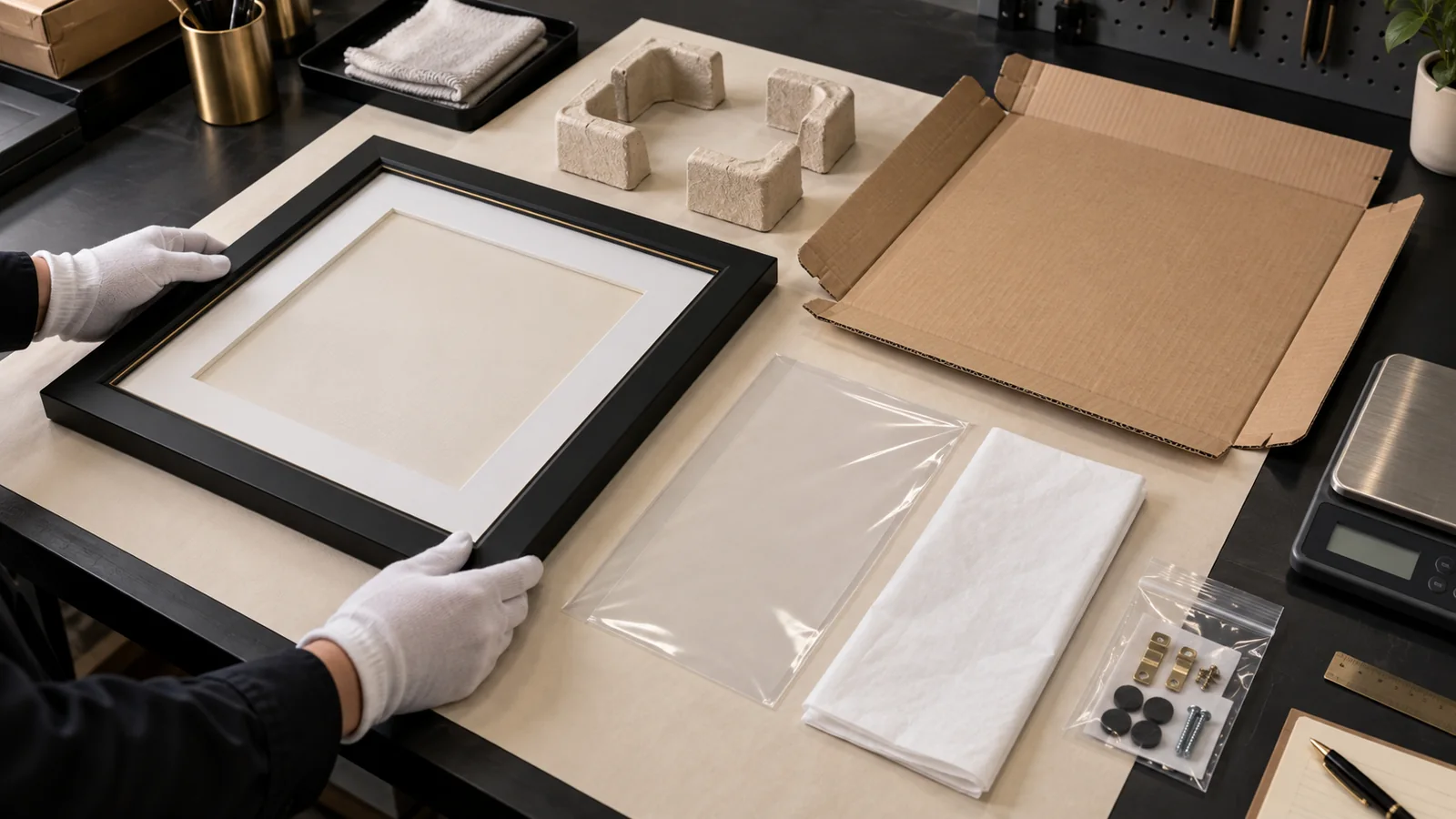
A useful inventory distinguishes sales packaging, grouped packaging, transport packaging, service packaging and production-primary packaging where relevant. For a display frame, the fitted carton and protective sleeve may stay with the product; a master carton groups several units; pallet wrap and edge boards support transport. A fulfilment operator may add a separate parcel carton after the factory shipment arrives.
Record the packaging function first, then material and weight. This prevents a polyethylene sleeve, stretch wrap and parcel mailer from being collapsed into one “plastic” line even though they have different owners and disposal points. The French Ministry’s current guidance explains that producer identification can differ by packaging function. Keep the source facts neutral so a competent reviewer can apply the final operational rules without reconstructing the pack.
Create a component-level packaging BOM
Give every packaging component a stable code, description, material, dimensions, finished weight, supplier, use level and applicable frame SKU. Include glazing film, tissue, foam or moulded-fibre corners, bags, accessory pouches, printed sleeves, retail cartons, master cartons, tape, labels, pallet wrap, straps and dunnage. Photograph each item beside a component identifier, not beside an invented compliance claim.
For composite items, record the construction rather than guessing a single material. A laminated presentation box can combine board, film, magnets, ink, adhesive and textile pull tabs. The buyer or eco-organisation may later specify how to report it. Preserve the raw specification and the reporting classification as separate fields. That separation protects the evidence when a category definition or fee method changes.
Measure production-equivalent components
Packaging drawings contain dimensions but do not establish finished mass. Weigh approved production-equivalent pieces with a defined scale, tare method and sample count. For light labels, films or small pouches, weigh a counted batch and calculate an average. For corrugated board, note grade and moisture conditions when they could materially affect the result. Retain dated photographs and the packaging revision.
Do not report a design target as though it were an audited production value. A supplier can provide a controlled average and tolerance; the responsible producer decides the precision and evidence accepted for declaration. If several frame sizes share one carton family, connect each SKU to its actual configuration. A 30 cm certificate frame and a deep jersey shadow box should not inherit one generic pack weight.
Keep French quantities separate from factory shipments
The factory knows how many packaged frames it ships, but that number may not equal the quantity first placed on the French market. Goods can enter an EU warehouse, be sold in several countries, remain in inventory, be returned or be repacked. Create a reconciliation between supplier shipment lines, warehouse receipts, French sales or transfers and the packaging revision used for each unit.
For grouped and transport materials, document how quantities are allocated when one pallet serves multiple destinations. Avoid unsupported percentages. Use warehouse or logistics records and keep the allocation method visible. Finance, sustainability and operations should agree which system is the source of truth for French quantities. The factory evidence supplies mass per configuration; the producer’s records supply the market volume.
Do not copy household artwork onto professional packs by assumption
France’s REP framework includes Triman and sorting-information rules, but the correct marking depends on the relevant stream, approved instructions and packaging context. A supplier should not paste a household Info-tri graphic onto a wholesale carton simply because it has seen the symbol on another product. Nor should it create a homemade recycling claim from a material datasheet.
Maintain an artwork approval matrix showing the owner, source file, language version, pack face, minimum size and release date for every required mark or instruction. The responsible French company should supply approved artwork or written instructions based on current official or eco-organisation guidance. The factory’s control is version accuracy: use only the released file and provide photographs of the production pack.
Prepare for eco-organisation onboarding without inventing the answer
The professional-packaging regime relies on collective eco-organisations or an approved individual system. At the time of a buyer review, confirm which organisations are approved for the relevant period and which data specification applies. Do not treat a commercial proposal, draft tariff or supplier spreadsheet as final government guidance. Save the date and version of every template used.
Assign one French or EU entity to own registration and declarations, one finance contact for contributions, and one operations contact for packaging data. The overseas manufacturer can answer physical questions but should not control the producer account. This separation keeps legal declarations with the responsible entity and lets the factory maintain evidence at the level it can genuinely verify.
Write supplier responsibilities into the purchase file
Add a packaging-data schedule to the RFQ or supply agreement. Define required fields, units, evidence, due dates and the notice period for substitutions. State that a change to film gauge, carton board, corner material, tape, label or grouped-pack quantity needs approval before use when it affects the declared configuration. Connect the schedule to the golden sample and packing specification.
A useful clause does not say the factory “guarantees French EPR compliance.” It says the supplier will provide accurate specified data, retain source records, notify changes and support reasonable verification. The buyer remains responsible for entity analysis, declarations, fees and consumer or professional communications. Clear boundaries prevent both sides from relying on a broad promise that no one can operationally prove.

Control packaging changes like product changes
Packaging optimisation is valuable, but an undocumented reduction or substitution can break the declared data. Use a change request with old and new component codes, specification, weight, reason, affected SKUs, validation result, effective shipment and remaining stock. Send it to quality, logistics and the producer’s reporting owner before the new pack is released.
Reconcile mixed transition lots carefully. A factory may consume old corner protectors while using a new carton, creating a temporary hybrid pack. Either prevent that combination or give it a unique revision with its own weight. The declared configuration should match what was actually placed on the French market. Keep a retained packed sample or complete photographic record for every approved version.
Use protection performance as a design constraint
EPR should not encourage a fragile frame to be under-packed. Broken glazing, damaged corners and returned products create additional material and transport impacts. Compare proposed reductions against the distribution route: pallet freight, mixed-load delivery, parcel networks or direct installation. Validate the changed pack with a documented method appropriate to the programme.
Keep environmental claims separate from engineering decisions. A moulded-fibre corner may reduce one type of plastic, but it still needs to protect the product, work with moisture conditions and fit the recovery route. Record factual attributes and test observations. Let the responsible brand approve any public claim using current substantiation rules rather than turning a packaging change into an automatic “eco-friendly” statement.
Build a 2027 readiness calendar
Work backwards from the intended French placement date. Schedule entity and stream review, eco-organisation confirmation, data-template mapping, supplier measurement, artwork release, contract updates, internal reconciliation and management approval. Add a checkpoint after final official implementation guidance or operator requirements are available. Assign a named owner and evidence location to each task.
For repeat programmes, set an annual cycle for quantity close, pack-version reconciliation, declaration review and supplier confirmation. New SKUs, new channels, marketplace fulfilment and cross-border warehouse changes should trigger an interim review. A calendar turns an uncertain regulatory launch into manageable project work without pretending that every legal detail is already settled.
Buyer readiness checklist
- Household and professional packaging routes assessed separately
- Legal entities, brands, importer, distributor and final users mapped
- Packaging functions identified before reporting categories are assigned
- Component BOM covers unit, grouped, shipment and transport materials
- Production-equivalent weights measured with retained evidence
- French market quantities reconciled separately from factory shipments
- Current eco-organisation and reporting instructions monitored
- Marks and sorting information released through controlled artwork
- Supplier agreement defines data, evidence and substitution notice
- Packaging changes receive protection and reporting review
- 2027 launch tasks have owners, dates and decision records
- Legal status, contributions and claims are confirmed by qualified owners
Experience scope and project limits
Editorial review: Jessica, Founder & Project Advisor at DOREMI Display. Updated 22 September 2026. Jessica’s practical scope covers custom display-frame briefs, packaging BOMs, sample coordination, component weighing, export packing, change control and buyer–supplier handovers. She is not presented as French counsel, a ministry or ADEME representative, an eco-organisation, an accountant or a contribution auditor.
This guide is educational procurement material, not legal advice or a producer, packaging-stream, exemption, contribution or marking determination. The responsible business must confirm the rules that apply to its legal entities, channels, packaging and reporting period using current French law, ministry guidance, approved eco-organisations and qualified advisers.
Public sources used for this guide
- Google Search Central: AI features and your website
- French Ministry for Ecological Transition: professional packaging
- French Ministry: operational implementation from 1 January 2027
- Légifrance: Environment Code Article L541-10-1
- ADEME: professional-packaging declaration guide
- French Ministry: general REP framework