
Great Britain is updating its product-safety framework, but a consultation is not the same as an operative replacement law. The Product Regulation and Metrology Act 2025 gives government powers to amend the system. In March 2026, the Department for Business and Trade and the Office for Product Safety and Standards consulted on a new framework, online-marketplace duties, product information and enforcement. As of this guide's update, ordinary consumer display frames in England, Scotland and Wales still need to be assessed against the current applicable law, including the General Product Safety Regulations 2005 where relevant.
This guide is for GB importers, private-label brands, retailers, e-commerce teams and institutional buyers sourcing non-electrical certificate frames, jersey shadow boxes, medal displays and vinyl record frames. It separates today's practical handover from reform monitoring. It does not classify a named product, decide safety, interpret legislation, predict the consultation outcome or replace UK legal, technical or Trading Standards advice.
Define the market before defining the duty
Great Britain means England, Scotland and Wales. Northern Ireland follows a different general product-safety route: Regulation (EU) 2023/988 superseded the 2005 regime there on 13 December 2024. A UK-wide launch may therefore need separate market analysis, responsible parties and product information. Do not publish one “UK GPSR compliant” line without clarifying which market and law it describes.
Create a route matrix for GB, Northern Ireland and any EU sales. Show legal seller, importer, fulfilment route, online offer, warehouse and first placement. If the same carton is used across markets, confirm that the combined identifiers and language remain accurate. The overseas factory can produce market variants, but the UK business and advisers must decide which rules apply.
Use the current GB general safety requirement now
OPSS guidance says products within the General Product Safety Regulations 2005 must be safe under normal or reasonably foreseeable conditions of use. For a frame, that assessment is not limited to chemical composition or a smooth finish. It can include glazing, edges, opening parts, magnets, hanging hardware, stability, weight, supplied fixings, instructions, intended contents and use around foreseeable users.
Start with the sold configuration. A shallow tabletop certificate frame, a heavy wall-mounted jersey case and an accessible-opening record display do not share one risk file merely because they use the same profile. Record dimensions, mass, materials, hardware, opening method, maximum intended contents, mounting orientation and use environment. Safety evidence should match the exact SKU and revision.
Identify the producer, importer and distributor roles
GB guidance explains that producers can include GB-based manufacturers and UK-based importers, and defines how other supply-chain professionals can be treated when their activities affect product safety. Map legal entities, not marketplace display names. Show who manufactures, imports, brands, modifies, stores and supplies each product. A private-label name on the frame can change how buyers and authorities understand responsibility.
Put the role map into contracts and operational files. The overseas OEM provides construction, production and change facts; the GB importer controls placement on the market and cannot outsource every public-law duty through a purchase order. Distributors also need due care, traceability and cooperation. If one group company imports and another sells, document both rather than treating the group as a single undefined “brand.”
Build a risk assessment around foreseeable use
Describe who opens, fills, hangs, moves and cleans the frame. Foreseeable use may include a consumer replacing a vinyl record, a parent placing a tabletop frame in a family room, a hotel installer using common wall substrates or a university changing certificates annually. Consider foreseeable misuse proportionately without trying to imagine every impossible event.
Translate scenarios into product questions: can glazing edges be touched during normal access, can the backboard disengage, can hardware detach from the backing, can a tabletop stand collapse, can fingers be pinched, and do supplied fixings match the product mass and stated installation boundary? Qualified owners should select validation methods. Do not invent a universal load factor or call a visual inspection a structural test.
Make instructions part of the safety system
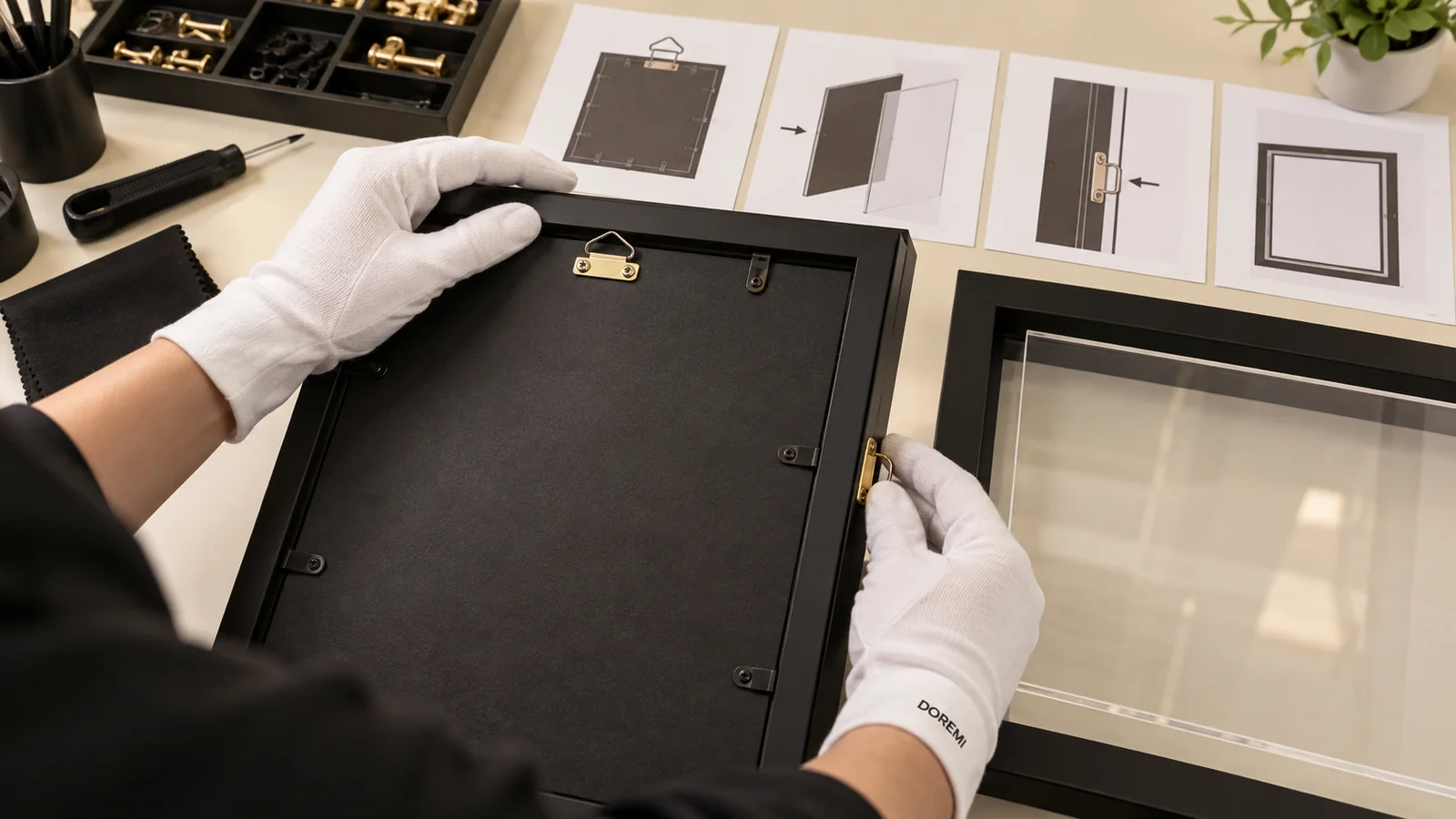
Current guidance requires relevant information that lets consumers assess non-obvious risks and take precautions. For display frames, instructions should match the actual rear fittings, opening system and contents. Identify orientation, installation sequence, supplied parts, wall-condition limitations, maintenance, glazing handling and any need for competent installation. A generic icon sheet reused across different weights can create rather than reduce uncertainty.
Run a usability review with someone who did not design the product. Observe whether they select the correct fixings, understand which hardware is supplied and close the frame securely. Record errors and improve product or instructions. Use clear English appropriate to the market and preserve the released artwork revision. A warning should not compensate for avoidable design weakness.
Put traceability on the product or packaging where reasonable
OPSS guidance describes producer identification and a product reference or batch indication on the product or packaging where reasonable. It also discusses time-limited alternative importer-address arrangements in certain circumstances, ending after 31 December 2027. Buyers should confirm the current rule and transition for their facts rather than assume a website or shipping invoice is always enough.
Agree legal name, postal address, model, batch or date code, placement and durability before the purchase order. Check that the consumer, retailer and authority can connect the sold unit to the responsible business and production record. Avoid QR-only solutions unless the law and adviser support them; links can expire, and the 2026 digital-information proposals are not automatically current permission.
Monitor products after sale
GB guidance describes proportionate measures to stay informed about risk, including sample testing, investigating complaints and keeping a complaint register where reasonable. Set categories that reflect frame failures: falling, loose hanger, cracked glazing, sharp edge, opening mechanism failure, backboard release, stand instability and instruction confusion. Preserve the customer's own account as well as the coded category.
Capture model, batch, sales channel, date, installed location, contents, wall and fixing information where relevant, photographs, injury or property-damage allegations and product custody. Trend repeated signals without waiting for a perfect diagnosis. At the same time, do not decide root cause from one image. Connect customer service, quality, legal and supplier contacts through a defined escalation route.
Report and act when a safety risk is known
The OPSS guidance states that a producer or distributor that knows a supplied product poses risks incompatible with the general safety requirement must notify the relevant enforcement authority in writing and explain action taken. The threshold and response for a real incident require qualified UK judgment. A supplier should never instruct the importer to wait for more complaints simply to protect the commercial relationship.
Prepare a response pack before launch: authority contacts, internal decision owners, insurer notification route, inventory and customer-location data, supplier investigation contact and approved communication controls. Possible actions can include warnings, stop-sale, withdrawal or recall depending on the facts and authority direction. Preserve samples, packaging, hardware and records before rework or disposal.
Keep corrective action linked to the exact product
A recall or field correction cannot work if a brand cannot identify affected units. Use model and batch logic that survives repacking and fulfilment. If retailers split master cartons, ensure unit or retail-pack identification remains. If several suppliers make a visually identical frame, preserve source differentiation in records and, where appropriate, product coding.
Test the retrieval process with a mock question: identify every shipment using a specified hanger and backboard combination. The answer should come from purchasing, production and sales records rather than memory. Define who can stop production and who approves substitute components. Speed matters, but uncontrolled public statements or blanket disposal can destroy evidence and confuse consumers.
Control OEM changes that affect safety
A thinner backboard, different hanger, new magnet, alternative acrylic, revised latch or heavier decorative insert can change the risk profile without changing the product photograph. Require pre-approval for material, dimension, hardware, assembly and instruction changes. The request should identify affected SKUs, old and new parts, reason, first lot, remaining stock and validation needed.
Archive the released bill of materials, drawings, golden sample, pack, instructions and inspection criteria. Incoming and in-process controls should be able to distinguish approved components. If an emergency substitution is proposed, pause and review it. “Equivalent” is a conclusion supported by the buyer's process, not a supplier adjective.
Understand what the 2025 Act does—and does not do
The Product Regulation and Metrology Act 2025 creates powers to make and amend product regulations. It is an enabling framework, not a single product specification that automatically replaces every existing requirement on Royal Assent. Buyers should track secondary legislation, commencement, transitional provisions and official guidance relevant to their products.
Do not redesign labels or contracts based only on headlines about the Act. Maintain compliance with current applicable rules while a qualified owner monitors changes. Record the date and source of each legal decision. This prevents a team from treating a policy announcement as a deadline or overlooking an actual instrument when it is later made.
Treat the March 2026 framework as a closed consultation
The government consultation proposed a modernised core framework with proactive duties across the supply chain, clearer accountability, updated product information and responsibilities for online marketplaces. It closed on 23 June 2026. Those proposals are useful direction for readiness, but they are not evidence that every proposed duty, definition or digital route is already law.
Create a reform watchlist with proposal, potential business impact, current rule, owner and trigger for action. Track the government response and subsequent legislation on GOV.UK. Use the consultation to stress-test product data and role ownership, not to make legal claims. In public content and supplier requests, label proposals clearly as proposals.
Prepare for stronger supply-chain accountability
Even before reform, a disciplined importer should know its product and supplier. Future proposals increase the value of structured information: legal operators, product identity, safety assessment, instructions, monitoring, incidents and corrective actions. Build these as durable operational records rather than a one-time “compliance pack” assembled for a launch meeting.
Ask the OEM for facts it controls: specifications, production processes, component sources, inspection evidence, change notices and traceability. Do not ask it to certify the importer's entire legal duty or online listing. The importer should integrate supplier facts with market presentation, consumer information, sales channels and post-market data.
Review online offers and fulfilment handovers
Online product pages influence foreseeable use and customer expectations. Check that images, dimensions, weight, installation method, included hardware and warnings agree with the approved product. Do not show a heavy frame above a bed if the project has not assessed that presentation. Do not call a product “unbreakable” or “child safe” without a defensible, scoped basis.
Give fulfilment partners the correct SKU, pack revision, traceability data and stop-sale route. Marketplace operators may request safety and economic-operator information, and future reforms may increase their duties. Preserve submitted records and version dates. A marketplace form is not the technical file, but inconsistent answers can reveal that the underlying ownership is unclear.

Separate product safety from conformity marking
Many ordinary non-electrical display frames do not need a UKCA or CE mark solely because they are frames, but the answer changes if the product has lighting, radio functions, batteries, toys or other regulated features. The general safety duty can apply even when no conformity mark is required. A missing mark is not proof of danger, and an affixed mark is not proof that every risk is controlled.
Run an applicability review for each configuration and market. Keep sector-specific files separate but connected to the same model identity. If a frame includes LED lighting or wireless electronics, use qualified advice for electrical, EMC, radio, battery and environmental requirements. Do not apply a decorative UKCA logo to an ordinary frame as a trust symbol.
Buyer readiness checklist
- GB, Northern Ireland and EU routes are analysed separately
- Every sold frame configuration has a controlled identity and revision
- Producer, importer, distributor and fulfilment roles are documented
- Normal and reasonably foreseeable use informs the risk assessment
- Hardware, glazing, backing, openings and stands have scoped evidence
- Instructions match the actual product and have been usability reviewed
- Importer details, model and batch are traceable after carton splitting
- Complaints and incidents have product-specific categories and escalation
- Corrective-action data can identify affected stock and customers
- Component substitutions require approval and updated evidence
- Current duties and 2026 reform proposals are never presented as identical
- Official reform sources have an accountable monitoring owner
Experience scope and project limits
Editorial review: Jessica, Founder & Project Advisor at DOREMI Display. Updated 25 September 2026. Jessica's practical scope covers display-frame briefs, samples, hardware and instruction reviews, production evidence, packaging, change control and importer handovers. She is not presented as UK counsel, OPSS, Trading Standards, a safety engineer, test laboratory or recall authority.
This guide is educational procurement material, not legal advice, a product-classification decision, safety approval or prediction of reform. Great Britain, Northern Ireland and sector-specific requirements differ, and current law or guidance can change. Businesses should confirm applicable duties, transitions, reporting and corrective actions with qualified UK advisers and official sources.