
A Wi-Fi digital photo frame prepared for Hong Kong needs two disciplined decisions before artwork and production are frozen. The buyer must verify that the finished wireless configuration can operate legally in Hong Kong and separately determine how the frame, external power supply and plug are treated under the Electrical Products (Safety) Regulation.
This guide is for Hong Kong importers, distributors, retailers, private-label brands, e-commerce teams and overseas OEMs. It is a project handover, not OFCA certification, a CA label authorization, certificate of safety compliance, frequency ruling, import permit or legal opinion. The Hong Kong supplier and qualified radio and electrical-safety specialists must confirm the current rules for the exact model.
Why is “Does it need a CA label?” the wrong first question?
The label question hides several earlier decisions. Is the frame a Wi-Fi client device or does it control other devices as an access point? Which 2.4, 5 or 6 GHz capabilities are enabled? Can firmware reach frequencies outside Hong Kong's permitted range? Is certification voluntary or compulsory for that function? What electrical product and plug are actually supplied?
Google Search Central notes that AI features may explore related subquestions and use the same people-first foundations as Search. This guide answers those connected buyer decisions. Search intent is an editorial inference from public regulator information; DOREMI does not claim direct extraction of Google AI Overview content.
Freeze the Hong Kong market configuration first
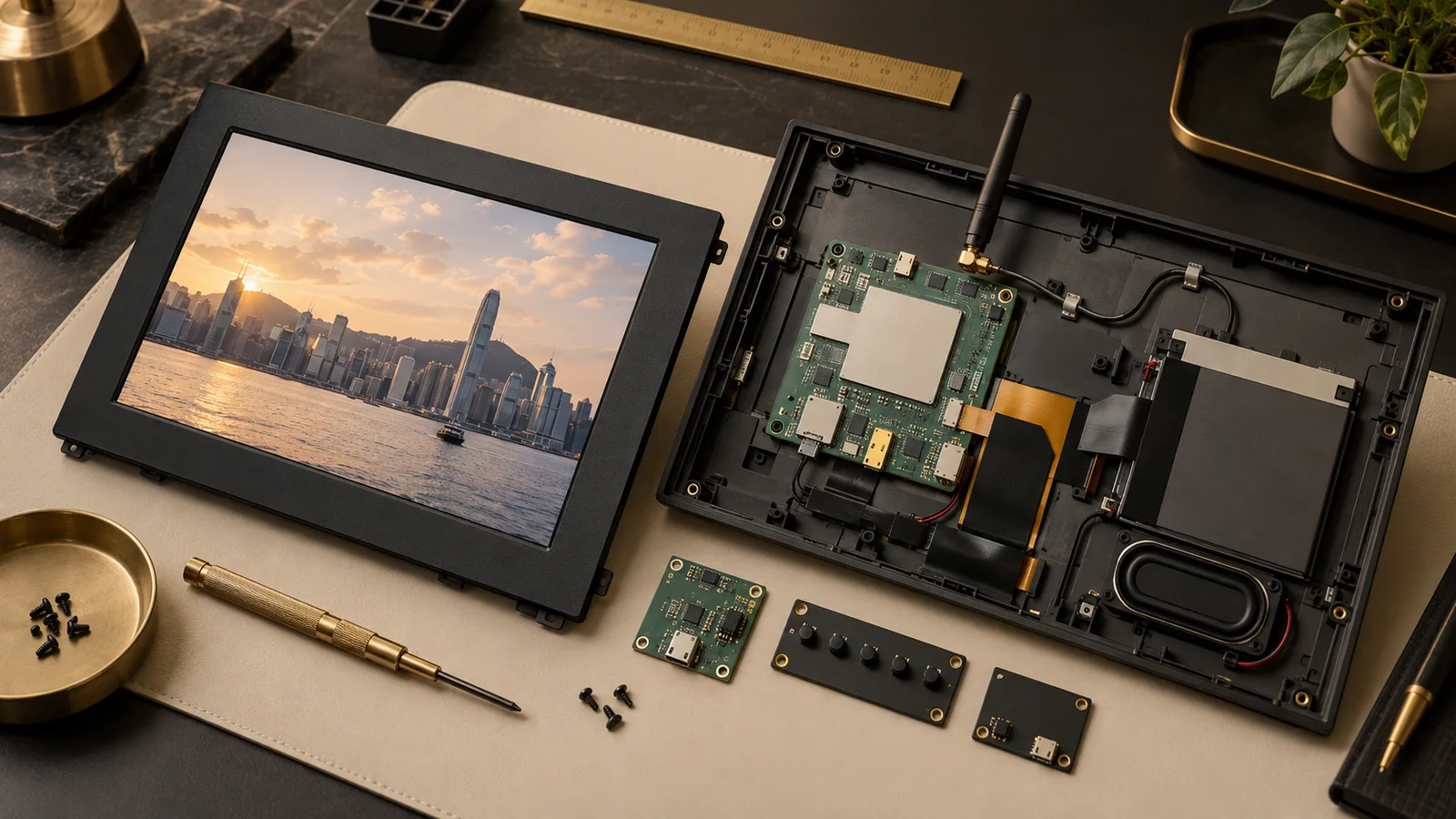
Record the frame model, processor board, Wi-Fi and Bluetooth module, supported generations, enabled bands, channel controls, antenna, firmware build, app functions, power input, external adapter, plug and included accessories. Identify whether the device only joins a network or can create, control or extend one.
Do not rely on a marketing phrase such as “Wi-Fi 6 ready.” The authority's treatment depends on technical capability and operating behavior, not the label on a sales page. Keep the Hong Kong variant visible in the bill of materials, software release, test evidence, manual, package and inspection checklist.
Separate conventional Wi-Fi from 6 GHz capability
OFCA's public Wi-Fi guidance distinguishes devices using conventional 2.4 and 5 GHz bands from Wi-Fi 6E and Wi-Fi 7 equipment capable of using 6 GHz. It states that only the designated 5.925–6.425 GHz portion is permitted for relevant 6 GHz devices in Hong Kong, while operation in 6.425–7.125 GHz is not permitted under the device class licence.
A buyer should therefore ask what the chipset can do, what the shipping firmware enables and whether the device can be region-locked. A module developed for another market may support a wider band. Disablement should be technically controlled and documented, not left as a user-selectable promise.
Decide whether the frame is a client device or an access point
OFCA explains that client devices normally operate under the control of an access point, while access points control connected devices and channel use. A normal digital photo frame that joins home Wi-Fi may be a client, but hotspot, repeater, bridge or local-network functions can change the analysis. Product names alone do not settle the classification.
Give the reviewer a functional description and network diagram. Identify every mode available at first setup, after updates and through engineering menus. If an unused access-point mode exists in generic firmware, decide whether it must be removed or assessed. The final configuration, not the intended marketing sentence, is what needs control.
Understand when certification and labelling are voluntary or compulsory
OFCA's consumer guidance says certification and labelling for Wi-Fi 4, 5 and 6 devices are voluntary, and that Wi-Fi 6E and Wi-Fi 7 client devices remain voluntary. It states that certification and prescribed CA labelling are compulsory for Wi-Fi 6E and Wi-Fi 7 access points covered by the 6 GHz device class licence.
That distinction matters. A buyer should not claim that every Wi-Fi frame must carry a CA label, but “voluntary label” does not mean “no technical requirements.” OFCA says all Wi-Fi devices must comply with the prescribed specifications. Ask the Hong Kong owner whether voluntary certification is commercially useful and which exact specification and scheme apply.
Build radio evidence around the complete host
Collect the module report, antenna specification, host board, enclosure, clock sources, power arrangement, enabled modes and production software. Compare frequency range, output, bandwidth, modulation and antenna assumptions with the Hong Kong configuration. A module report can support the file, but it does not document every host integration decision.
If certification is pursued, use an accepted certification body and agreed test plan. Confirm model names, sample count, report format, test modes and software before booking. Do not place a CA label or certificate number on product artwork until the holder releases the exact authorized data.
Keep legal use separate from certification marketing
OFCA's framework addresses permitted possession, use and sale of radio equipment, technical compliance, licensing exemptions and certification. A voluntary certification label can support buyer confidence, but it should not be described as government endorsement. Conversely, absence of a voluntary label does not authorize an out-of-band or otherwise non-compliant device.
Prepare accurate product-page language. State supported Wi-Fi functions and bands only when the production configuration supports them. Avoid broad phrases such as “globally certified” or “works everywhere.” Each destination can have different frequency, power, labelling and importer responsibilities.
Screen the low-voltage frame and mains adapter separately
Hong Kong EMSD says the Electrical Products (Safety) Regulation applies to household electrical products supplied in Hong Kong, while products operating at extra-low voltage—no more than 50 V AC or 120 V DC—fall outside its application. A digital frame may receive low-voltage DC, yet the supplied external adapter connects to household mains and needs its own review.
Document the adapter manufacturer, model, input and output, class, plug, cable, standards and certificates. Ask a qualified Hong Kong party whether the adapter is a prescribed adaptor, another prescribed product, or part of a non-prescribed product arrangement. Do not infer the answer from the frame's DC rating alone.
Use acceptable certificate-of-safety-compliance evidence
EMSD explains that suppliers must ensure a certificate of safety compliance has been issued before a household electrical product is supplied. For non-prescribed products, accepted evidence may include manufacturer declarations or a certificate or report from a recognized body. Prescribed products have narrower accepted routes. The exact product classification controls what evidence is sufficient.
Request the full document set and connect it to the exact adapter and plug. Check the model, ratings, construction, standard edition, issuer and validity. A safety report for a visually similar power supply or a declaration that omits the packed plug is not a controlled handover.
Specify the Hong Kong plug and connection arrangement
EMSD's outline identifies accepted three-pin plug arrangements for products connecting to Hong Kong mains and explains that a Class II product with an IEC two-pin plug must be changed to an appropriate three-pin type or fitted with a suitable adaptor before supply. The buyer should approve the actual plug and cable that will be packed.
Do not add a loose travel adaptor after the sample is approved. Confirm whether the power supply is integral, direct plug-in or cord connected; record fuse and rating information where relevant; and review how the plug fits inside the tray without damaging the frame. Instructions should show the actual connection rather than a generic overseas image.
Control model, brand and certificate relationships
A platform may be sold under several buyer brands, screen sizes and memory options. Build a family matrix showing which hardware, radio, enclosure, power and software elements remain common. Ask the certification body or responsible Hong Kong specialist whether the variants can share evidence and what record or approval is needed for brand and model changes.
Never copy a certificate number or CA label from a similar listing. The holder, model and approved particulars must match. If a distributor changes, review rights to the certification data, safety documents, artwork and service contact before the next order.
Release product, package and manual artwork together
Create a controlled artwork schedule for the rear label, carton, manual, retail listing and any app setup content. Include the product model, electrical ratings, supplier information, approved certification data, warnings and service details only after the responsible party confirms them. Keep editable artwork separate from the final released files.
If bilingual information is used, have the Hong Kong business approve the wording. Verify that regulatory data remains legible after printing and that protective films or stands do not hide it. QR codes may support instructions, but the destination and owner should be tested and a code should not replace information that must remain with the product.
Keep firmware and cloud functions under change control
A software update can enable a band, alter channel selection, add hotspot behavior or change connection screens. Record the assessed build and region configuration. Restrict the production process so a generic global firmware image cannot replace the Hong Kong release without review.
Cloud-service and app changes also affect the customer experience and manual. Compare new releases with radio behavior, permissions, reset, security and support instructions. Compliance specialists should decide whether a change affects evidence or certification; the OEM should not treat software as outside the product file.
Prepare commercial and import documents consistently
The invoice, packing list, product label, test file, certification record and online listing should use the same model and truthful description. A Wi-Fi digital photo frame is not a passive frame simply because it has a decorative bezel. Give the importer and broker accurate hardware, origin, quantity and value information for their separate classification and entry decisions.
Distinguish engineering samples from commercial units. A sample imported for assessment should not be mixed into saleable inventory. Record the purpose, quantity and disposition of pre-approval units and follow the importer's instructions before dispatch.

Inspect the packed product, not only the front appearance
Pre-shipment inspection should compare the frame, model, rear label, firmware, power supply, plug, manual, accessories, inner tray, carton and shipping marks with the approved reference. Define critical mismatches such as wrong adapter, unauthorized radio variant, obsolete label or missing safety document.
Inspect representative packed units and photograph the evidence. Sampling does not create OFCA or electrical-safety compliance, but it can reveal whether the factory built the controlled Hong Kong configuration. Hold mixed or unexplained stock until the responsible owner decides corrective action.
Manage reorders as a renewed configuration decision
Ask the OEM to declare changes in module, antenna, processor, screen, enclosure, power supply, plug, firmware, app and package before each reorder. Compare those changes with the radio and safety file. Component shortages are not an automatic justification for substitution.
Review the supplier, certificate holder, brand and service details as well. Archive superseded label and manual files. A stable retail model name can hide significant internal changes, so the reorder gate must look at the technical baseline rather than the sales name alone.
Buyer release checklist
- The exact Hong Kong radio and firmware configuration is documented
- Client-device versus access-point behavior is confirmed
- Enabled Wi-Fi bands are permitted for the intended use
- Certification and labelling are correctly identified as voluntary or compulsory
- Radio evidence matches the module, antenna and finished host
- CA label data is used only when authorized for the model
- The low-voltage frame and mains adapter are screened separately
- The certificate-of-safety-compliance route is confirmed
- The packed plug and adapter match the approved evidence
- Model and brand variants are mapped
- Product, package, manual and online artwork use controlled data
- Firmware and network modes are frozen
- Inspection checks the complete packed configuration
- Reorders trigger a documented change review
Questions for the OEM and Hong Kong supplier
Ask the OEM: Which Wi-Fi generation, bands, module, antenna and firmware ship? Can the frame create or extend a network? Which reports support the host? Which adapter and plug are packed? What changes across models? How are software and component substitutions controlled?
Ask the Hong Kong team: Is the frame a client device or access point? Which OFCA specification and certification route apply? Is a CA label voluntary or compulsory? How are the frame and adapter classified under electrical-safety rules? Which documents, warnings and artwork may be released?
Experience scope and project limits
Editorial review: Jessica, Founder & Project Advisor at DOREMI Display. Updated 12 October 2026. Jessica's practical scope covers B2B digital-frame specifications, OEM evidence handover, sample and packaging review, artwork control and production change management. DOREMI is not presented as OFCA, EMSD, a certification body, recognized laboratory, customs broker or Hong Kong legal adviser.
Use this guide to structure the project. Current Hong Kong legislation, class licences, technical specifications, authority guidance, the exact product and qualified local advice control the final radio, electrical-safety, certification, labelling and import decisions.