
A display-frame buyer can approve a beautiful retail box and still discover that the Indian importer name, country of origin, product identity, quantity, date field, MRP or consumer-care details were not ready for sale. The factory may own the dieline, but the importer and brand need to control the declarations that belong on the actual retail package and, where required, the e-commerce offer.
This guide is for importers, retailers, marketplace teams and OEM suppliers preparing picture, certificate, medal, jersey, record and digital display frames for retail sale in India. It is an artwork and data-handover framework, not a legal opinion on whether a particular pack is covered, exempt or correctly marked.
What are buyers trying to solve?
Common questions include “What must be printed on a picture-frame box in India?”, “Can the importer apply a label after arrival?”, “Does an online listing need the same information?” and “How do we show frame size, included pieces and MRP?” Those are connected decisions about product classification, package type, responsible entity, data ownership, layout, print method and channel.
Google Search Central encourages useful, original, people-first material instead of keyword pages with no added value. This article organises the official rules into a procurement workflow for display-frame projects. Search intent is an editorial inference from public sources and buyer handovers; DOREMI does not claim direct access to Google AI Overview or AI Mode output.
Use the current official rule set, not a copied label
Section 18 of India's Legal Metrology Act addresses declarations on pre-packaged commodities. The Legal Metrology (Packaged Commodities) Rules, 2011 and their amendments provide the detailed framework. The Department of Consumer Affairs also publishes official FAQs and advisories that help businesses understand recurring questions.
Start each project by saving the version and date of the official material reviewed. A label copied from another product may reflect a different commodity, package type, exemption, amendment or enforcement interpretation. Ask the Indian importer or qualified adviser to confirm the current requirements for the actual SKU before artwork release.
Decide whether the unit is a retail package
The project team should describe how the frame reaches the consumer. Is it sold in a closed box with a predetermined product, displayed unpacked for inspection, supplied only to an institution, grouped with other retail units or shipped in an outer transport carton? The legal outcome should be assessed from the facts and current definitions, not from the factory's informal use of “gift box” or “export carton.”
Create photographs and drawings of every layer: product sleeve, retail box, grouped pack, promotional combination, e-commerce shipping carton and master carton. Mark which layer is seen by the consumer and which contains one or more retail packages. This makes the review specific and reduces the risk that mandatory information exists only on a discarded outer carton.
Map the responsible legal names before layout
The official materials refer to manufacturer, packer and importer information. The artwork owner needs the exact legal name and address selected through qualified Indian review. Do not substitute a brand, marketplace storefront or overseas sales office for a required legal entity. Confirm spelling, punctuation and address lines before they enter the dieline.
Record which company manufactures the frame, who packs it for retail, who imports it into India and who operates consumer care. If the entities change between pilot and production, trigger artwork reapproval. A late importer switch can affect several fields at once and should not be solved by an undocumented sticker.
Define a precise common or generic product name
“Premium memories” may work as marketing copy but does not tell a consumer what is inside. Agree a common or generic name that accurately identifies the commodity, such as a picture frame, certificate frame, medal display frame or digital photo frame, subject to local review. Avoid language that creates a material, function or included-content claim the product does not support.
For a multi-component shadow box, list the actual contents in the product specification and let the Indian compliance owner decide how quantity and identity should appear. If a medal, photo, certificate, jersey or record shown in lifestyle artwork is not included, prevent the pack from implying otherwise.
Control country-of-origin information
The Department's official outer-package advisory lists country of origin for imported products among mandatory retail-package information. The buyer should obtain the origin conclusion from the responsible importer or adviser and ensure that the approved wording matches customs and product records. The final assembly location, component origins and marketing story should not be blended casually.
Do not ask the OEM to guess origin based on the shipping port. Preserve the manufacturing route, bill of materials and any origin analysis that supports the declaration. If production moves to another site or a substantial process changes, recheck the conclusion before using old printed stock.
Specify quantity and included pieces clearly
A display frame may be sold as one piece, a set, a pair or a kit containing hardware and accessories. The rules use standard units of weight, measure or number as appropriate. The local reviewer should determine the required expression for the actual retail pack. The buyer should provide a complete pack-content list and unit configuration.
Use the same approved quantity in the product master, artwork, marketplace listing, order and inspection checklist. If a two-frame set becomes a single-frame SKU, do not reuse a carton because its dimensions fit. Quantity and commercial configuration are part of the controlled identity.
Handle dimensions as consumer information, not factory shorthand
The official advisory says dimensions should be declared where the size of the commodity is relevant. A frame has several dimensions that buyers commonly confuse: outside size, opening, insert size, glazing size and internal depth. The Indian reviewer should decide what must be declared; the supplier should provide accurate measurement definitions and tolerances.
Create a diagram in the internal specification even if the consumer pack uses a short line of text. State the unit and order of dimensions. For a mixed-size set, identify each different piece. Do not convert an imperial marketing name to metric by approximation without agreeing the commercial and technical meaning.
Build variable fields for month and year
The rules and official guidance refer to manufacture, packing or import timing in prescribed contexts. Decide which date field applies with the importer and how it will be produced. A fixed printed date on a reusable carton design can become false when production or import timing changes.
Reserve a controlled variable-print area and define the source system, format, print method, responsible operator and inspection. Link the applied date to the production and shipment record. If a label is used, test adhesion and readability on the real carton surface and through the intended distribution environment.
Keep MRP data under importer control
The official materials describe maximum retail price in Indian currency inclusive of taxes. Pricing is not an OEM assumption. The Indian commercial and compliance owner should approve the exact MRP presentation and effective value for each SKU, market plan and revision. Prevent the supplier from copying a value from a sample order into future production.
Use a secure variable-data handover with an approval deadline. Separate ex-factory price, customs value, wholesale price, marketplace selling price and MRP in the project file so they cannot be confused. If the business changes the MRP after boxes are printed, obtain qualified advice on the permitted correction route.
Make consumer-care details operational
A printed email address or phone number is only useful if the responsible team can receive and resolve enquiries. Confirm the legal entity, address and channels required by the current rules, then test them before mass printing. Define language coverage, response ownership and escalation for safety complaints.
Keep consumer-care content consistent across the pack, listing, warranty material and website. If a third-party service is used, the importer should approve the representation and ensure complaints can be connected to the right SKU and lot. An unreachable address creates both trust and operational risk.
Connect retail artwork to the e-commerce listing
The Department's FAQ states that an e-commerce entity must ensure specified mandatory declarations are displayed on the digital or electronic network, with the stated exception for month and year of manufacture or packing. The responsible Indian team should confirm the current rule and how it applies to the product and platform.
Create a channel field table that maps each approved declaration to the box, product page and marketplace feed. Provide plain text and accurate product images; do not rely on zooming into a low-resolution package photograph. When a listing is translated or syndicated, protect legal fields from being shortened or replaced by promotional language.
Treat grouped, combination and gift packs separately
The Department's advisory addresses outer retail packages containing multiple retail packages and notes that required declarations also need attention on the packages inside a group, combination, multi-piece or gift package under the cited rules. A certificate frame plus plaque, a three-frame gallery set or a promotional frame-and-album bundle should therefore be reviewed as an actual configuration.
List each included retail unit, whether it can be sold separately and which information appears at each layer. Do not assume a transparent window or a product page cures missing information. Preserve the local review and approved hierarchy in the artwork record.
Do not confuse transport packaging with the retail declaration
Master cartons need operational marks for receiving and logistics, but those marks do not replace consumer-facing declarations. Likewise, retail information should not be placed where fulfilment labels or tape will obscure it. Review the physical shipping configuration and the surfaces used by parcel operators.
Give the factory separate controlled files for retail artwork, variable legal data and transport marks. Each should have a revision, owner and approval status. This separation prevents a freight forwarder or packer from editing consumer content to solve a warehouse problem.

Choose pre-printing or labelling deliberately
Buyers often ask whether declarations can be added by label. The correct route depends on the current rule, package, field and facts, so the importer should obtain qualified confirmation. Operationally, a label also needs a controlled source, durable material, approved placement and inspection method.
Never cover a required declaration with another label. Test for lifting, smearing, abrasion, curvature, cold or heat exposure and tamper effects relevant to the route. Record who applies the label, when, against which data file and how rejects are controlled. A compliant instruction that is applied to the wrong SKU remains a failure.
Approve the real production sample
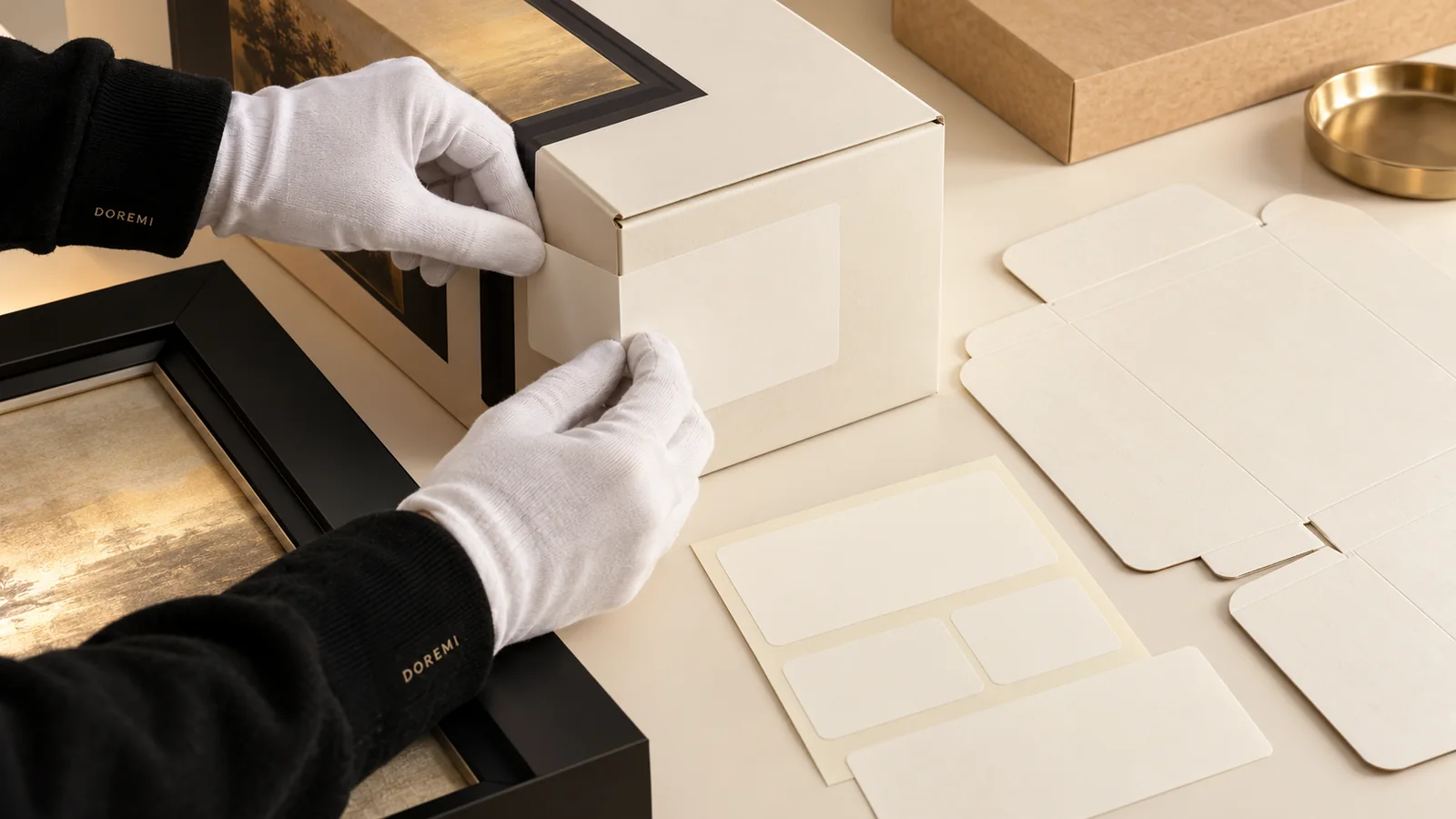
A PDF can hide scale, contrast, fold position and surface problems. Review a production-equivalent box with final substrate, printing, coating, closures, variable label and packed frame. Check that legal information is legible and not interrupted by a seam, handle, opening flap or retailer sticker.
Compare the sample with the approved product master. Verify frame type, included parts, dimension statement, legal entities, origin, quantity, date area, MRP and consumer-care data as applicable. Photograph all panels and retain the signed revision. Do not approve solely from a lifestyle front panel.
Build change control for every dependent field
Trigger reapproval when the importer, manufacturer, packer, origin, pack quantity, frame dimensions, product name, MRP, consumer-care contact, carton construction or sales channel changes. Also recheck when India publishes a relevant amendment or official clarification. Put these triggers in the purchase agreement and artwork workflow.
Quarantine obsolete printed stock and control any authorised transition. Suppliers should report substitutions before production, not after shipment. The importer should own the legal conclusion; the OEM should provide accurate product and production facts and implement the approved artwork.
Buyer–OEM artwork checklist
- Current official act, rules, amendments and guidance reviewed
- Retail, grouped, gift, shipping and marketplace configurations mapped
- Manufacturer, packer, importer and consumer-care entities confirmed
- Common or generic product name approved
- Country-of-origin conclusion owned by the responsible importer
- Quantity and included pieces match the physical pack
- Relevant dimensions and units are defined consistently
- Date field and variable-print source are controlled
- MRP value and presentation come from the Indian owner
- Consumer-care channels have been tested
- Box and e-commerce fields are mapped
- Artwork areas remain visible after fulfilment labelling
- Production sample matches the approved SKU master
- Label application, inspection and reject control are documented
- Changes trigger local re-review before production
Experience scope and project limits
Editorial review: Jessica, Founder & Project Advisor at DOREMI Display. Updated 24 October 2026. Jessica's practical scope covers display-frame specifications, retail and export packaging, artwork handovers, samples, production coordination and inspection. She is not presented as an Indian Legal Metrology authority, importer of record, tax adviser, marketplace operator or lawyer.
This guide is educational. The current law, package type, commodity, exemptions, State or Union Territory enforcement, importer facts and qualified Indian review control the final declarations. Obtain approval from the responsible Indian importer and adviser before printing or listing.
Public sources used for this guide
- Google Search Central: optimizing for generative AI features
- India Code: Legal Metrology Act, 2009
- Department of Consumer Affairs: Packaged Commodities Rules with amendments
- Department of Consumer Affairs: Packaged Commodities FAQs
- Department of Consumer Affairs: outer retail-package declaration advisory
- Department of Consumer Affairs: 2023 amendment rules