
A wooden display frame and the wood used to carry it across a border are not the same compliance question. ISPM 15 is directed at wood packaging material used to support, protect or carry commodities in international trade. A frame made from wood may be the product, while a solid-wood pallet, crate, packing block or piece of dunnage is transport packaging. Buyers need to identify both accurately and apply the destination’s current rules to the correct item.
This guide is for importers, private-label brands, distributors, brokers, logistics teams and frame suppliers planning international shipments. It turns official IPPC, USDA APHIS and U.S. Customs information into a supplier handover. It is not phytosanitary, customs or legal advice, and it does not decide the requirements of every country, route or construction.
Ask the threshold question about the packaging, not the product name
Start by listing every material used to support, protect or secure the shipment: pallet, skid, collar, crate, case, box, bin, reel, drum, load board, packing block and dunnage. USDA APHIS includes these forms in its wood-packaging guidance. A shipment described commercially as picture frames can still contain regulated wood packaging even when the retail pack is paperboard.
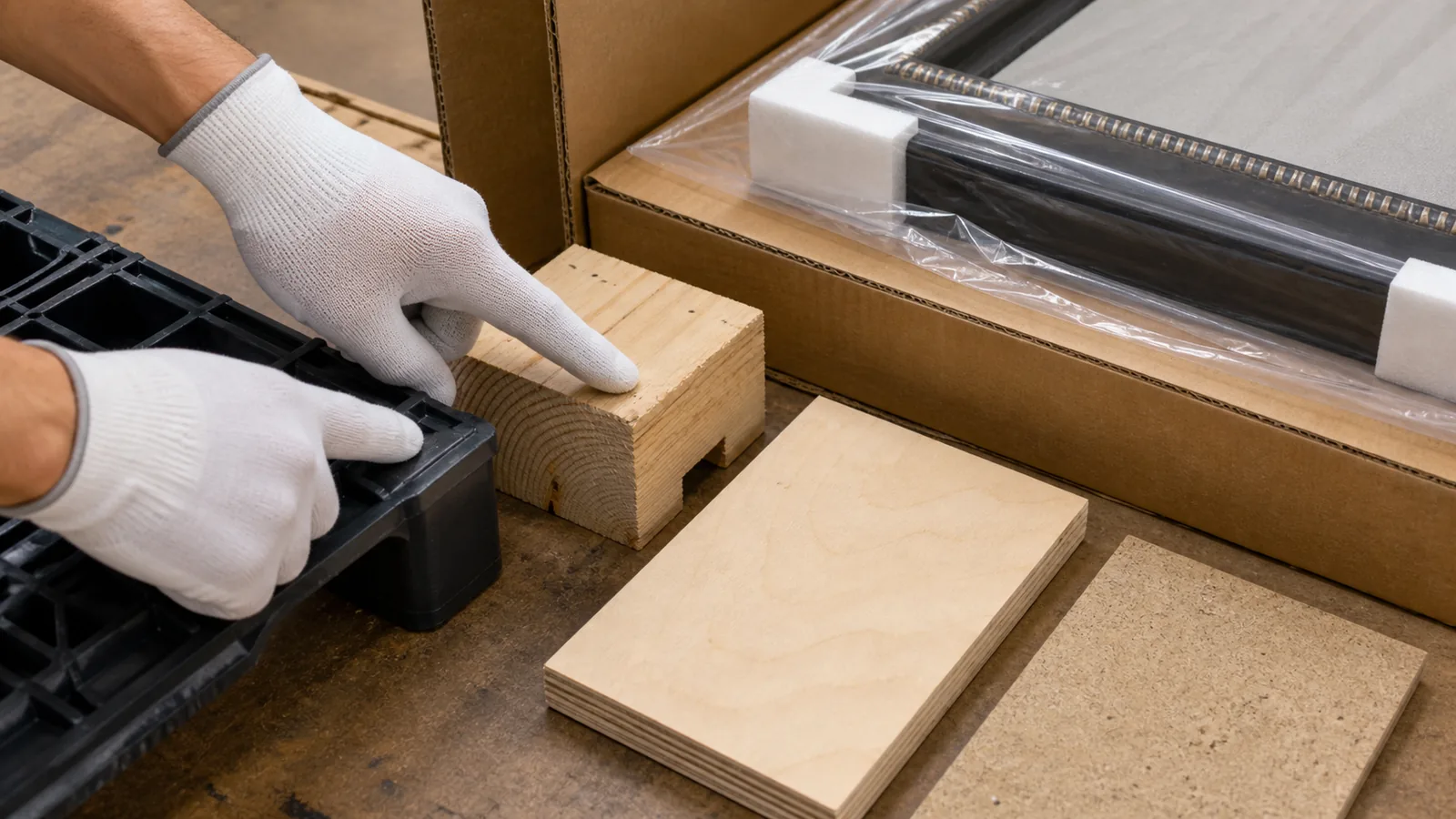
Record which pieces are solid wood, processed wood, plastic, metal or paper-based. Do not infer material from colour or appearance. A pallet block may be solid sawn wood, moulded composite or another construction. Ask the packing provider to identify the material and retain photographs before wrapping hides the evidence.
Separate the frame’s wood from wood packaging material
ISPM 15 defines wood packaging material around its cargo-supporting role. It does not turn every wooden commodity into packaging. A solid-wood frame sold to the customer is normally described and regulated as the imported product under the destination’s product, customs, plant or timber rules. The pallet or crate carrying it is a separate packaging layer.
Keep this distinction in the purchase order, packing list preparation and broker handover. Do not write all wood is ISPM 15 treated if the statement is intended only for a pallet. Equally, do not assume that a treated wooden product makes an unmarked pallet acceptable. Product-origin, EUDR, Lacey Act, tariff or material-claim questions require their own review.
Map the complete route and current country rules
ISPM 15 is an international standard implemented through national plant-protection systems. Import procedures, enforcement and permitted actions can vary. Check the destination and transit requirements with the importing country’s national plant protection organisation, official database, broker or qualified adviser before the packing method is approved.
For the United States, USDA APHIS directs importers to its Agricultural Commodity Import Requirements database and states that incoming or transiting regulated WPM must be compliant. Australia, the EU, Canada and other markets publish their own official guidance. Date the check and identify the exact route; a rule remembered from a previous shipment is not sufficient current evidence.
Understand the difference between solid wood and processed alternatives
APHIS identifies plywood, pressboard, oriented strand board, hardboard and plastic pallets among alternatives not subject to its WPM regulation. This can help buyers design an export pack that avoids regulated solid wood where performance, cost and destination rules allow. The construction still needs to be verified rather than described only as wood-free.
A processed-wood panel can be attached to solid-wood battens or pallet blocks, making the combined item relevant to WPM controls. A paperboard crate may use hidden timber bracing. Ask for a section or bill of materials where the construction is not obvious. Never remove solid-wood bracing solely for compliance if a competent packaging designer has not confirmed a safe alternative.
Source regulated WPM from an authorised provider
USDA APHIS tells importers to use accredited companies and review the accreditation overseen by the exporting country’s national plant protection organisation. The frame factory should not create, copy or apply an IPPC mark unless it is authorised within the official programme. A photograph of a stamp is not a substitute for knowing who made and treated the packaging.
Record the WPM provider’s legal identity, authorisation reference, treatment facility, packaging type and the party responsible for applying the mark. If the display-frame supplier purchases finished pallets or crates, include that provider in the approved-supplier and incoming-verification process. Keep the evidence connected to the actual units used for the shipment.
Know what the official mark must communicate
APHIS describes the official mark as including the IPPC symbol, a two-letter country code, a unique facility number and a treatment code such as HT or MB. The IPPC standard controls the mark’s design and application. Buyers should use the current official standard and country programme, not recreate a logo from an online image.
Ask a trained person to verify that marks are legible, permanent, visible and applied in the required way before cargo is loaded. Do not add marketing graphics inside the mark or place it on a removable label unless the official programme permits that method. This article deliberately does not reproduce a fabricated mark.
Inspect the mark on the actual pallet or crate
Include mark verification in the final packing and container-loading checklist. Photograph the whole pallet or crate, then close views that show the mark and construction without exposing unrelated customer information. Capture more than one side where relevant and keep the photos with the shipment identity, packing date and container or booking record.
A certificate emailed by the pallet supplier may support traceability, but border inspectors examine the physical WPM. If stretch wrap, cartons or load orientation will hide the mark, review visibility before finalising the pack. Do not rely on a mark photographed on a sample pallet if different units are used for the shipment.
Inspect for pest evidence and packaging condition
APHIS identifies unmarked or inappropriately marked WPM and signs such as pests, feeding damage, exit holes or frass as concerns. Treated and marked WPM should still be checked for visible contamination or damage. A compliant mark does not make a broken, wet or structurally inadequate pallet acceptable for fragile frames.
Create a receiving and pre-load inspection that covers both phytosanitary indicators and transport condition. Quarantine suspect items, prevent accidental use and contact the authorised WPM provider or qualified phytosanitary owner. Do not brush away evidence and proceed; the shipment risk needs a documented decision.
Control dunnage and blocking inside the container
Dunnage used to secure or support cargo is part of the WPM definition when it is made from regulated wood. A shipment can use compliant pallets yet fail because loose timber bracing, chocks or blocks were added during container loading without the required treatment and mark control.
List every intended securing material in the load plan. Require the loading team to use approved items and prohibit unplanned scrap wood. If last-minute blocking is necessary, pause and obtain compliant material or an approved non-wood alternative from the responsible provider. Photograph the final securing arrangement before doors close.
Manage mixed-material and repaired packaging
A crate can combine plywood panels, solid-wood rails, metal fasteners and foam. The buyer should identify which solid-wood elements need to be covered by the official programme and how the completed article is marked. Repaired or remanufactured WPM needs control under the current ISPM and national programme; old marks should not be assumed valid after uncontrolled repair.
Ask whether pallets are new, reused or repaired and what evidence supports their status. Do not overstate that reused packaging is prohibited: the correct question is whether the actual unit remains compliant, structurally suitable and accepted for the route. Involve the authorised provider where marks, components or repairs are uncertain.
Keep WPM dry without inventing a treatment claim
Heat treatment for phytosanitary purposes and kiln drying for moisture management are not interchangeable commercial phrases. Do not use dry, kiln-dried or heat-treated as synonyms unless the provider’s evidence and official programme support the exact statement. Treatment compliance does not guarantee a pallet is dry enough for every frame-shipment moisture plan.
The CTU Code advises against packing wet timber planks, bracings, pallets or packaging with moisture-sensitive cargo. Display frames, backing boards, cartons and metal hardware can be vulnerable to condensation or moisture. Measure and manage packaging condition through the qualified packing plan rather than assuming an IPPC mark controls humidity.
Connect phytosanitary compliance to structural design
ISPM 15 addresses pest risk, not pallet load capacity, crate engineering, shock protection or carton compression. The packaging designer still needs the product dimensions, centre of gravity, glazing, packed mass, handling route, stack pattern and securing method. A correctly marked pallet can be too weak; a strong unmarked solid-wood pallet can be non-compliant.
Approve the structure and compliance route together. If the project changes from parcel cartons to a wooden export crate, or from engineered-wood pallets to solid timber, trigger both packaging validation and WPM review. Keep responsibilities visible so logistics does not assume the factory’s product approval covers the transport base.
Define evidence in the purchase order and packing instruction
State the destination, regulated WPM types, approved provider requirement, official treatment and marking requirement as confirmed by the responsible adviser, mark visibility, inspection points and photo evidence. Identify who releases WPM at incoming inspection and who performs the final pre-load check.
Avoid vague clauses such as export standard wooden packing. That phrase does not identify material, structure, treatment, mark, destination or evidence. Use a named packaging drawing or revision and connect it to the frame SKU, carton configuration and shipment. Commercial documents should not make broader compliance claims than the evidence supports.

Coordinate supplier, forwarder, broker and importer
The frame supplier controls product and packing information; the WPM provider controls authorised treatment and marking; the packer or warehouse controls what is actually used; the forwarder coordinates transport; the broker and importer handle destination entry responsibilities. Write this chain for the exact shipment rather than assuming one party owns everything.
Hold a short handover before cargo pickup. Confirm pack revision, pallet or crate count, material, mark evidence, dunnage, container-loading instructions, document descriptions, destination advice and escalation contacts. Resolve missing evidence before the truck or container deadline turns a correctable issue into an import risk.
Plan for non-compliance without improvising
For U.S. imports, CBP states that non-compliant WPM may require immediate export and that the importer is responsible for exporting it. Other countries may use different actions. Buyers should understand potential holds, treatment restrictions, separation options, costs, notifications and decision authority with their broker and official agencies before shipment.
If a problem is found before departure, quarantine the affected WPM, stop loading and replace it through an authorised source. Preserve photographs and provider records. If an authority issues a notice after arrival, follow the official direction; do not remove marks, rework packaging or arrange treatment without approval.
Audit the control on repeat shipments
Reorders can drift when a warehouse changes pallet suppliers, a crate is repaired, a loading team adds scrap dunnage or a route changes. Include WPM in supplier change notification and periodic shipment review. Compare marks, provider identity and construction with the approved baseline.
Track exceptions and corrective actions rather than treating each photograph as an isolated task. A stable programme has named providers, controlled packing revisions, trained inspectors and an escalation route. That system is more dependable than requesting an ISPM certificate after the container is already sealed.
Buyer ISPM 15 handover checklist
- Destination and transit requirements are checked in current official sources
- The wooden frame product is distinguished from transport packaging
- Every pallet, crate, block, case and dunnage component is identified by material
- Processed-wood or plastic alternatives are verified for the exact construction
- Regulated WPM comes from an authorised provider under the exporting NPPO
- The official mark is checked on the actual packaging before loading
- Photographs connect marks, construction and count to the shipment
- No unapproved scrap timber or dunnage is added at loading
- Reused or repaired WPM has a documented compliance decision
- Pest evidence, damage and moisture condition are inspected separately
- Structural packaging validation remains distinct from phytosanitary compliance
- Purchase order and packing instruction name the revision and evidence owner
- Supplier, warehouse, forwarder, broker and importer responsibilities are clear
- Non-compliance escalation follows official destination instructions
Experience scope and project limits
Editorial review: Jessica, Founder & Project Advisor at DOREMI Display. Updated 25 August 2026. Jessica’s practical scope covers display-frame specifications, export packing coordination, supplier communication, sample review and buyer handover. She is not presented as a national plant protection authority, customs broker, phytosanitary treatment provider, packaging engineer or lawyer.
This guide is a planning framework, not a compliance determination. Importers must check current requirements for the actual country, transit route, commodity, packaging material and shipment with official agencies and qualified advisers. Only authorised providers may apply official IPPC marks.
Public sources used for this guide
- Google Search Central: optimizing for generative AI features
- USDA APHIS: importing ISPM 15-compliant wood packaging material
- USDA APHIS: wood packaging material resources
- IPPC: ISPM 15 implementation resources
- U.S. Customs and Border Protection: WPM import and export requirements
- UNECE CTU Code: planning of packing