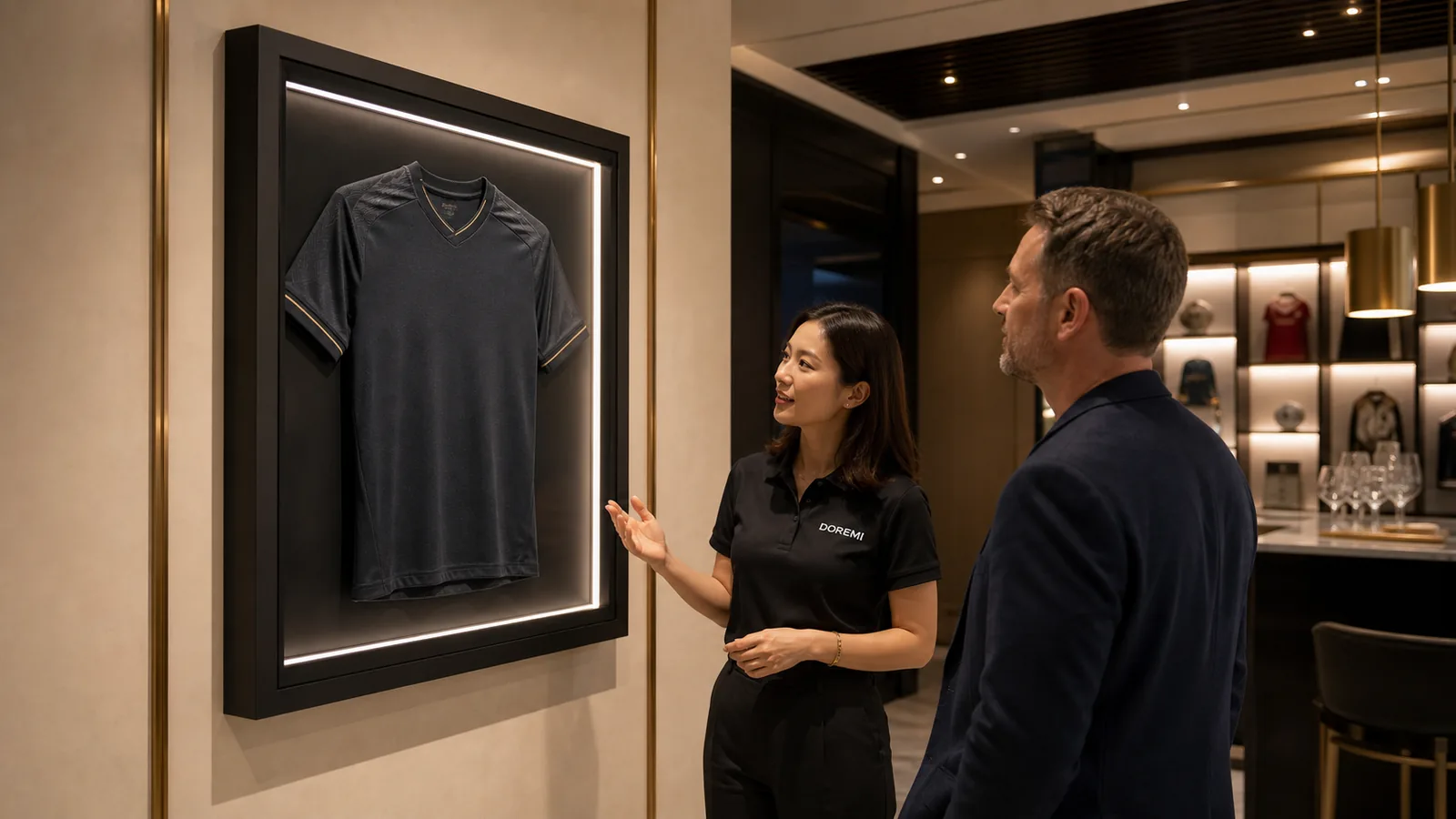
Adding an LED strip to a display frame changes more than the mood of the product. It introduces a power architecture, wiring, heat, electromagnetic behaviour, restricted-substance questions, end-of-life obligations and a technical file. A declaration for a separate adapter or LED strip does not automatically establish conformity of the assembled private-label frame.
This guide is for EU importers, sports and music licensors, hospitality groups, retailers and institutional procurement teams buying illuminated jersey, certificate, poster, vinyl or memorabilia frames. It provides a specification and evidence workflow. It does not determine which legislation or harmonised standards apply to a particular model, perform conformity assessment, or replace an EU compliance professional, laboratory or market-surveillance authority.
Freeze the product architecture before asking for certificates
Describe whether the frame uses an external mains adapter, an internal power supply, USB power, a rechargeable battery, replaceable cells, a dimmer, touch control, remote, timer, Bluetooth or Wi-Fi. Record rated input and output, cable length, connector, LED type, driver, control board and installation location. Small functional differences can change the legislation and evidence path.
State indoor or outdoor use, wall-mounted or freestanding installation, intended user, access for changing the displayed object and whether electrical parts remain energised when the back is open. A supplier cannot choose a credible assessment from the front photograph. The finished electrical block diagram and intended use are the starting documents.
Distinguish a passive frame from electrical equipment
A passive frame may not require CE marking merely because it is a frame, as DOREMI’s earlier importer guide explains. An illuminated frame is a different product. Once electrical or electronic functions are integrated, EMC, RoHS and other Union rules may apply, and the frame’s power arrangement may bring parts of the product under the Low Voltage Directive.
Do not reuse a declaration from the passive family or add a CE mark because the adapter bears one. Define a separate electrical SKU and revision. The responsible manufacturer evaluates all applicable Union harmonisation legislation for the complete model and draws up the EU declaration of conformity on that basis.
Map economic-operator roles for the private label
Under the LVD, EMC and RoHS frameworks, importers have defined checks and record obligations. A business placing the product on the market under its own name or trade mark, or modifying it in a way that may affect compliance, can take on manufacturer obligations. Record the legal manufacturer, EU importer, distributor, brand owner and WEEE producer role for each market.
A contract can assign work, but it cannot make statutory duties disappear. The product, packaging and accompanying documents must carry the required identities and contact information. The team keeping the technical file and declaration must be able to provide them to authorities for the applicable retention period.
Check Low Voltage Directive scope by actual ratings
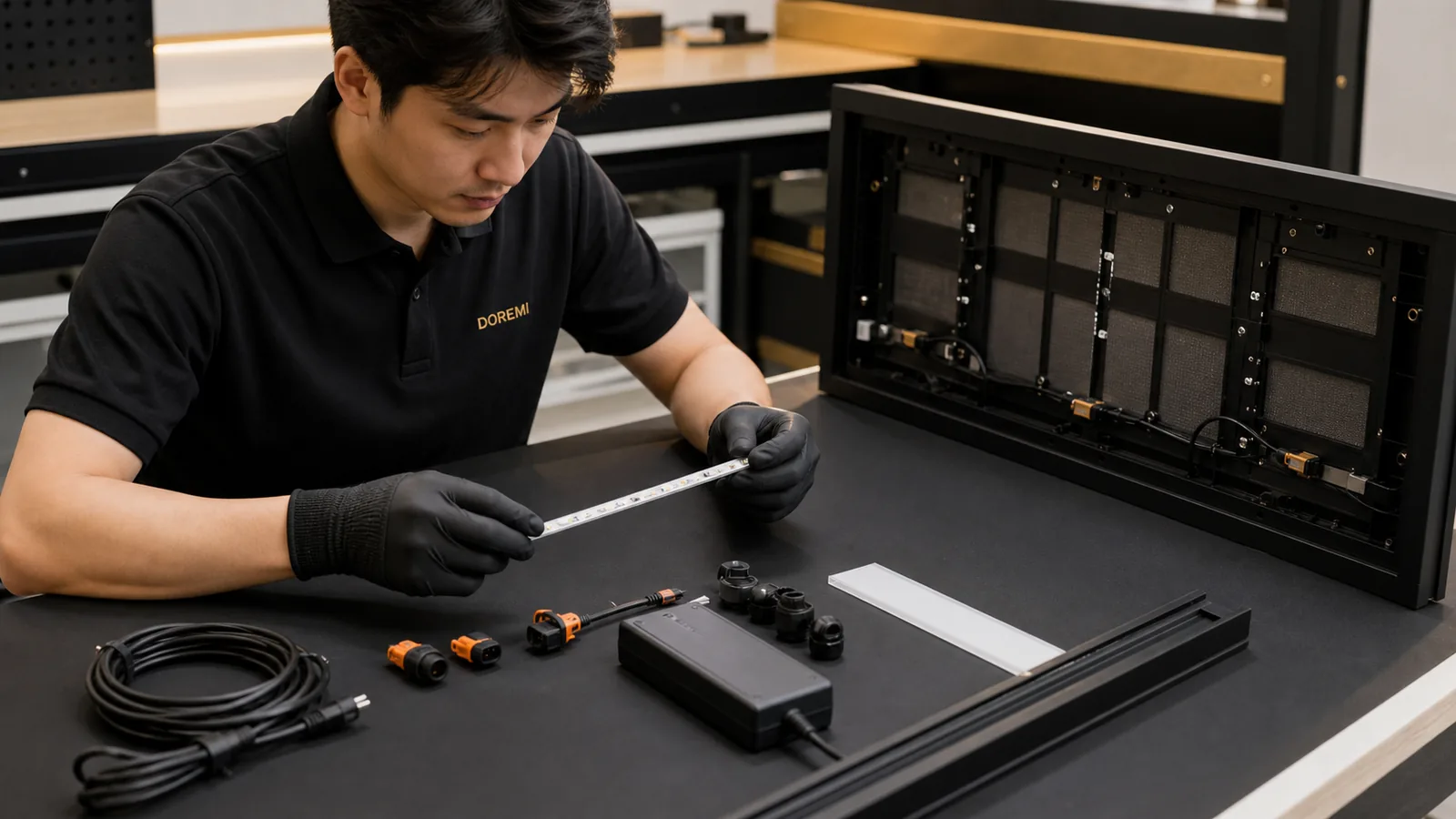
The European Commission states that the LVD covers electrical equipment designed for use with input or output voltages from 50 to 1,000 volts AC and from 75 to 1,500 volts DC. A low-voltage LED strip inside the frame may sit below those thresholds while its mains adapter falls within them. This does not make the complete product unregulated or automatically safe.
Have a qualified reviewer map the adapter, cables, frame circuits and interfaces. Below-LVD consumer products can still fall under the General Product Safety Regulation and other applicable rules. Do not market “low voltage” as a universal compliance exemption. Record which legislation covers each safety risk and who owns the finished-product assessment.
Treat EMC as a finished-configuration question
The EMC Directive addresses the ability of equipment to function in its electromagnetic environment without creating intolerable disturbances. LED drivers, dimmers, switching adapters, control boards and long cables can affect emissions and immunity. A frame may behave differently from the bare driver because enclosure, grounding, cable routing and load have changed.
Define worst-case configurations for assessment: longest supplied cable, highest-power size, dimming states, control modes and intended adapter. If several frame sizes use one electrical design, justify the representative model rather than assuming the smallest sample covers the largest. Keep the rationale and test configuration in the technical file.
Build RoHS evidence from homogeneous materials
RoHS restricts specified substances in electrical and electronic equipment, subject to scope and exemptions. A finished-frame declaration should be supported by the electrical bill of materials and material evidence for relevant homogeneous materials: solder, cable insulation, connector plating, LED packages, circuit boards, enclosures and other parts.
Supplier declarations are inputs, not an automatic product conclusion. Link each document to a manufacturer part number and revision. Use risk-based testing where the evidence, supplier history or material category warrants it. A broad statement saying “all components are RoHS” is weak if it cannot be reconciled with the production bill of materials.
Plan WEEE obligations market by market
The WEEE Directive creates collection, treatment, information, marking and producer-registration duties implemented through Member States. A brand selling electrical frames in several EU countries should not assume one factory declaration or one registration covers every destination. Identify who is the producer for each country and which authorised scheme or representative is needed.
Coordinate the crossed-out wheeled-bin marking, producer identification, registration numbers where required, reporting data, sales weights and treatment information with local advisers. WEEE is not simply another line on the CE declaration. It is an ongoing market and end-of-life operating system.
Evaluate the external adapter as a controlled component
Specify manufacturer, model, electrical ratings, plug, cable, insulation class, indoor-use conditions and output connector. Obtain its declaration and relevant reports, but also verify that the adapter is appropriate for the final load and sales country. An apparently equivalent substitute can change safety, EMC, energy or labelling evidence.
Prevent open-market substitution during production. Put the approved adapter on the bill of materials and require written change approval. Inspect production units for model identity and ratings. If the buyer supplies the adapter separately, document how the complete consumer offer and instructions remain coherent.
Control temperature and material interaction
LEDs, drivers and adapters generate heat. Measure relevant temperatures in representative operating positions, including the largest or most demanding frame, maximum brightness and expected ambient conditions. Review clearance to jersey fabric, paper, foam, adhesives, acrylic, wood composites and enclosed cavities. Ventilation that works on an open bench may fail after wall installation.
A compliance professional should select safety requirements and methods. Procurement should ensure the sample matches production: LED density, driver, diffuser, wire gauge, backing and ventilation. Do not convert one room-temperature demonstration into a lifetime or fire-safety claim.
Design wiring for assembly and customer access
Map strain relief, insulation, connector retention, routing near sharp profile edges, protection from screws and separation from moving back panels. If customers open the frame to install memorabilia, wiring must not become an accidental handle or trap. Define whether electrical access requires a tool and what the instructions say about disconnecting power.
Inspect corners and pass-through holes where cables can be pinched. Include cable routing in the approved sample photographs and work instructions. A supplier may reproduce the front appearance while changing the hidden route, so the back construction needs its own controlled evidence.
Choose standards only after the product is classified
Harmonised standards can provide presumption of conformity for requirements they cover, but the correct list depends on product function and scope. A test laboratory should not begin with “our normal LED test package” without the intended use, architecture, market and risk assessment. Ask the compliance owner to document why each standard and edition was selected.
Confirm the laboratory’s competence and scope for the methods used. A component report may support the file, but gaps remain where the frame changes enclosure, load, cable, thermal conditions or user access. Record deviations, engineering judgements and any additional verification.
Create a variant and worst-case matrix
List frame size, LED length and density, power rating, adapter, controller, cable, materials, mounting and market plug. Identify common and variable elements. Then document which tested model represents each risk: largest load for temperature, longest cable for EMC, tightest enclosure for heat, and each distinct control or radio function.
Do not add a remote or smart feature after testing and call it the same family. Radio functions can introduce the Radio Equipment Directive and cybersecurity-related requirements. Treat them as a new compliance review unless the responsible professional documents an acceptable relationship.
Build the technical documentation before mass production
The EMC and LVD frameworks describe technical documentation that includes a general product description, design and manufacturing drawings, component schemes, explanations, standards applied and solutions used to meet requirements. Add the risk assessment, bill of materials, critical-component evidence, reports, labels, instructions, photographs and change history needed for the actual product.
The file should identify the model on the declaration and on the product. A folder of unrelated certificates is not a technical file. Use one index with document owner, revision, date and applicable variant. Resolve missing evidence before the purchase order becomes difficult to change.
Draft the EU declaration of conformity from the file
The legal manufacturer issues the declaration for the identified model and assumes responsibility for conformity with the listed legislation. The document should be reviewed for model identity, manufacturer, applied acts, standards or specifications, authorised signature and date. Do not list legislation merely because a test lab offers it.
Keep the signed declaration aligned with the product and instructions. If the adapter, controller or other compliance-critical part changes, the responsible party reviews whether the assessment and declaration remain valid. A date change alone does not update the evidence.
Plan markings and multilingual instructions
Confirm CE marking, product identification, manufacturer and importer details, electrical ratings, WEEE marking and other applicable information with the compliance owner. Decide what appears on the frame, adapter, packaging and instructions. Space constraints should be solved in the design, not by making required information unreadable.
Instructions and safety information must be understandable in the Member State where the product is supplied. Include intended indoor or environmental conditions, installation, wall-mount limits, power connection, opening, cleaning, fault response and disposal information as applicable. Translation should preserve technical meaning and model-specific warnings.
Validate mechanical and electrical risks together
An illuminated shadow box can be heavier than a passive frame because of the deeper enclosure, power components and glazing. Electrical conformity does not prove the wall fixing or hanging system is adequate. Specify finished mass, hardware, wall assumptions and installation instructions, and obtain appropriate mechanical verification.
Also inspect what happens if the frame shifts, a cable is pulled or the back is opened while mounted. Product safety is the interaction of enclosure, installation, power and use. Keep the electrical and mechanical risk reviews connected even when different specialists perform them.
Run a production and packing gate
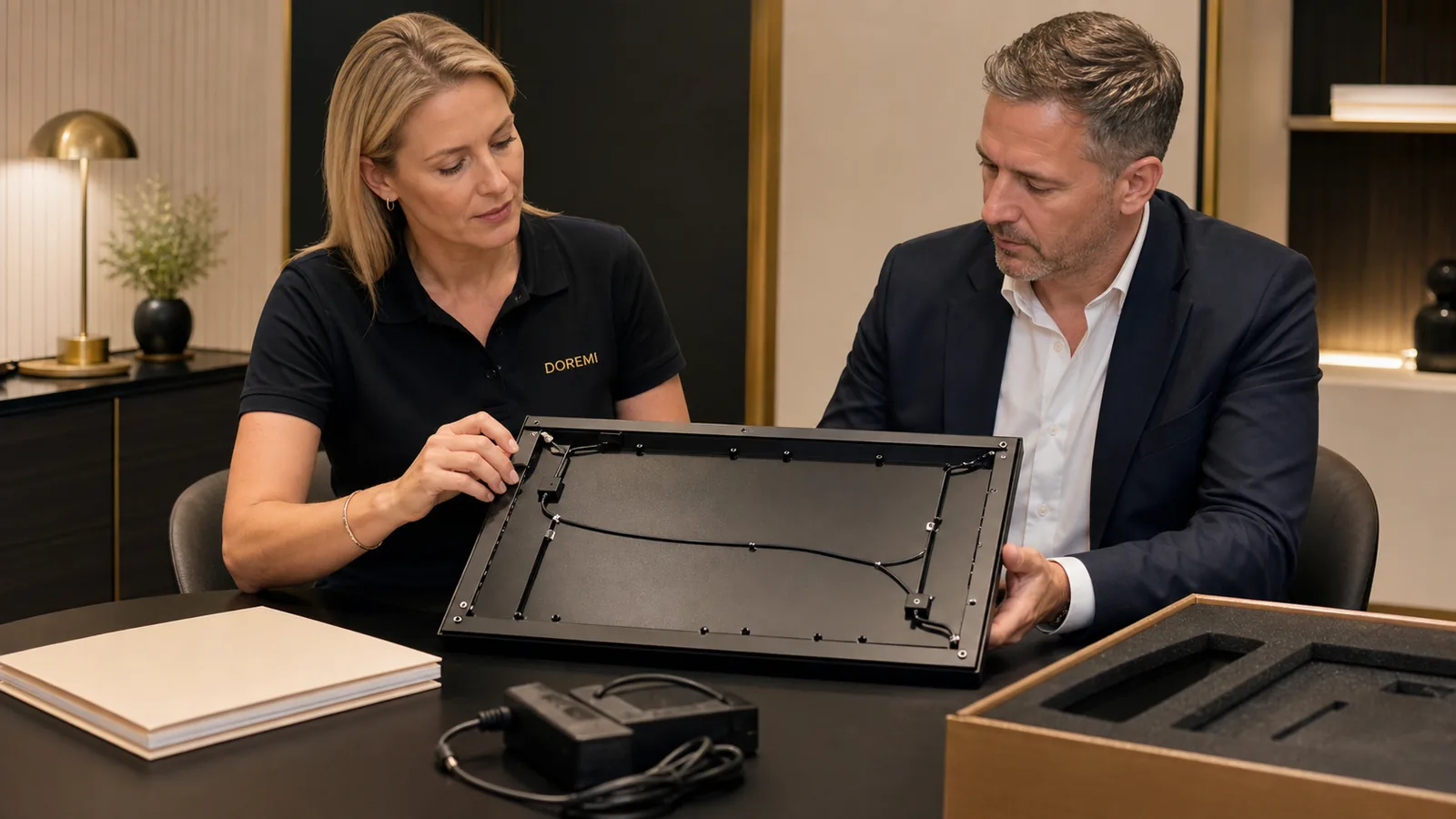
At pilot and pre-shipment stages, compare critical component identities, wire routing, connector retention, illumination, temperature-related construction, labels, instructions and packaging with the approved reference. Power a representative sample through operating states and investigate flicker, noise, overheating, loose connections or controller faults under the approved test plan.
Package the adapter and cables so they cannot scratch glazing or damage the frame. Confirm the customer can identify the correct parts without opening electrical enclosures. If packaging or transport changes ventilation parts, cable bends or enclosures, recheck the product before shipment.
Control complaints, incidents and corrective action
Define serial or batch traceability for the frame and critical electrical components. Customer support should capture model, adapter identity, market, installation, operating mode, photographs and fault description. Separate cosmetic lighting variation from overheating, shock, smoke, repeated adapter failure or mounting incidents that require escalation.
EU economic operators have duties when they believe a product is non-compliant or presents a risk. Prepare contact and decision routes before launch. Keep complaint, non-conforming-product, withdrawal and recall records as required by the applicable legislation and company system.
A copy-ready buyer checklist
- Intended use, environment, user and installation defined.
- Power block diagram, ratings and complete electrical bill of materials frozen.
- Manufacturer, importer, distributor and WEEE producer roles assigned per market.
- LVD, EMC, RoHS, GPSR, WEEE and any radio or battery scope reviewed.
- Worst-case variant matrix and assessment rationale documented.
- Adapter, LEDs, controller, cables and connectors controlled by model and revision.
- Risk assessment, drawings, reports, declarations, labels and instructions indexed.
- Languages, product identity, importer details and end-of-life information approved.
- Pilot, production, packaging and change-control gates assigned.
- Traceability, complaints and corrective-action routes ready before sale.
Experience scope and project limits
Editorial review: Jessica, Founder & Project Advisor at DOREMI Display. Updated 29 August 2026. Jessica’s practical scope covers display-frame briefs, material and layout review, sample coordination, packaging and supplier handover. She is not presented as an EU notified body, electrical engineer, test laboratory, legal adviser, national WEEE authority or market-surveillance authority.
This guide cannot establish legislation or standards for a specific product, certify an LED frame, approve a technical file or confirm registration in a Member State. Use production-equivalent samples and current EU and national requirements with qualified compliance, electrical, mechanical, environmental and legal professionals.