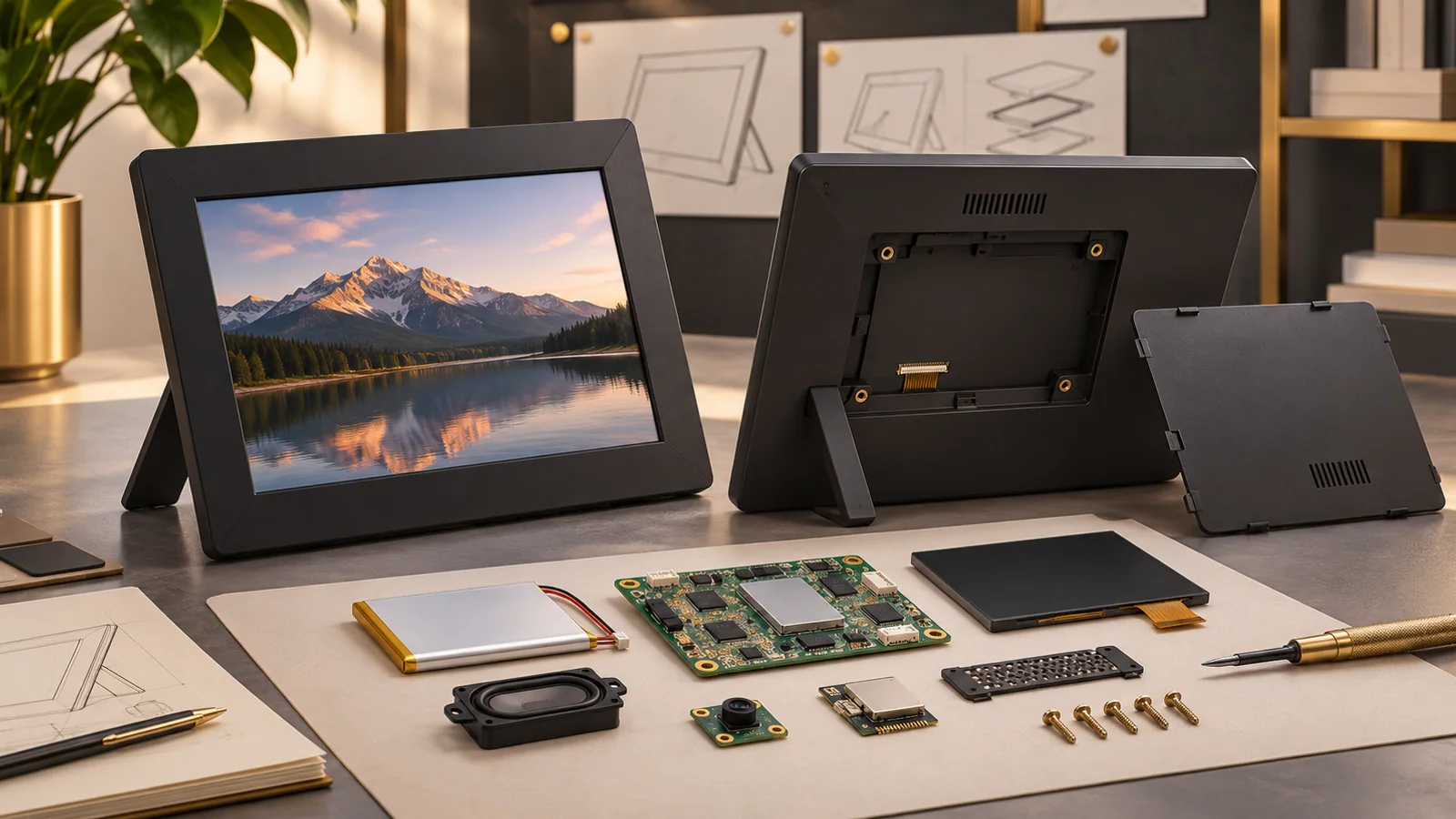
A private-label Wi-Fi digital photo frame can be easy to launch and surprisingly hard to repair. The brand may control the retail name while the overseas OEM controls board drawings, firmware recovery, replacement screens and service passwords. Minnesota’s Digital Fair Repair Act makes that split a procurement question: before a brand promises after-sales support, it should understand whether the product and business model enter the Act and whether the supplier can support the resulting service route.
This guide is for connected-frame brand owners, Minnesota retailers, importers, product managers, service teams and OEM/ODM factories. It organises a practical scope and evidence review under Minnesota Statutes section 325E.72. It does not decide that every digital frame is covered, interpret “fair and reasonable,” or replace advice from Minnesota counsel or the Attorney General.
Why are digital-frame buyers asking about repair access?
A connected frame combines a display, enclosure, power supply, radio module, firmware, app and sometimes cloud service. Common failures can involve the stand, adapter, display cable, storage, Wi-Fi board, corrupted firmware or account provisioning. A brand that cannot distinguish those failures may replace complete units, create avoidable waste and lose the evidence needed for supplier recovery.
These buyer questions are editorial inferences from the current statute, Attorney General guidance and normal OEM service handovers. They were not captured from Google AI Overviews or AI Mode. Google Search Central recommends helpful, reliable content and manual fact-checking; the useful answer therefore begins with the legal definitions and the actual repair channel rather than a generic “right-to-repair compliant” badge.
Screen the statutory product definition before making a conclusion
The Act defines digital electronic equipment around hardware that depends in whole or in part on embedded or attached digital electronics, and for which the original equipment manufacturer makes tools, parts or documentation available to authorised repair providers. A Wi-Fi frame plainly contains digital electronics, but the second part of the definition still requires facts about the OEM’s service model.
Ask whether the brand or manufacturer repairs the product itself, appoints an outside authorised provider, supplies service parts to a distributor or maintains a controlled service portal. Record the answer and evidence. Do not assume that a connected screen is covered solely because it has firmware, and do not assume it is outside scope because it is inexpensive.
Identify the original equipment manufacturer in a private-label structure
The statute’s OEM definition includes a business that sells or leases new digital electronic equipment manufactured by or on behalf of that business. A private-label brand can therefore have a different legal role from the factory that physically assembles the frame. The purchase order should not use “OEM” casually when the commercial brand, U.S. seller and manufacturer-of-record are different entities.
Create a role page showing the trademark owner, seller, importer, factory, firmware provider, app publisher, cloud operator and repair provider. Then identify who makes parts, tools and documentation available to the authorised channel. Qualified advisers should apply the statute to that real structure.
Use the correct date and sale route
The Minnesota Attorney General says the Act took effect on 1 July 2024 and applies to equipment sold on or after 1 July 2021. That historic reach matters when a brand continues to support older models or sells refurbished inventory alongside a new generation. Record first-sale dates by model and preserve the product revision in service records.
Do not use the factory shipment date as the only date field. Capture when the equipment was sold or used in Minnesota, the seller, the customer type and whether the unit was a sample, warranty replacement or retail sale. Counsel can determine how the Act applies to a particular transaction.
Check exclusions without stretching them
The Attorney General lists excluded categories such as motor vehicles, medical devices, specified off-road equipment and video-game consoles. A normal digital photo frame does not become excluded merely because it is used in a clinic, installed in a vehicle showroom or carries game-like software. Product purpose and statutory definitions matter.
Create an exclusion memo only when a qualified reviewer identifies a real provision and supporting facts. Keep it with the model file. An informal supplier email saying “consumer electronics are exempt” is not a reliable scope record.
Map documentation, parts and tools separately
The Act treats these as distinct elements. Documentation can include manuals, diagrams, reporting output, service-code descriptions and schematics. Parts are replacement parts or assemblies made available to authorised repair providers. Tools include hardware and software used to diagnose, maintain, pair, calibrate or return equipment to function.
Build three lists for each frame family. A PDF user manual is not a complete answer if the authorised provider also receives firmware recovery software, diagnostic codes, a screen assembly and a pairing utility. Conversely, do not demand items that the OEM never provides to its own authorised channel without first reviewing the statutory definitions.
Build a model-level service bill of materials
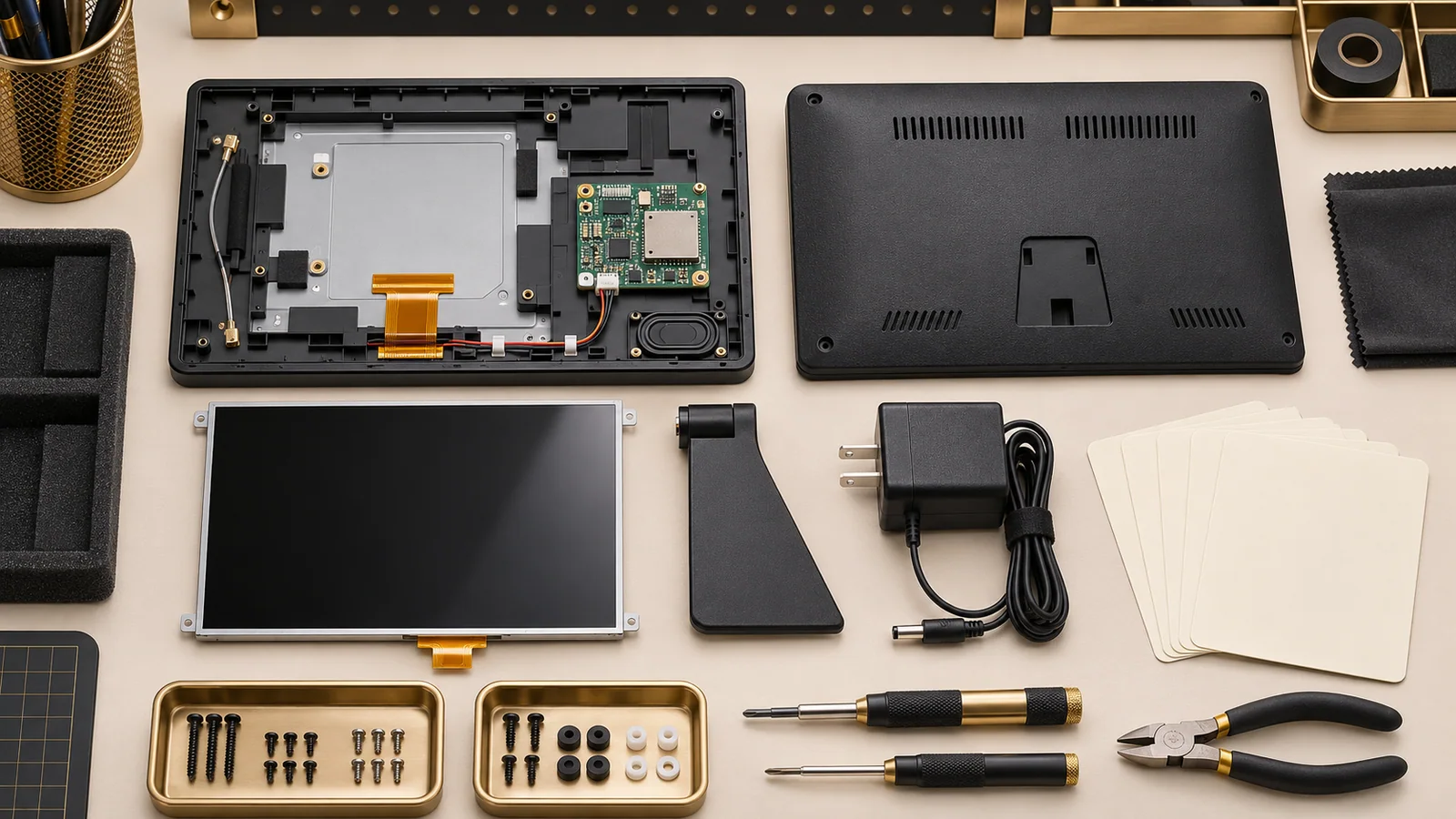
Start with failure-relevant assemblies: external power supply, stand, back cover, display panel, touch layer if present, main board, radio module, speaker, storage device, cables, fasteners and packaging needed for return shipment. Record part numbers, compatible revisions, lead times and whether the part is offered to the authorised channel.
A production BOM alone is not a service BOM. It may list factory subcomponents that are not safe or practical to replace in the field. The service list should reflect the repair level actually supported and show when a full assembly is used instead of a board-level component.
Connect embedded software to the repair plan
The statute includes updates to information or embedded software within the repair requirement. A replacement main board may need firmware, device identity, configuration, security keys, calibration or app compatibility. A physical part that cannot be activated is not a complete service path.
Document the approved recovery image, version checks, update source, pairing steps and access controls. Decide who can restore a device without exposing signing keys, customer photos or factory credentials. If the frame requires cloud re-enrolment, include that operational owner as well as the hardware technician.
Use the 60-day requirement as a launch checkpoint
Section 325E.72 says required parts, tools and documentation must be made available within 60 days after first sale in Minnesota. The brand should not wait for the first failure to ask the factory for a repair pack. Put a service-readiness gate beside packaging approval and production release.
Work backwards from the expected first sale. Allow time to translate or clean up manuals, validate recovery tools, stock parts, train the support team and publish an access route. The legal reviewer should confirm what must be available and to whom.
Review “fair and reasonable” terms at the item level
The statute contains detailed rules for parts, tools, software and documentation. For example, documentation is generally to be available without charge except reasonable physical-copy costs, while tool and software terms are compared with the most favourable terms offered to authorised providers. The responsible team should read the current text rather than reduce this to a single price cap.
Create a comparison sheet showing the authorised-channel price, independent-channel price, delivery method, access duration, prerequisites and restrictions for each item. Mark confidential legal analysis separately. Do not publish supplier cost data or credentials in a public manual.
Keep cybersecurity controls proportionate
Repair access does not mean publishing universal passwords, update-signing keys or customer data. The statute includes limitations relating to trade secrets, antitheft measures and modifications. A connected-frame brand still needs to protect account tokens, device certificates, personal photos and cloud administration.
Design least-privilege service tools. A technician may need to confirm a radio, restore approved firmware and erase storage without receiving access to production signing infrastructure. Log sensitive actions and test the reset state before a repaired unit returns to a customer.
Distinguish diagnosis and repair from product modification
The Act does not require access for the purpose of making modifications. Define the approved repair outcome: restore the model to its documented function, safety state and software release. Make this boundary visible in the service manual and parts catalogue.
A replacement display, board or wireless module can also change FCC, cybersecurity, privacy or electrical evidence. Require authorised replacement configurations and escalation for substitutions. Right-to-repair planning does not remove other compliance or product-safety reviews.
Do not confuse warranty rules with repair access
A warranty decides what the brand will pay for and what remedy it promises. Repair access concerns availability of service inputs. A unit can be outside warranty and still create an access question, while an in-warranty unit may still be routed through the brand’s authorised process.
Give support staff separate scripts for warranty eligibility, paid repair, independent repair, data erasure and safety recalls. Avoid telling customers that any independent repair automatically cancels all rights; obtain qualified advice on the exact warranty language and facts.
Evaluate the no-charge replacement route carefully
The statute includes a limitation where the OEM provides equivalent or better, readily available replacement equipment at no charge to the customer. This is a specific condition, not permission to substitute a discounted replacement or store credit for repair access. Counsel should assess whether a programme meets it.
If the brand uses replacement units, document equivalence, availability, data transfer, old-device handling and customer cost. A replacement may solve the immediate case while creating privacy and e-waste obligations that still need ownership.
Write a repairable OEM agreement
Include service BOM delivery, manuals, diagrams, software tools, update access, part availability, prices, lead times, training, security controls, change notice and end-of-life support. State which files arrive before first sale and which are updated during the product life.
Give the buyer a continued-use route if the factory relationship ends. Depending on risk and negotiation, that may include controlled source materials, recovery images, escrow, named component suppliers or a final parts purchase. Do not promise customers a repair horizon that the contract cannot support.
Validate the repair pack on a production-equivalent unit
Select representative failures and ask a technician who did not design the frame to follow only the supplied materials. Time diagnosis, confirm tool access, replace the approved assembly, restore firmware, verify radios and perform a secure reset. Record missing steps and ambiguity.
The goal is not an invented performance claim. It is evidence that the handover can be used. Repeat the validation when the board, display, firmware, enclosure fasteners or provisioning process changes.
Control model families and private-label variants
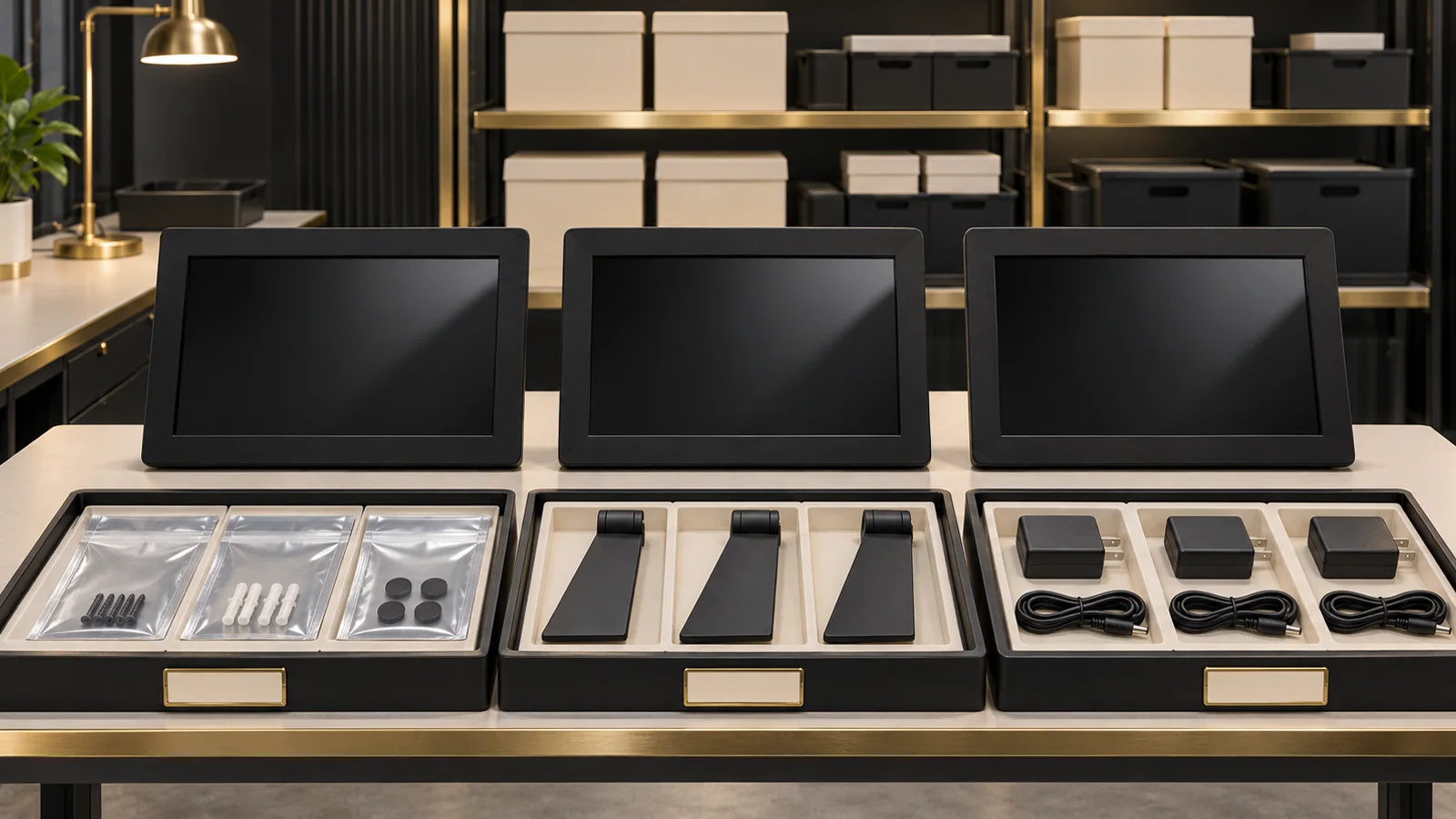
Two frames with the same outside appearance may use different panels, boards or firmware. Create a variant matrix linking retail model, serial or lot logic, main-board revision, display, adapter, radio module and app version to the correct service pack.
Private-label customers should not inherit a generic repair manual if their enclosure, firmware or cloud setup differs. Approve shared parts only after compatibility is verified. Retire obsolete files from the active service portal while retaining the records needed for units already sold.
Plan customer data handling through repair
Frames can hold family photographs, Wi-Fi credentials and account tokens. Tell customers what they should back up or erase, what the service centre may access, and what happens when a device cannot be powered on. Obtain privacy review for the collection and transfer process.
Use intake identifiers that do not expose photo content. After repair, verify that the intended data-retention or erasure step occurred. Do not ask a factory to browse user media merely to prove that a screen works.
Create an auditable readiness file
Keep the scope analysis, role matrix, authorised-provider facts, service BOM, manuals, tool access, price comparison, validation record, security review, first-sale date and change log together. Date the file and identify the reviewer.
Unknowns should remain visible. If the OEM cannot provide a recovery tool or cannot identify compatible displays, treat that as a sourcing risk before launch rather than filling the gap with a broad compliance statement.
Minnesota repair-handover checklist
- The statutory product definition is screened against real service facts
- The private-label brand, seller, factory and repair-provider roles are mapped
- First-sale dates and model revisions are recorded
- Documentation, parts and physical/software tools are listed separately
- The service BOM identifies compatible assemblies
- Firmware recovery and pairing are operationally owned
- The 60-day readiness gate is included in the launch calendar
- Terms are compared at item level with the authorised channel
- Security, privacy and antitheft controls remain protected
- Warranty and repair-access responses are separated
- The service pack is tested on a production-equivalent unit
- Changes trigger an updated model and evidence review
Experience scope and project limits
Editorial review: Jessica, Founder & Project Advisor at DOREMI Display. Updated 23 November 2026. Jessica’s practical scope covers digital-frame specifications, OEM/ODM quotations, component handovers, samples, packaging and buyer–supplier coordination. She is not presented as Minnesota counsel, the Attorney General, a repair-law auditor or a software-security assessor.
The brand, OEM, repair provider and qualified advisers must determine product coverage, definitions, exclusions, fair-and-reasonable terms, access controls, warranty language and enforcement exposure. This guide organises project evidence; it is not a legal opinion, repair licence or assurance of statutory compliance.