
An OEM display frame quotation is only as comparable as the brief behind it. If one supplier assumes acrylic, another prices glass, and a third excludes retail packaging, the lowest number is not a useful purchasing signal. It is three different products presented as though they were the same.
This guide is for importers, private-label brands, distributors and institutional buyers preparing a request for quotation for custom jersey, certificate, medal, vinyl record or mixed-object displays. It focuses on the decisions a factory needs before it can assess feasibility, build a sample and state a commercial basis. It does not prescribe a universal minimum order, tolerance, lead time or trade term; those belong to the actual project and contract.
Start the RFQ with one purchasing outcome
Begin with a short sentence that describes what the programme must achieve. A retail buyer might need a private-label shadow box that can be fulfilled one unit at a time. A club might need a coordinated wall installation. A university may need a frame platform that supports several certificate sizes. This outcome tells the supplier why apparently small details—opening method, outer dimensions, packaging level or record control—matter.
Then identify the target market, sales or installation channel, expected launch window and buyer team. Do not ask the factory to infer these from a mood board. A supplier can recommend a more suitable construction when it understands whether the product will be handled by consumers, installers, venue staff or a fulfilment centre.
Separate fixed requirements from supplier recommendations
Mark every line of the brief as fixed, preferred or open for recommendation. Brand colour, outside size and retail barcode may be fixed. Frame substrate, glazing thickness or hanging method may be open. A preferred line gives the supplier room to propose a practical alternative while showing what the buyer values.
This distinction prevents two common failures. The first is over-specifying a construction that has never been sampled. The second is giving so little direction that each supplier prices a different interpretation. A good RFQ creates a controlled comparison without pretending the buyer already knows every production answer.
Describe the displayed object before the frame
Record the object type, actual dimensions, thickness, weight, orientation and the areas that must remain visible. For textiles, include a physical sample or a measured folded-volume reference. For certificates, state the document size, orientation, paper features and protected content area. For medals or records, include thickness, attachment points and any components that vary between editions.
Photographs are useful but should not replace measurements. Add a ruler or known reference in object images, show front and back, and identify which sample is representative of production. If the object is irreplaceable or licensed, use a dimensional dummy for development and retain the original with its owner unless specialist handling is arranged.
Build a dimension stack, not one outside size
The RFQ should distinguish outside frame size, visible opening, internal usable depth, rebate or retention area, mat opening, backing size and finished wall projection. For a mixed layout, locate every plaque, image, medal or object from named reference edges. Include units and a drawing revision date.
Ask the supplier to return a dimensioned construction drawing with the quotation or sample proposal. That drawing is where hidden assumptions become visible. A small change in opening can affect the object fold, mat strength, glazing size, carton cube and perceived proportion. Approving only a front-view rendering leaves those consequences unresolved.
Specify the material system line by line
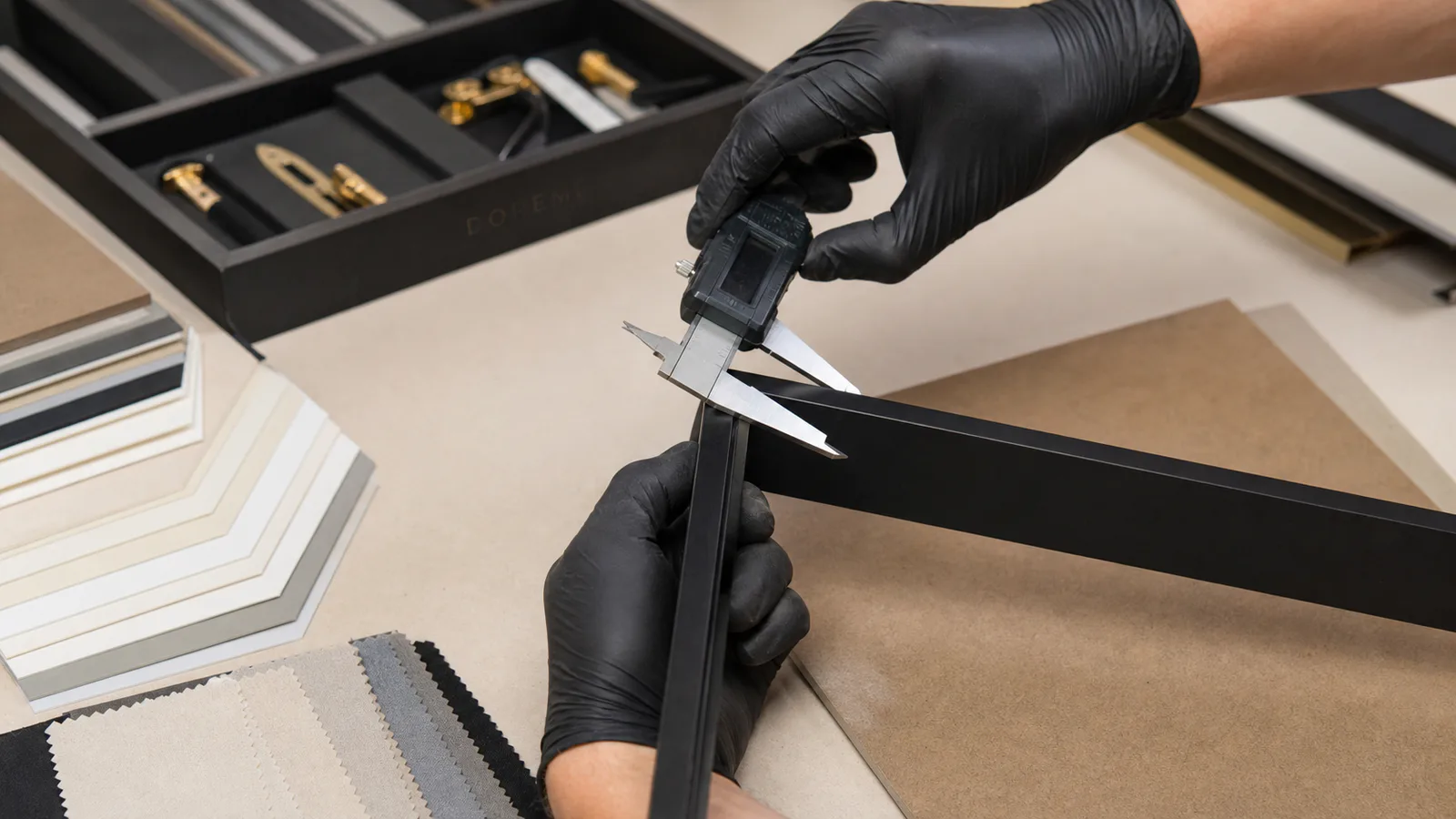
A phrase such as “black wood frame with clear front” is not enough for a repeat order. Break the construction into profile substrate, surface finish, glazing type and grade, mat or liner, object support, backing board, rear closure, hanging hardware and visible metal details. State any required appearance reference without making an unsupported material or conservation claim.
Where exact grades are not known, request the proposed supplier reference, datasheet and sample. If natural wood or hand-finished surfaces are acceptable, describe which variation is part of the desired character and which changes would be defects. If a metallic gold detail must match existing packaging, provide a controlled physical or digital reference and define how approval will be recorded.
Make the opening and mounting experience explicit
Some displays are sealed presentation pieces; others must be opened by a consumer who inserts a jersey, diploma or record. State who assembles the object, how often the frame may be reopened, what tools are acceptable and whether instructions are required. The backing and retention method should suit that real user, not only the factory bench.
For valuable, signed or sensitive objects, ask whether the mounting is reversible and whether any adhesive, pressure point or metal component touches the object. DOREMI can discuss practical frame construction, but an irreplaceable or culturally significant object should have mounting reviewed by a qualified conservator.
Give branding its own artwork schedule
List every branded surface: plaque, mat, printed insert, backboard, care card, presentation box, retail carton, master carton and shipping label. For each, state artwork owner, file format, colour reference, maximum print area, language version and approval contact. Keep product dimensions separate from artwork files so a logo update does not obscure a construction revision.
Confirm that the buyer owns or is authorised to use all names, marks, photographs and event assets supplied. The manufacturer can apply approved artwork; it cannot decide licensing rights for a club, university, artist or recipient. Avoid asking for a sample with protected marks before the internal rights review is complete.
State quantity as a planning range
Provide a launch quantity, likely repeat quantity and any size or colour split. If demand is uncertain, ask for clearly defined quantity tiers using the same specification. This allows the factory to explain where material purchase, tooling, printing or packing setup changes the commercial basis.
Do not copy a minimum order from another supplier or another category into the RFQ as though it were universal. MOQ can depend on profile availability, finish, print method, component tooling, size mix and packaging. Ask which element creates the threshold and whether a standard component or staged rollout could reduce risk without changing the approved customer proposition.
Define the sample ladder before asking for lead time
Separate digital layout, material or colour sample, appearance sample, functional sample, packaging sample and pre-production sample. One physical unit may cover several stages, but the approval purpose should be stated. A beautiful front-facing sample does not automatically approve wall hardware, opening method or export packing.
Ask the supplier to quote sample cost, sample build time, courier basis and the information required to start. Then show who approves construction, artwork, packaging and commercial changes on the buyer side. Lead time should begin from a named event—such as final sample and artwork approval—not from a vague “order confirmation.”
Ask for capacity evidence that fits the programme
A useful capacity question is not simply “How many frames can you make per month?” Ask which lines, skills or sourced components constrain this construction; what quantity can be supported in the required window; and how peak-season changes are managed. For repeat programmes, ask how the retained sample and final bill of materials will be used.
Evidence should be proportionate. Current production photographs, a live process review, sample consistency and a credible planning explanation can help. Do not treat a polished factory video, an unverified certificate image or a maximum output claim as proof by itself. If a certification is required, define the exact scheme, scope, issuing body and verification route with your compliance team.
Make packaging a quotation component
State the delivery route: pallet, container, fulfilment centre, parcel network, venue handover or a combination. Request individual-pack construction, master-carton quantity, packed dimensions, gross weight, opening sequence, presentation-box requirement and product orientation. Reference the separate packaging validation plan when formal testing or retailer compliance is required.
This RFQ should not repeat the entire transport-test protocol, but it must prevent packaging from disappearing behind the words “export carton.” Ask whether the quoted pack is a development assumption or an approved system. Require a production-equivalent packaging sample before the pack becomes part of the purchase order.
Add retail and logistics data early
If the product will be sold or scanned, state the primary scanning environment, barcode owner, symbol type, placement approval and quiet-area needs. GS1 guidance notes that barcode specifications and placement depend on where scanning occurs, and that folds, edges or other package layers should not obscure the symbol. The buyer or authorised GS1 owner should provide final data; the factory should not invent it.
Request packaged width, height and depth using an agreed orientation and measurement method. These values influence storage, freight and product data feeds. If master cartons or pallets need logistics labels, give the supplier the required data fields and approval workflow rather than adding a last-minute sticker wherever space remains.

Name the quotation basis and exclusions
Ask every supplier to return price currency, quantity tier, sample cost, tooling or setup, unit packaging, master packing, artwork setup, inspection basis, payment milestone, quotation validity and proposed Incoterms rule with a precisely named place. The International Chamber of Commerce explains that Incoterms allocate defined costs, obligations and risk between buyer and seller, but they do not replace the rest of the sales contract.
List exclusions clearly. Duties, destination taxes, third-party tests, retailer fees, installation, insurance or local delivery may sit outside the quoted unit. A comparison sheet should normalise these items before procurement ranks suppliers. The objective is not to force identical business models; it is to see what each number includes.
Define approval evidence and change control
Create a short approval register with product drawing, material references, artwork, physical sample, packaging drawing, packing sample and final inspection evidence. Give each item a revision, date, approver and status. State which changes require buyer approval and whether a new sample or validation step is needed.
After approval, the quotation should reference the same revision that production will use. If a profile, glazing grade, mat, plaque finish, carton supplier or barcode layout changes, record the impact on cost, timing, appearance, packing and validation. A decision log is often more valuable than a long message chain because it shows the current answer and why it changed.
Write acceptance criteria buyers can inspect
Describe critical, major and cosmetic issues in product language. Examples might include unsafe glazing, wrong artwork, insecure mounting, opened mitres, visible finish damage, dust inside the display, misaligned plaque, incorrect hardware or carton identification. Add a visual reference where a written description could be interpreted differently.
Do not insert a generic inspection level or tolerance copied from the internet. Agree the sampling and decision method with a qualified quality professional against order size, product risk, destination requirements and buyer policy. The RFQ should ask the supplier to confirm what in-process and pre-shipment evidence it can provide, not pretend that photographs alone replace inspection.
Use a return schedule that forces comparability
Provide a response table with one row for every requested field: compliant, alternative proposed, not available, information required, price impact and lead-time impact. Ask suppliers to attach their proposed drawing and material references. This makes a thoughtful alternative visible without allowing an assumption to hide inside a total price.
Include an open-issues section at the end. A credible supplier should be able to say what cannot yet be confirmed before receiving an object sample, artwork, route or test requirement. Unknowns are not automatically a weakness; unrecorded unknowns are.
A practical RFQ checklist
- Purchasing outcome, market, channel and launch window
- Displayed object dimensions, weight, orientation and representative sample
- Outside size, visible opening, usable depth and component layout
- Material, finish, glazing, backing, mounting and hardware lines
- Fixed, preferred and supplier-recommended requirements marked
- Brand artwork schedule and rights owner confirmed
- Launch quantity, repeat range and variant split
- Sample ladder, approvers and lead-time starting event
- Individual pack, master carton, route and packed-data needs
- Barcode, label and retail information owner
- Quotation inclusions, exclusions, currency and named trade basis
- Acceptance evidence, revision control and open issues
Experience scope and project limits
Editorial review: Jessica, Founder & Project Advisor at DOREMI Display. Updated 13 August 2026. Jessica’s practical experience covers B2B display-frame briefs, material and layout discussion, sample coordination, branded details, packaging handover and buyer approval records. She is not presented as a GS1 auditor, customs broker, contract lawyer, accredited testing laboratory, destination-market compliance authority or conservation specialist.
This article is a project-planning guide, not a purchase contract or assurance of price, MOQ, tolerance, lead time, compliance or factory capacity. Validate the final construction with actual objects, approved artwork, supplier documentation, physical and packaging samples, qualified testing where required, and your own quality, logistics, legal and destination-market review.