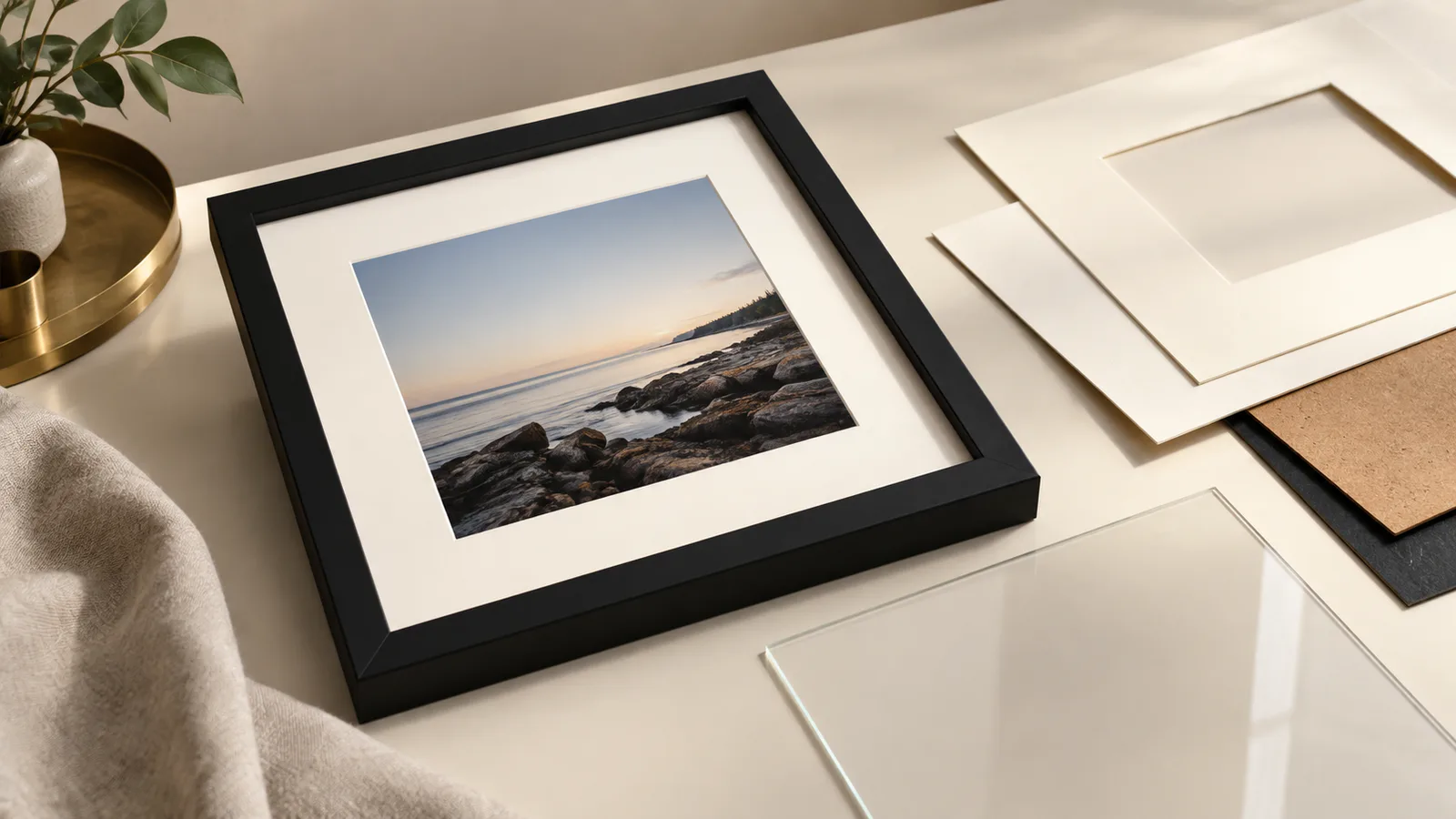
“Photo-safe,” “acid-free,” “museum quality” and “archival” can appear beside the same picture frame even though they do not describe the same evidence. For a private-label buyer, the useful question is not which phrase sounds strongest. It is which exact frame component was evaluated, for which photographic material, under which method and revision, and what the result does not cover.
This guide is for photo-gift brands, importers, institutional programmes, framers and quality teams specifying frames for processed photographs and printed images. It focuses on a practical supplier handover around ISO 18916:2025, the Photographic Activity Test (PAT), and ISO 18902:2013. It does not certify a material, interpret a purchased standard, or replace a photograph conservator, imaging-material specialist or qualified laboratory.
Why the 2025 PAT revision belongs in a current RFQ
ISO published the second edition of ISO 18916 in March 2025. Its public abstract describes a method for evaluating possible chemical interactions between enclosure materials and specified silver-gelatin photographic materials, with modified methods for certain chromogenic and diazo materials. The scope includes materials used for storage, display and transport, including paper, tissue, cardboard, mat board, plastics, adhesives, inks, paints, labels and tape.
A buyer should therefore update an old template that merely asks whether a frame is “acid-free.” Add fields for the standard designation and edition, tested material identity, supplier, test laboratory, report date, sample description, result and intended photographic process. The 2007 edition has been withdrawn, so an evidence pack should not hide the edition behind the phrase “PAT approved.”
Understand what PAT is designed to evaluate
PAT is an accelerated test for possible chemical interactions between a photographic image and materials that may be near it. It helps screen whether an enclosure material can contribute to specified image or stain changes under the method. That makes it relevant to matboard, backing, sleeves, plastics, adhesive systems, printed inserts and other parts of a frame package.
It is not a general quality badge for the whole finished frame. A result for one white matboard does not automatically cover a black core, a different surface paper, a printed decorative mat, an adhesive-backed board or a new supplier. Procurement should connect every report to the exact commercial grade and construction being quoted.
Do not turn a PAT result into an “archival” claim
The ISO 18916:2025 abstract explicitly states that passing PAT alone does not indicate that a material is archival. It also says the method does not address harmful physical interactions such as sticking, dye bleed, adhesive migration or plasticizer exudation, and it does not assess inherent chemical stability, physical integrity or workmanship. Those boundaries are commercially important.
If a packaging panel says “archival frame” while the supplier holds only a PAT result for one board, pause the artwork. Replace the broad claim with wording that a qualified brand and legal team can support from the complete evidence. A buyer can request PAT-related documentation without implying that the frame will preserve every photograph indefinitely.
Use ISO 18902 as the wider frame-package question
ISO 18902:2013 addresses principal physical and chemical requirements for album, storage and framing materials. Its public scope covers paper, paperboard, plastics, metals, writing instruments, adhesives, tapes, labels, inks, framing and glazing materials across traditional and digitally printed imaging systems. ISO 18916 is one part of that broader material-quality picture.
Ask whether a supplier is claiming conformance to ISO 18902, only reporting a PAT result, or simply using a marketing description. These are different assertions. Conformance should be supported for the relevant material and intended application by evidence that a competent owner has reviewed. Do not let a sales table collapse them into one yes/no “archival” column.
Start with the image process and ownership
A silver-gelatin print, chromogenic print, dye-sublimation gift photo, pigment-ink print and inexpensive laser copy do not create identical questions. Record the actual image process where known, whether the item is original or replaceable, who inserts it, how long it will be displayed and whether it has historic, personal or monetary value.
If the process is unknown, state that uncertainty. Do not assume a digital file means the physical print is interchangeable. The photo lab, print provider, institution or conservator may need to identify the medium and suitable frame package. DOREMI can help organise the component and sample discussion, but it cannot identify every photographic process from a phone image.
Build a component-to-evidence matrix
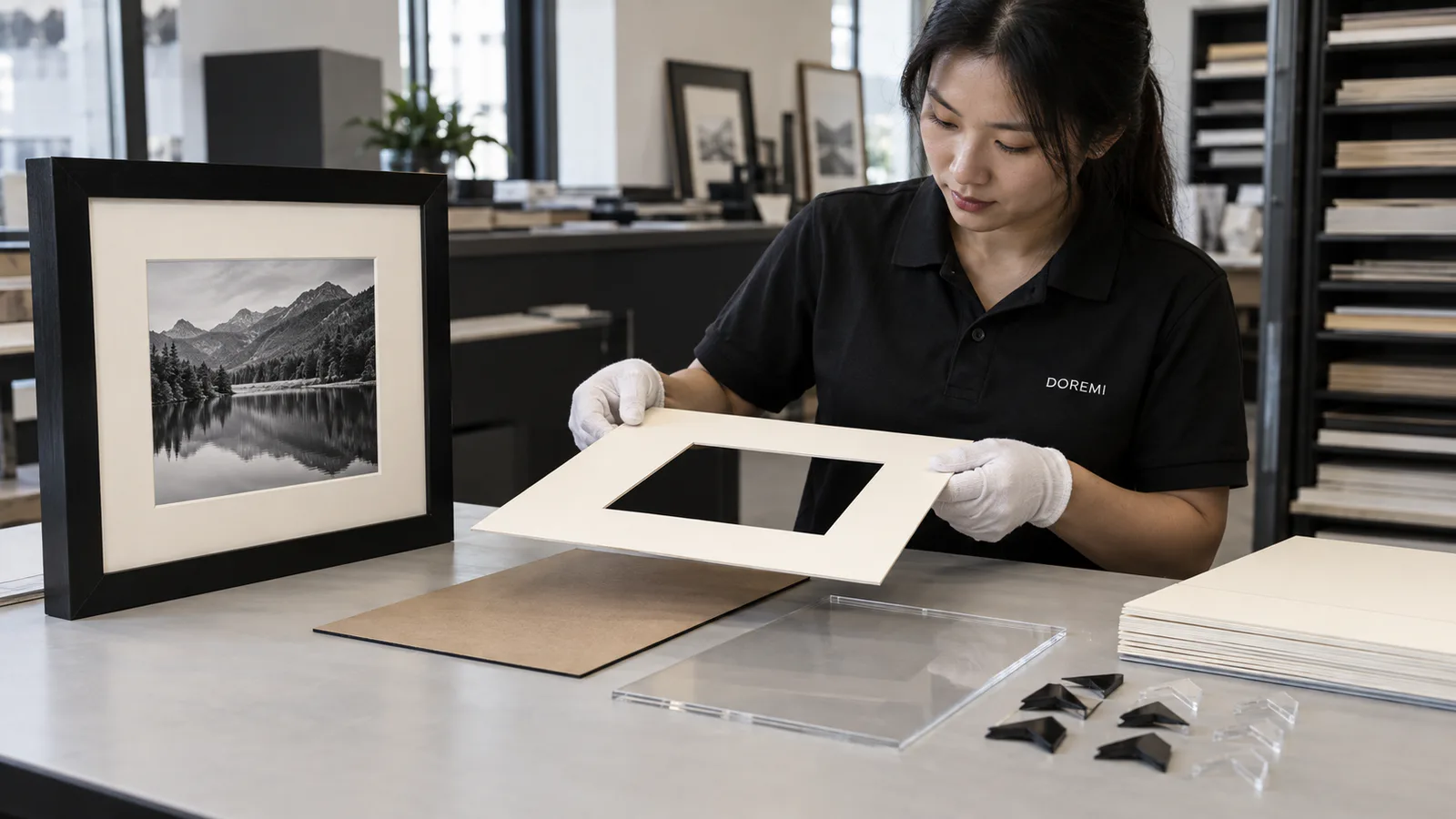
List every material that touches or sits near the image: window mat, back mat, photo corner, hinge, mounting strip, spacer, backing, dust cover, glazing, printed insert, label, tape, ink and adhesive. Include the frame rabbet or liner where migration from wood-based components is a concern. Give each item a controlled supplier, grade, colour, thickness and revision.
Beside each item, record whether it has direct contact, near contact or no plausible contact with the photograph. Then link the claim, standard, report and limitation. A matrix exposes the common gap where a mat is documented but the pressure-sensitive tape, printed logo, adhesive label or foam spacer has no identity.
Control colour variants and printed decoration
Changing a cream board to black, adding metallic ink or laminating a printed layer may change the relevant construction. Ask the material supplier or qualified laboratory whether existing evidence covers the variant. Do not assume that every colour in a product range shares one result because the stock code begins with the same letters.
For customised programmes, control the ink, coating and application area as part of the approved artwork. A university seal, recipient name or event graphic can introduce ink, foil or adhesive near the photograph. Keep the decorative approval connected to the material approval instead of treating artwork as a purely visual file.
Separate direct-contact mounting from visual layout
Library of Congress guidance recommends non-adhesive approaches where possible for preservation matting, including photo corners, mounting strips or other support methods selected for the object. For a commercial self-fit frame, the buyer should specify how the photograph is retained, how much overlap is acceptable and whether the print can be removed without avoidable damage.
A visually centered image can still be pinched, bowed or attached with an unsuitable tape. Review the front and back of the mounted sample. Ask an independent person to remove and reinstall the print using only the supplied instructions. Record contact points, tools, residue, abrasion and whether the image shifts when the frame is handled vertically.
Keep the photograph away from glazing
The Library of Congress advises designing a frame so the photograph does not touch the glass or acrylic, using a window mat or spacers. Contact can become especially problematic if moisture, pressure or surface change causes a photograph to adhere to glazing. Specify a real separation method and verify it around the complete perimeter.
Measure clearance with the production-equivalent print, mat, backing and closure. Check whether flexing or packing pressure removes the gap. A deep profile is not proof of separation if the backboard bows forward or the print is loosely retained. For valuable originals, ask a conservator to define the full housing and display approach.
Treat glazing claims as a separate evidence stream
Glazing affects breakage, weight, static, abrasion, reflection, ultraviolet transmission and cleaning. PAT does not answer all of those questions. A UV-filtering claim also does not mean a photograph will not fade; the Library of Congress notes that light exposure can cause irreversible damage even behind UV-filtering glazing.
Specify glazing material, thickness, surface treatment, optical claim, protective film, cleaning method and allowed substitutions. Request the evidence for any quantified claim. Review anti-static or anti-reflective options with the actual image and display environment. Do not combine a material certificate, optical datasheet and marketing promise into one unsupported “conservation glass” label.
Review adhesives, tapes and labels by exact use
An adhesive used only to close the outer carton has a different relationship to the photograph from a tape used behind the mount. Record the application location and whether the adhesive is exposed after assembly. Ask for the exact commercial product and backing or carrier, not simply “acid-free glue.”
The Library of Congress cautions that pressure-sensitive tape can be difficult to remove and can create condition problems. If an adhesive is unavoidable in a commercial construction, a qualified owner should decide whether its evidence and location are appropriate. Keep it off the image unless the approved method specifically allows contact.
Read the report, not only the supplier declaration
A useful evidence review checks the tested specimen, standard edition, test method, laboratory, dates, results and any scope statements. Confirm that the commercial material can be traced to the specimen. A one-page declaration may be part of the file, but it should not erase differences in grade, coating, adhesive, colour or manufacturing site.
Where a report is confidential, agree a controlled review route or a meaningful summary verified by the responsible buyer. Do not publish laboratory pages as consumer content without permission. The objective is traceability and a defensible claim, not collecting PDFs that nobody can connect to the production frame.
Design the sample review around real insertion
Build a sample with the intended print size and process, not a blank card chosen only for photography. Have the user open the back, identify orientation, insert the photograph, secure it, close the frame and hang or stand it. Look for fingerprints, edge damage, excessive force, trapped dust, misalignment and unwanted contact with glazing.
If recipients will fit their own images, include those steps in the instruction review. If a fulfilment partner installs personalised prints, test the batch process, clean-work controls and rework route. The same front design can need different back construction depending on who touches the photograph.

Make substitutions visible before production
Require written notice before the supplier changes matboard, backing, glazing, tape, adhesive, ink, print method, spacer or coating. The change request should identify the old and new materials, reason, stock affected, visual effect, evidence difference and sample requirement. A “same specification” note is not enough when the original claim depended on a named component.
Link the change-control gate to purchase-order release and incoming inspection. Inspectors can verify labels, appearance, thickness and component identity, but they cannot recreate PAT on the line. Maintain approved supplier records and retain representative materials where practical.
Write packaging and ecommerce copy from the evidence
Product pages should state what the frame is designed to hold, how the print is inserted, which materials are identified, and the care or display limits the brand can support. Avoid absolute preservation promises. “PAT-tested matboard” is more specific than “archival frame,” but even that wording must match the exact tested board and approved legal position.
Keep marketing, technical file, purchase order and production artwork aligned. If a component changes, check whether the website, carton, instruction and retailer feed also need revision. A traceable modest claim is more useful to buyers than a sweeping phrase that the evidence cannot carry.
Prepare an evidence pack for reorders
Archive the component matrix, supplier datasheets, reports or reviewed summaries, claim decisions, drawings, artwork, insertion instructions, sample photographs and change log. Give the approved frame and materials a revision. Record whether the physical sample contains an original, dummy or replaceable print.
At reorder, ask for a no-change declaration and current component identity. Evidence can become stale when a supplier, formula, colour or production site changes. A reorder should be faster because the reference is clear, not because the team assumes that every invisible material stayed the same.
Buyer handover checklist
- Image process, value and replacement status are recorded
- Every direct and near-contact component has a controlled identity
- PAT evidence names the standard edition and tested specimen
- ISO 18902 claims are separated from PAT-only statements
- No PAT result is presented as proof that the whole frame is archival
- Print remains separated from glazing in the production-equivalent sample
- Mounting and removal are reviewed with the intended user
- Adhesives, inks, labels and tapes are mapped by exact location
- Glazing performance claims have their own evidence and limits
- Colour and printed variants are reviewed before approval
- Supplier substitutions trigger evidence and sample reassessment
- Packaging and product-page copy match the approved claim record
Experience scope and project limits
Editorial review: Jessica, Founder & Project Advisor at DOREMI Display. Updated 16 September 2026. Jessica's practical scope covers B2B display-frame briefs, materials, samples, packaging, supplier coordination and buyer handover. She is not presented as ISO, a testing laboratory, photograph conservator, materials scientist, archivist or claims lawyer.
This guide is educational sourcing preparation. It does not determine whether a material conforms to ISO 18916 or ISO 18902, certify a finished frame, identify every photographic process or approve an archival claim. Purchase and apply the current standards through qualified specialists, and consult a photograph conservator for irreplaceable, historic, fragile or high-value originals.