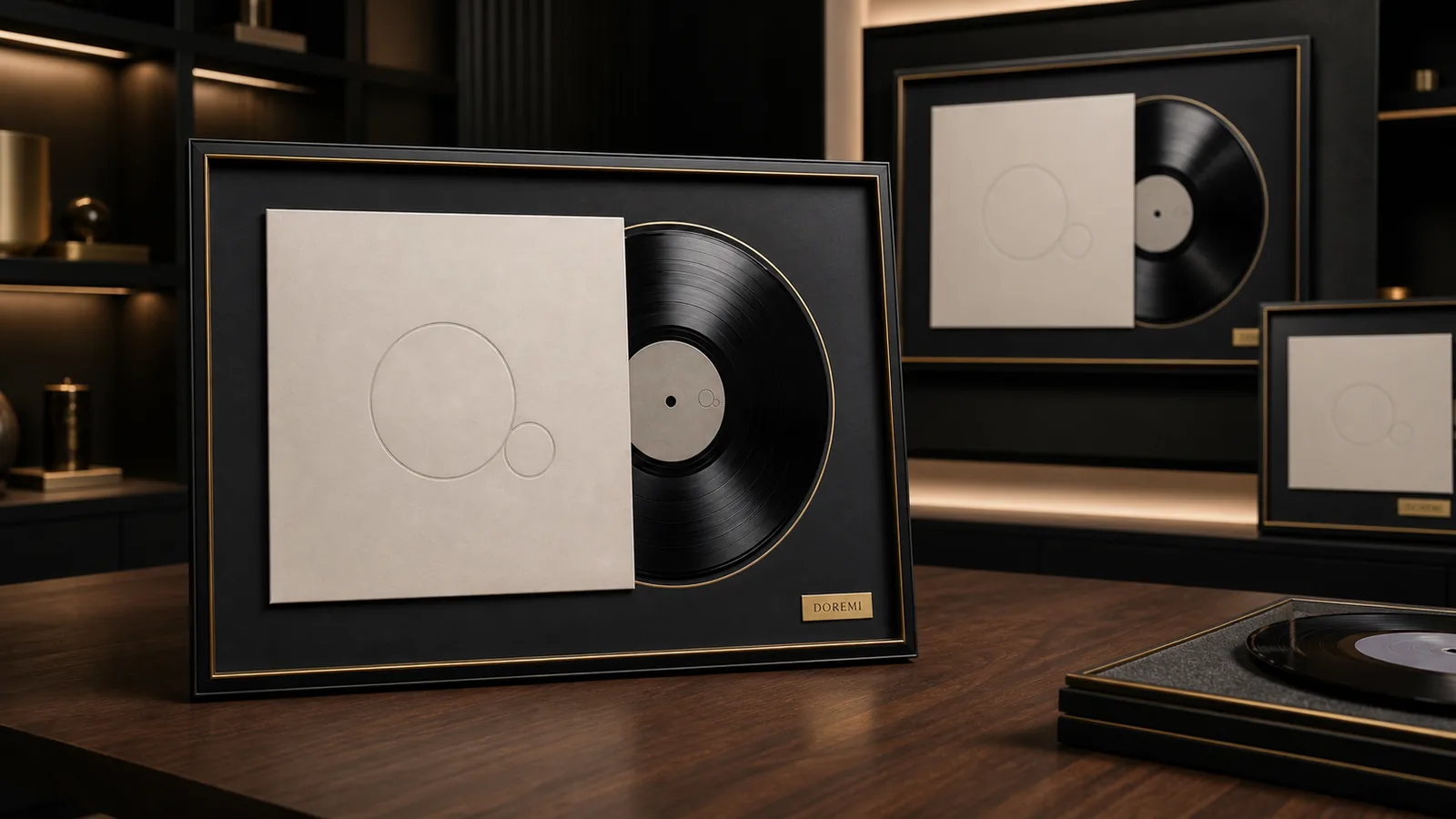
A vinyl record display frame sits between two product worlds. It must respect an object people may want to keep, yet it also has to behave like a repeatable retail or corporate-gift product. That combination is why a request such as “quote a frame for a 12-inch record” is rarely enough for a dependable OEM quotation.
Importers, record labels, artist merchandise teams and music retailers usually need to decide more than the outside size. Will the display hold a jacket, the disc, both items, a plaque or a campaign insert? Can the customer remove the record? How will a gatefold or unusually thick sleeve fit? What should remain consistent when the next artist edition uses different artwork? This guide turns those questions into a specification that a buyer, designer and manufacturer can review together.
What are buyers actually trying to solve?
Recent public search results around vinyl display frames repeatedly surface four practical questions: what size fits an LP, whether a record can be displayed without damage, how easily the artwork can be changed and what protection the clear front provides. A B2B buyer has the same questions at programme scale, plus several others: whether the format can be private-labelled, whether different releases can share components, how samples will be approved and whether the packed unit can survive the chosen delivery route.
Those are decision questions, not decorative inspiration. They suggest that a useful sourcing page should provide clear trade-offs and a brief structure rather than promise a universal “best” frame. Google’s current guidance for generative search features similarly emphasises helpful, non-commodity content grounded in real experience, while noting that no special AI Overview markup guarantees inclusion. This article follows that approach; it does not claim access to private AI Overview data.
Start with the programme model
Define how the display will be sold or presented before selecting the construction. A record-store wall frame that lets a customer rotate album art needs a different opening method from a sealed commemorative edition. A label gift for an artist may display the disc permanently beside a numbered plaque. A fan merchandise product may need simple instructions, retail-ready packaging and a cost structure that works across several releases.
Write a one-sentence programme statement: “A wall-mounted, gift-ready display for one standard LP jacket and one visible disc, supplied as a sealed branded edition,” or “A reusable front-opening frame for consumers who rotate 12-inch jacket artwork.” This sentence becomes the first test for every later choice. If a proposed feature does not support the intended use, it should not automatically be added.
Do not specify an LP from a nominal label alone
“12-inch record” describes the disc format, not the complete object you need to accommodate. Jackets, inner sleeves, gatefolds, booklets, obi strips, box-set elements and shrink-wrapped retail copies vary in thickness and outside dimensions. Ask your team to measure the actual release sample at several points and note whether the contents should remain inside the jacket. If several releases will share the frame, measure the thickest expected sample and record the acceptable clearance.
For a side-by-side disc-and-jacket layout, define the visible diameter of the record, the jacket opening, the gap between items and the safe edge distance to the frame. For a jacket-only format, decide whether the cover should float with a reveal or sit behind a mat opening. For a rotating design, measure the hand clearance and make sure the opening method does not scrape the sleeve.
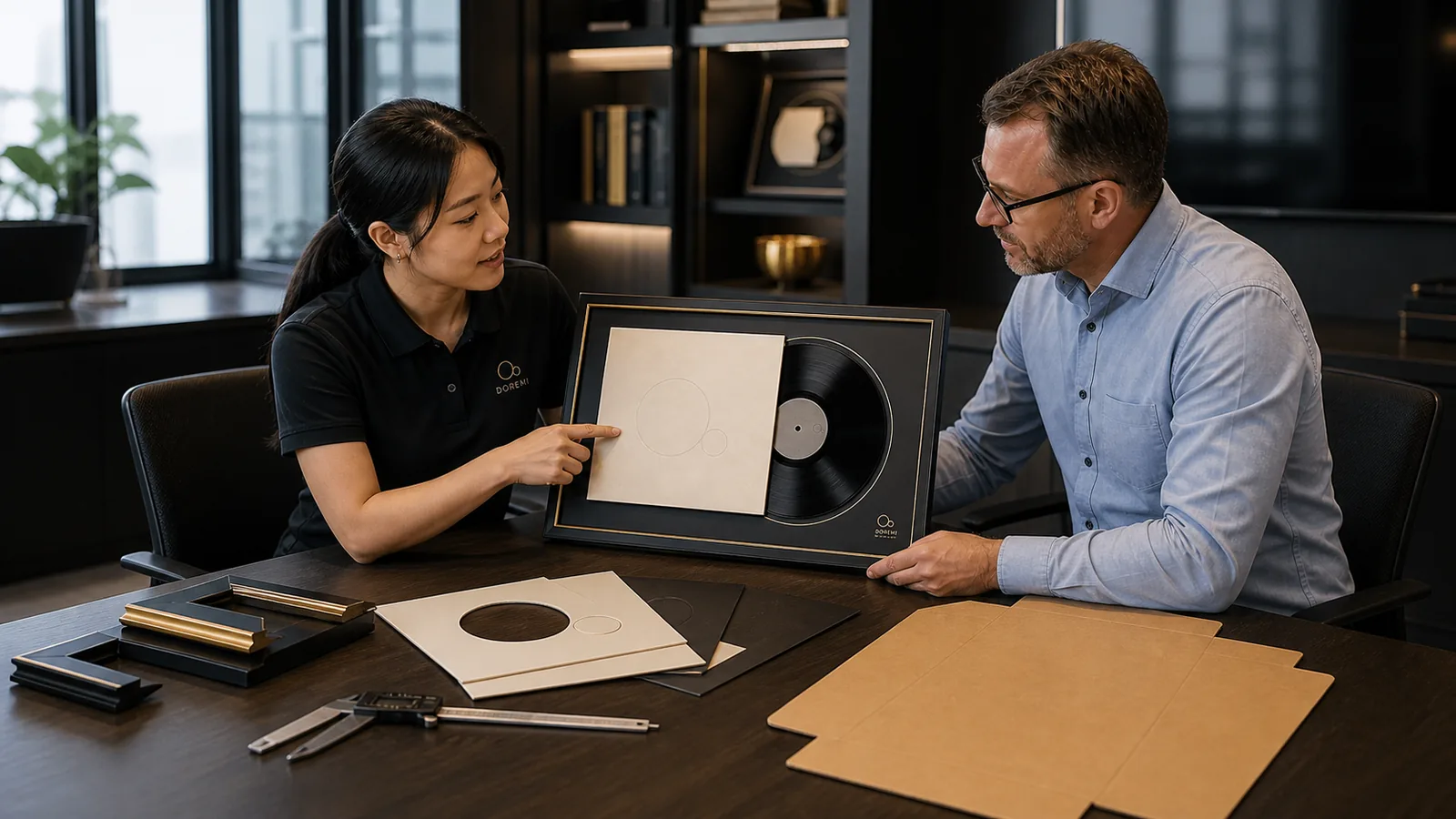
Choose whether the record is collectible, playable or replaceable
A display can prioritise preservation, access or presentation, but it cannot maximise every objective without trade-offs. If the disc will remain playable, avoid permanent adhesive and pressure points, and design a support method that lets the owner remove it deliberately. If the piece is a sealed commemorative display, document how the disc and jacket are held so they do not shift in transit. If artwork will rotate frequently, the back or front closure must be simple enough for ordinary use and durable enough for repeated opening.
Also decide what the buyer receives if the displayed record is not included. A merchandise listing should make the included contents unambiguous. For wholesale cartons, the product code and packing list should distinguish “frame only,” “frame with printed insert” and “complete licensed edition.” This is both a customer-experience decision and a warehouse-control decision.
Build the layout as a hierarchy
The strongest record displays usually have one clear focal point. It may be the jacket artwork, the disc, an artist portrait or a plaque. Give that element visual priority and use the other elements to support it. A gold accent can provide separation in a black mat, but too many metallic lines, logos and captions compete with the release itself.
Ask for a digital layout showing the exact visible openings and margins before a physical sample is made. Review it at likely wall-viewing distance, not only zoomed in on a design screen. If the programme will cover many releases, test one dark cover, one pale cover and one visually busy cover. A backing colour that makes the first edition look premium may not work equally well for the rest of the catalogue.
Separate product branding from release artwork
Private-label projects move faster when the manufacturer receives two controlled files. The product-branding file covers the DOREMI or buyer mark, back label, instruction card, barcode area, carton marks and any reusable plaque position. The release-artwork file covers artist-approved images, title treatment, edition copy and variable data. The product file may remain stable while the release file changes.
Define exactly where a logo is permitted and its maximum size. On a premium display, a small plaque, backboard mark or packaging detail often feels more considered than a large logo competing with the album art. If the edition uses licensed artwork, the buyer should manage rights and approvals; a frame supplier can place approved files but should not be asked to confirm ownership of artwork it did not create.
Select materials by the delivery and display risk
Frame profile, backing, mat, glazing and hardware act as one system. A heavy profile can communicate value but increases packed weight and wall-fixing requirements. A thin profile can look refined but needs enough rigidity for the display size. Black wrapped MDF, wood, aluminium and composite profiles each have valid applications; the comparison should state the exact substrate, finish and profile dimensions rather than rely on broad material names.
For the clear front, evaluate reflection, scratch exposure, breakage behaviour, weight and any requested light-filtering performance. Do not accept an undefined phrase such as “museum quality” as a specification. Ask for the product grade, supplier documentation and sample appearance. Light-filtering glazing does not make direct sunlight harmless, and it does not replace sensible display conditions.
Protect the jacket and disc from contact they do not need
Archives and conservation organisations consistently recommend keeping sensitive paper and photographs away from direct glazing contact and reducing damaging light exposure. The same principle is useful when a display contains a valuable jacket, printed insert or photograph: use a mat, spacer or supported recess so the visible object does not press against the clear front. The exact material choice depends on the object and expected life of the programme.
Vinyl records also respond poorly to heat and deformation. A frame should not be marketed as permission to hang a valuable disc beside a radiator or in strong sun. Provide realistic care instructions covering secure installation, indoor use, avoiding heat and moisture, and cleaning the glazing with a method appropriate to the selected material.
Make the sample answer operational questions
A useful sample is not merely a beauty shot. It should use the intended profile, glazing, mat construction, backing, hardware and an accurate substitute for the release contents. Open and close it if access is part of the product. Check how the jacket is inserted, whether corners rub, whether the disc remains supported and whether the back closes without force.
Review the sample from the front, at an angle, on a wall and inside its proposed packaging. Photograph the front, sides, back, hanging hardware and every protection layer. Record any approved variation in writing. If a later edition will reuse the construction, the retained sample and photo set become the reference for what stays unchanged.
Design packaging around the sales channel
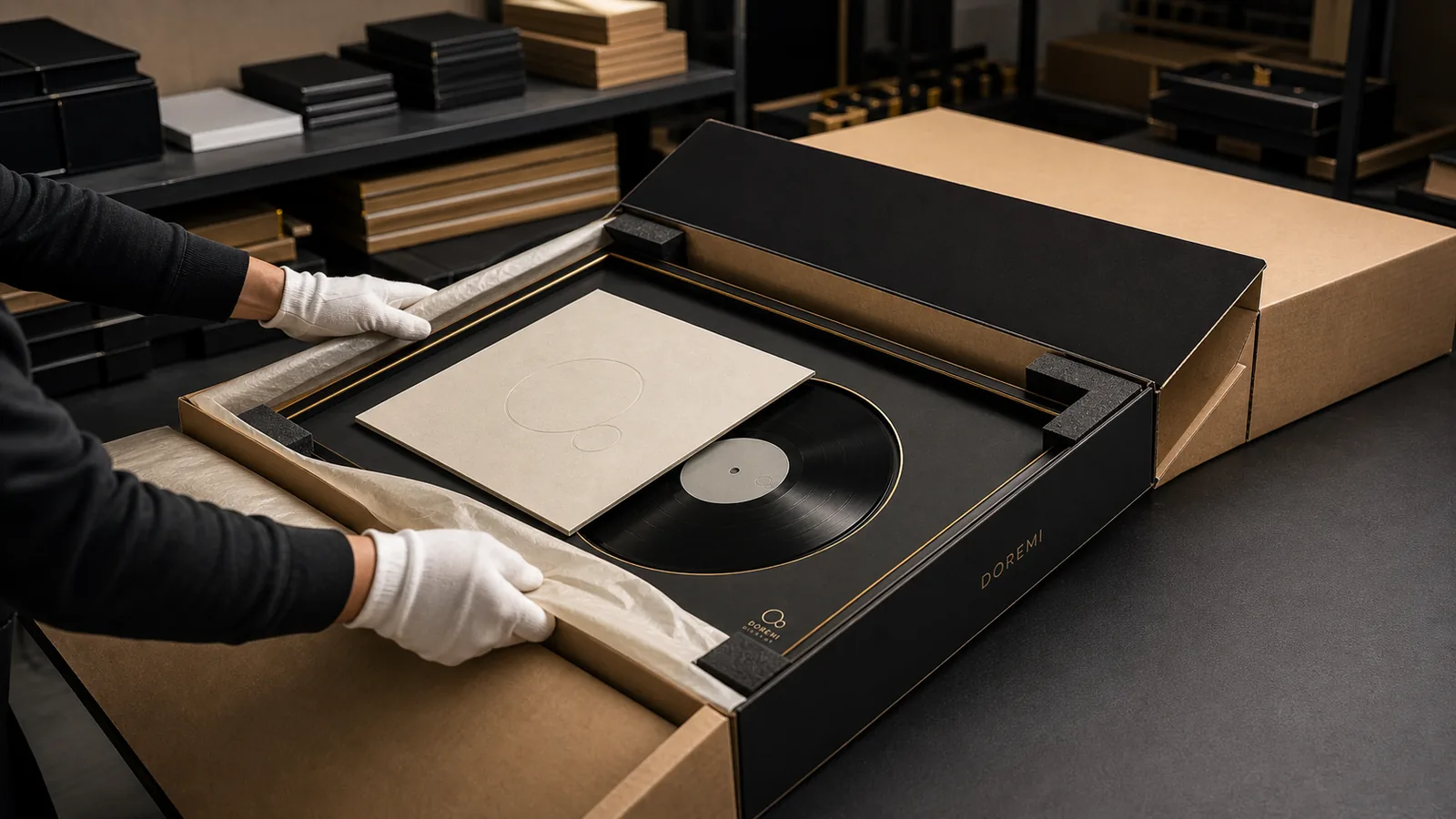
A retail shelf, distributor pallet and direct-to-consumer parcel network create different hazards and presentation needs. For store delivery, master-carton efficiency and shelf-ready identification may be important. For e-commerce, the individual pack sees more handling and needs controlled movement inside the carton. For a presentation gift, the inner box must protect the frame and still feel appropriate when opened.
Ask the quotation to state the inner protection, corner blocks, glazing separation, product wrap, inner-box dimensions, master-carton quantity and gross weight. Decide when the protective film is removed. For acrylic, leaving film in place through assembly can reduce handling marks, but the customer needs a clear, safe removal instruction. For glass, separation and breakage containment deserve explicit review.
Quote the variants as a platform, not six unrelated products
If a label or retailer expects several editions, ask which components can be standardised: outside frame, glazing, backing, hardware, inner box and master carton. Then identify the variable elements: mat openings, insert print, plaque, sleeve art and barcode. Standardisation can reduce repeated setup and simplify replacement stock, but only if the artwork range still fits the shared construction.
Request a quotation table that separates one-time development, sample cost, common components, edition-specific printing, packaging and quantity breaks. Do not assume a minimum order from another supplier or another project applies to yours. MOQ and lead time depend on the profile, finish, artwork, packaging, production schedule and number of variants; the manufacturer should confirm them against the final brief.
Questions to put in the RFQ
- Which actual jacket, disc and insert dimensions must the frame accommodate?
- Is the record included, removable, replaceable or permanently presented?
- Which components remain common across releases, and which are variable?
- What substrate, finish, glazing, backing and hanging hardware are quoted?
- How are paper, disc and glazing kept from unwanted contact or movement?
- What is included in the individual pack and master carton?
- Which sample, artwork, rights and packaging approvals are owned by the buyer?
- What evidence will be supplied before shipment?
Prepare the retail content before production photography
A private-label collection also needs an accurate content handover. List the finished outside dimensions, usable internal opening, packed weight, included hardware, intended orientation, care method and exactly what is not included. Photograph the real production sample rather than a visualisation when the product page will make fit or access claims. If one photograph shows a record inside the frame, the listing must still say clearly whether the record is supplied.
Plan image angles that answer buyer questions: closed front, open access method, back and hanging hardware, frame depth, protective packaging and the product installed at a believable scale. These images help distributors and retail teams explain the product without inventing details. They also create a dated visual reference for final inspection.
Agree how replacements and reorders will work
Before launch, decide which parts can be replaced: glazing, backboard, hanging hardware, insert, plaque or complete unit. Record part dimensions and finishes so customer service does not rely on visual guesses. If the collection will reorder, keep the approved colour, profile and packaging references together with the artwork revision.
A reorder should begin with a change declaration. The buyer confirms which release artwork is new and whether the product, pack, labels or destination have changed. The manufacturer confirms current material availability and identifies any substitution before production. This short step protects continuity without assuming that an old quotation or sample remains valid forever.
Experience scope and project limits
Editorial review: Jessica, Founder & Project Advisor at DOREMI Display. Updated 12 August 2026. Jessica’s practical scope is B2B display-project briefing, material and layout discussion, sample coordination, private-label details and packaging handover. This article does not present her as a records conservator, licensing lawyer, carrier laboratory or destination-market compliance authority.
Use the guidance to prepare a clearer manufacturer conversation. Final construction should be validated with the actual release objects, approved artwork, physical sample, packaging sample, destination requirements and your own rights and compliance review.