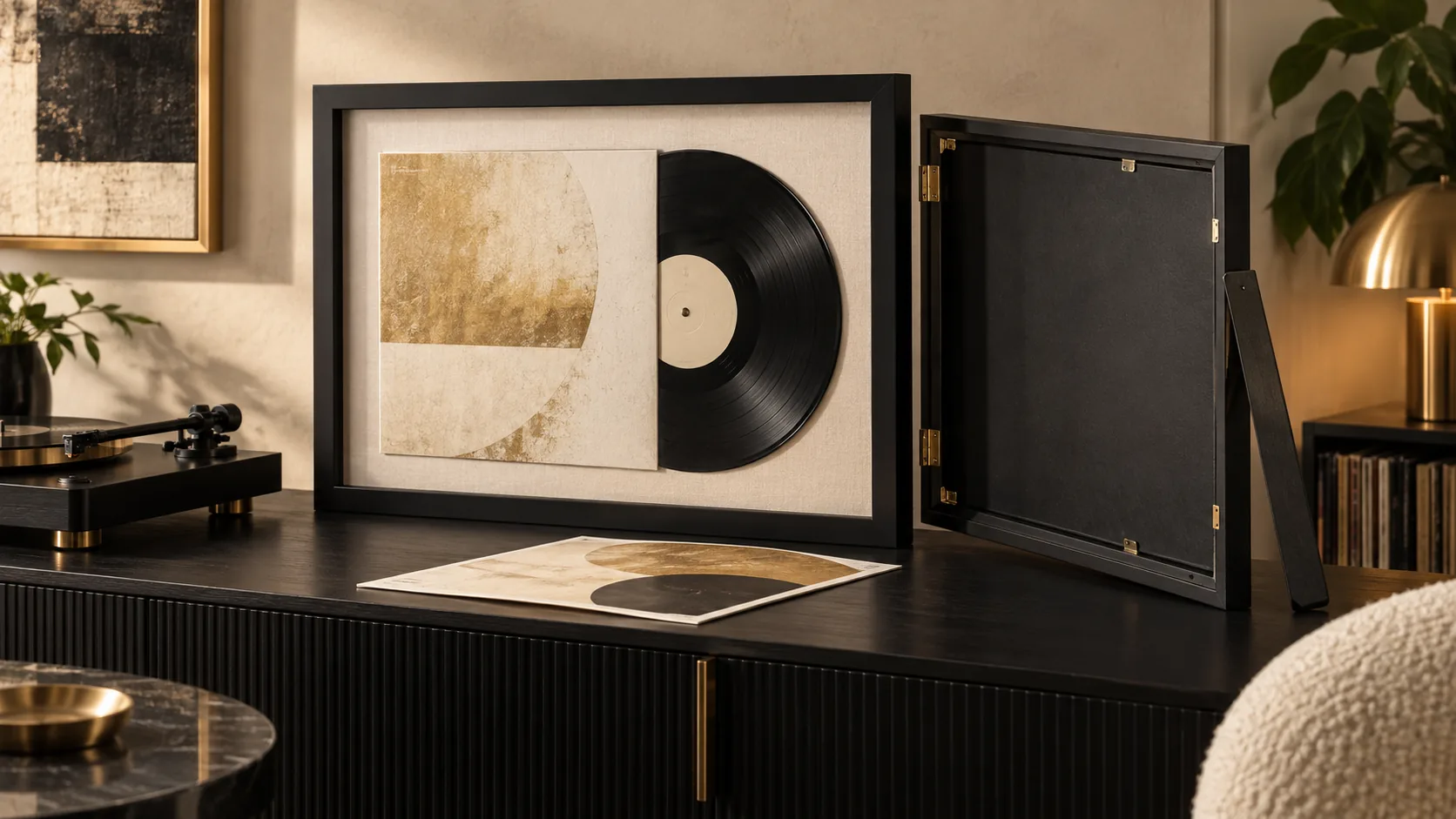
Many vinyl buyers want two things at once: an album displayed as artwork and the record still available to play. A frame designed only around a front photograph may pinch a gatefold sleeve, leave the disc touching glazing, require the whole product to come off the wall or encourage users to handle grooves. A good brief starts with access, not just outside dimensions.
This guide is for music retailers, labels, artist-merchandise teams, collectors' brands, hospitality projects and private-label importers developing removable vinyl record display frames. It covers commercial specification and sample approval. It does not provide conservation treatment, authenticate memorabilia, license album artwork or guarantee preservation of rare, signed or irreplaceable records.
Define what the customer is displaying
“Vinyl record” can mean a 12-inch LP, 7-inch single, 10-inch disc, picture disc, shellac record, gatefold jacket, double album, booklet, obi strip, signed sleeve or a combination. Record the exact intended format and whether the displayed item is replaceable, playable, collectible, signed or historically significant.
Do not derive the product cavity from a nominal disc diameter alone. Measure production examples of the disc, inner sleeve, outer jacket, gatefold spine and any included inserts. Create a supported-range table and identify exceptions. The frame should not invite customers to force thick or unusual editions into a space designed for a simple single sleeve.
Choose the access model before the visual layout
A removable-access frame may open from the front, side or back; use a hinged door; slide a cassette-like tray; or display the jacket while storing the playable disc separately. Each model affects wall clearance, dust entry, hardware, safety and customer behaviour. Name the intended sequence from seeing the album to playing it and returning it.
If the user must take the frame off the wall, place it face-down and remove multiple clips, the product is technically openable but not truly convenient. Set a target task: open, remove, close, play, return and relock without touching grooves or disturbing artwork. Test that task with representative users.
Keep the playable surface out of the handling path
Library of Congress guidance advises handling grooved discs by the outer edge and label areas rather than touching playing surfaces. The frame should give the user enough space to grip those areas. Avoid narrow cut-outs that make fingers slide across grooves or press the record against a mat.
Provide a stable place for the jacket or door while the record is removed. If a tray pulls forward, it should not tilt and release the disc. If the record is mounted by the centre hole, verify that the support does not bind, abrade the label or place an unintended load on the disc.
Separate display pressure from retention
A record or sleeve should stay in position vertically without being clamped between glazing and backing. Create a defined support surface, edge restraint or pocket. Confirm that gravity is carried where intended and that normal door operation does not drag the item.
The Library of Congress recommends storing grooved discs upright and fully supported. A wall display is not the same as archival storage, but the principle highlights why a disc should not sag from one point or sit under uneven pressure. For valuable material, a conservator should define the housing and display limits.

Give the disc, jacket and glazing independent clearance
Specify the gap between disc and glazing, jacket and glazing, and moving hardware and every album component. Check the thickest supported gatefold or double-record configuration. A deep frame does not automatically create safe clearance if the backing bows or a latch projects into the cavity.
Measure in the wall-hung orientation and during opening. Verify that the disc cannot swing into glazing and that the sleeve does not rub a hinge. If a spacer or liner controls the gap, give it a material, dimension and position in the drawing. Treat substitution as a design change.
Support gatefolds without crushing the spine
A gatefold sleeve may be displayed closed, partly open or fully open. Each choice changes outside size, depth, hinge strain and access. Do not use the frame to force a naturally sprung gatefold flat. Agree how much opening is intended and support both panels so the spine does not carry the full load.
For double albums, confirm whether both discs remain inside their inner sleeves, one is displayed and one stored, or both are visible. Mark the complete configuration on the product page. Photography should not show a layout that the retail item cannot safely reproduce.
Decide how inner and outer sleeves are treated
Collectors may replace paper inner sleeves with polyethylene or other sleeves, or add a protective outer jacket sleeve. Those additions change thickness, friction and static behaviour. State whether the product supports them and test representative approved materials.
Do not require customers to discard original components to make the frame fit. If the product is designed for artwork-only display, say where the record and original inner sleeve should be kept. If the frame includes storage behind the display, confirm that components remain vertical, supported and accessible.
Control materials near the album
Identify every mat, board, fabric, plastic, coating, adhesive, tape, ink, gasket and metal part near the disc or paper jacket. Avoid vague “archival” claims. A commercial frame can use known, specified materials without promising that every album will remain unchanged indefinitely.
Unknown plastics, pressure-sensitive adhesives and fresh coatings deserve careful review. The Library of Congress notes the importance of appropriate enclosures and stable storage materials for audiovisual collections. For high-value originals, ask a conservation professional to approve direct-contact materials and display conditions.
Manage static, dust and cleaning honestly
Clear plastics and record surfaces can attract dust. A gasket may reduce entry but not create a sealed conservation case. Provide a cleaning method for the glazing and frame that does not imply customers should wipe grooves with a household cloth. Keep accessories separate from the record unless their use is clearly approved.
Specify whether the clear panel is glass, acrylic or another material and disclose practical care differences. Anti-static or anti-reflective claims need evidence for the exact product. A marketing phrase such as “dust-proof” should not be used when the opening mechanism and gaps do not support it.
Design the latch for repeated use
A removable record frame may be opened far more often than a certificate frame. Define the expected usage scenario and test hinges, magnets, clips, sliders or fasteners through a qualified cycle plan. Watch for loosening, rattling, finish wear, trapped fingers and misalignment.
Magnets and small detachable parts need product-specific safety review, especially where children may be present. Do not select a closure only because it creates a clean front view. The user should understand when the frame is fully secured, and the door or tray should not open under normal wall vibration or handling.
Keep wall hardware connected to access forces
Opening a front door or pulling a side tray applies forces that a static wall frame may not experience. The wall system, frame back and access hardware should be evaluated together for the intended orientation and loaded mass. A one-point hanger may allow the frame to rotate during use.
Provide model-specific instructions that state the wall assumptions and direct users to suitable installation support. A frame supplier cannot select a fastener for every unknown wall. Qualified engineering and product-safety owners should approve the hanging system, loads, hardware and warnings for the destination market.
Make the product understandable at shelf and online
Show whether the record, jacket or both are included in the display area; whether the frame opens on the wall; which album formats fit; and whether a protective sleeve is supported. Use a dimension diagram with outside size, visible opening, cavity depth and access clearance.
Avoid staging a famous album if artwork rights are not cleared. Use owned, licensed or generic art and state that records are not included where applicable. If the frame can rotate artwork, demonstrate the real sequence rather than implying tool-free access that the sample does not provide.
Prototype the full size matrix
A single-LP sample does not prove a gatefold or double-album variant. Select samples that represent the thinnest and thickest supported products, different opening directions and the largest outside frame. If 7-inch and 12-inch products share a mechanism, check whether the smaller format can be handled without entering the groove area.
Record album dimensions and condition before the test. Use expendable surrogate records for destructive or repeated development work. Rare, signed or valuable items should not be used to prove an unvalidated mechanism.
Run a realistic access usability test
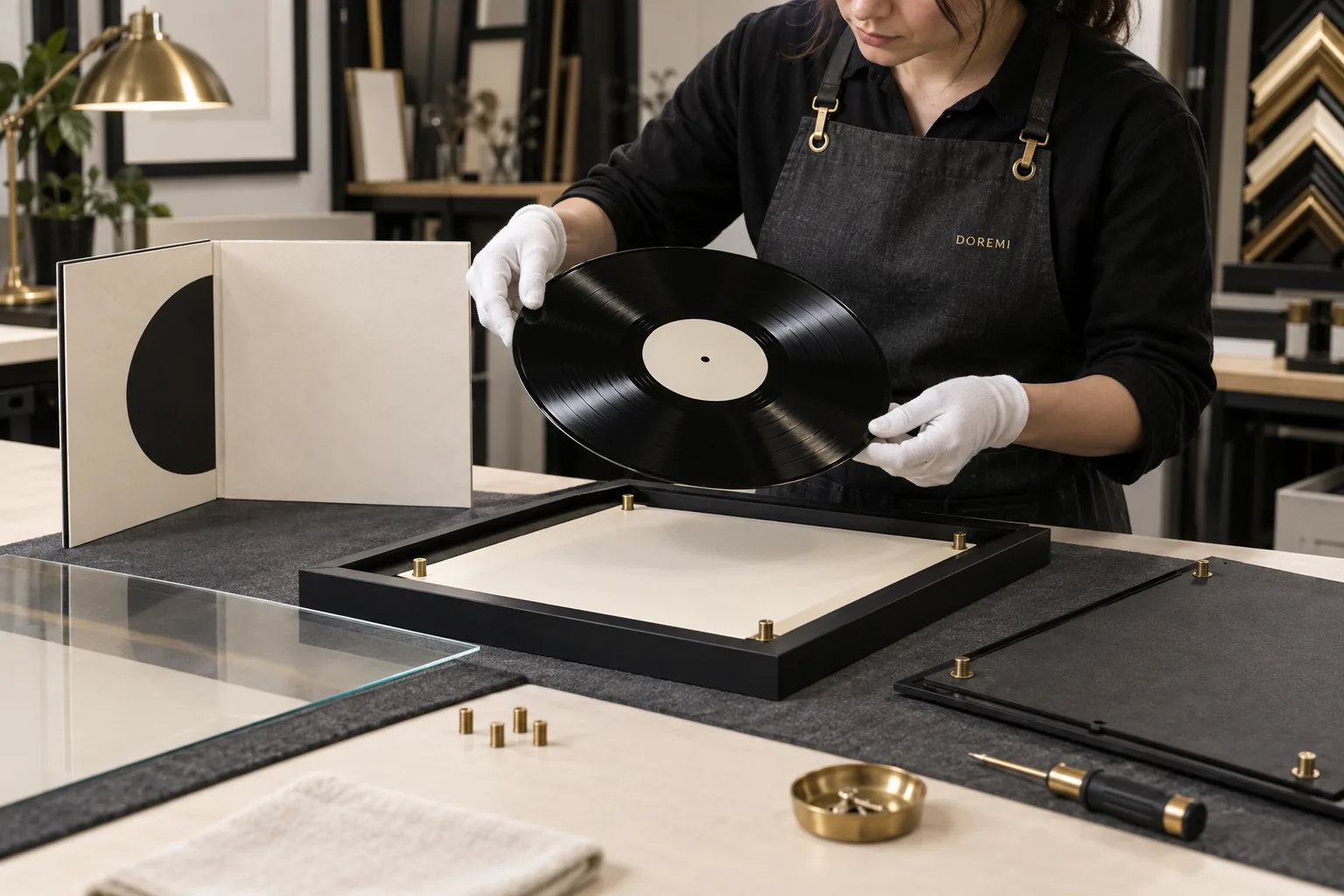
Give participants the packaged product and instruction. Ask them to install or simulate installation, open the frame, remove the disc, place it on a turntable, return it and secure the display. Observe grip points, confusion, contact with grooves, door support, frame movement and final alignment.
Include people with different hand sizes and familiarity with vinyl. Do not coach unless the instruction directs them. A mechanism can feel obvious to its designer and still cause a first-time user to push the wrong edge or leave a latch partly open.
Inspect wear after repeated opening
Check the frame finish, glazing, mat, sleeve edges, centre support, latch, hinge, fasteners and wall interface after the agreed cycles. Look for debris or abrasion inside the cavity. Measure whether gaps and alignment have changed.
Cycle testing should reflect the intended product and be designed by qualified owners; this guide does not set a universal number. Pair mechanical evidence with user observations. A latch can continue operating while becoming unpleasant, noisy or visually misaligned.
Validate packaging with the access mechanism locked
Transit clips, protective films and door restraints should keep moving parts secure without marking the frame. Tell the customer what must be removed before use and where it is located. A magnet or latch intended for normal operation may not be sufficient as the only transit restraint.
Package the production-equivalent record-frame configuration, including accessories and any display inserts. Protect broad faces, corners and hardware. If glazing is glass, classify and test the pack accordingly with a qualified packaging professional and relevant distribution procedure.
Define SKU and fit language precisely
Product codes should distinguish format, outside size, visible layout, cavity depth, access direction, glazing, finish and package. Avoid calling a model “universal 12-inch” when gatefold, double-LP, picture-disc and sleeved configurations differ. Publish the measured supported range and exclusions.
Connect the product page, carton, instruction and factory drawing to one revision. If the mat opening or spacer changes, review fit language everywhere. Customer-service teams need the same matrix so they can answer whether a particular edition is likely to fit without guessing.
Respect artwork, signatures and authenticity boundaries
A supplier should use only artwork provided or licensed by the programme owner. Do not reproduce album covers, label designs, artist names or signatures for samples without permission. Generic development art should be visibly generic and never presented as an endorsed release.
The frame does not authenticate a signed sleeve, limited edition or memorabilia item. If a brand offers a display for signed material, define custody and condition records and keep claims separate from the frame. High-value autographs or historic records need specialist advice and may be better displayed as a facsimile while the original is stored appropriately.
Plan replacement parts and after-sales support
Repeated-use products may need replacement glazing, latches, spacers, back panels or wall hardware. Decide which parts are serviceable and how the customer identifies the model. Keep small hardware controlled and provide installation instructions appropriate to the repair.
A replaceable part should not require the customer to expose the record to unnecessary risk. Archive drawings and component references. If a mechanism is discontinued, define whether a compatible part, repair service or replacement frame is offered and avoid indefinite support promises the brand cannot meet.
Use feedback to refine the collection
Track fit questions, access difficulty, groove-contact reports, frame movement, door alignment, damaged sleeves, transit damage and returns by SKU and album configuration. Ask customer service to record the actual format rather than “vinyl did not fit.”
Review whether one issue belongs to product design, fit communication, instruction, wall installation or packaging. Update the supported-range table and sample matrix before expanding finishes or sizes. A smaller, reliable range can be more valuable than a broad catalogue with uncertain fit.
Buyer handover checklist
- Intended disc, jacket, gatefold and insert formats are measured
- Access model and complete user task are defined
- Disc can be handled by edges or label areas without touching grooves
- Disc and jacket are supported without pressure against glazing
- Gatefold spine and double-LP variants have their own fit review
- Clearance is verified during display and opening
- Contact materials, static and cleaning claims are controlled
- Latch and hinge are reviewed for repeat use and positive closure
- Wall hardware is evaluated with access forces
- Fit dimensions and exclusions match page, carton and instruction
- Artwork and authenticity boundaries are documented
- Packaging restrains the mechanism and protects the full product
- Field feedback is linked to SKU and album configuration
Experience scope and project limits
Editorial review: Jessica, Founder & Project Advisor at DOREMI Display. Updated 16 September 2026. Jessica's practical scope covers B2B display-frame briefs, layouts, samples, manufacturing coordination, packaging and buyer handover. She is not presented as a record conservator, audio archivist, structural engineer, testing laboratory, art-rights adviser or autograph authenticator.
This guide is educational product-development preparation. It does not approve a conservation housing, select wall fixings, license artwork, certify a repeated-use mechanism or guarantee long-term preservation. Rare, signed, historic, damaged or irreplaceable records should be reviewed by qualified conservation and collection professionals.