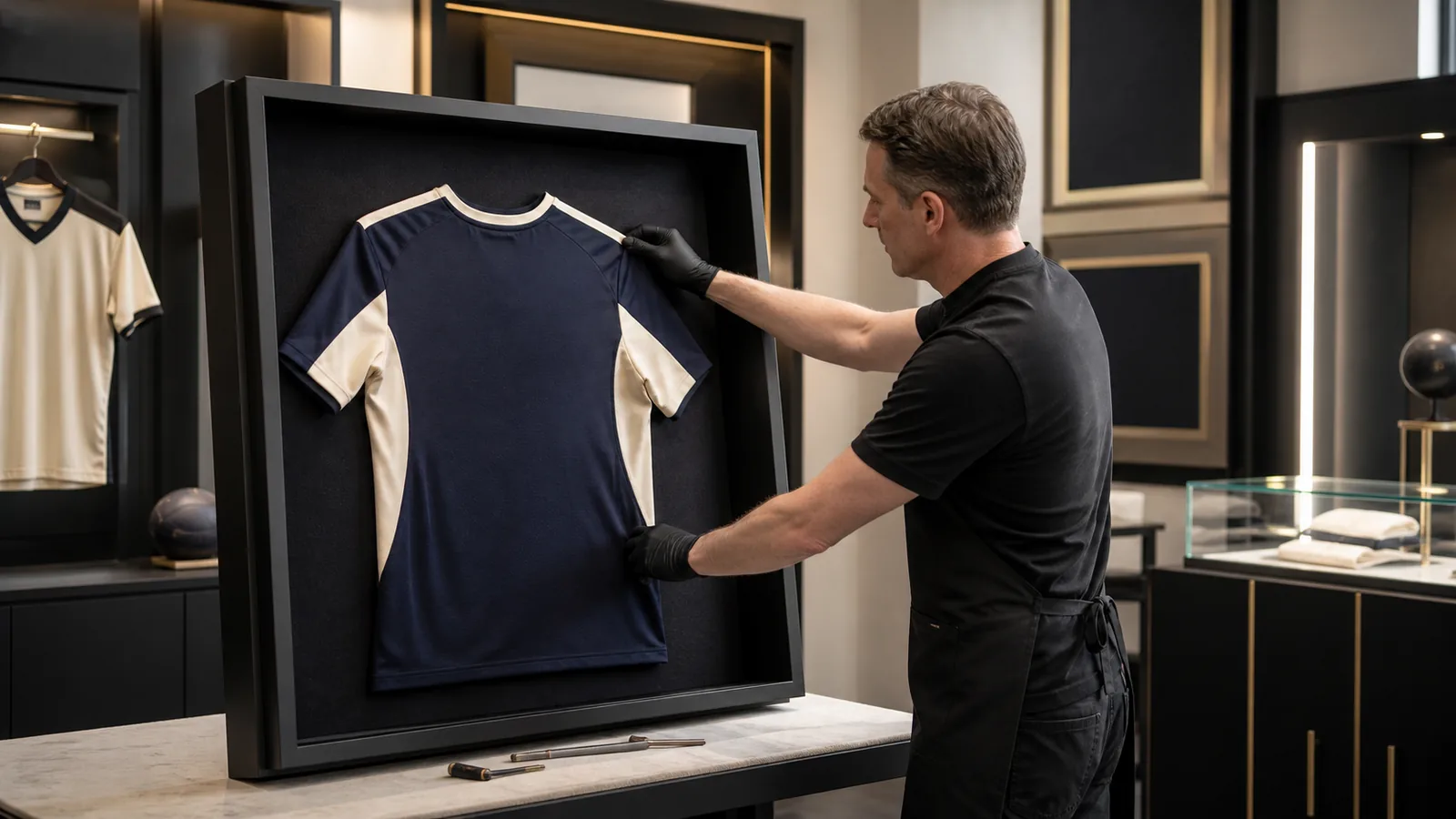
A jersey frame can look correct in one front photograph while the garment is carrying uneven tension, touching the glazing or depending on an attachment that cannot be removed cleanly. For a club, memorabilia retailer or private-label programme, mounting is not a hidden craft detail. It is a controlled part of the product specification and the sample approval.
This guide explains how a buyer can brief a reversible, support-led mounting concept and compare physical samples. It draws practical questions from textile-conservation sources, but it does not turn a commercial frame factory into a conservator. Damaged, fragile, historic, culturally significant, signed or high-value garments should be assessed by a qualified textile conservator before mounting.
Classify the jersey before designing the frame
Record whether the garment is a replaceable replica, retail stock, game-worn original, signed collectible, historic club item or temporary display sample. Note fabric construction, stretch, lining, printed graphics, embroidery, patches, heat-applied marks, autograph media, condition and any weak areas. Photograph the front, back, sides, collar, cuffs and sensitive details.
The commercial brief should say who owns the garment, whether it may be altered, how long it will be displayed and whether it must be returned in usable condition. A method acceptable for a replacement shirt may be unacceptable for an irreplaceable original. The object decision comes before the outside frame size.
Define “reversible” in operational terms
Reversible should mean that the garment can be removed by a competent person without avoidable permanent change caused by the mount. It does not mean the textile experiences no stress, no ageing or no stitch holes. Ask who can disassemble the frame, which tools are required and which attachment points must be released.
Request a removal sequence with back-view photographs. If a supplier says “no glue,” confirm whether adhesive appears on an insert, backing fabric or hidden support and whether it can migrate or contact the garment. Define the expected condition after removal instead of treating “reversible” as a marketing badge.
Use a representative garment, not an apparel size chart
Two jerseys with the same labelled size can differ in body width, sleeve geometry, fabric weight, patches and stiffness. Supply the actual garment where possible or an authorised equivalent with a measurement map. Record laid-flat width and height, sleeve reach, collar shape, thickest decoration and the areas that must remain visible.
If production will frame customer-supplied jerseys, define the acceptable intake range and the exception route. The frame may need an adjustable support system, but “fits most jerseys” is not measurable. Sample the smallest, largest, lightest and most structured expected garments before approving one construction.
Approve the presentation geometry separately from attachment
Mark the visible front or back, sleeve fold, collar position, name or number zone, patch clearance and any accompanying object. Use a full-scale layout rather than asking an assembler to copy a small mood-board image. The layout should show the garment centreline and the minimum quiet area to the frame edge.
Then create a separate attachment map. This prevents visual requests from silently dictating damaging tension. A sleeve can appear straight because the support carries it, because stitches distribute its weight or because one hidden point pulls hard on the fabric. The sample review needs to distinguish those outcomes.
Design the support layer to carry shape and weight
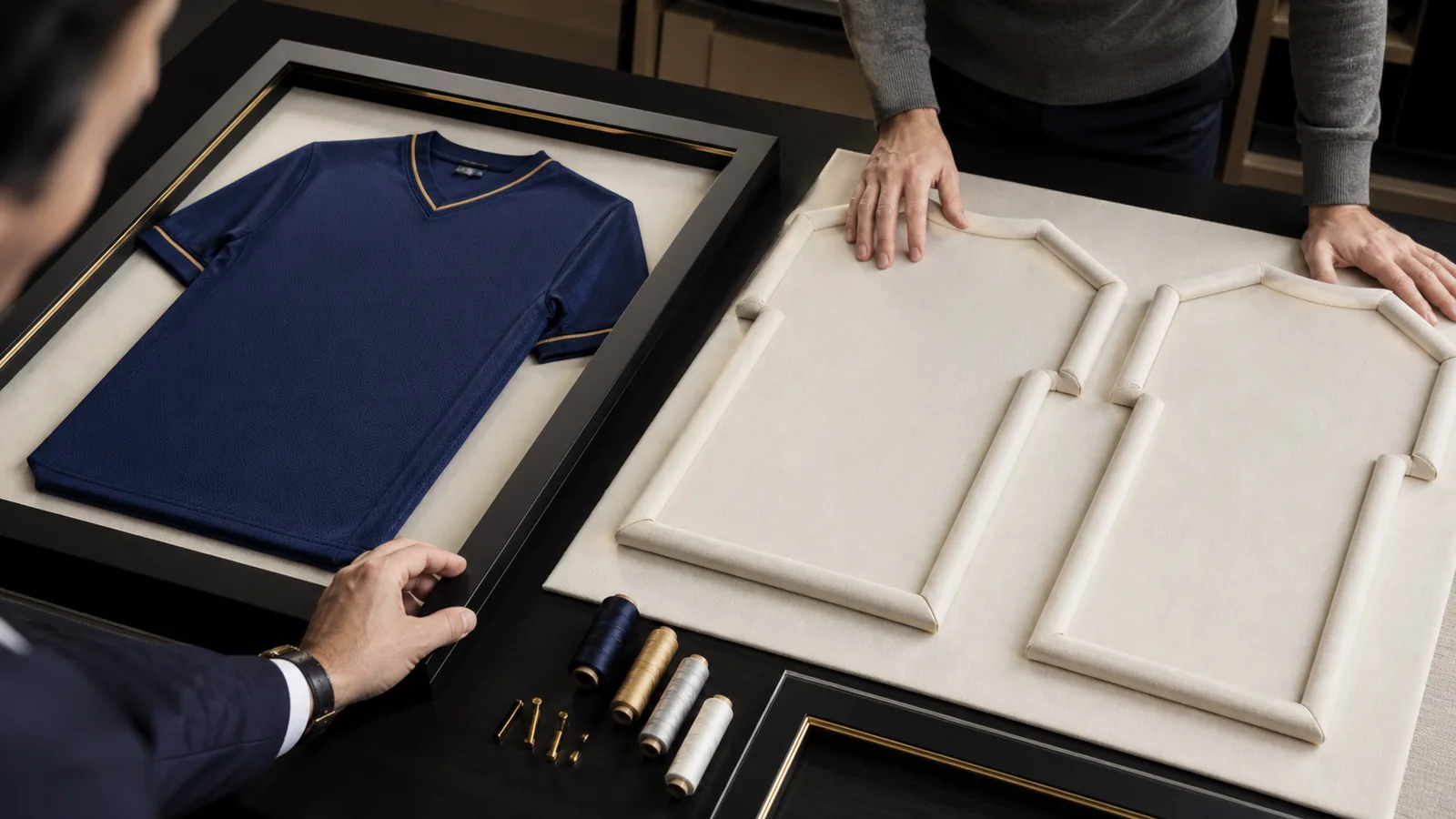
The Canadian Conservation Institute describes fabric-covered rigid supports and padded mounts as ways to support textiles. For a commercial jersey programme, ask the supplier to identify the rigid support, padding, cover fabric, preparation method and any barrier between textile and wood-based components. Do not accept “acid-free” without the exact component and evidence behind the claim.
The support should follow the approved silhouette without stretching the jersey. A shaped insert inside the garment can help distribute form, while a covered back support can carry the assembled object. Confirm whether edges are smooth, whether inserts can migrate and whether the garment rests naturally when the frame stands vertically.
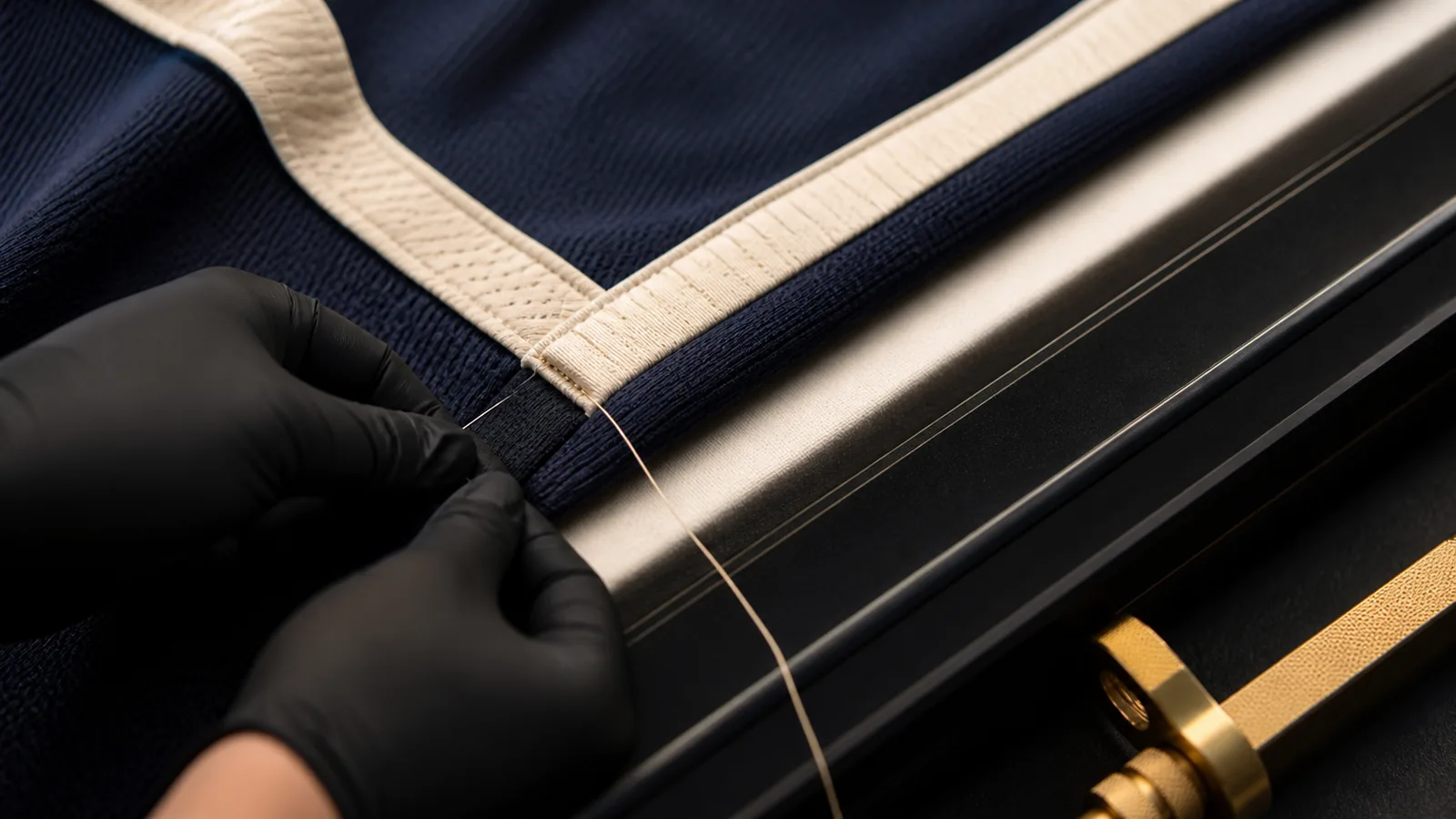
Specify stitch placement rather than asking for “hand sewn”
CCI guidance for sound flat textiles describes fine needles, colourfast thread and stitches selected for the textile, with support distributed so a vertically mounted piece does not pucker. Translate that principle into a garment-specific stitch map reviewed on the representative jersey.
Identify permitted areas such as existing seams, hems or robust structural zones, and prohibited areas such as autographs, fragile print, weak fabric, visible face zones or unsupported stretch panels. Define thread colour, visibility and removal path. The final stitch and spacing remain a condition-specific decision, not a universal number from this article.
Do not treat pins as an invisible default
Pins may be useful temporarily during positioning, but direct pinning can create holes, concentrated loads, corrosion or handling hazards depending on material and method. CCI notes recommend placing temporary pins between threads where possible when positioning small flat textiles, then removing them as stitching proceeds.
If a proposed commercial mount retains pins, ask what metal, point, head, locking method and contact path are used; how the risk of movement is controlled; and how removal occurs. For valuable garments, have a conservator approve the method. “Stainless” or “archival” should not be accepted without a specific product and appropriate evidence.
Keep adhesive away from the garment unless specifically approved
CCI conservation-framing guidance lists glues, adhesive tapes and adhesive-coated boards among materials that should not directly contact textile artefacts. A commercial jersey may not be a museum object, but the buyer should still ask where every adhesive sits and what happens if it ages, releases or migrates.
Adhesive can be appropriate for constructing parts of a support when it is isolated from the garment and fully cured under a reviewed design. Draw a contact-layer section showing jersey, cover fabric, padding, rigid board, barrier, backing and frame. This makes “no adhesive on the jersey” verifiable in a sample.
Separate the textile from glazing
Spacers or a deep frame should maintain clearance so raised seams, embroidery and fabric do not press against glazing. CCI notes explain that spacers prevent crushing and reduce risks associated with condensation in cold, damp exposure. State the minimum design clearance at the thickest garment point and verify it in the closed sample.
Check the frame in normal orientation and after gentle handling. A jersey that clears the front on the bench may move forward when vertical. If other objects such as medals, plaques or photographs share the display, map their depth and mounting independently so one component does not push the textile into the glazing.
Use barriers where wood-based materials are present
CCI conservation-framing guidance states that wood and wood products require an appropriate barrier when used near textile artefacts. Ask the supplier to identify frame substrate, backing and support materials, their contact path and any barrier. Do not infer long-term suitability from a black surface finish.
For ordinary retail replicas, the buyer may choose a different material standard from a museum. Record that decision honestly. For originals or valued signed items, let a conservator decide the materials and separation required. A factory datasheet is useful evidence, but it is not a full object-specific conservation assessment.
Build opening and removal into the rear construction
Choose whether the back is consumer-openable, technician-serviceable or permanently closed. Record fastener type, access sequence, tool, sharp-edge control and how the mounted support is lifted without touching the jersey. A removal tab or handling board may reduce direct contact.
Test reassembly. Retaining tabs, screws, clips and seals should return the frame to the approved rigidity and clearance without improvisation. If tamper evidence is required for a venue or collectible, keep that requirement separate from reversibility: the buyer should know which seal is sacrificed and which mounting parts remain reusable.
Review the sample vertically, not only on a table
Hang the sample using the proposed rear hardware and observe the jersey after an agreed period in representative conditions. Look for sleeve drop, collar distortion, diagonal pull, puckering, insert migration, visible stitch points and contact with glazing. Photograph consistent front, side and back views.
This is not a claim that a short sample review predicts decades of behaviour. It is a practical check that the support and attachment work in the intended orientation. High-value objects or long-term institutional displays need a conservator’s plan for condition review and environmental control.
Add gentle handling and distribution checks
A repeat programme may travel from factory to warehouse, venue or consumer. Review the mounted garment after representative handling and any qualified packaging validation required by the route. The purpose is to see whether supports or attachments move, not to create a universal “vibration-proof” marketing claim.
Photograph the approved position before the test and compare it afterwards. If the garment shifts, adjust the support or attachment map before increasing restraint. More force at one point can create a new textile problem. Keep the mounting decision connected to the separate packaging and logistics plan.
Set workmanship criteria the inspector can see
Define visible acceptance points: garment centre, fold symmetry, collar position, sleeve angle, approved feature visibility, even fabric tension, no visible adhesive, no unintended pins, no loose thread, required glazing clearance, clean interior and secure rear closure. Provide the approved sample photographs.
Also define critical exceptions: wrong garment, contact with an autograph, puncture in a prohibited area, missing support, unsafe loose object or insecure hanging hardware. Do not ask an inspector to infer collectible value. The intake record must identify which areas are protected before assembly begins.
Create a controlled intake record for customer garments
Photograph condition on arrival and list existing marks, pulls, stains, loose stitching, cracked print, autograph location and included accessories. Give the garment a project identifier without pinning a label through it. Record who approved cleaning, steaming or no-treatment status.
Do not promise cleaning or repair unless a qualified provider has assessed the garment. If condition is poor, pause assembly and ask the owner for direction. CCI guidance says soiled or fragile textiles should not simply be mounted; specialist advice may be needed.
Keep branding and plaques independent of the garment
Logos, nameplates and captions should use approved artwork and be mounted to their own controlled support wherever possible. Do not print, heat-press or adhere new branding to a customer’s jersey as a shortcut. Separate removable labels also make future correction easier.
If a person appears in project photography, keep any DOREMI detail natural and small. Product images should not invent team marks, signatures, certification badges or athlete identity. The buyer must confirm rights for every supplied club logo, player image, signature reproduction and licensed asset.
Record the sample as a mounting system
The golden-sample file should include garment reference, approved visible layout, support cross-section, material list, attachment map, stitch or fastener specification, prohibited zones, glazing clearance, back-opening sequence, hardware, photographs and approver. Record what varies by garment size and what must remain fixed.
On reorders, compare the incoming garment to the approved range. A change in fabric, patch position, sleeve cut or autograph location may require a new attachment layout even when the outside frame is unchanged. Change control protects the garment and prevents assemblers from solving differences silently.
Decide when professional conservation review is required
Escalate when the garment is fragile, deteriorated, unusually heavy, historically significant, culturally sensitive, highly valuable, signed with uncertain media, already repaired or expected to remain on long-term display. The conservator may recommend treatment, a different mount, environmental limits, rotation or display of a replica.
DOREMI can coordinate a frame and sample around an approved mounting brief. It should not diagnose fibre condition, authenticate a signature or guarantee preservation. Keep the owner, conservator, framer and manufacturer roles explicit in the project record.
Buyer sample-approval checklist
- Garment ownership, value class, condition and permissions recorded
- Representative size, fabric and decoration supplied
- Visible geometry and protected zones approved at full scale
- Support layers and every textile-contact material identified
- Attachment map, thread or fastener and removal path documented
- No unapproved adhesive, staple, tack or pin contacts the garment
- Clearance from glazing verified at the thickest point
- Vertical appearance and gentle handling reviewed
- Back opening, reassembly and wall hardware checked
- Condition photographs and golden-sample record archived
- Variant limits and change-control triggers agreed
- Qualified conservator approval obtained where warranted
Experience scope and project limits
Editorial review: Jessica, Founder & Project Advisor at DOREMI Display. Updated 14 August 2026. Jessica’s practical scope covers B2B display briefs, layout discussion, samples, branded details, manufacturing coordination, packaging and buyer handover. She is not presented as a textile conservator, museum registrar, autograph authenticator, materials laboratory or collections manager.
This guide provides procurement questions for commercial frame development, not a conservation treatment or preservation guarantee. Final mounting must be validated against the actual garment, condition, ownership permissions, exact materials, physical sample, display environment and distribution route. Irreplaceable, damaged, historic, culturally significant or high-value textiles require qualified professional advice.