
A federal buyer may want Wi-Fi digital photo frames for recognition, communications, reception areas or distributed employee programmes. The frame’s appearance is only one part of the sourcing decision. The radio module, network functions, cloud route, component producer and contractor’s wider use of telecommunications equipment can create Section 889 questions that an ordinary product quotation does not answer.
This guide is for federal contractors, recognition vendors, public-sector resellers, brand owners and overseas digital-frame OEM/ODM teams. It organises product and supplier evidence for review under FAR 4.21 and clauses 52.204-24 through 52.204-26. It does not decide whether a product or company is prohibited, covered by an exception or eligible for a waiver.
Why is Section 889 different from Buy American and TAA?
Domestic-preference and trade-agreement rules ask origin questions. Section 889 addresses covered telecommunications and video-surveillance equipment or services and the use of such equipment. A frame could satisfy one origin route and still require a separate Section 889 review. Conversely, Chinese manufacture alone does not prove that the device contains covered telecommunications equipment.
These buyer questions are editorial inferences from current FAR text and connected-device sourcing work. They were not captured from Google AI Overviews or AI Mode. Google Search Central recommends clear, reliable answers to complex questions; the first step is therefore to keep origin, cybersecurity, radio approval and Section 889 in separate evidence columns.
Read the solicitation and flow-downs first
Save the solicitation, amendments, contract clauses, line-item description and prime-contractor questionnaire. Record whether FAR 52.204-24, 52.204-25, 52.204-26 or related representations are included and how a prime expects suppliers to respond. Do not sign a generic “NDAA compliant” letter without seeing the actual request.
Identify the legal offeror and the party making the representation in SAM or the solicitation. An overseas factory can supply product facts, but it normally cannot make the U.S. contractor’s entity-wide representation.
Understand the two different prohibitions
FAR 52.204-24 describes one prohibition on agencies procuring or obtaining equipment, systems or services that use covered telecommunications equipment or services as a substantial or essential component or critical technology. It also describes a broader prohibition on contracting with an entity that uses such equipment or services, regardless of whether that use is in performance of the federal contract.
Build two workstreams: what the offered digital-frame solution provides, and what the contractor entity uses in its business. The supplier BOM helps the first; it does not complete the contractor’s reasonable inquiry for the second.
Map every communications function in the offered solution
List Wi-Fi, Bluetooth, cellular, Ethernet, USB networking, camera, microphone, cloud messaging, remote-management and video functions. Record which are present, disabled or absent. Include bundled routers, gateways, hotspots and management services, not only the frame.
A non-connected frame and a Wi-Fi frame should have separate configurations and SKUs. Do not claim that a radio function is absent because the app does not expose it; verify the hardware, firmware and production settings.
Collect module and producer identity at part-number level
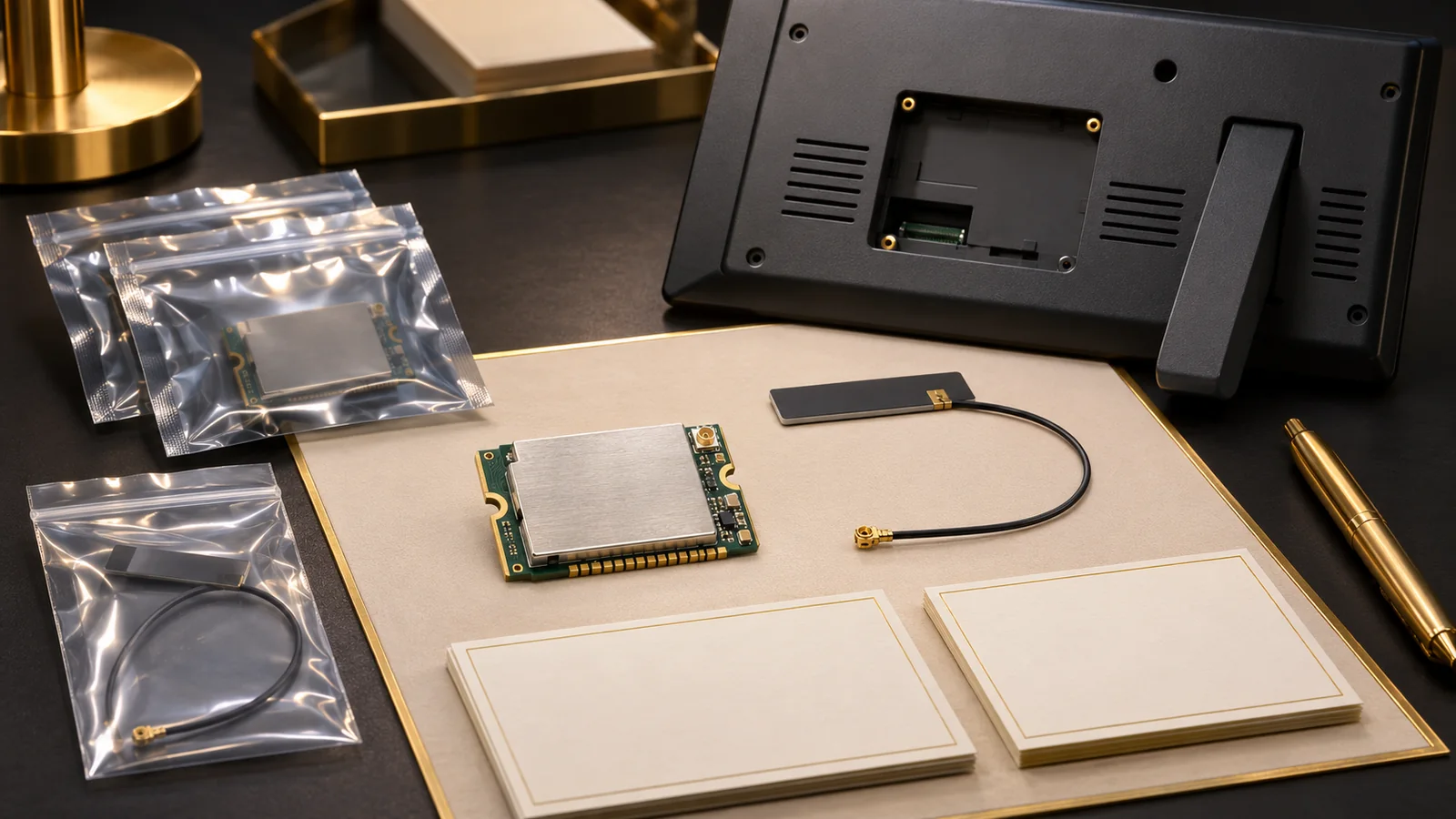
Request the radio module manufacturer, brand, model, chipset, module photographs, regulatory identifiers, board revision and supplier. “Generic Wi-Fi” is insufficient. The FAR disclosure fields can require the entity that produced covered equipment plus brand, model and item description when a disclosure is needed.
Trace private-label and distributor names back to the original producer where possible. Preserve invoices, declarations and component labels. If the supplier cannot identify the producer, mark the gap rather than converting an unknown into a negative answer.
Use the FAR definition rather than a brand blacklist alone
FAR 52.204-25 defines covered telecommunications equipment or services by named entities, specified equipment purposes and additional entities that may be designated. It also defines a substantial or essential component as one necessary for proper function or performance.
Do not reduce the review to a fixed spreadsheet copied from an old bid. Check current FAR text, SAM exclusions and the solicitation. Ask procurement counsel to interpret subsidiaries, affiliates, resellers and component function for the actual configuration.
Evaluate whether the component routes or sees user data
The FAR clauses include an exception relating to telecommunications equipment that cannot route or redirect user data traffic or permit visibility into user data or packets it transmits or handles. A digital frame’s Wi-Fi module may transmit photo, account or update traffic, so the technical function matters.
Ask engineers for a data-flow diagram and module capabilities. Do not assert the exception merely because the component is small or embedded. The authorised contracting and legal team should decide whether the exception applies.
Conduct a reasonable inquiry at the correct level
FAR defines reasonable inquiry as an inquiry designed to uncover information in the entity’s possession about covered telecommunications producers or providers, without necessarily requiring an internal or third-party audit. The contractor owns the scope and conclusion for its representation.
For the product stream, send controlled questionnaires to the OEM, module supplier, cloud provider and relevant subcontractors. For the entity-use stream, the contractor may need separate IT, facilities, security and procurement input. Do not present the product questionnaire as the whole company inquiry.
Distinguish “provide” from “use” responses
FAR 52.204-24 asks whether the offeror will provide covered telecommunications equipment or services and, after reasonable inquiry, whether it uses covered equipment or services. These are separate representations with separate disclosure paths.
Create a sign-off page that shows who answered each question, what evidence period was reviewed and which legal entity is covered. Avoid a supplier declaration that merges both answers into one ambiguous sentence.
Build an evidence packet for the offered digital-frame SKU
Include the model specification, hardware block diagram, radio-module identity, board and firmware revision, component supplier declarations, cloud-service map, regulatory photos, manufacturing site and change-control commitment. Link every file to the offered SKU and date.
Do not include unrelated technical secrets by default. Agree a confidential review route for sensitive BOM data. A redacted summary can be useful only if the responsible reviewer can still see the producer, model and functional facts needed for the decision.
Screen the cloud and service layer
A connected frame may rely on cloud storage, content delivery, device management, customer support or telecommunications services. Record providers, subcontractors and network roles. Do not assume Section 889 ends at the physical module.
At the same time, avoid calling ordinary internet connectivity a covered service without analysis. The FAR contains specific definitions and exceptions. Supply accurate service facts and let the authorised team apply the clause.
Control substitutions through production
Radio modules are frequently substituted because of price, availability or end-of-life notices. A change can alter producer identity, firmware, radio approvals, cybersecurity evidence and Section 889 screening. Require written approval before any alternate enters federal-destined production.
Maintain an approved vendor list tied to part numbers and board revisions. Quarantine units with unverified modules. Update the evidence packet and contracting determination before shipment, not after receiving inspection finds the change.
Separate samples from production units
Engineering samples may use an available development board or module that is not intended for the final configuration. Mark sample status and do not let a compliant sample photograph become evidence for a changed production build.
Before first article approval, compare the opened unit, BOM, firmware and carton model identifier. Record the component label without inventing a compliance badge for the exterior product.
Prepare disclosures without guessing
If the offeror must disclose covered equipment or services, FAR 52.204-24 specifies information such as producer, brand, model and proposed use. Do not omit an issue to preserve a bid, and do not make a positive disclosure solely because a supplier name sounds similar to a listed entity.
Escalate unknowns early to the contracting officer or prime contractor. Keep written instructions and the final authorised response. The factory should provide accurate facts and avoid signing an American legal representation outside its role.

Plan the receiving inspection
Inspect a sample from each production lot or according to the approved quality plan. Confirm model, board revision, module label, adapter, firmware and packaging identifiers. Where opening every device is impractical, define traceability and destructive-sample rules before production.
Record discrepancies and hold affected lots. A cosmetic pass does not close a component-identity failure. Connect receiving records to the purchase order and delivery line item.
Handle resellers, integrators and subcontractors
A federal solution may pass through a recognition vendor, IT integrator, distributor and prime contractor. Each party needs an evidence handover proportionate to its role. State which entity controls the product, app, cloud and support service.
Flow down change-notification and information obligations in purchase orders. Avoid a chain of identical certificates where no party has the underlying component facts. The prime or offeror should retain the final representation and contracting communication.
Coordinate security and privacy reviews without conflating them
Section 889 screening does not replace cybersecurity testing, CRA work, FCC authorisation, privacy assessment or agency-specific security requirements. A module from a non-covered producer can still have vulnerabilities, and a secure product can still present a Section 889 issue.
Use a compliance matrix with separate owners and evidence. Share the hardware and data-flow facts across workstreams, but keep each conclusion tied to its own rule and reviewer.
Create a lower-risk non-connected option
Some federal recognition projects need only a rotating local image set. A frame without radios, cloud or app dependency may reduce review and support complexity. Define it as a genuine hardware configuration rather than a Wi-Fi model with a hidden menu toggle.
Quote the connected and non-connected routes separately with differences in functions, updates, security and lead time. Let the buyer choose based on operational need; do not remove needed capability merely to simplify a form.
Maintain the record through reorder and contract renewal
Refresh screening when the module, chipset, factory, cloud provider, contractor legal entity, acquisition clause or covered-entity designation changes. Also review after mergers and supplier ownership changes. Date every supplier declaration.
For reorders, compare the current unit with the previously approved evidence rather than asking whether it is “the same product.” Preserve superseded records for earlier deliveries and document the effective lot of each change.
Set a bid calendar that leaves time for unresolved facts
Work backwards from the proposal deadline through supplier questionnaires, engineering review, counsel assessment, prime-contractor clarification and authorised signature. A last-day request for a module producer or data-flow answer usually produces either delay or an unreliable declaration.
Assign an owner and due date to every unknown. Where a fact cannot be confirmed, offer a different approved configuration, request formal direction or decline to make the representation. Procurement integrity is more valuable than forcing an uncertain product into a bid. Keep clarification responses with the final proposal so delivery teams understand the basis of the accepted route.
Section 889 supplier-handover checklist
- The solicitation and all flow-down clauses are saved
- Buy American, TAA and Section 889 are separate reviews
- “Provide” and entity-wide “use” representations are separated
- Every radio and communications function is mapped
- Module producer, brand and model are traceable
- Data-routing and packet-visibility functions are described
- The contractor scopes and documents its reasonable inquiry
- Cloud and service providers are included where relevant
- Supplier unknowns stay visible until resolved
- Component substitutions require approval
- Receiving inspection checks the approved configuration
- The authorised offeror owns disclosures and representations
Experience scope and project limits
Editorial review: Jessica, Founder & Project Advisor at DOREMI Display. Updated 22 November 2026. Jessica’s practical scope covers digital-frame specifications, OEM/ODM quotations, component handovers, samples, packaging and buyer–supplier communication. She is not presented as a contracting officer, federal procurement lawyer, SAM administrator or Section 889 certifying official.
The offeror, prime contractor, contracting officer and qualified advisers must determine clause applicability, covered equipment or services, reasonable-inquiry scope, exceptions, waivers, disclosures and representations. This guide organises supplier facts; it is not a SAM representation, waiver, legal opinion or government approval.