A Cybersecurity Labelling Scheme label is not a decorative star rating that a private-label buyer can add to a Wi-Fi digital photo frame carton. It represents a defined product, developer evidence, testing-laboratory work and approval by Singapore's Cyber Security Agency, or CSA. The required depth changes significantly from Level 1 to Level 4.
This guide is for Singapore importers, retailers, connected-frame brands, firmware owners, test coordinators and OEM/ODM suppliers. It translates current CSA material into a practical buyer–manufacturer handover for consumer digital photo frames. It does not confirm that a particular frame is eligible, select a level, interpret every technical requirement, approve a test plan, issue a label or replace advice from CSA, an approved laboratory and qualified cybersecurity professionals.
What are digital-frame buyers asking about CLS(IoT)?
Procurement questions include: “Is the label mandatory for a photo frame?”, “Can the importer apply?”, “Does Level 2 require a penetration test?”, “Can an ETSI EN 303 645 report be reused?”, “Which firmware build is assessed?”, “What happens if the cloud or wireless module changes?”, “Can a UK or Japanese label shorten the process?” and “May the star mark appear on samples before approval?”
These questions are editorial inferences from CSA's current scheme pages and publications and from recurring connected-product handovers. Google Search Central recommends original, useful, well-structured content and relevant media for generative search. DOREMI does not claim direct access to or measurement of Google AI Overview or AI Mode results.
Confirm scope and voluntary status first
CSA says CLS(IoT) has expanded beyond routers and smart-home hubs to all categories of consumer IoT devices. Its 18 March 2026 announcement describes the scheme as voluntary except for Wi-Fi routers, for which Level 1 is mandatory. A Wi-Fi digital photo frame is not a router merely because it connects to one.
Ask CSA or an approved testing laboratory whether the exact consumer frame, app and service configuration can enter the scheme and what applicant route applies. Do not tell retailers that every connected frame sold in Singapore must carry CLS, and do not treat general scheme coverage as product approval. Keep IMDA equipment registration, electrical safety, privacy and other market duties as separate workstreams.
Choose the commercial objective before the level
Start with why the brand wants the label. A retailer may need a baseline assurance signal; an institutional buyer may request deeper evidence; a group may want a recognised route into another market. Higher levels add assessment depth and project inputs. Choosing four stars for marketing before confirming source-code access, lifecycle records and test budget can create a schedule the OEM cannot meet.
Write a one-page objective covering target market, sales channel, product lifetime, launch date, desired level, recognised foreign schemes and buyer requirements. Ask the laboratory for a scoped proposal based on the exact model and architecture. A price comparison without identical level, sample, software and retest assumptions is not meaningful.
Understand what the four levels represent
CSA's consumer explanation says Level 1 covers basic security such as unique default passwords and software updates. Level 2 adds all mandatory security requirements of the referenced international standard and includes Level 1. Level 3 adds security-by-design, lifecycle assessment and software-binary analysis by an approved third-party laboratory. Level 4 adds structured penetration testing and includes the preceding levels.
These are cumulative assurance levels, not interchangeable badge designs. Scheme Specification v1.4 describes Level 2 around mandatory ETSI EN 303 645 requirements, Level 3 around lifecycle requirements and binary analysis, and Level 4 around black-box penetration testing. Use the latest publications and laboratory instructions; a summary article cannot replace their detailed provisions or acceptance criteria.
Freeze the device under test
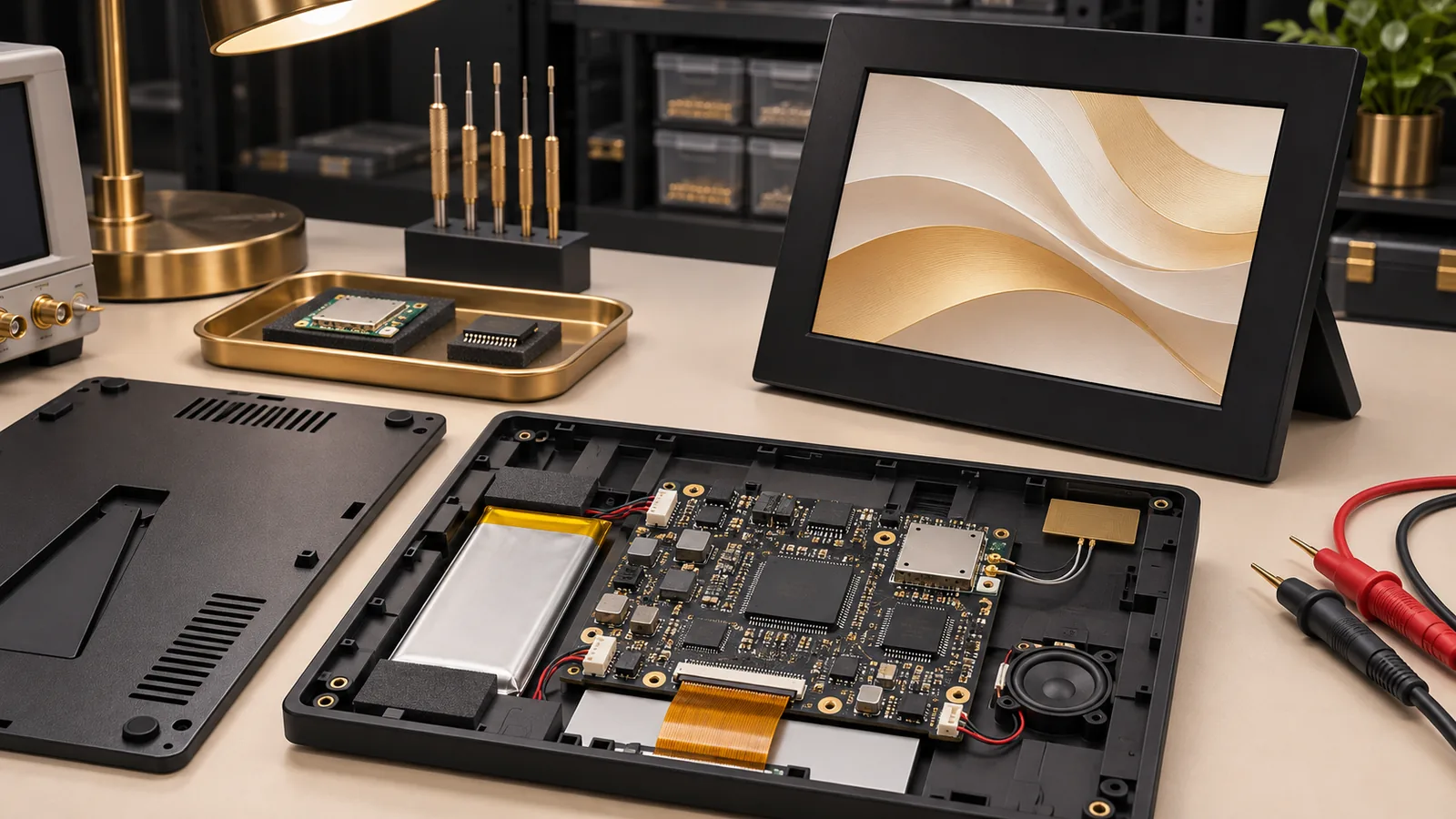
The evidence pack needs a stable device identity: brand, product name, model, hardware revision, wireless module, processor, memory, operating system, firmware build, app version and backend environment. Record features such as local upload, cloud album, invitation links, Bluetooth, microphone, camera, removable storage and remote administration. The laboratory cannot assess a marketing family that changes underneath the task.
Define which colour or storage variants share security-relevant hardware and software and which require separate review. A cosmetic finish may be low risk, while a new module, board, firmware branch or cloud endpoint may change the attack surface. Ask the laboratory to confirm grouping rather than copying one label across every SKU.
Assign developer, applicant and supplier responsibilities
CSA's scheme overview identifies the Cybersecurity Certification Centre as scheme owner and approval authority, an approved testing laboratory as reviewer and assessor, and the manufacturer or developer as the party supplying evidence and supporting tests. The publications also explain sponsor and submission routes. Do not assume that a trading company can complete missing technical evidence after the factory disappears.
Create a RACI matrix for product identity, declaration of conformity, security architecture, evidence, samples, lab questions, application, label artwork and post-approval changes. If the brand controls the app and cloud while the OEM controls firmware, both must contribute. Put response times and document access into the supply agreement before the laboratory begins.
Build Level 1 evidence from product behaviour
Baseline work commonly reaches credentials, vulnerability reporting and security-update information. Show how each unit avoids universal default passwords, how a user sets or receives credentials, how pairing tokens expire, where a security issue can be reported and how the defined support period is published. Screenshots alone are weak if they do not match the actual production flow.
Test first boot, reset, account transfer and recovery. A frame returned by one customer should not reopen with the prior account or album. If the app forces password creation but the device exposes an undocumented local service, the baseline story is incomplete. Record firmware and backend controls together.
Prepare Level 2 as an evidence exercise, not a checkbox
Scheme Specification v1.4 bases Level 2 on the mandatory requirements of ETSI EN 303 645. CSA's supporting-evidence examples include descriptions, screenshots, process charts and work instructions. The supplier should map each applicable provision to a specific control, evidence location, owner and product version, with a reasoned treatment of anything not applicable.
Build the mapping from engineering sources: credential design, secure communications, update mechanism, protected parameters, attack-surface reduction, integrity, data deletion, telemetry, resilience and user guidance. Do not submit a generic policy that never mentions the frame. An approved laboratory now reviews Level 1 and Level 2 applications before submission, so allocate time for clarification and evidence repair.
Plan Level 3 lifecycle and binary analysis early
Level 3 adds evidence that security was considered through development and maintenance, plus analysis of software binaries by an approved laboratory. The OEM should be able to explain threat review, secure coding, dependency management, build control, vulnerability handling, patch decisions, release approval and support. Reconstructing these records after mass production is slow and often incomplete.
Confirm which binaries the laboratory needs, how encrypted or signed images are provided, whether third-party components can be identified and how findings are remediated. The tested firmware hash should connect to the release candidate and production image. If a supplier cannot reproduce a build or explain included libraries, decide whether to change the architecture, supplier or requested level before launch.
Treat Level 4 penetration testing as model-specific
Level 4 adds structured black-box penetration testing. The laboratory needs a functioning product, app, accounts, network setup, relevant services and enough documentation to establish the target. Agree the test boundaries, sample quantity, firmware, cloud environment, credentials, destructive-test limits and remediation/retest process.
A penetration test is not a promise of permanent security. It evaluates a defined configuration and time window. New firmware, a changed API, a replacement wireless module or a migrated cloud can alter the result. Store the report and closure evidence securely, and describe public claims without exposing sensitive findings or implying immunity from attack.
Engage an approved laboratory before final quotation
CSA maintains a list of approved CLS(IoT) laboratories. Use that source rather than a supplier's old accreditation slide. Ask the laboratory to confirm level, scope, documentation, sample needs, fees, expected review sequence, testing time, remediation assumptions and application support. CSA's May 2026 updates should be checked for current process changes.
Put laboratory milestones into the OEM quote: evidence-ready date, sample build, assessment start, clarification window, remediation build, retest, application and artwork release. Do not promise a retail launch based only on the nominal test duration. Shipping samples, answering questions and fixing firmware can take longer than the bench work.
Publish a truthful support period
CSA's assessment methodology expects the defined support period to be clearly published on the developer's website. Decide who funds and delivers vulnerability fixes, app compatibility and cloud support throughout that period. A label project should not publish a date that the brand, OEM or platform provider has not contractually accepted.
Connect the support statement to component availability, source access, signing keys, update infrastructure and customer communications. Define what happens at end of support: notice, safe retirement, account export, local-only behaviour or device replacement. Avoid vague “lifetime updates” claims unless the lifetime and delivery commitment are defined and supportable.
Create a vulnerability-reporting route that reaches engineering
A security contact page is useful only if reports reach a qualified owner, are acknowledged, triaged and resolved. Set an inbox or portal, required information, safe-harbour language where appropriate, escalation contacts, severity method, response targets and disclosure coordination. Test the route from outside the company.
The OEM agreement should require prompt cooperation, relevant logs, build access and patch development. If the brand receives a report about a third-party library, it still needs to determine affected models and users. Keep a decision record linking the vulnerability, affected version, remedy, release and user notice.
Control samples, firmware and production release
Label each laboratory sample with model, hardware revision, firmware hash, app build and backend environment. Photograph ports, rear labels and packaging state. Prevent development units with debug interfaces, shared passwords or test certificates from being mistaken for retail production. After assessment, reconcile the approved configuration with the golden sample and factory release file.
Production inspection should verify model identity, correct firmware, disabled debug access, credential behaviour, reset, update check and required user information. A front-view product photo cannot prove these controls. Keep a shipment-level record showing which approved build was installed.
Use label artwork only after approval
CSA issues the label and registration identity. Keep draft commercial mock-ups clearly internal and do not make a sample look certified before approval. After issuance, use the correct artwork, level and product association in accordance with CSA requirements. Reconcile physical product, retail carton, ecommerce listing and registration record.
Train marketing and retailers not to describe the label as government endorsement of every feature, privacy practice or future version. The label addresses the scheme's cybersecurity assurance for the approved product. Radio, electrical, privacy, consumer and subscription claims need their own evidence.

Verify mutual-recognition routes product by product
CSA describes arrangements with the United Kingdom, Germany, Korea, Japan and other partners, but scope and equivalent level differ. In March 2026 Singapore and Japan announced mutual recognition with effect from 1 June 2026; CSA also explains that UK PSTI-compliant products may use a simplified route toward Level 1. These arrangements can reduce duplicated work, but they do not make every foreign label automatically valid for every digital frame.
Ask CSA and the laboratory whether the product category, scheme version, evidence and desired level fit a recognised route. Preserve the foreign certificate, model identity, validity and any additional Singapore evidence. Do not market cross-border recognition until the applicable Singapore process is complete.
Build change control around the security claim
Create triggers for processor, memory, wireless module, board, operating system, firmware branch, app SDK, cloud endpoint, cryptography, credential flow, update method, support period, factory and debug configuration. The supplier must notify the brand before implementation and provide an impact assessment.
Ask the laboratory or CSA what amendment, evidence update or reassessment is required. Hold label artwork and shipment release until the decision is recorded. A security-relevant change can be invisible in product photography, so visual sample approval alone is not enough.
Buyer–OEM CLS(IoT) handover checklist
- The exact digital frame's scheme scope and voluntary status are confirmed
- The commercial reason and desired CLS level are documented
- Level 1, 2, 3 and 4 are not treated as equivalent
- Model, hardware, firmware, app and backend identity are frozen
- Brand, OEM, developer and laboratory responsibilities are assigned
- Baseline credentials, updates and vulnerability reporting are tested
- Level 2 controls map to product-specific evidence
- Level 3 lifecycle and binary inputs are available before application
- Level 4 test scope, remediation and retest are agreed where selected
- The laboratory is on CSA's current approved list
- The published support period is contractually supportable
- Samples and production units share the assessed configuration
- Label artwork is withheld until approval
- Mutual recognition is verified for the exact product and level
- Security-relevant changes trigger review before shipment
Experience scope and project limits
Editorial review: Jessica, Founder & Project Advisor at DOREMI Display. Updated 9 November 2026. Jessica's practical scope covers digital-frame feature briefs, OEM/ODM quotations, component and firmware coordination, samples, packaging, production communication and buyer–supplier handovers. She is not presented as CSA, CCC, an approved testing laboratory, penetration tester or cybersecurity lawyer.
The applicant, developer, approved laboratory, CSA and qualified advisers must determine eligibility, level, applicable provisions, evidence, testing, findings, remediation, label use, mutual recognition and post-approval change treatment for the actual product. This guide prepares the commercial and manufacturing handover; it is not an application, test report, approval or cybersecurity guarantee.