
A display frame sold in Spain may arrive with a retail box, protective sleeve, corner blocks, instruction pouch and transport carton. After the EU Packaging and Packaging Waste Regulation began applying on 12 August 2026, the first commercial question is no longer simply “How many kilograms of packaging did we use?” It is “Who is the producer for this exact packaging flow, and which 2026 quantities belong to that entity?”
This guide is for Spanish importers, private-label brands, distributors, remote sellers and overseas frame suppliers. It connects the current MITECO packaging register guidance, Royal Decree 1055/2022 and Regulation (EU) 2025/40 to an OEM packaging handover. It does not register a company, select an EPR system, interpret a contract or replace MITECO, Spanish environmental counsel, an authorised representative or a qualified packaging adviser.
Use the 12 August 2026 dividing line
Regulation (EU) 2025/40, the PPWR, began applying generally on 12 August 2026. MITECO explains that the new producer definition changes who may be the packaging producer in Spain for some flows. The 2026 data file therefore may need to distinguish packaging first marketed from 1 January through 12 August and packaging first marketed from 13 August through 31 December.
Put that date into the sales and packaging dataset. Do not aggregate the whole year first and try to reconstruct the legal role later. Keep transaction date, channel, seller, customer type, packaging configuration and responsible entity available for qualified review.
Use the 1 October–31 December RPP update window
MITECO's current Register of Product Producers page states that the ordinary window for modifying registration details for packaging categories and the associated individual or collective EPR systems runs from 1 October through 31 December. That makes an October review commercially urgent for brands whose packaging categories, sales model or producer status changed after PPWR application.
Compare the current RPP record with actual 2026 packaging flows. Confirm the categories and the SRAP or SCRAP arrangement for each. Do not wait for the annual declaration window to discover that the registration profile and operational packaging map disagree.
Define the Spanish packaging flow before naming the producer
Draw the route from the packaging manufacturer and frame factory to the importer, distributor, marketplace, fulfilment centre and final user. State who is established in Spain, who owns the brand, who commissions the packaged product, who imports it, who sells it directly across borders and who first makes each package available in Spain.
Use one route per channel. A pallet delivered to a Spanish distributor, a private-label frame imported by a Spanish brand and a parcel shipped directly from abroad to a Spanish end user can produce different legal questions. The overseas factory supplies facts; it should not guess the Spanish obligated person.
Handle own-brand packaging explicitly
The PPWR manufacturer definition generally points to the person that has packaging or a packaged product designed or manufactured under its own name or trademark, subject to a micro-enterprise exception described in the regulation. MITECO highlights this own-brand change in its current 2026 guidance.
Record who commissions the retail box and whose brand appears on the frame and packaging. If the buyer is a micro-enterprise, ask Spanish counsel to review the exception and the location of the packaging or packaged-product supplier. Do not use company size as an informal assumption; retain the factual basis and conclusion.
Identify direct distance sales to Spanish end users
The PPWR producer definition includes a manufacturer, importer or distributor established in a Member State or third country that first makes packaging or packaged products available directly to end users in another Member State through distance sales. MITECO states that certain foreign operators selling directly to Spanish end users must appoint an authorised representative in Spain for EPR purposes.
Map the contracting seller and the end user, not only the shipping origin. Ask qualified Spanish advisers whether the foreign seller is the producer for the route and which representative, registration and system obligations apply. A marketplace storefront does not automatically answer the question.
Separate the legal owner from the supplier-data owner
The Spanish entity or appointed representative may own registration and reporting. The frame supplier owns product and packaging facts such as material, mass, dimensions and packaging level. Write both roles into the project plan so the factory does not file legal conclusions and the Spanish team does not invent component data.
Create a responsibility matrix for producer determination, RPP record, EPR system, annual declaration, packaging BOM, evidence approval and change notices. Name a person, not only a department, for each.
Map retail, grouped and transport packaging
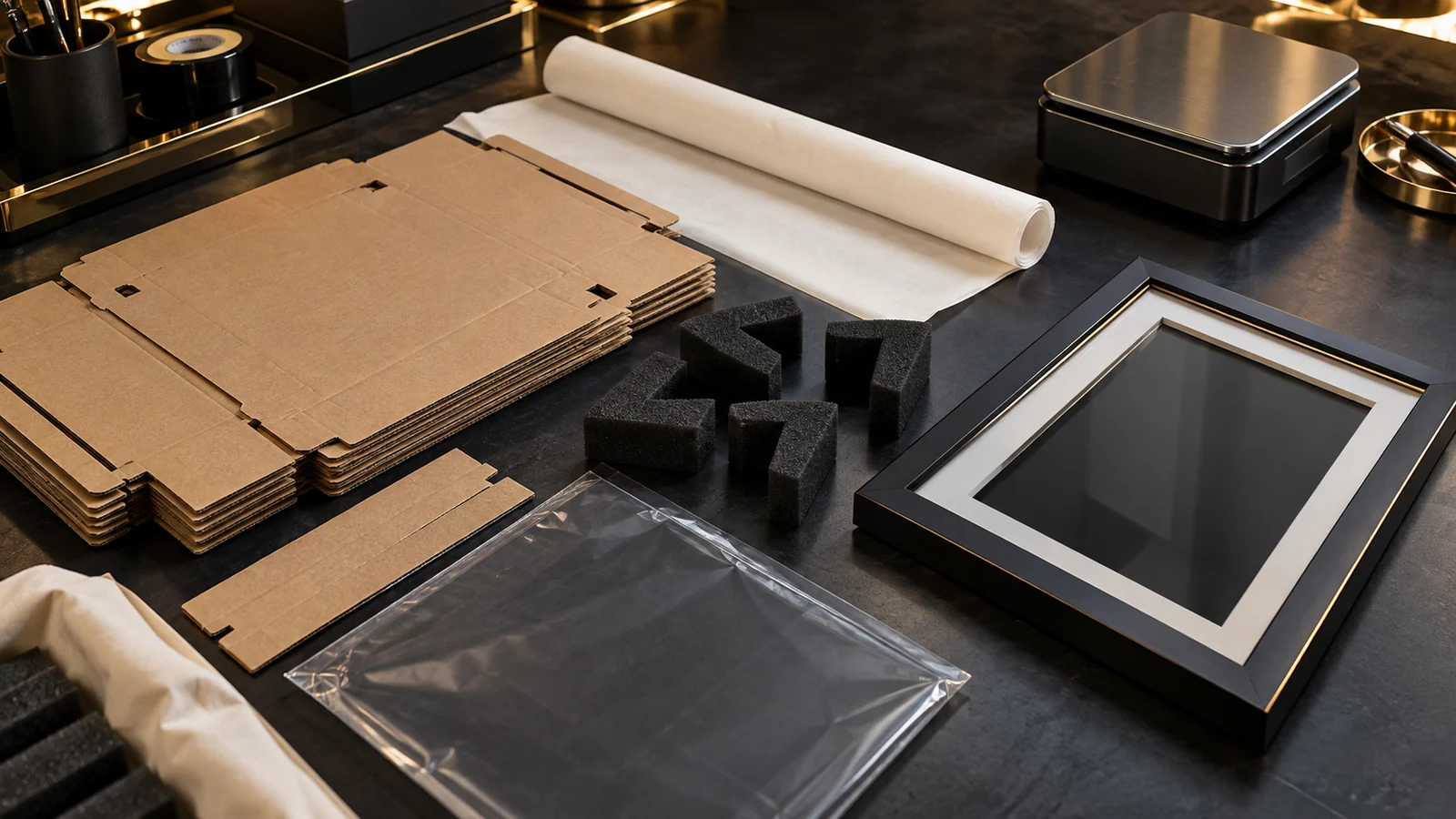
A frame programme can include a printed gift box around one unit, an outer carton holding several retail packs, a master carton, pallet wrap, corner boards, straps and labels. Depending on the product and route, the legal categories and reporting treatment can differ. Do not collapse every layer into “carton.”
Give each component a stable ID and packaging level. Record units per saleable frame, units per inner or master carton and the pallet pattern. If a fulfilment centre adds an overpack, identify who controls that data and how it is included in the Spanish analysis.
Include transport and service packaging after the PPWR change
MITECO's 2026 update explains that manufacturers, importers or distributors that first make transport, service or primary-production packaging available in Spain can be producers under the PPWR definition. For display frames, transport packaging is especially important because protective outer cartons, pallet film and securing materials may be substantial.
Do not treat warehouse packaging as invisible because the consumer never sees it. Ask the Spanish owner to classify each level and identify the applicable EPR arrangement. Keep reusable transport items separate from single-use packaging and document how returns or reuse are managed.
Build a packaging bill of materials by SKU
Use one row per packaging component: SKU, revision, component ID, packaging level, material, material subtype, unit mass, quantity per sales unit, supplier, calculation method and evidence reference. Add the sales channel and destination configuration because an e-commerce pack may differ from a pallet-delivered retail pack.
For composite items, identify separable materials and ask the adviser how to report them. Avoid descriptions such as “eco foam” or “paper-like bag.” Procurement names are not reporting categories.
Measure mass reproducibly
Use a calibrated scale, converter specification or documented calculation suitable for the component. Lightweight film may require batch weighing. Corrugated pieces should be weighed in the production size and flute, not from a generic material sample. Record whether adhesive, ink, labels or closures are included.
Save photographs, sample count, scale resolution, date and unit conversion. A supplier spreadsheet without a measurement trail becomes hard to defend when packaging changes or a second factory is added.
Prepare the 2026 split-period dataset
MITECO explains that entities whose producer status changes with PPWR application should declare the quantities for the portion of 2026 during which they were the producer. Some entities remain producers for the whole year; some cease on 12 August; others begin from 13 August. The correct treatment depends on the packaging flow and legal role.
Create a controlled calculation with pre- and post-application columns. Keep the determination memo beside the totals. Do not assign the same package to two producers merely because both an importer and a brand touched the product.
Plan for the 2 January–31 March 2027 declaration
MITECO states that the 2026 packaging declaration window opens on 2 January 2027 and closes on 31 March 2027. The absence of an on-time declaration can constitute an administrative infringement under the cited Spanish waste law. The site also describes a simplified procedure for specified cases, including producers placing less than 15 tonnes of packaging on the market annually.
Do not assume a small frame programme qualifies without organization-wide data and a legal review. Prepare unit packaging mass and transaction quantities during 2026 so January is a reconciliation period, not the start of supplier research.
Connect the RPP record to the EPR system
The register record and the producer's individual or collective EPR arrangement should describe the same packaging categories. Confirm that the chosen SRAP or SCRAP is authorised for the relevant category and that membership, reporting scope and commercial records align.
Keep evidence of registration, representative appointment and system participation under controlled access. Give procurement only the fields it needs for supplier and invoice workflows; do not circulate personal credentials or digital certificates.
Review marketplace responsibilities after 12 August
MITECO notes that online platforms no longer have the same subsidiary producer status for affected packaging after 12 August 2026 and instead have other obligations under the new framework. A foreign seller should not assume the platform will absorb its EPR role when no representative has been appointed.
Ask the marketplace what registration or EPR evidence it requires, then compare that policy with the legal determination. Platform onboarding is an operational gate, but it does not replace Spanish law or professional advice.
Keep the RPP identifier and commercial records consistent
Royal Decree 1055/2022 creates registration and information duties for packaging producers. The legal owner should confirm how the assigned registration number must appear in invoices or other commercial documentation for the actual arrangement. Supplier and sales systems should use the same entity and number once approved.
Do not print a number on retail packaging merely because it exists in an internal file. Confirm the required placement and audience. Control the number as master data and prevent old artwork or invoices from using a superseded entity.
Write packaging data into sample approval
Approve the product and its packaging as one revision. Photograph every layer, record mass and material, and connect the result to the commercial SKU. A premium presentation box can contain hidden magnets, laminates, foam, ribbon or plastic film that the outer photograph does not reveal.
At pre-shipment inspection, compare the actual packing sequence with the approved BOM. If a factory replaces foam with paper corners or adds stretch film, pause the data handover for review. Sustainability improvements are welcome, but they are still controlled changes.

Connect annual quantity to the right packaging revision
A commercial SKU can use more than one packaging revision during the year. Join sales or first-placement quantities to effective dates and order lots. Do not multiply the full-year unit count by the latest BOM if an earlier carton or protective system was different.
Keep raw transaction data, per-unit BOM calculations and declaration totals as separate layers. The reporting owner should be able to trace a kilogram total back to a SKU, packaging revision and evidence source.
Control cross-border returns and repacking
Returns, replacements, samples and repacking can complicate quantity data. A replacement frame may use new packaging even if no full retail sale occurs. A Spanish fulfilment centre may discard inbound transport packaging and add outbound parcel materials.
Document each flow and give it to the qualified owner. The supplier should not decide exclusions it cannot see. Its job is to provide accurate unit packaging data for the configurations it supplies.
Common handover failures
Typical problems include using a pre-August producer map for the whole year, ignoring transport packaging, treating the overseas factory as the Spanish reporting owner, failing to appoint an authorised representative for direct sales, applying one average BOM to several channels, and entering recycled or composite material claims without evidence.
Another failure is late discovery. If packaging data is first requested after the declaration window opens, discontinued materials and converter records may be difficult to recover. Put the data request into supplier onboarding and reorder control.
Buyer checklist for the 2026 transition
- Every Spanish sales and packaging route mapped
- Producer role reviewed for pre- and post-12-August periods
- Own-brand and micro-enterprise facts documented
- Direct distance sellers and authorised representative needs reviewed
- RPP registration profile compared with actual packaging categories
- 1 October–31 December modification window assigned
- SRAP or SCRAP status confirmed for each category
- Retail, grouped, transport and fulfilment packaging separated
- SKU-level component mass and material evidence retained
- 2026 quantities linked to responsible entity and effective dates
- 2 January–31 March 2027 reporting plan assigned
- Marketplace evidence requests checked separately
- Sample approval and inspection reconcile the packaging BOM
- Change notices update data before the next shipment
Questions to send the supplier
Ask: What packaging component surrounds, groups, protects or transports each frame? What is the material, mass, quantity, level and supplier for each component? Which packaging changes by channel? Which revision and effective order does the data cover? Are there laminates, coatings, magnets, adhesives or mixed-material pieces? What substitutions require notice?
Then ask the Spanish adviser: Who is the producer for each route before and after 12 August 2026? Does a foreign seller need an authorised representative? Which RPP categories and EPR systems apply? How should the 2026 split period, simplified reporting, returns and fulfilment packaging be treated? Which commercial documents must carry the registration number?
Experience scope and project limits
Editorial review: Jessica, Founder & Project Advisor at DOREMI Display. Updated 1 October 2026. Jessica's practical scope is B2B display-frame briefing, packaging BOM discussion, sample coordination, supplier data handover and production change control. This article does not present her or DOREMI as MITECO, an EPR scheme, an authorised representative, a Spanish lawyer or an environmental auditor.
Use this workflow to make packaging facts reviewable by the Spanish legal and reporting owners. The current PPWR, Spanish rules, MITECO guidance, registration record and actual commercial route control the decision.