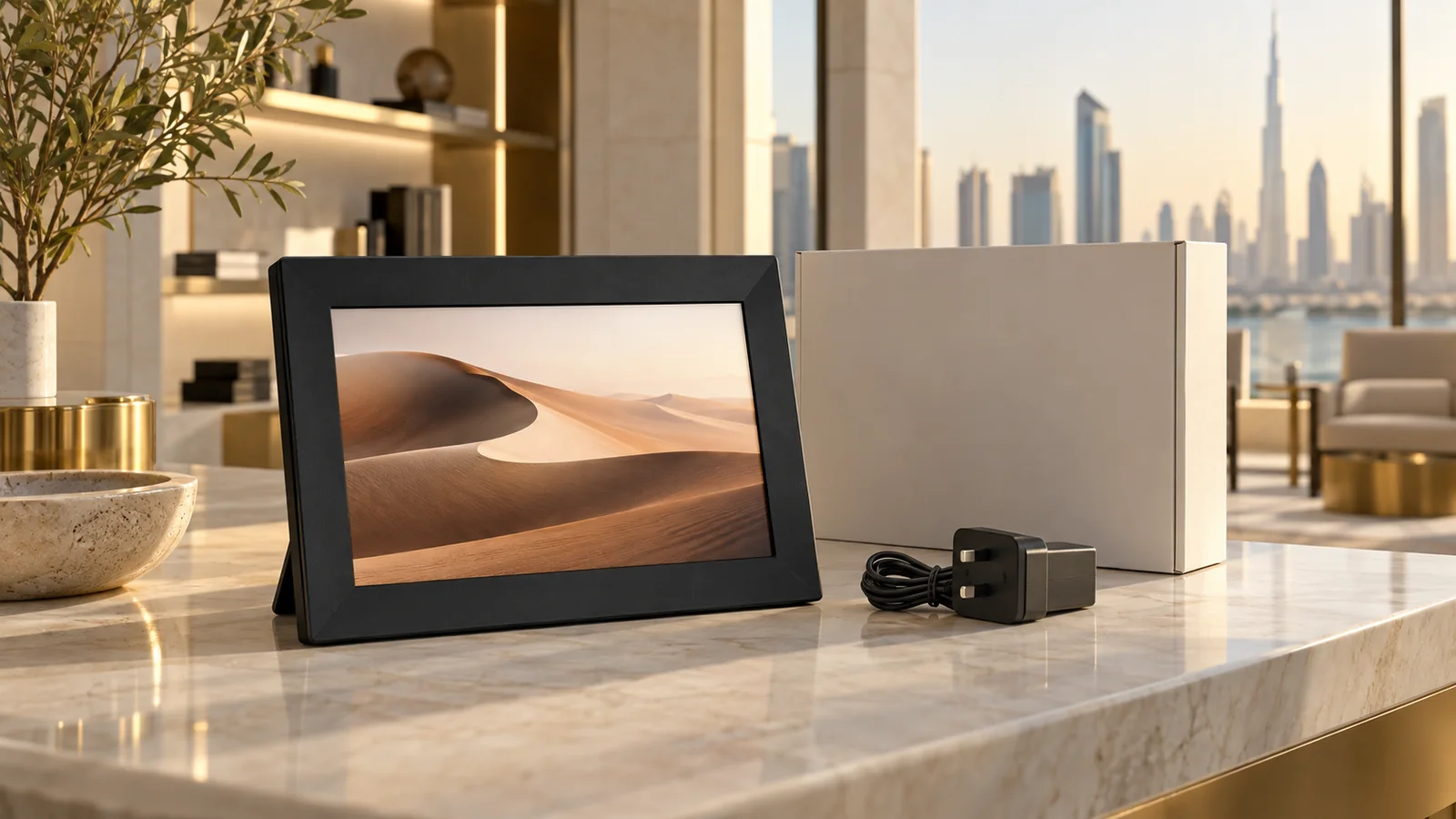
A Wi-Fi digital photo frame entering the United Arab Emirates moves through a connected regulatory chain: the local supplier or manufacturer is registered, the exact telecommunications equipment is submitted under the applicable TDRA risk level, technical evidence and any required samples are reviewed, and the approved model is tied to the commercial import and customs-release process.
This guide is for UAE importers, distributors, retailers, hospitality procurement teams, private-label brands and overseas OEM suppliers. It is an operational framework, not a TDRA registration certificate, risk classification, customs release, laboratory opinion or legal advice. The UAE applicant and qualified professionals must confirm the current policy, technical specifications, fees, sample requirements and model treatment before filing or shipment.
What changed for UAE equipment approval in 2026?
TDRA's public FAQ says the updated Telecommunications Equipment Type Approval Policy took effect on 1 May 2026. It describes a unified framework covering registration, approval, import, distribution, display, sale, commercial use, testing, customs clearance, market surveillance and fees. A buyer should therefore treat approval as an operating process, not a certificate attached after production.
For a new project, save the version and effective date of the policy used by the applicant. If an existing digital-frame model was approved under an earlier regime, ask whether renewal, transition or updated evidence applies. Do not assume an old approval continues unchanged merely because the enclosure and marketing name look familiar.
Why is a Wi-Fi frame telecommunications equipment?
The TDRA equipment-registration service expressly includes Wireless LAN or Wi-Fi devices in its sample and inspection information. A connected frame uses radio functions to receive images, communicate with an app or access cloud services. Calling it décor does not remove the radio transmitter.
Define the marketed functions before classification: Wi-Fi bands, Bluetooth, cellular capability if any, NFC, location functions, microphones, cameras and cloud connectivity. A basic frame with only Wi-Fi can require a different evidence set from a variant with mobile-network capability or a camera. Freeze those functions in the model brief before the laboratory and UAE applicant plan the route.
Register the responsible UAE supplier first
TDRA identifies supplier registration as the first regulatory step and makes it a condition of the equipment-registration service. The overseas factory can prepare evidence and samples, but the UAE entity needs the correct registration and account relationship to place equipment through the process.
Map manufacturer, brand owner, UAE importer, distributor, retailer and end customer. Record which entity will register the model, own the approval, receive notices and request customs release. If several distributors intend to sell the same platform, obtain TDRA guidance on the permitted arrangement rather than duplicating or sharing credentials informally.
Freeze the exact model identity
A private-label programme can use one housing with several screen sizes, memory options, radio modules, adapters, firmware builds and brand names. TDRA's approved-equipment directory uses fields such as marketing name, model name, equipment-registration number, expiry date and organisation. Those public identities need a reliable source in the factory file.
Create a configuration sheet with manufacturer, marketed brand, model, hardware revision, module, antenna, supported bands, software, power equipment and package version. Keep spelling and punctuation consistent across technical data, reports, sample labels, invoices and the application. Ask the applicant which variants can be grouped and which need separate review.
Determine the applicable risk level
TDRA's service page uses three risk levels: Level 1 for the lowest risk, Level 2 for medium risk that can involve inspection when requested, and Level 3 for the highest risk with inspection. The service publishes different expected processing times for those levels, but the correct classification belongs to TDRA and the applicant's current review.
Do not build a launch calendar around the shortest published time before the device is classified and the file is complete. Add time for report gaps, sample shipping, technical questions, certificate issuance, artwork release and customs coordination. A buyer's plan should show dependencies instead of presenting the service estimate as a guaranteed market date.
Build the technical file from current TDRA requirements
The equipment-registration service lists an official technical data sheet and, for Levels 2 and 3, test reports for radio, electromagnetic field and safety standards from an ILAC laboratory. It also lists IMSI evidence for smart network-enabled devices and sample provisions for certain device types, including WLAN or Wi-Fi.
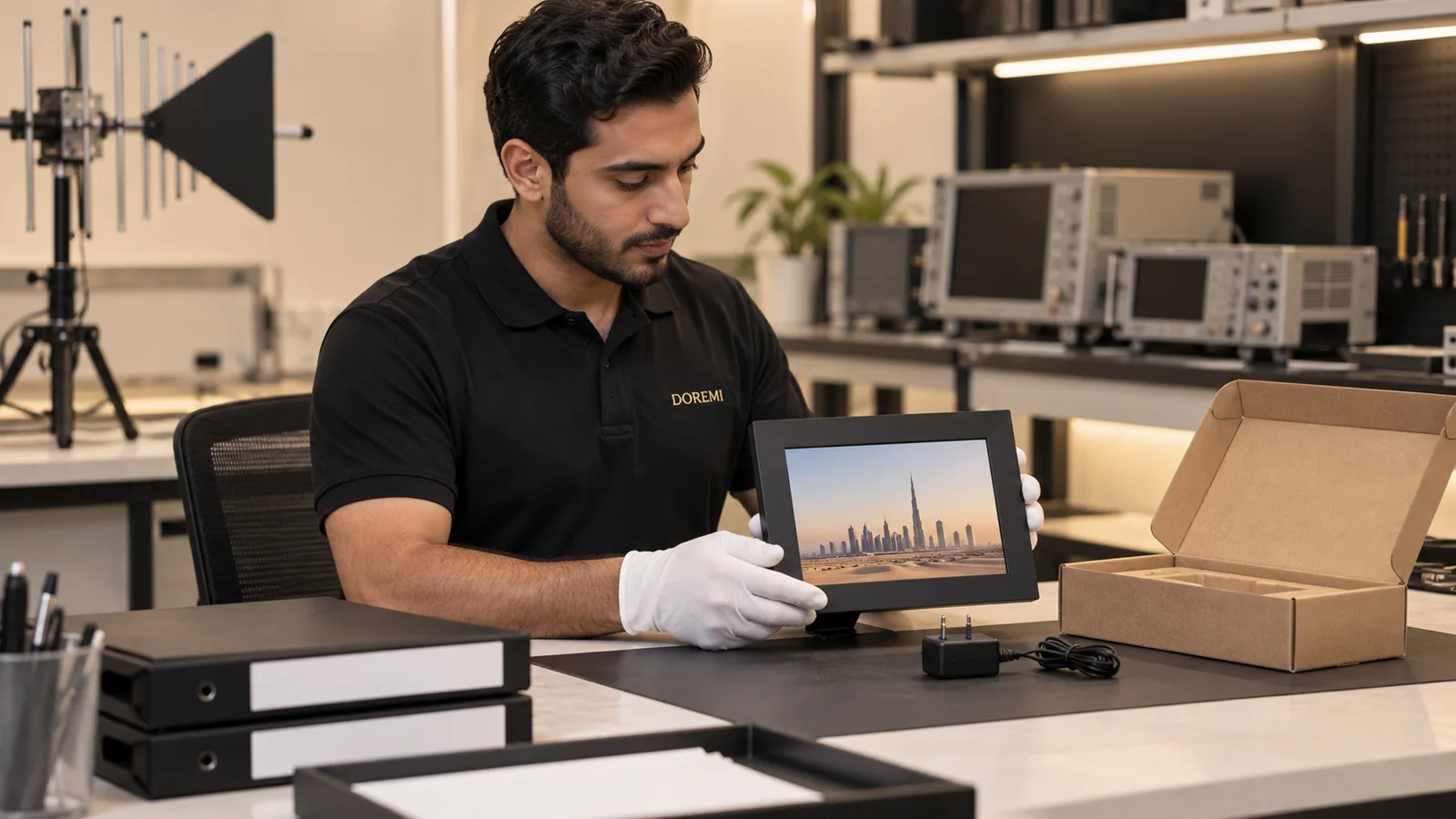
Ask the UAE applicant and laboratory to define the exact reports for the frame. Provide radio block diagrams, band and channel data, antenna details, maximum power modes, enclosure information, safety construction, adapter data and production firmware. Do not submit a module brochure in place of a finished-product technical file unless the approved route explicitly accepts it.
Map every radio function to a technical specification
TDRA Technical Specification TS RE 014 addresses broadband wireless access equipment and refers to the UAE frequency allocation and requirements for 2.4 GHz and 5.8 GHz WLAN or RLAN. It also notes that several technical specifications may apply when a product includes multiple functions.
Build a function-to-standard matrix and let the responsible applicant or laboratory confirm it. If a frame includes both Wi-Fi and Bluetooth, document both. If firmware exposes bands not intended for the UAE, determine how they are controlled in production and service. Never assume a European report automatically proves every UAE requirement without a current gap review.
Control samples like approval evidence
The TDRA service lists sample provision for WLAN or Wi-Fi devices. A sample sent for inspection or testing should represent the configuration that will be sold. Record serial or build identity internally, hardware and firmware revisions, module and antenna, adapter, accessories and packaging status.
After submission, stop uncontrolled component substitutions. If a replacement sample is requested, document why and whether it differs. Keep photographs of the submitted unit and its labels. The purpose is not to create marketing proof; it is to maintain a traceable connection between the authority's review and production.
Keep fees and service timing in the commercial plan
TDRA publishes transaction-review and certificate-issuance fees and lists inspection fees by technology when a customer requests inspection. These amounts and conditions can change, and the buyer should not treat a web-page snapshot as a permanent quotation.
Assign approval charges, laboratory work, samples, local representation and customs coordination in the landed-cost model. Decide which party pays for retesting after an OEM change. The purchase agreement can allocate commercial responsibility, but it should not describe a fee payment as proof that approval has been granted.
Verify the approved-equipment record
TDRA provides a public approved-equipment directory. Before production artwork and shipment release, the UAE owner should verify that the intended model is present with the expected marketing name, registration record, organisation and validity information. A similar model from the same manufacturer is not the same evidence.
Save the verification date and record used by the responsible team. Do not copy an equipment-registration number from the directory into packaging without confirming the current marking rule and the relationship to the exact product. Public listing, physical marking and customs release are connected checks, not interchangeable approvals.
Separate type approval from product artwork
Early design files should reserve space for approved product and importer information without inventing official marks, registration numbers or compliance claims. Once the UAE applicant supplies controlled content, place it on the correct model label, carton or manual under the current policy.
Review material, contrast, durability, placement and visibility on the physical sample. A rear label can be obstructed by a stand or wall mount. Digital labels or manual-only information should not be used unless the applicable rule permits that route. The designer should receive approved data, not interpret regulatory documents independently.
Make the adapter and electrical file model-specific
A digital frame typically ships with an external power supply. Record manufacturer, model, plug type, input and output ratings, safety reports and the frames it supports. A radio approval does not by itself establish the adapter's electrical conformity or confirm that a different adapter can be substituted.
Ask the UAE importer and conformity specialists which safety, EMC, energy-efficiency, plug or other product requirements apply to the frame and power equipment. Link the released adapter to the BOM and packaging. If procurement changes it, reopen the affected assessment rather than hiding the substitution behind the same retail model name.
Connect approval to the customs-release permit
TDRA's customs-release service says that companies should be registered and their devices approved. It lists documents such as the approved device in the company's account, customs declaration, bill of lading, device specifications, shipping lists or invoices. The exact shipment and permit type determine the final file.
Before booking freight, reconcile model, quantity, importer, invoice description and approval record. Use an accurate description such as Wi-Fi digital photo frame rather than a vague décor label. If samples enter temporarily for an exhibition or testing, ask which permit route and undertakings apply instead of treating them as commercial stock.
Prepare instructions and support for the UAE customer
The user experience should match the approved hardware and software: adapter and plug, stand or wall mounting, Wi-Fi connection, app setup, privacy controls, reset, safe ventilation, cleaning and customer support. Decide the required languages and consumer information with the UAE seller.
Test URLs, apps and cloud services from the intended market before printing. If the product depends on an account or mobile application, define who maintains it and how changes are controlled. A working radio module at the factory does not prove that the complete service will be available or supported in the UAE.
Control private-label and hospitality variants
Hotels, corporate gift programmes and retailers may request a custom boot screen, logo, enclosure finish, app, packaging or accessory set. Determine whether each change affects marketing identity, model grouping, radio behaviour, safety evidence or the approved-equipment record.
Keep a variation table with approval impact and responsible reviewer. A custom frame delivered only to one hospitality project is still not automatically outside the equipment framework. Ask the UAE applicant whether the sales route, end use or limited quantity changes any requirement, and keep that answer with the order.
Verify production before shipment
Pre-shipment inspection should compare model, brand, hardware revision, module, antenna, firmware, adapter, product label, carton, instructions and included accessories against the released matrix. Inspect representative radio and label evidence where practical. Photograph results under the buyer's confidentiality and retention rules.
Define escalation rules for mismatches. An unexplained module change, missing label, expired record, wrong importer or different adapter should stop release until the UAE owner decides the corrective route. Factory inspection supports conformity control but does not replace TDRA approval or the customs permit.

Maintain approvals through renewal and change
TDRA offers renewal and modification services, and the approved-equipment directory includes expiry information. Assign a calendar owner for renewals and a technical owner for changes. Review planned shipments against the record instead of discovering an expiry after goods reach the port.
Require the OEM to notify the buyer before changes to radio module, antenna, enclosure, firmware, adapter, model, brand or manufacturing site. The UAE applicant should determine whether a modification, new application, updated report or no action is appropriate. Keep each decision and supporting evidence in the model history.
Buyer release checklist
- The 1 May 2026 policy version is identified
- The UAE supplier or manufacturer has the required registration
- The exact model, brand and hardware configuration are frozen
- TDRA risk level and application route are confirmed
- Technical data and ILAC reports match the submitted configuration
- Every radio function is mapped to current specifications
- Required samples are controlled and traceable
- Fees and approval lead time are included in the launch plan
- The approved-equipment directory record is verified
- Only applicant-supplied identifiers enter final artwork
- Adapter and other product requirements are reviewed separately
- Customs-release documents match the approved model
- Private-label variants receive impact review
- Renewal and change owners are assigned
Questions to send the OEM and UAE importer
Ask the OEM: Which radio functions, bands, modules, antennas and firmware are present? Which reports and laboratory accreditations support the finished model? Can the required sample and test mode be provided? Which adapters and variants share the platform? What changes require advance notice?
Ask the UAE team: Is the supplier registration current? Which TDRA risk level and specifications apply? What reports and samples are required? Which organisation will hold and renew the equipment record? What label information is permitted? Which customs-release permit and shipment documents are needed for the planned route?
Experience scope and project limits
Editorial review: Jessica, Founder & Project Advisor at DOREMI Display. Updated 10 October 2026. Jessica's practical scope covers connected-frame specifications, OEM evidence handovers, packaging coordination, sample review and production change control. DOREMI is not presented as TDRA, an ILAC laboratory, UAE customs authority, conformity-assessment body or legal adviser.
Use this guide to organise project ownership and evidence. The current TDRA policy, live service requirements, applicable technical specifications, exact device, approved record and qualified UAE advice control type approval, marking and customs release.
Public sources used for this guide
- Google Search Central: optimizing for generative AI features
- TDRA: register and approve telecommunication equipment
- TDRA: type-approval policy frequently asked questions
- TDRA: TS RE 014 broadband wireless technical specification
- TDRA: approved-equipment directory
- TDRA: customs release permit for telecommunications devices