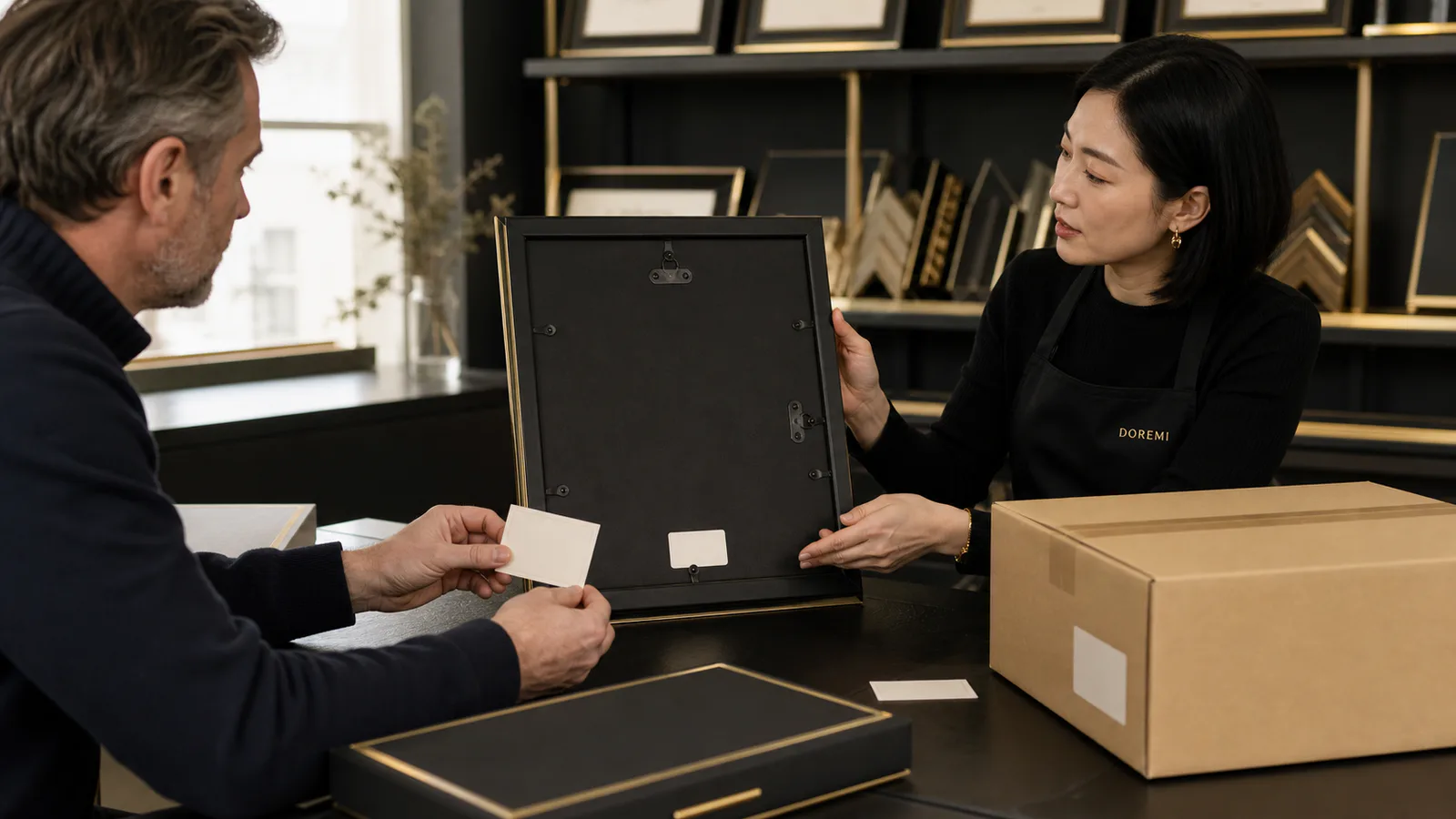
A private-label display frame can carry a U.S. brand name, a domestic distributor address and artwork designed in America while still being a product of foreign origin for customs marking. Adding a plaque, photograph or final pack in the United States may change the commercial story, but it does not automatically change the customs result or support an unqualified Made in USA claim.
This guide is for U.S. importers, brands, retailers, fulfilment teams and purchasing managers sourcing certificate, award, jersey, medal, vinyl-record or memorabilia frames. It provides a product-fact and artwork-control workflow based on public CBP regulations and FTC guidance. It is not a country-of-origin determination, binding ruling, legal opinion, entry instruction or approval of any origin claim.
Keep four origin questions separate
Buyers often treat origin as one data field, but at least four questions can appear: customs country of origin, country-of-origin marking, eligibility for a preferential programme and marketing claims such as Made in USA. Trade-remedy rules can add another origin analysis. The same processing facts may be assessed under different legal standards and purposes.
Create a decision register with a separate owner and authority for each question. This article focuses on CBP marking under 19 CFR Part 134 and FTC U.S.-origin marketing guidance. Do not copy the origin used on a commercial invoice into retail artwork without confirming that it answers the marking question for the actual merchandise.
Define the merchandise in its imported condition
Describe exactly what crosses the border: a finished empty frame, unassembled kit, moulding lengths, frame with printed art, frame with plaque, retail pack, replacement glazing or mixed set. List materials, components, country of each production step and what happens after import.
The origin analysis depends on facts, not the product page title. State where profiles are made, cut, finished and joined; where glazing and backing are produced; where the frame is assembled; and whether later U.S. work changes name, character or use. Qualified customs specialists or CBP must apply the law to those facts.
Identify the ultimate purchaser
19 CFR Part 134 defines the ultimate purchaser generally as the last U.S. person receiving the article in the form in which it was imported, subject to rules and exceptions. A retailer selling an imported finished frame usually presents a different chain from a U.S. manufacturer substantially transforming imported components.
Map importer, repacker, retailer, institutional buyer and consumer. Record whether the frame is changed after import and who receives it in imported form. This determines whose ability to see the origin marking matters. Do not assume the importer is always the ultimate purchaser or that consumer packaging alone is sufficient.
Apply the core marking qualities
Section 134.11 states that, unless excepted, every article of foreign origin or its container must be marked in a conspicuous place as legibly, indelibly and permanently as the nature of the article or container permits, to indicate the English name of the country of origin to the ultimate purchaser at importation.
Turn those words into a sample check. Can a normal recipient find and read the mark without disassembly? Will it remain through packing, handling and sale? Is the country name clear in English? Is the mark on the article unless a confirmed exception permits container marking? Have the broker or counsel review the proposed method before production.
Select a location that stays with the frame
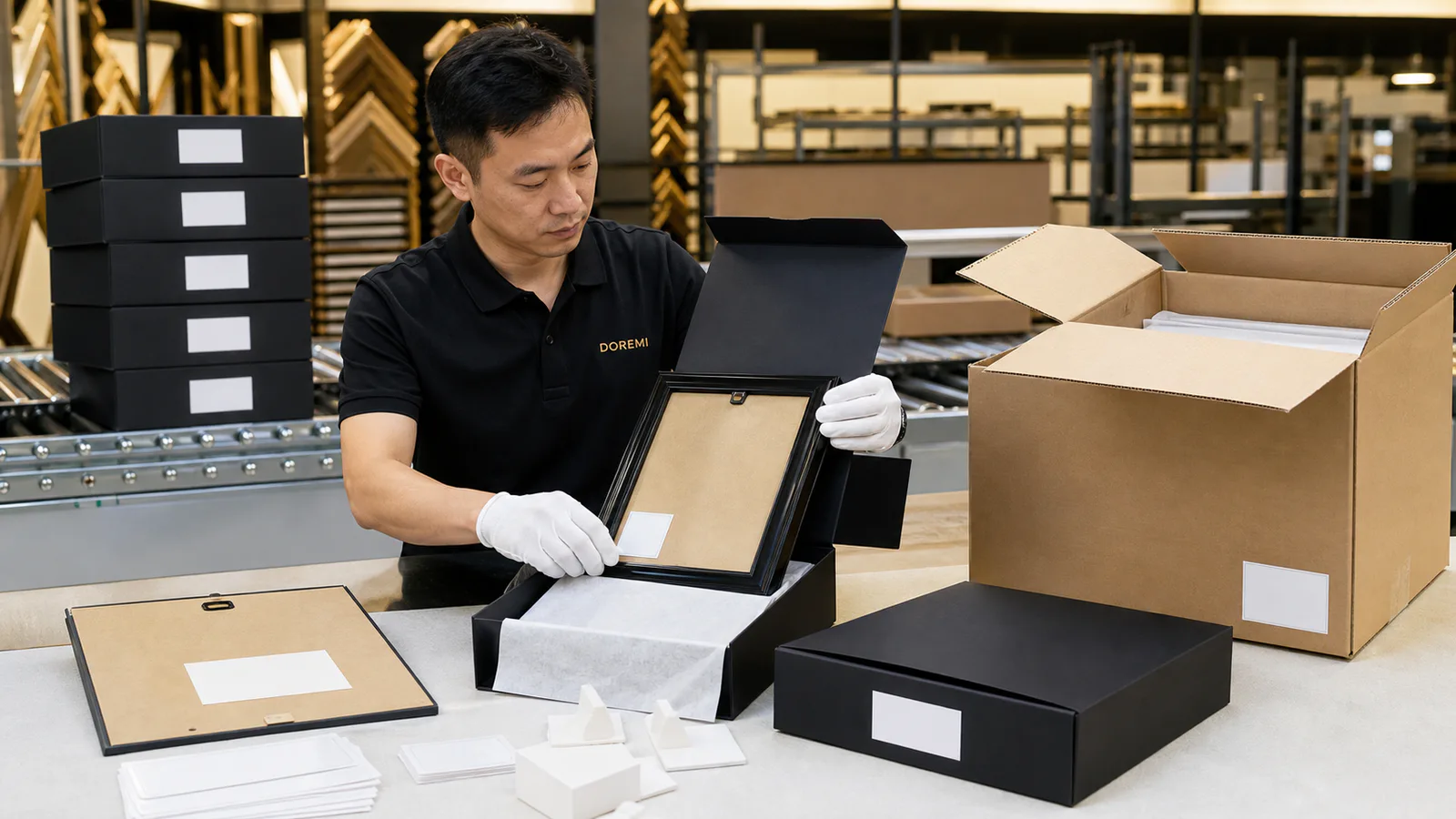
Display frames often have removable easel backs, turn buttons, dust covers, hanging hardware and retail sleeves. A label on protective film may disappear during setup. A mark under a backing board may require disassembly. A sticker on the master carton may never reach a retail consumer.
Create a location drawing for each construction. Consider the rear board, fixed frame edge, permanent plate, product label or allowed container location. Check appearance, adhesion, abrasion and normal opening. The correct location is a customs decision, not a styling preference; obtain qualified advice where permanence or visibility is uncertain.
Check container-marking exceptions carefully
Part 134 contains exceptions and container rules. Some articles may be excepted from individual marking while the outermost container reaching the ultimate purchaser must show origin. The fact that an item is small, decorative or sold in a box does not itself create an exception.
Ask the customs adviser to cite the applicable provision and conditions. Document which container is considered the outermost one reaching the ultimate purchaser. If retail fulfilment removes or replaces that container, reassess the plan. Never create a box-only standard by copying another product category.
Handle U.S. addresses and place names
Retail packaging commonly shows the U.S. importer, distributor or brand address. Part 134 includes rules where a U.S. location or another place name could mislead the ultimate purchaser about the actual origin. Depending on the circumstance, origin wording may need close proximity and comparable prominence.
Send complete artwork, not a cropped origin label, to the customs reviewer. Include brand name, addresses, claims, maps, flags, slogans and model photography. A compliant mark can still be undermined by a larger conflicting impression elsewhere on the package. Review website and marketplace copy as well as physical packaging.
Control repacking after import
Imported frames may be removed from export cartons, bundled with certificates, personalised, gift boxed or shipped through fulfilment centres. Repacking can conceal or remove the original mark. Part 134 contains importer certification and notice mechanisms for certain repacked articles.
Map every domestic handling step and identify who owns marking preservation. Give repackers written specifications, approved label files and inspection criteria. Record whether the article remains marked or the new container must carry origin. The customs broker or counsel should determine the correct certification and notice requirements for the actual route.
Separate carton marks from retail marks
Shipping marks help warehouses identify purchase orders, carton counts and destinations. They are not automatically the country-of-origin mark intended for the ultimate purchaser. A master carton may also need its own origin information, but that does not replace an article or retail-container requirement unless the law permits it.
Use separate artwork layers for logistics data, product identification, regulatory information and consumer-facing claims. Validate every packaging level: individual frame, retail box, inner pack, master case and pallet label. Keep country data consistent across commercial invoice, packing list and approved artwork while preserving each document's purpose.
Do not let private labelling obscure origin
A brand may specify the design, own the mould, approve materials and control quality while manufacturing occurs abroad. Private-label ownership does not by itself make the frame a U.S.-origin product or remove import marking. The physical production and applicable origin rules remain decisive.
Place origin review before packaging artwork and photography. If the brand name suggests a place, examine the overall impression. Ask marketing teams not to crop out required marks in product images when the images could mislead. Maintain one approved origin statement per product and route rather than letting vendors improvise.
Document substantial-transformation facts
Part 134 defines country of origin through manufacture, production or growth and recognises that further work in another country must effect a substantial transformation to change origin, with special rules for certain USMCA goods. Whether processing is substantial is fact-specific and should be decided by qualified professionals or CBP.
Prepare a manufacturing-flow record with component origins, values where requested, processing steps, skills, equipment, time and resulting article. Avoid conclusions such as assembled in USA changes origin. Adding a plaque, inserting a certificate, repacking or minor finishing may or may not be legally significant; the decision cannot come from a marketing preference.
Use CBP rulings for fact comparison
CBP's CROSS database contains published rulings on origin and marking. Search by materials, processing and imported condition, not just picture frame. Read the complete ruling and check whether it has been modified or revoked. A ruling for another company's merchandise does not automatically bind your product.
Create a comparison table showing the ruling facts, processing, origin result, marking decision and differences from the proposed frame. Where uncertainty is commercially important, ask counsel or the broker whether to request a binding ruling. Submit accurate, complete and production-equivalent facts.
Keep CBP marking and FTC claims distinct
CBP marking tells the ultimate purchaser the foreign country of origin for imported merchandise. The FTC governs U.S.-origin claims in advertising and labelling. FTC guidance says an unqualified Made in USA claim generally requires the product to be all or virtually all made in the United States.
A product can therefore need a foreign-country mark while marketing teams also consider a specific U.S. process claim. Review both regimes together to prevent contradiction. Do not use American designed, finished in USA or assembled in USA unless the statement is truthful, substantiated and presented in a way that does not imply more U.S. content than the evidence supports.

Substantiate qualified U.S.-origin claims
FTC guidance allows truthful qualified claims where they clearly communicate limits on U.S. content or processing. The qualification must be understandable and must not be contradicted by the overall presentation. The company needs evidence for the specific process, part or content statement.
Build a claim file with component sources, manufacturing locations, cost analysis where relevant, processing records, approved wording and legal review. Keep photographs and advertising consistent. A small qualification cannot cure a dominant unqualified flag, headline or product badge that creates a broader net impression.
Approve permanent artwork from a single source
Create a controlled marking brief with product SKU, country determination owner, approved wording, type size, colour, method, location, artwork revision, retail pack, master carton and effective shipment. Restrict editing access. The factory should not translate or abbreviate country names without approval.
Compare digital artwork, pre-production sample and packed unit. Photograph the mark with a scale and record adhesion or permanence checks appropriate to the product. If the backing, box or label stock changes, trigger review. Preserve superseded versions so receiving teams can identify older inventory accurately.
Inspect incoming and repacked inventory
At receiving, sample product and packaging across cartons. Check legibility, location, permanence, correct country, U.S. address treatment and consistency with the purchase order. Separate missing, incorrect, obscured and damaged marks as distinct defects.
Define stop, correction and escalation authority before goods arrive. Re-marking imported merchandise can involve CBP supervision or other formal requirements; do not improvise labels after entry. Contact the broker or counsel immediately and retain affected lots. Commercial deadlines do not replace customs procedure.
Manage mixed-origin product families
A brand may source the same-looking frame from several countries or shift final processing between plants. One universal retail box can become wrong. Link approved origin artwork to supplier site, bill of materials, purchase order and production batch.
Use destination and origin-specific packaging variants where needed. Prevent fulfilment centres from mixing products with incompatible claims. When supplier or processing changes, reopen the origin and marking review before the order, not after labels are printed. Visual equivalence is not origin equivalence.
Buyer marking checklist
- Customs origin, marking, preference and marketing claims separated
- Merchandise described in its exact imported condition
- Manufacturing and post-import processing facts documented
- Ultimate purchaser and distribution route mapped
- Article or permitted container marking basis confirmed
- Country name is conspicuous, legible and sufficiently permanent
- Location remains visible through normal use and repacking
- U.S. addresses, place names and overall artwork reviewed together
- Repacker duties and written controls assigned
- Retail, inner, master and logistics labels serve defined purposes
- Private-label branding does not obscure foreign origin
- CBP ruling comparisons use the actual material facts
- FTC claims are truthful, qualified where needed and substantiated
- Artwork, production samples and incoming goods are inspected
- Supplier, site or process changes trigger a new review
Experience scope and project limits
Editorial review: Jessica, Founder & Project Advisor at DOREMI Display. Updated 18 August 2026. Jessica's practical scope covers B2B display-frame briefs, product construction, samples, manufacturing coordination, packaging and supplier handover. She is not presented as CBP, the FTC, a customs broker, lawyer, origin specialist or ruling authority.
This guide supports product-data preparation only. Importers and qualified customs or legal professionals must determine origin, ultimate purchaser, marking method, exceptions, repacking procedure, rulings and marketing claims for the exact merchandise and route. Do not print or alter origin wording based only on this article.
Public sources used for this guide
- U.S. Government Publishing Office: current 19 CFR Part 134
- U.S. Customs and Border Protection: requirements to import specific goods
- U.S. Customs and Border Protection: Customs Rulings Online Search System
- Federal Trade Commission: Complying with the Made in USA Standard
- Federal Trade Commission: Made in USA Labeling Rule