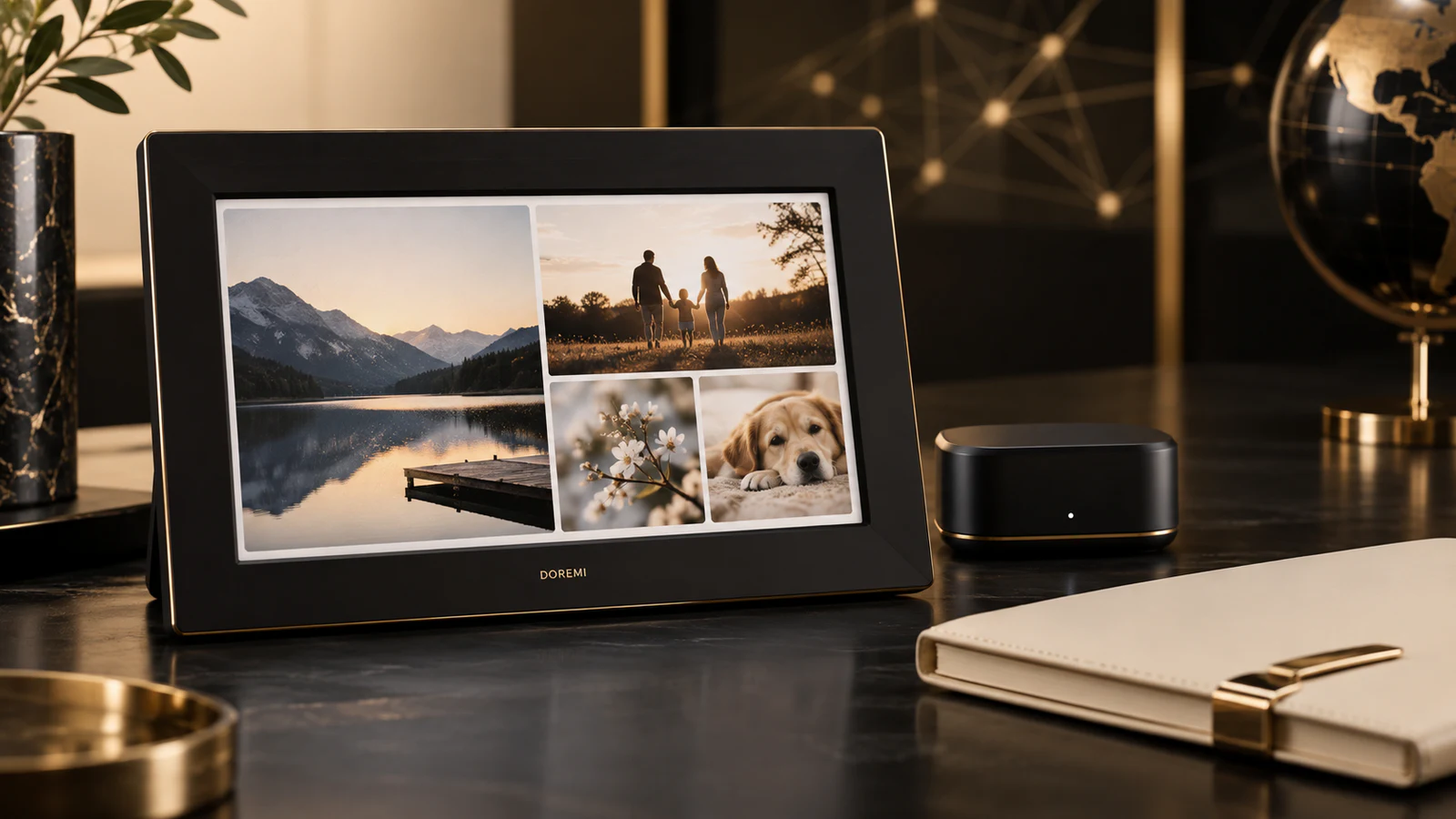
A Wi-Fi digital photo frame is more than a screen in a decorative enclosure. The product a buyer places on the U.S. market can include the physical frame, firmware, mobile application, cloud service, account system and update channel. The U.S. Cyber Trust Mark is designed around that connected product rather than a single radio module, which makes the buyer–OEM handover a commercial issue as well as a technical one.
In 2026 the practical question is not simply “Can this frame carry the mark?” It is “Is the program ready for this application, what exact product is being assessed, who controls each component, and what evidence and continuing support would the private-label brand need?” This guide turns those questions into a project workflow. It is educational, not a cybersecurity certification, FCC authorization, legal opinion or promise that a product will qualify.
What is the current Cyber Trust Mark position in October 2026?
The Federal Communications Commission established a voluntary cybersecurity labeling program for consumer wireless Internet of Things products in its 2024 IoT Labeling Order. The design uses a recognizable U.S. Cyber Trust Mark together with a QR code leading to a consumer registry. The order assigns application review to approved Cybersecurity Label Administrators and bases the program on cybersecurity criteria informed by the National Institute of Standards and Technology.
Implementation has continued to develop. On 13 April 2026 the FCC selected ioXt Alliance as the new Lead Administrator and said the parties would work to finalize implementation. On 11 August 2026 the Public Safety and Homeland Security Bureau conditionally approved two additional Cybersecurity Label Administrators and opened another application window. Buyers should therefore obtain the live application, laboratory, standard and registry instructions from an authorized program participant before committing a launch date or printing artwork.
Is the mark mandatory?
No. The FCC describes the Cyber Trust Mark program as voluntary. A brand may decide to pursue it for retail confidence, procurement requirements or product differentiation, but the mark should not be treated as a legal prerequisite for every connected frame. A buyer should ask whether target retailers, institutions or channel partners intend to request the mark and whether the expected commercial value justifies the assessment and continuing obligations.
Voluntary does not mean informal. The FCC owns the mark and limits its use to products authorized through the program. A factory self-declaration, generic cybersecurity report or logo copied into packaging cannot substitute for authorization. Until the exact product has completed the applicable process, describe the project as assessing or preparing for the program, not as certified, approved or entitled to display the mark.
Keep FCC equipment authorization separate
The IoT Labeling Order is explicit that the Cyber Trust Mark does not replace the FCC equipment authorization program. A Wi-Fi or Bluetooth frame may still need the applicable equipment authorization before marketing, regardless of whether the brand participates in the voluntary label program. The two workstreams can share model identities and radio documentation, but they answer different questions.
Create separate rows in the launch plan for radio authorization and the Cyber Trust Mark. Record the responsible party, filing or grant reference where applicable, tested radio configuration, label instructions and supporting reports for the first. Record the product-level cybersecurity criteria, test report, administrator application, registry data and continuing obligations for the second. This prevents a supplier from presenting a module FCC ID as evidence that the connected product has earned a cybersecurity label.
Define the product before asking whether it qualifies
NIST describes a consumer IoT product as one or more IoT devices together with related components such as companion apps, gateways and back-end services. For a digital frame, start with a component map: display unit, processor, wireless module, firmware, boot process, local storage, mobile and web apps, account service, image-storage service, messaging service, update server and any analytics or support tools.
Mark which legal entity develops, supplies and controls each component. The physical OEM may not control the cloud account or mobile-app release. The private-label buyer may own the app-store listing but rely on a platform company for updates. If one party can change a critical service without notifying the others, the product definition and evidence can drift after testing. Resolve ownership and change-notice duties before requesting a quotation for assessment.

Screen eligibility without making a marketing promise
The FCC program addresses consumer wireless IoT products. A connected frame intended for home or personal use may be a plausible candidate, but the responsible Cybersecurity Label Administrator should confirm eligibility for the exact product and current program scope. Record its wireless functions, intended users, installation environment and related services. Do not assume that every display with Wi-Fi is handled identically.
Also screen exclusions and supply-chain conditions in the current rules and administrator instructions. The FCC has emphasized national-security considerations in 2026. Ask the administrator which applicant, manufacturer, laboratory, component and entity restrictions must be checked. This is not a suitable area for a buyer to rely on an undated supplier statement that “the chipset supports the mark.”
Use the NIST baseline as an engineering conversation
NIST IR 8425 provides the consumer profile that forms the technical basis of the program. It organizes product capabilities around asset identification, interface access control, product configuration, data protection, software update and cybersecurity state awareness. It also identifies developer activities such as documentation, receiving questions and vulnerability information, disseminating information, and product education.
Turn those headings into model-specific questions. Can the team identify hardware and software components? Which interfaces are exposed, and how is access controlled? Which security-relevant settings can a user or administrator change? How are stored and transmitted data protected? Who signs and distributes updates? How can the product communicate a security-relevant state? The final conformity criteria and procedures must come from the FCC program, but an early NIST-based gap review helps the buyer discover missing ownership before laboratory work begins.
Build a model-and-version identity that survives handover
Give the proposed product one controlled configuration record. Include the consumer brand, model and family; hardware revision; processor; wireless module and antenna; bootloader and firmware; app identifiers and versions; cloud environment; update service; and support contact. Add the packaging and device locations where any approved label and QR code could appear, subject to final instructions.
Version the record and tie it to a physical production-intent sample. A shared enclosure is not enough to define a family. Two frames can look identical while using different chipsets, firmware branches or cloud regions. Conversely, one technical platform may support multiple cosmetic variants. Ask the administrator how variants and families are handled before assuming one report or authorization covers every size and brand.
Prepare evidence across the complete connected system
A practical evidence index can include the architecture and data-flow diagrams, component inventory, interface list, access-control design, credential handling, secure-configuration description, update design, cryptographic and key-management overview, data-protection controls, logging or security-state behavior, vulnerability intake process, support-period statement and user education. The applicable test plan and administrator request determine the final set.
Label every document with model, version, owner, date and confidentiality level. A buyer should know which evidence can be given to a laboratory or administrator, which remains controlled at the developer, and how it will be produced if the product is audited. Avoid marketing phrases such as “military-grade security.” A specific design description or test observation is more useful than an unsupported superlative.
Understand the testing-and-application sequence
The FCC order describes a two-step route. First, the applicant obtains conformity testing and a report through an accredited and FCC-recognized testing path allowed by the program. Second, the applicant submits an application and supporting report to a Cybersecurity Label Administrator, which evaluates the request and authorizes use of the mark if requirements are met.
Obtain the current procedure directly from an authorized administrator. Confirm the laboratory recognition status, tested sample, criteria version, report format, application entity, fees, renewal or reassessment triggers and expected registry fields. Do not schedule packaging around a hoped-for approval date. Keep blank artwork positions during development and release the actual mark and QR code only after authorization and final artwork review.
Treat the QR code and registry as controlled product information
The label is layered: the visible mark is accompanied by a QR code that directs consumers to registry information about the product. That means the project must govern both physical artwork and online data. Decide who supplies the model name, manufacturer or applicant identity, security information, support period, update information and consumer contact required by the current registry design.
Test the final QR code on the actual packaging and device surface at production size, print method and finish. Confirm contrast, quiet space, curvature and scan performance with ordinary phones. Also establish who monitors the destination after launch. A technically scannable code is not successful if it resolves to the wrong model, a stale record or a page the responsible team cannot update.
Contract for updates and vulnerability handling
A connected product remains dependent on suppliers after shipment. The purchase agreement should identify who receives vulnerability reports, who assesses them, who can change firmware or the cloud, who signs updates, how the buyer approves releases and how users are informed. Define the promised support period only after the responsible parties have accepted the obligation and the administrator requirements are understood.
Include escalation contacts and response paths rather than inventing a guaranteed fix time. Test the contact route before launch. If the OEM platform provider changes, the brand still needs access to records, signing arrangements, source or escrow terms where negotiated, release tools and registry responsibilities. A low hardware price does not offset a support model that cannot maintain the claims attached to the product.
Review privacy facts without calling the mark a privacy guarantee
Digital frames may process family photographs, account details, device identifiers, contact invitations and usage information. Map what data are collected, where they move, how long they are retained, who can access them and how deletion or account transfer works. Align the product behavior with the consumer notice and the exact U.S. privacy obligations identified by qualified counsel.
Do not present the Cyber Trust Mark as a blanket privacy certification or a guarantee that a product cannot be compromised. The program provides a defined cybersecurity labeling framework. Product claims, privacy notices, retailer descriptions and support language should stay within the scope of the authorization and the evidence the team can maintain.
Control changes after testing
Require written notice before changes to processors, radios, memory, firmware, libraries, app code, cloud providers, authentication, encryption, data flows, update infrastructure or security settings. For each change, record whether the existing test and authorization remain applicable, whether the registry must be updated, and whether the administrator or laboratory must review it.
Apply the rule to emergency substitutions and service migrations. A visually identical frame can become a different cybersecurity product if its platform or update path changes. Keep a release manifest for every production batch and connect customer-support records to that manifest. This makes post-market questions answerable without guessing which configuration a user owns.

Use a readiness gate before spending on final testing
A useful internal gate asks whether the exact product and applicant are eligible; whether the current program criteria and authorized parties are known; whether hardware, software and service versions are stable; whether evidence owners can supply the required material; whether update and vulnerability processes are operating; and whether budget and timing include assessment, application, registry and post-launch maintenance.
If any answer is unknown, keep the project in readiness rather than approval. Buyers can still improve the product against the NIST baseline, strengthen contracts and make the evidence index complete. Those actions support product quality even if the brand later decides not to apply or the program procedure changes.
Buyer approval checklist
- Consumer use case and wireless functions documented
- Current eligibility confirmed with an authorized program participant
- FCC equipment authorization tracked separately
- Applicant, OEM, app, cloud and support owners named
- Hardware, firmware, app and service configuration versioned
- NIST-based gap review completed without claiming authorization
- Evidence index and confidentiality route agreed
- Recognized testing and administrator route confirmed
- Label, QR code and registry data held until approval
- Support period and vulnerability path contractually owned
- Post-test changes require documented impact review
- Marketing language limited to the actual authorization
Questions to send the OEM and program administrator
Ask the OEM: Which components make up the IoT product? Who owns the firmware, app, cloud and signing keys? Which versions will be tested? How are unique credentials, updates, resets and vulnerability reports handled? What support period can the responsible parties actually maintain? Which changes can occur without buyer approval?
Ask the administrator: Is this configuration eligible? Which standards, criteria version, laboratory recognition and application documents apply now? Who should be the applicant? How are model families and cosmetic variants treated? Which registry fields and continuing obligations apply? What changes, surveillance findings or support events require notice, reassessment or removal of the mark?
Experience scope and project limits
Editorial review: Jessica, Founder & Project Advisor at DOREMI Display. Updated 5 October 2026. Jessica's practical experience scope covers B2B display briefs, supplier coordination, sample review, packaging, version handover and production change control. DOREMI is not presented here as the FCC, NIST, a Cybersecurity Label Administrator, accredited laboratory, cybersecurity auditor or legal adviser.
Use this workflow to make the project reviewable. The current FCC rules, administrator instructions, recognized test procedure, exact product configuration and advice of qualified cybersecurity and legal professionals control the final decision.