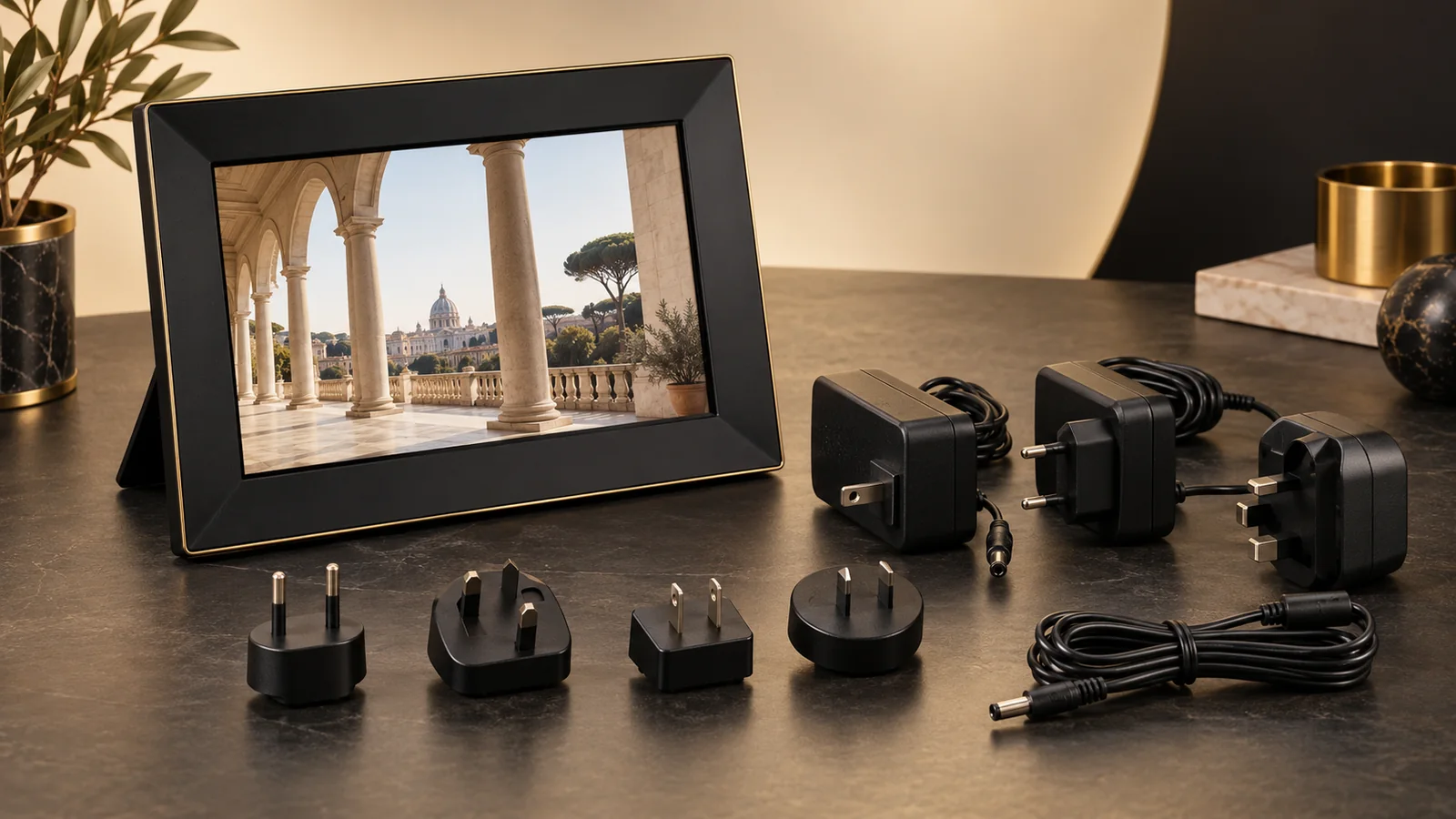
A digital photo frame can have compliant radio electronics and still reach a U.S. buyer with the wrong external power supply file. The adapter is often sourced late, changed for cost or bundled differently by market. Yet the U.S. Department of Energy maintains current standards, test procedures, marking provisions and certification rules for covered external power supplies.
DOE also lists a 2025 proposal to rescind existing consumer external power supply standards and a 2026 final rule concerning reporting for certain exempt supplies. A proposal is not the current rule. This guide helps importers, private-label brands and OEM teams separate those layers and build a model-family handover. It is not legal advice, a DOE certification, a test report or a determination that a particular adapter is covered or exempt.
What is the current buyer question in 2026?
The practical question is not “Is Level VI still a thing?” DOE's product page currently points manufacturers to 10 CFR 430.32(w) for energy conservation standards, Appendix Z for the test procedure and 10 CFR Part 429 for certification, compliance and enforcement. The page separately describes a notice proposing to rescind the standards. Until a proposal becomes an effective final rule and the codified requirements change, buyers should not remove current controls based on a headline.
Record the date on which the responsible team checked the DOE page and eCFR. Ask counsel or a qualified compliance specialist to review later changes before shipment. The sourcing file should distinguish “current requirement,” “final rule with effective date,” “proposal,” “guidance” and “supplier claim.” Those labels prevent a commercial team from treating an open rulemaking as an exemption.
Is the adapter an external power supply under DOE rules?
DOE describes an external power supply as a circuit used to convert household electric current into direct current or lower-voltage alternating current to operate a consumer product, subject to exclusions in the regulatory definition. Many wall adapters supplied with digital photo frames fit the everyday description, but legal coverage depends on the exact design and use.
Identify input and output type, output voltage and current, nameplate power, whether operation is direct or indirect, whether the unit is single-voltage, switch-selectable, adaptive or multiple-voltage, and whether any regulatory exclusion is claimed. Do not infer the class from connector shape or an international efficiency numeral alone. Have the responsible U.S. party document the coverage basis for the actual basic model.
Why should the adapter be controlled as its own model?
A digital frame model may ship with adapters from different manufacturers. Conversely, one adapter design family may serve several frame SKUs. DOE certification and represented values attach to the covered external power supply basic model or design family, not simply to the marketing name of the frame. The buyer needs a cross-reference between frame SKU, adapter manufacturer, adapter model and approved markets.
Create a controlled bill of materials row for the adapter and cable. Include manufacturer, factory, model, electrical ratings, plug configuration, efficiency marking, report reference, certification reference where applicable and approved frame SKUs. Lock photographs of the nameplate and physical construction. This makes a substitute visible before it enters a production lot.
What does Level VI mean for the handover?
10 CFR 430.32(w) identifies Level VI standards for direct-operation external power supplies manufactured on or after 10 February 2016, subject to the rule's categories and exceptions. The section also requires a covered external power supply to be clearly and permanently marked in accordance with the incorporated international efficiency marking protocol. The numeral is an efficiency-level marking, not a general safety or product approval badge.
Ask the adapter supplier which table and product class were used, which active-mode and no-load values apply and how the production label is controlled. Verify that the mark and electrical information are legible, durable and consistent with the evidence. Do not add a Level VI symbol in artwork because the buyer requested it; the responsible manufacturer must first establish the basis.
Which test procedure should the supplier use?
DOE directs manufacturers to 10 CFR Part 430, Subpart B, Appendix Z for measuring external power supply energy consumption, including active-mode efficiency and no-load, off or standby characteristics as applicable. A generic safety report, EMC report or supplier datasheet does not answer the DOE energy test question.
Request the full test report or a controlled evidence package acceptable to the responsible certifying party. Confirm sample identifiers, electrical ratings, test procedure version, operating points, results, laboratory identity and issue date. Check whether the tested sample represents the claimed basic model or design family. Procurement should not recalculate compliance from a marketing efficiency percentage without the underlying method.
Who tests, certifies and retains the record?
10 CFR 429.37 applies sampling and certification-report requirements to external power supplies. It permits required information to be reported on the basis of a basic model or design family, with covered model numbers identified when a design family is used. Public product-specific information can include average active-mode efficiency, no-load consumption, nameplate output power and output current in defined circumstances.
The contract should name the party responsible for DOE certification and ongoing accuracy. A Chinese OEM can provide test samples and technical evidence, while a U.S. brand or another party may hold the certification role. Do not leave the responsibility as “supplier handles compliance.” State who submits, who can retrieve the record, who keeps supporting data and who responds if the adapter changes.
How should buyers treat the 2025 rescission proposal?
DOE's current product page lists a Notice of Proposed Rulemaking published in May 2025 to rescind existing regulations regarding consumer external power supply energy conservation standards. The same page continues to label 10 CFR 430.32(w) as the current standard. A proposal signals possible future change; it does not by itself erase the codified rule.
Maintain a regulatory watch item with an owner and next review date. Do not freeze the article's summary into a multi-year sourcing manual. Before each new production season, check DOE, the Federal Register and current eCFR text. If a final rule changes coverage or compliance dates, update the decision with qualified advice and preserve the older basis for units manufactured under the earlier rule.
What changed in the 2026 exempt-supply reporting rule?
DOE reports a final rule published 28 April 2026, effective 28 May 2026, revising regulations to remove certain reporting requirements imposed on exempt consumer external power supplies. This is narrower than a blanket end to external power supply standards. A buyer should not call an ordinary digital-frame adapter exempt merely because the 2026 rule uses the word “exempt.”
If a supplier claims a service-part, security-system, medical or other exception, request the exact citation and facts. Have the responsible specialist confirm eligibility and any marking, certification or documentation conditions. Keep that rationale with the model file. Exceptions are not interchangeable, and a product feature should not be redesigned on the basis of an unverified sales statement.
Do FCC, UL or Energy Star records replace DOE evidence?
No single record should be assumed to answer every regime. FCC rules concern radiofrequency matters, safety certification or listing addresses another risk, and ENERGY STAR is a separate programme. DOE efficiency standards, testing and certification have their own legal basis. A package may need several evidence streams, but their names should not be mixed.
Create a compliance matrix with one row per requirement, responsible party, model identifier, evidence and status. This prevents a supplier from submitting a safety file when the buyer requested energy evidence. It also keeps the final retail artwork honest: do not print programme marks or claims unless the authorised party has confirmed permission and the exact model is covered.
Make the nameplate and retail pack agree
Photograph the final adapter nameplate at production scale. Check manufacturer or brand information, model, input, output, polarity where used, efficiency marking and other required information against the controlled evidence. Verify that mould texture, curvature and small print do not make the final label unreadable. A flat PDF proof is not enough.
Then review the digital-frame carton and instructions. If the box lists an adapter rating or image, it must match the shipped unit. If multiple plug variants share artwork, define how the correct market version is identified. Avoid broad claims such as “DOE certified frame” when the underlying record concerns a covered adapter and does not certify the entire display frame.
Validate compatibility without inventing a compliance test
The frame project still needs ordinary engineering checks: connector fit, polarity, voltage, current capacity, cable length, thermal behaviour, standby and active operation, noise, display stability and start-up under representative conditions. These checks do not replace Appendix Z testing. They show whether the approved adapter works safely and consistently with the buyer's frame configuration.
Use production-intent frame and adapter samples. Test normal and high-load use defined by the project, power cycling and packing fit. Record observations without calling them DOE results. If a substitution changes electrical characteristics or behaviour, stop and route the new model through technical and compliance review.
Write a supplier change-notice gate
Require approval before a change to adapter manufacturer, factory, model, topology, rated input or output, transformer, key control components, firmware where present, cable, connector, label, plug head or family composition. Even when output ratings appear unchanged, the evidence and certification basis may differ.
State what the supplier must submit with a proposed change: reason, comparison, drawings, ratings, label, test evidence, certification impact, compatibility sample and implementation lot. Set a no-substitution rule until written approval. The purchasing team should know that an adapter shortage is a compliance change, not only a delivery issue.
Buyer approval checklist
- Current DOE page and eCFR checked on a recorded date
- Coverage and product class assessed for the exact adapter
- Frame SKU mapped to adapter manufacturer, model and factory
- Direct or indirect operation and voltage type documented
- Applicable 10 CFR 430.32(w) standard identified
- Appendix Z test evidence reviewed by the responsible party
- 10 CFR 429.37 certification responsibility assigned
- Design-family members and public represented values controlled
- Efficiency marking basis confirmed
- Final nameplate, carton and shipped adapter match
- Compatibility review completed separately from DOE testing
- Exception claims supported by exact citations and facts
- Proposals tracked without treating them as effective rules
- Supplier substitution gate written into the purchase order
Questions to send the adapter supplier
Ask: What is the legal manufacturer and basic-model identifier? Which DOE product class and table apply? Is the unit direct operation? Which Appendix Z test report supports the represented values? Is the certification filed by basic model or design family? Which models are in that family? What permanent efficiency mark is used? Has the factory, circuitry or label changed since testing?
Then ask the U.S. responsible party: Who owns the certification? Can the record be retrieved and matched to the shipped model? Does any claimed exception apply? Has current eCFR changed since the last order? Does the 2026 final rule affect this model, or only a different exempt category? What event triggers a new submission or technical review?
Experience scope and project limits
Editorial review: Jessica, Founder & Project Advisor at DOREMI Display. Updated 3 October 2026. Jessica's practical scope is B2B display-frame briefing, supplier and component coordination, sample review, packaging handover and production change control. DOREMI is not presenting itself as DOE, a U.S. law firm, certification submitter, accredited laboratory or authority on regulatory exemptions.
Use this workflow to keep the product, model and evidence aligned. Current DOE publications, the codified regulations, the actual adapter design and advice from the responsible U.S. compliance specialists control the final determination.