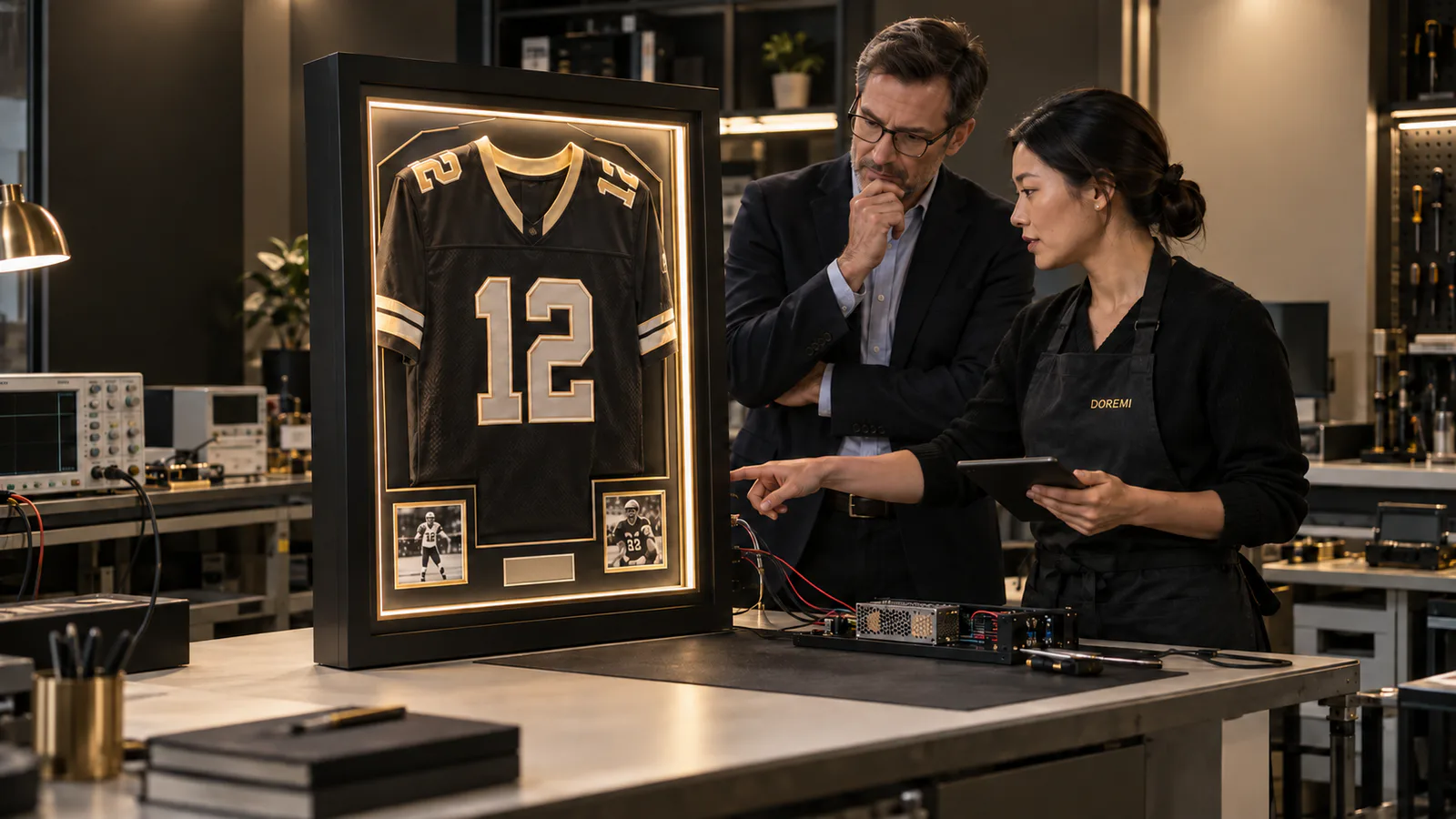
Does an LED display frame need FCC certification? The useful answer is not a universal yes or no. A passive frame has no radio-frequency electronics. A wired LED frame may contain circuitry that intentionally generates radio-frequency energy for internal use and may be an unintentional radiator. A frame with Bluetooth, Wi-Fi or another radio function can include an intentional radiator. The applicable FCC rules and authorization procedure depend on the complete product, its functions, circuitry and supplied configuration.
This guide is for U.S. importers, private-label brands, product managers and sourcing teams developing illuminated jersey, certificate, medal, vinyl-record or memorabilia frames. It turns public FCC requirements into a supplier evidence and model-control workflow. It is not an FCC classification, laboratory opinion, authorization, customs instruction or finding that a particular frame complies.
Begin with the complete product, not the word LED
LED describes a light source, not an FCC category. Two frames can use the same LED strip while one has a simple analogue dimmer, another has a digital controller and a third has a wireless application. External power supplies, USB interfaces, clocks, memory functions, touch controls and wireless modules can change the analysis. Procurement should freeze the exact electrical architecture before requesting a quotation for testing.
Create a block diagram that identifies every board, oscillator, controller, power converter, radio module, cable, connector and external supply. Add operating modes and user interfaces. Link the diagram to the mechanical drawing and bill of materials. A supplier response such as “FCC available” is not enough because it does not say which device, procedure, model or configuration the evidence covers.
Separate passive, unintentional and intentional functions
The FCC rules distinguish devices by how they generate and use radio-frequency energy. An unintentional radiator intentionally generates RF energy for use within the device or sends RF signals by conduction through connecting wiring but is not intended to emit RF energy by radiation or induction. An intentional radiator deliberately generates and emits RF energy. Qualified specialists should apply those definitions to the actual frame rather than to a catalogue label.
Make a feature table for each proposed SKU. Record whether it has only lighting, digital control, wired data, wireless charging, Bluetooth, Wi-Fi, a remote control or another transmitter. Do not assume that a certified wireless module settles every requirement for the host product, or that removing an app removes all digital circuitry. The table should lead to a documented scope review by the U.S. responsible party and competent test laboratory.
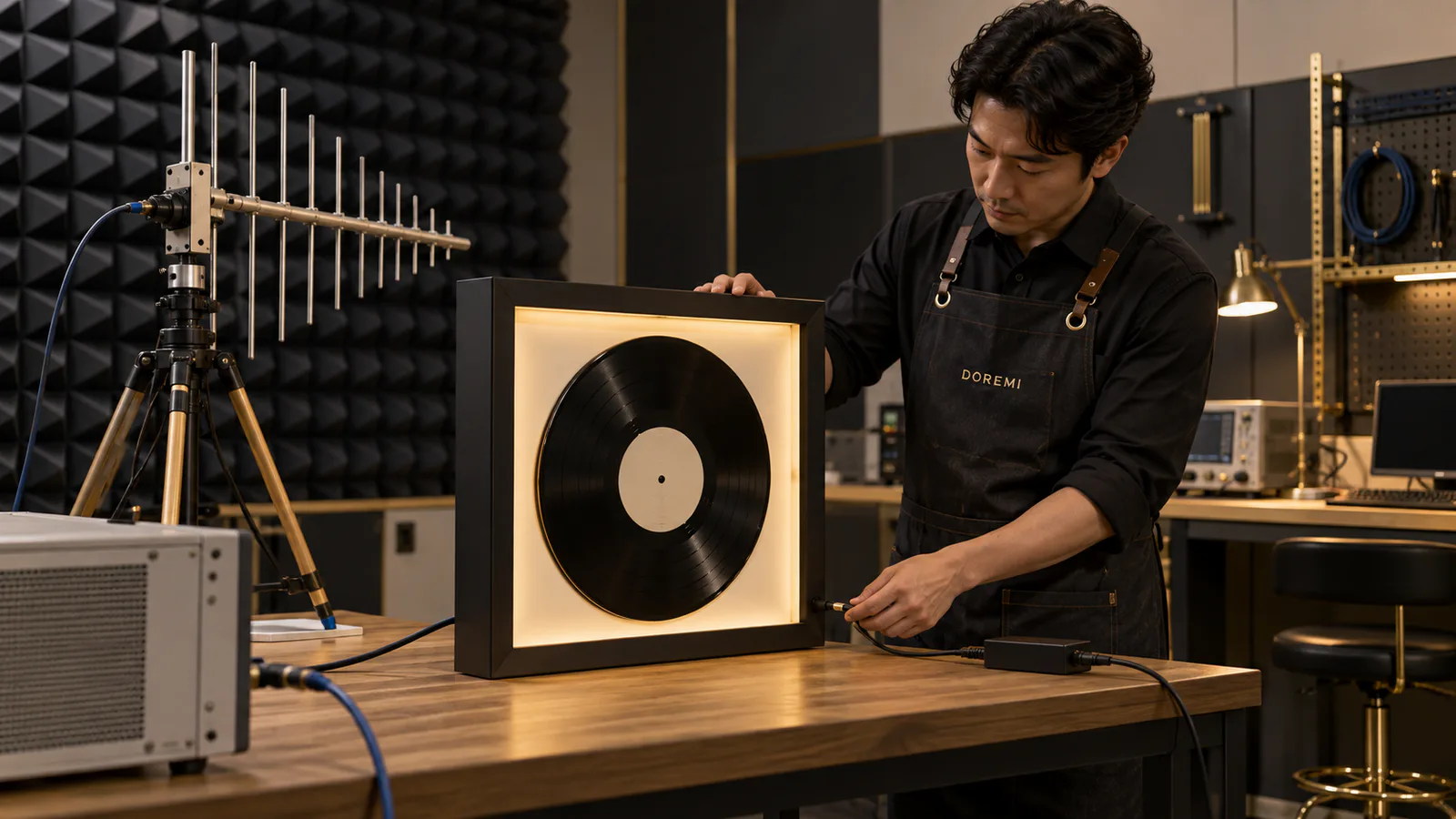
Choose the authorization procedure from the real functions
FCC equipment authorization currently uses Certification and Supplier's Declaration of Conformity procedures. The FCC's enforcement advisory explains that many unintentional radiators are generally authorized under SDoC, while intentional radiators generally require Certification. Those are starting points, not a substitute for reviewing the rule part and device features.
Ask the laboratory or qualified adviser to state the proposed procedure, applicable rule sections, equipment class and measurement method in writing. If the product contains more than one function, record the path for each. A buyer should not force an SDoC path because it appears faster, or demand an FCC ID for a product that is not subject to Certification, without understanding the actual requirement.
Name the U.S. responsible party before testing
For equipment subject to SDoC, the responsible party defined by the FCC rules must be located in the United States. That role is not automatically the overseas frame assembler or the laboratory. It can involve the manufacturer, assembler, importer or another qualifying party depending on the facts. The commercial agreement should identify the legal entity that will accept the responsibility and maintain the required evidence.
Record the entity's legal name, U.S. address, contact route, relationship to the model and authority over compliance changes. Do not put a distributor's address in the user information merely because it is convenient. If the importer, brand owner or distribution structure changes, review whether the responsible-party arrangement and supplied compliance information remain correct.
Define the model family before the laboratory quotation
A test programme should identify the model or models it covers and the technical basis for any family grouping. Size alone may affect cable length, LED quantity, enclosure geometry or emissions. A controller, power supply, wireless module or dimmer change may be more significant than a finish colour. Ask the laboratory which variants must be tested and which can be documented as equivalent.
Prepare a model matrix with frame size, display type, board revision, power input, adapter model, cable, control method, radio module, enclosure material and LED load. Mark the worst-case rationale and keep it with the quotation. Do not add a larger illuminated jersey frame to a report written for a small certificate frame unless the responsible technical owner accepts the grouping.
Send the laboratory a production-equivalent configuration
The equipment under test should represent the product that will be marketed. The laboratory needs the final controller, LED system, enclosure, wiring, ferrites, grounding method, external supply, cable types and intended accessories. A bare board tested on a bench may help development, but it does not by itself represent the assembled display frame.
Give the sample a controlled identifier and photograph it before shipment. Include the hardware and software or firmware revision where applicable. If the laboratory makes modifications to achieve a passing result, require a precise record and incorporate approved changes into drawings, component specifications and production controls. A piece of tape or ferrite added only to the test unit is not a mass-production solution.
Test realistic operating modes and cable arrangements
An illuminated frame can have maximum brightness, dimming, animation, standby, charging, wired data or wireless operating modes. The representative configuration and measurement method should be selected by qualified test personnel under the applicable rules. Procurement should nevertheless provide a complete operating description so the laboratory is not forced to guess how users will run the product.
Identify all ports, supplied cables and optional accessories. Explain which combinations can operate simultaneously. Preserve photographs of the tested arrangement and the equipment connected to it. If the marketed pack later includes a longer cable or another power supply, the technical owner should review the impact before shipment rather than rely on the product name remaining unchanged.
Treat the external power supply as part of the handover
A supplier may present a power-adapter report while providing no evidence for the complete frame. The adapter's evidence and the host product's FCC analysis answer different questions. At the same time, the adapter model, cable and grounding arrangement can influence the complete configuration, so procurement cannot treat the supply as an interchangeable purchasing accessory.
Lock the approved manufacturer, model, ratings, connector, cable and relevant technical characteristics. Connect the adapter evidence to the frame model and packing list. If buyers may use their own USB supply, describe the intended input and have qualified advisers determine the test configuration and user information. Do not imply that compatibility with a connector proves regulatory suitability.
Do not turn a module grant into a host-product conclusion
A certified Bluetooth or Wi-Fi module can be a valuable building block, but integration conditions matter. Antenna type, separation, shielding, host layout, simultaneous transmission, enclosure and user exposure conditions can affect the authorization strategy. The module label or grant is not a decorative asset that can be copied to every finished frame.
Request the exact module identity, grant information, integration instructions and antenna details from the electronics supplier. Have the responsible technical owner document how the finished frame follows those conditions and what additional host evaluation is required. Control module substitutions. A pin-compatible part from another source is not automatically covered by the original grant.
Prepare identification and compliance information accurately
Devices subject to SDoC must be uniquely identified by the party responsible for marketing or importing them in the United States, and the responsible party must maintain adequate identification records. FCC rules also require compliance information to be supplied with applicable products. The exact wording and placement should be confirmed for the device and procedure.
Create an artwork table that separates product identity, electrical ratings, FCC information, safety warnings, brand content and retailer data. Assign a source and approver to every line. Do not add an FCC logo as a substitute for authorization; its use is voluntary for SDoC devices and does not create compliance. Do not use an FCC ID format on a device subject only to SDoC in a way that could cause confusion.
Align private-label artwork with evidence ownership
Private-label programmes can put one electrical platform under several brand names. The buyer needs a controlled link between each marketed identity and the authorized technical configuration. A report showing an unfamiliar factory model is not automatically useless, but the cross-reference must be clear, legitimate and maintained by the responsible party.
Keep a brand-model mapping with photographs of the product label, packaging and user information. Define who approves new trade names and model numbers. If the product is modified for one retailer, review whether that version remains within the evidence scope. Marketing should not publish “FCC certified” across a family when only a radio module or different model has a grant.
Build the record file around the tested unit
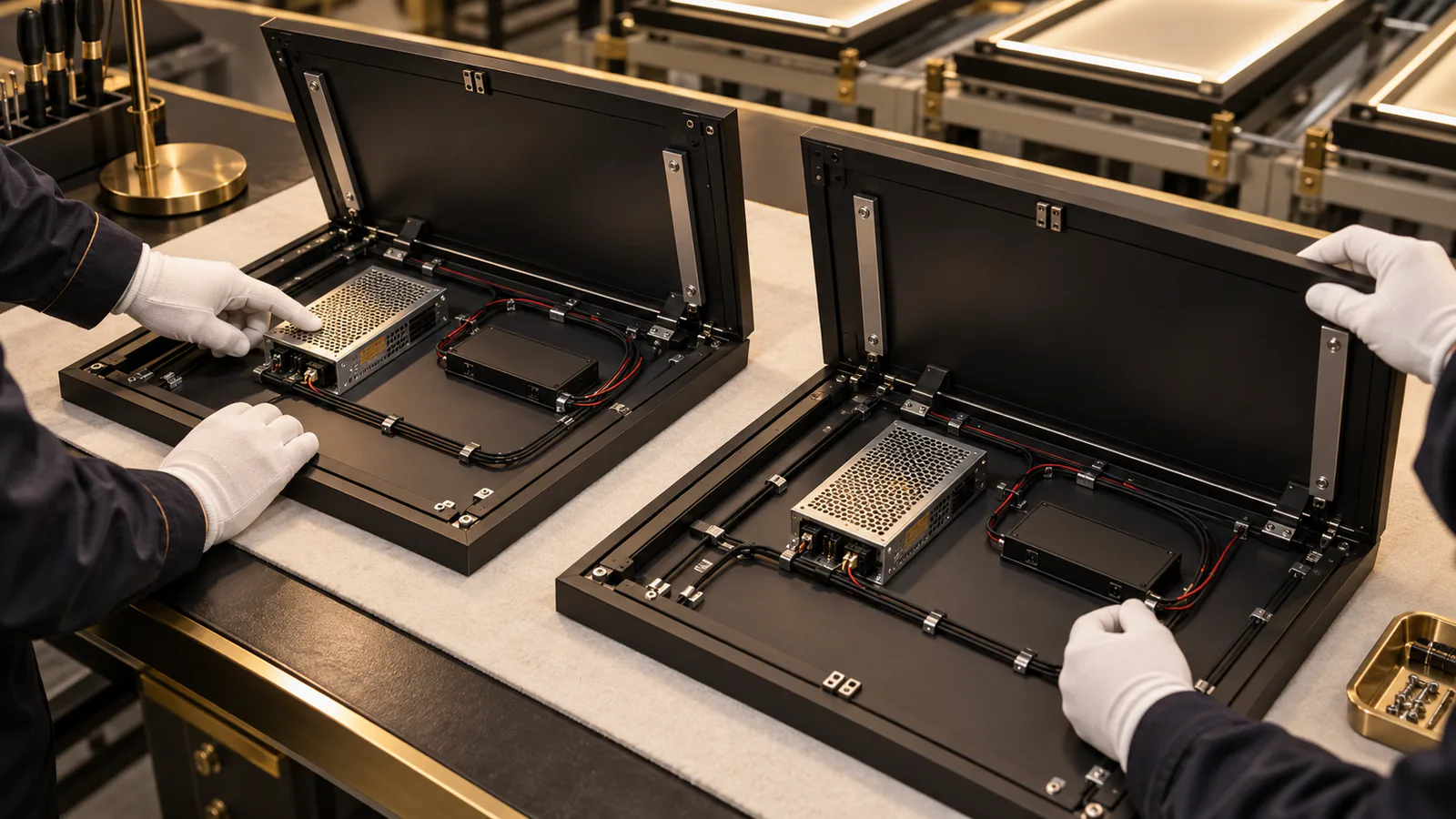
FCC record-retention requirements for equipment authorization include design information, production procedures and test records. The responsible party should decide the complete index for the applicable procedure. A useful supplier handover links the test report, sample photographs, block diagram, schematics where appropriate, bill of materials, component evidence, user information and label artwork to one model revision.
Record the laboratory, test dates, methods, equipment under test and any modifications. Protect original files and change history. A cropped “PASS” page sent through a messaging app cannot show the configuration or support an engineering review. Ask for searchable, complete records from the authorized owner and confirm that the legal entity and model identities are consistent.
Control changes after a passing test
The evidence is tied to a design, not permanently to a product name. Changes to the controller, clock, power converter, wireless module, antenna, adapter, cable, shielding, grounding, enclosure or LED load can affect the analysis. Cosmetic changes may be lower risk, but the technical owner should define the boundary instead of leaving production staff to decide.
Add an FCC-impact field to engineering change requests. Require the supplier to describe the old and new part, reason, technical differences, affected orders and implementation date. The responsible party and laboratory should decide whether documentation, comparison measurements, retesting or a new authorization is needed. Quarantine unapproved substitutions until that decision is recorded.
Use incoming and production checks to protect the configuration
A compliance report cannot prevent a factory from receiving the wrong adapter or installing a revised board. Define incoming identity checks for critical electronics and controlled assembly checks for cable routing, ferrites, grounding, shielding and fasteners. The exact controls should follow the approved design and quality plan.
Retain production photographs and traceability at a useful level. Sample inspections can verify identity and workmanship, but they are not a replacement for authorization testing. If a failure or market complaint appears, the records should allow the U.S. responsible party to identify which batches used the affected configuration and whether other brands or sizes share it.
Keep pre-authorization samples and marketing within the rules
The FCC rules include limited conditions for importing, displaying or marketing RF devices before authorization. Those conditions are specific and should be reviewed before prototypes are shipped for trade shows, retailer photography, pre-sale activity or user trials. The removal of an old customs declaration form did not remove the underlying equipment-authorization obligations.
Label development samples and control their quantity, ownership, use and retrieval route according to qualified advice. Do not deliver an SDoC product to ordinary customers before the applicable requirements are met. Commercial teams should know that marketing is defined broadly and can include advertising, importation, shipment and distribution for sale.
Request one coherent supplier evidence pack
A buyer-ready handover should include the product block diagram, model matrix, approved bill of materials, sample identity, proposed authorization path, responsible-party details, complete reports, module grants and integration instructions where relevant, power-supply evidence, product identification, supplied compliance information, label artwork, user instructions, production controls and change-notification agreement.
Ask for document titles and revisions before requesting hundreds of files. Mark gaps and owners. The objective is not to make the frame factory act as U.S. counsel or the FCC. It is to ensure that the responsible U.S. business and its laboratory receive accurate product facts and can connect a marketed unit to the evidence used for the decision.
Buyer approval checklist
- Complete electrical and wireless architecture frozen
- Passive, unintentional and intentional functions reviewed
- Applicable authorization procedure documented by qualified owners
- U.S.-located responsible party identified where required
- Model family and worst-case rationale controlled
- Production-equivalent sample and all accessories supplied to the laboratory
- Operating modes, cables and external supplies represented
- Module conditions and host-product responsibilities separated
- Product identification and compliance information approved
- Private-label model mapping linked to the evidence
- Complete test and design records retained
- Engineering changes trigger an FCC impact review
- Incoming and production checks protect critical components
- Pre-authorization imports and marketing reviewed before activity
Experience scope and project limits
Editorial review: Jessica, Founder & Project Advisor at DOREMI Display. Updated 12 September 2026. Jessica's practical scope covers B2B display-frame briefs, materials, samples, private-label packaging, production coordination, quality discussions and supplier-to-buyer handover. She is not presented as the FCC, a U.S. responsible party, telecommunications lawyer, accredited laboratory, Telecommunications Certification Body, customs authority or electrical-safety body.
This guide is educational procurement guidance. The responsible U.S. business and qualified FCC specialists must determine the rules, equipment class, authorization procedure, measurements, labeling, user information, import conditions, record retention and change treatment for the exact product and date. Electrical safety, energy efficiency, CPSC, battery, transport and state requirements require separate review.