
“Picture-frame component” sounds like a clear product name. In U.S. antidumping and countervailing duty work, it is only the start of the facts. The wood mouldings and millwork orders from China contain a written exclusion for picture-frame components three feet and under in individual lengths, yet a buyer still needs to know what each piece is, how long it is, how it was processed, what enters in the carton and whether the shipment actually matches the exclusion.
This guide is for U.S. importers, frame brands, distributors and OEM suppliers comparing loose moulding, cut components, kits and finished frames. It turns product configuration into a reviewable broker or counsel handover. It does not determine scope, classification, origin, producer/exporter rates, cash deposits or final duties, and it does not replace the U.S. Department of Commerce, CBP, a customs broker or trade counsel.
Start with the live orders and written scope
Commerce's current case detail for wood mouldings and millwork products from China identifies AD case A-570-117 and CVD case C-570-118. The scope covers a broad range of wood mouldings and millwork, including products with specified processing and surface treatments, subject to stated exclusions. Administrative reviews and instructions continue, so buyers should not treat the orders as old news.
Save the exact scope text and access date used for the decision. The written description controls; HTSUS numbers are listed for convenience. Give advisers the actual merchandise before setting landed cost.
Do not let the product name decide the answer
A supplier may call the same profile picture-frame moulding, decorative trim, wood strip or finished rail. The commercial name does not establish whether it is within or outside the order. Build the description from objective facts: species and construction, profile, dimensions, length, coatings, machining, joinery, quantity, packaging and imported state.
Photograph cross-sections and both ends. Include a dimensioned drawing and bill of materials. If the profile is wrapped, painted or coated, document the substrate rather than assuming the visible finish changes the scope analysis.
Read the three-foot exclusion exactly
The published scope excludes picture-frame components three feet and under in individual lengths. Buyers should not paraphrase this as “picture frames are excluded.” The words component, three feet and under, and individual lengths all deserve factual support for the shipment under review.
Ask qualified U.S. counsel or the broker's trade-remedy specialist how the exclusion applies to the actual product. Keep the conclusion with the drawings, measurements and configuration on which it depends. A new length or imported form can require a new review.
Measure every individual length, not an average
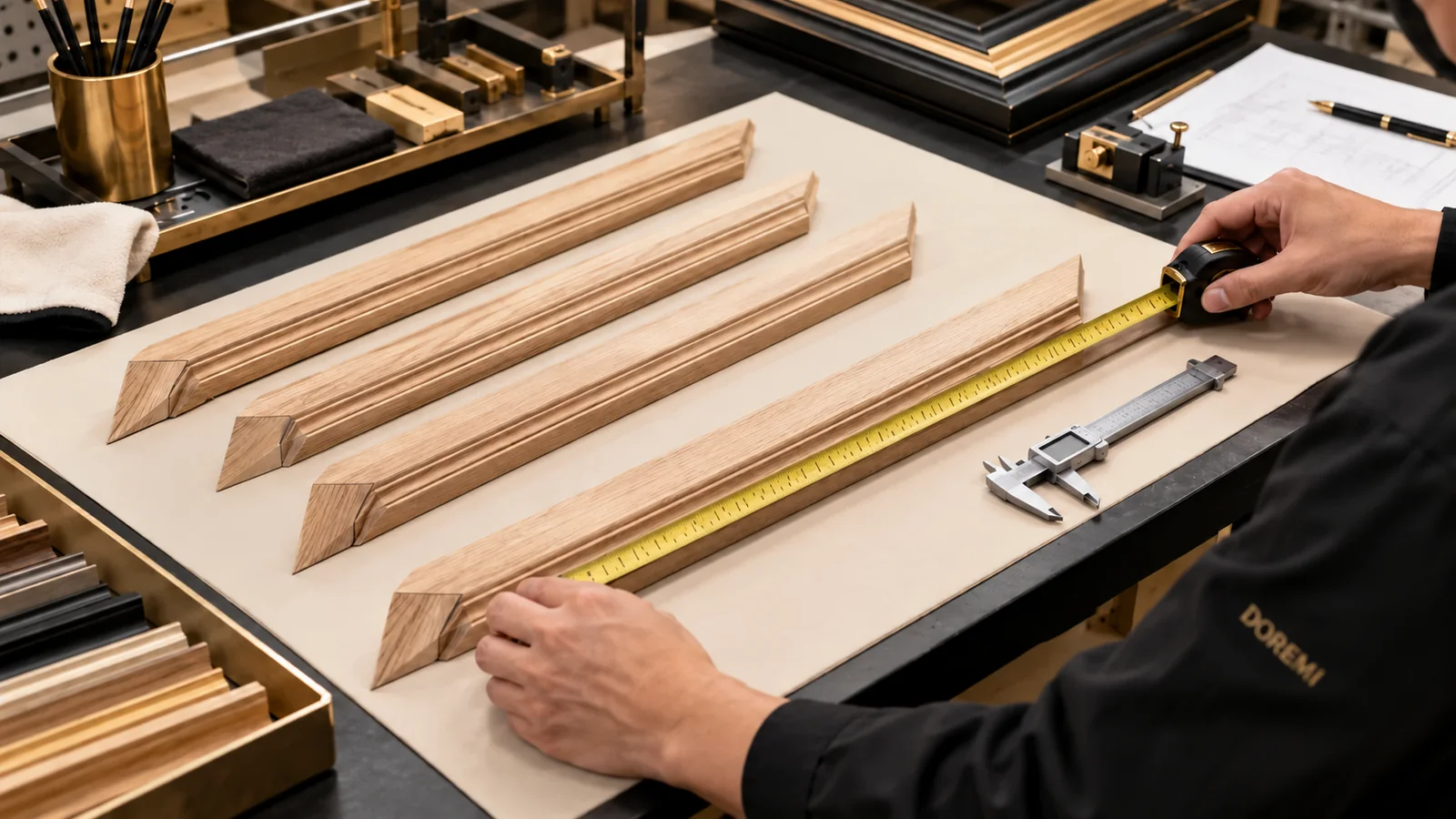
A carton may contain four cut sides for one frame, long moulding sticks for local cutting or mixed service pieces. Record each component length in inches and millimetres, the tolerance, measurement points and maximum production condition. An average below three feet does not show that every individual length is three feet or under.
Use a controlled gauge or tape, identify the sampled carton and photograph representative measurements. For a purchase order, define the maximum allowed shipped length and require notice before any oversize service part or replacement strip is added.
Define what “component” means in the shipment
A cut and mitred side, a joined frame shell, a full retail frame and a long profile are different imported configurations. The scope exclusion uses a specific phrase; buyers should not assume that a finished assembly or complete kit receives the same analysis as loose individual lengths.
Create a carton map showing every item: wood pieces, glazing, backing, mat, hardware, connectors, stands, packaging and instructions. State whether corners are joined, fasteners inserted, holes drilled or finishing complete. Advisers need the import condition, not only an exploded product drawing.
Separate finished frames, kits and loose moulding
Commercial teams often compare three sourcing models: import a finished frame, import a complete set of cut components for local joining, or import long moulding for domestic cutting. Each model changes the physical facts and can change classification, scope and landed-cost analysis.
Give each model its own SKU and review record. Do not reuse an exclusion memo prepared for cut components to price long sticks. If a trial shipment differs from mass production, mark the difference before the broker sees the entry documents.
Document wood construction and joinery
The scope describes covered products that may be solid, laminated, finger-jointed, edge-glued, face-glued or otherwise joined. Record species where known, lamination, joints, core, veneer, profile creation and adhesive process. A photograph of the finished black surface does not reveal this construction.
Ask the producer for a process flow from raw blank through profiling, joining, sanding and finishing. If a subcontractor supplies the moulding blank, identify that source. The importer needs facts that can be traced to the producer, not a generic material name on a sales quote.
Surface treatments do not automatically remove coverage
The order's scope addresses wood mouldings whether raw or with treatments such as gesso, polymer, plastic, primer, paint, stain, paper or vinyl overlay. A buyer should not assume that foil wrap, black lacquer or a decorative coating makes the product a different non-wood item.
Record every layer and who applies it. This information is also useful for product quality and chemical compliance, but those reviews do not replace the AD/CVD scope analysis.
Do not use an HTS code as a scope ruling
Commerce states that the written scope is dispositive while tariff numbers are provided for convenience. CBP likewise directs importers to review the scope of AD/CVD orders and current instructions. A classification opinion can be important, but it does not automatically answer the separate trade-remedy question.
Keep two decision rows: tariff classification and AD/CVD scope. Record the owner, authority, facts, date and assumptions for each. If one analysis changes, prompt a review of the other without merging them into one unsupported conclusion.
Map producer, exporter and processing countries
AD/CVD cases and rates can depend on producer and exporter identity. The scope also addresses specified further processing in a third country that would not otherwise remove merchandise from the order. Identify who made the wood moulding, who cut or coated it, who assembled the frame, who exported it and where each step occurred.
Do not accept “made in Vietnam” or another country based only on final packing or assembly. Origin and scope determinations are legal questions built on manufacturing facts. Preserve invoices, production records, component origin statements and transport documents for qualified review.
Control mixed cartons and service parts
A finished-frame shipment may include spare rails, replacement sides or long repair moulding. Those items can present a different configuration from the main product. List each line separately on the packing evidence and ask the broker whether separate invoice descriptions or entry treatment are needed.
Customer service should not add an oversize replacement strip after compliance review closes. Create approved spare-part SKUs with dimensions, producer and packing rules. The smallest unreviewed item can undermine an otherwise controlled shipment.
Build a configuration evidence pack
A useful pack includes dimensioned profile drawings, maximum individual lengths, tolerance, wood construction, coatings, machining, joint state, bill of materials, carton contents, photographs, producer/exporter map, countries of processing and the purchase-order revision. Add the adviser conclusion and all assumptions.
Name files with the SKU and revision. Avoid a folder called “wood frames” containing evidence from several suppliers and sizes. If the adviser cannot tell which drawing matches the shipment, the file is not ready for entry.

Write critical facts into the purchase order
The purchase order should name the approved producer, exporter, profile, material construction, finish, component lengths, tolerances, imported state and packing configuration. Require written approval before changing the moulding source, joint method, length, country of processing or included service parts.
A statement such as “not subject to AD/CVD” should not replace factual controls. Ask the supplier to warrant the accuracy of production information and change notices, while the U.S. importer retains its own legal and entry responsibilities.
Reconcile the shipment before entry
Before loading, compare the production order, inspection report, commercial invoice, packing list, carton photos, drawings and supplier declarations. Check maximum lengths and unexpected items. Give the broker enough time to raise a question before arrival.
Use invoice descriptions that accurately describe the merchandise without copying legal conclusions the supplier is not qualified to make. If cartons contain different configurations, identify them rather than using one broad line such as “wooden frames.”
Treat cash-deposit rates as live data
Even after scope is confirmed, the applicable producer/exporter combination and current instructions matter. Administrative reviews can change rates and liquidation outcomes. Do not use a rate from a search snippet, an old entry or another supplier to approve the current landed cost.
The broker or trade counsel should verify current Commerce and CBP information close to entry. Commercial teams should model uncertainty and avoid promising customers a fixed duty outcome without the responsible review.
Use formal channels when the facts do not fit
Commerce's ACCESS system contains proceeding documents, and its scope process provides a route for eligible interested parties to seek a formal determination. CBP import specialists may provide guidance, but CBP notes that such advice is not binding. Material uncertainty deserves a deliberate escalation.
Ask counsel whether an existing ruling genuinely matches the product or whether a scope application or other formal route is appropriate. Preserve the complete set of facts submitted. A favourable conclusion for a different profile or configuration is not a blanket product exemption.
Reopen the decision when the product changes
Trigger review for changes to length, profile, wood construction, coating, producer, exporter, processing country, assembly state, carton contents or service parts. A marketing-only SKU change may not affect the analysis, while a hidden moulding substitution may.
Add the scope review to engineering change control and supplier onboarding. The compliance owner should approve the impact before samples, production or shipment proceeds.
Buyer screening checklist
- AD A-570-117 and CVD C-570-118 records identified
- Current written scope saved with an access date
- Commercial product names replaced by objective descriptions
- Every individual component length and tolerance recorded
- Picture-frame-component exclusion reviewed for the actual configuration
- Finished frames, kits, loose components and long moulding separated
- Wood construction, joinery, profile and coatings documented
- Carton map includes glazing, backing, hardware and spare parts
- Producer, exporter and each processing country identified
- HTS classification and AD/CVD scope kept as separate decisions
- Adviser conclusion retains facts, assumptions and date
- Purchase order controls lengths, source and imported state
- Pre-entry records match the reviewed shipment
- Current rates and instructions verified by the U.S. entry team
Questions to send the supplier
Ask: Who produced the moulding? What is the wood construction and profile? What is every individual length, maximum tolerance and unit of measure? Which coatings, wraps and machining steps were applied? Are corners joined? What else is packed in the carton? Are any long service pieces or replacement rails included? Which countries perform each step?
Then ask the U.S. adviser: Does the current written scope or picture-frame-component exclusion apply to this exact imported form? Which facts are decisive? Does an existing ruling genuinely match? Which producer/exporter instructions and rates should the broker verify? What change would invalidate the conclusion? Is a formal scope route appropriate?
Experience scope and project limits
Editorial review: Jessica, Founder & Project Advisor at DOREMI Display. Updated 30 September 2026. Jessica's practical scope is B2B frame-project briefing, material/profile discussion, sample coordination, packaging evidence and supplier handover. This article does not present her or DOREMI as U.S. trade counsel, a customs broker, Commerce or CBP, and it does not decide scope, classification, origin, rates, cash deposits or final duties.
Use the workflow to make the imported merchandise visible to qualified U.S. advisers before landed cost and production are approved. Verify current official scope language, instructions and rates for the exact producer, exporter, configuration and entry date.
Public sources used for this guide
- Google Search Central: optimizing for generative AI features
- U.S. International Trade Administration: C-570-118 case detail and scope
- U.S. Commerce: wood mouldings and millwork scope information
- U.S. CBP: how to determine whether goods are subject to AD/CVD
- U.S. CBP: difference between antidumping and countervailing duties
- Federal Register public inspection: 2026 wood mouldings order notice and scope
- U.S. Commerce ACCESS AD/CVD portal