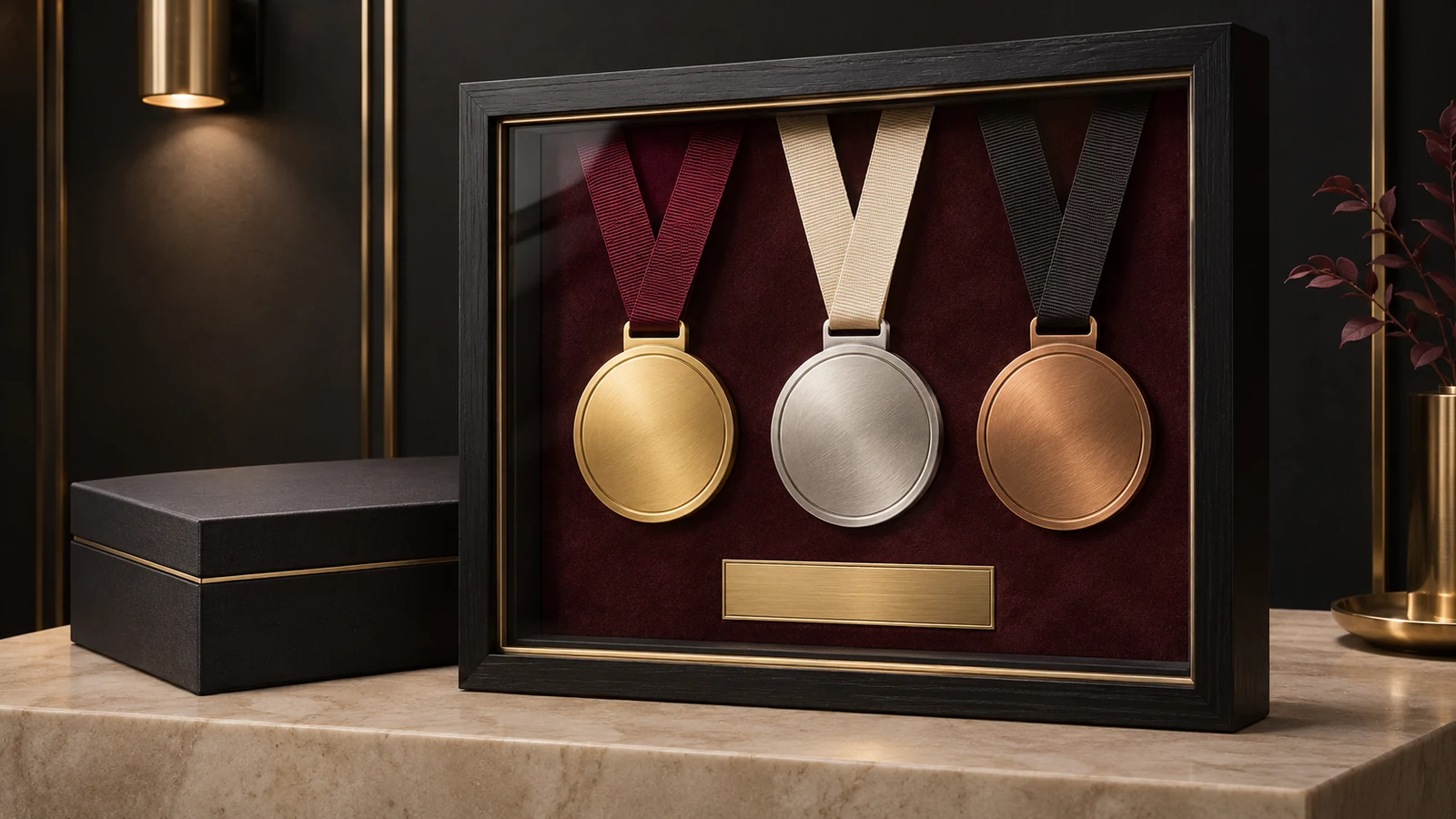
A medal display frame can combine a physical medal, event words, rings or emblems, an athlete photograph, a nameplate, sponsor branding and retail packaging. Those elements do not arrive under one universal permission. A brand preparing an Olympic- or Paralympic-related product needs to separate the USOPC’s special statutory rights, Games and Team USA assets, athlete name/image/likeness interests, photographer copyright and the buyer’s manufacturing approvals before an overseas factory receives final artwork.
This guide is for authorised merchandise teams, athlete managers, sports brands, event partners, medal-frame importers, agencies and OEM/ODM factories preparing concepts during the LA28 cycle. It is not permission to use a protected mark, medal design, athlete image or competition photograph. The relevant rights holders and qualified U.S. counsel must approve the exact product, territory, channel, term, artwork, advertising and parties.
Why is a medal frame more than a frame specification?
The construction may be straightforward: deep moulding, backing, mounts, glazing, nameplate and hanging hardware. The commercial value often comes from protected content. A product can be physically well made and still be unusable because the artwork, listing image or product name was never authorised for merchandise.
The buyer questions below are editorial inferences from current USOPC guidance, federal law, Copyright Office material and normal licensing handovers. They were not captured from Google AI Overviews or AI Mode. Google Search Central recommends accurate, original, expert-led content. The useful answer is therefore a rights-and-approval workflow, not a generic claim that “fan art” or ownership of a medal makes commercial use safe.
Start with the USOPC’s special statutory rights
36 U.S.C. § 220506 gives the United States Olympic and Paralympic Committee exclusive rights in specified names, symbols, emblems and words. The statute also provides a civil-action route for unauthorised trade uses and uses that falsely suggest a connection with Olympic, Paralympic, Pan-American or Parapan American activity. This is broader and more specific than a buyer’s ordinary logo checklist.
Do not assume that changing a spelling, drawing a ring-like simulation or describing a product as unofficial solves the issue. USOPC guidance says businesses should not use USOPC IP commercially without express consent and directs prospective official merchandise licensees to its licensing route.
Build a rights matrix before drawing the first concept
List every proposed element: product name, event name, USOPC or Team USA mark, Olympic or Paralympic symbol, Games logo, National Governing Body mark, athlete name, athlete image, competition photograph, medal depiction, sponsor logo, venue image, quote, signature and packaging copy. Give each element an owner, permission basis, territory, channel, term, approval route and file source.
“Provided by client” is not a permission basis. Ask the client to identify the agreement or written approval that covers this manufacturer, product class, market and use. Record restrictions without distributing confidential licence terms more widely than needed.
Keep USOPC assets separate from sport-governing-body assets
USOPC guidance notes that it does not control the trademarks or logos owned by the National Governing Body for a specific sport. A product may therefore require more than one organisation’s review. The event, team, sport federation, local organising body and athlete can control different elements.
Create separate artwork layers and approval records. Do not infer that permission to use a sport federation mark includes Team USA, or that a Team USA merchandise relationship includes a local club, sponsor or Games organising-committee asset.
Treat the athlete’s identity as its own approval stream
An athlete’s name, image, likeness, voice, signature and other identity signals can create rights and contractual issues separate from the product mark. The USPTO explains that NIL can be licensed for endorsements and branded goods, while organisational policies and contracts may also apply. USOPC athlete guidance adds rules around commercial activity and protected competition periods.
The buyer should identify who is contracting with the athlete, what uses are approved, whether the athlete is endorsing the product, the term and channels, and what happens after the licence expires. A factory does not need the full athlete agreement, but it needs a controlled proof that the final image and nameplate version are approved for production.

Owning a photograph is not the same as owning its copyright
The U.S. Copyright Office explains that the person who takes a photograph is generally its initial copyright owner, while owning a copy of the photograph does not itself transfer copyright. Competition images can also contain protected marks and event assets. A photograph supplied by an athlete, agency or archive therefore needs a documented use right.
Record photographer or agency, image identifier, licence scope, crop permission, colour-edit permission, product use, packaging use, ecommerce use, social use, territory, term and required credit. Do not let the factory download a higher-resolution version from the internet or remove a watermark.
Separate product artwork from advertising artwork
A licence may permit a mark on the product but control how it appears in advertising, social posts, packaging or retailer displays. USOPC guidance describes strict limits on corporate social-media use and the commercial use of Games images and athlete content. The ecommerce hero should not be approved merely because the physical nameplate was approved.
Create an approval set for the front, back, insert, box, shipping carton, listing images, detail images, video, social crop and marketplace title. Link each approval to a version. If a retailer builds its own campaign, define whether the brand can supply only pre-approved assets.
Do not use protected marks in an early factory mood board
A speculative concept can leak through shared drives, vendor catalogues or sample rooms. Use generic medals, ribbons, geometric placeholders and neutral copy for construction development. Release protected artwork only to named suppliers under the buyer’s approved confidentiality and security process.
Watermark or otherwise control pre-release proofs where the rights holder requires it. Tell the factory that placeholder artwork may not be shown at trade fairs, on sourcing platforms, in a portfolio or to other customers.
Define what the medal itself contributes
Ask whether the frame is sold empty, includes a replica or commemorative medal, or is designed to hold a medal already owned by the athlete or customer. A replica programme can introduce additional design, manufacture and distribution permissions. Do not manufacture a recognisable medal from a photograph without written clearance.
For customer-supplied medals, design reversible mounts that do not damage the object. Record ribbon width, medal size, mass and suspension method using authorised sample information. The mount specification is a manufacturing fact; it does not grant permission to reproduce the medal design in marketing.
Create a protected-artwork package with minimum access
The final package can include locked production PDF, vector or high-resolution raster files, colour references, size and clear-space rules, placement dimensions, substrate, finish, approval code and expiry or destruction instructions. Separate editable construction drawings from controlled IP artwork so engineering can continue without duplicating sensitive files.
Use access logs and named recipients for high-risk assets. The packaging printer, plaque vendor and frame assembler may need different subsets. If one supplier subcontracts decoration, the buyer should know and approve the path before files move.
Build approval gates into the commercial calendar
Licensing review can affect lead time more than frame construction. Set gates for concept, rights matrix, digital layout, material sample, colour proof, pre-production sample, packaging, listing content and final production. State which party submits and which party approves each gate.
Do not promise a retail launch date before the approval calendar is realistic. If a rights holder requests changes, update every derivative asset. A new product photo showing an unapproved crop can reopen the review even when the physical frame is unchanged.
Write the licence scope into the supplier brief without over-sharing
The PO should identify the authorised SKU, quantity, territory, approved channels, artwork version, approved suppliers, overrun policy, scrap treatment, sample count, confidentiality and no-publicity rule. If the factory may produce only for the named buyer, state that clearly.
Do not ask the factory to interpret a licence agreement it has not negotiated. The brand or licensee should translate legal scope into specific production controls and retain ownership of the approval decision.
Control overruns, seconds and rejected parts
Licensed merchandise creates special risk when extra plaques, printed backs, inserts or complete units remain after production. Define permitted overrun, reconciliation, destruction or return evidence, and how rejected branded parts are handled. The supplier should not sell seconds or use branded components in samples.
Count rights-bearing components separately from generic frames. A blank frame may be reusable; a printed badge may require controlled destruction. Ask for a completion statement appropriate to the licence and buyer policy.
Make the sample a complete rights-and-product review
Review the front, side, back, hardware, glazing, medal mount, nameplate, artwork colour, packaging, labels and inserts. Compare the sample with the approved digital layout and actual authorised asset files. Photograph the sample in controlled lighting for the rights holder’s review.
Do not use an AI-generated athlete, event logo or medal design to make a sample look “close enough.” A generic construction sample should remain visibly generic. A licensed sample should use only released production assets.
Protect the athlete and customer experience
A medal represents a real achievement. Confirm whether the athlete will receive an approval sample, whether personal name data is correct and whether the display can be opened without damaging the medal. If the product is personalised, use a controlled data template and minimum-access workflow.
Avoid claims that the frame is “official,” “used by” or “approved by” an athlete or organisation unless the responsible rights holder has authorised that exact wording. The product page should distinguish factual contents from endorsement language.
Keep AI-generated visuals out of rights evidence
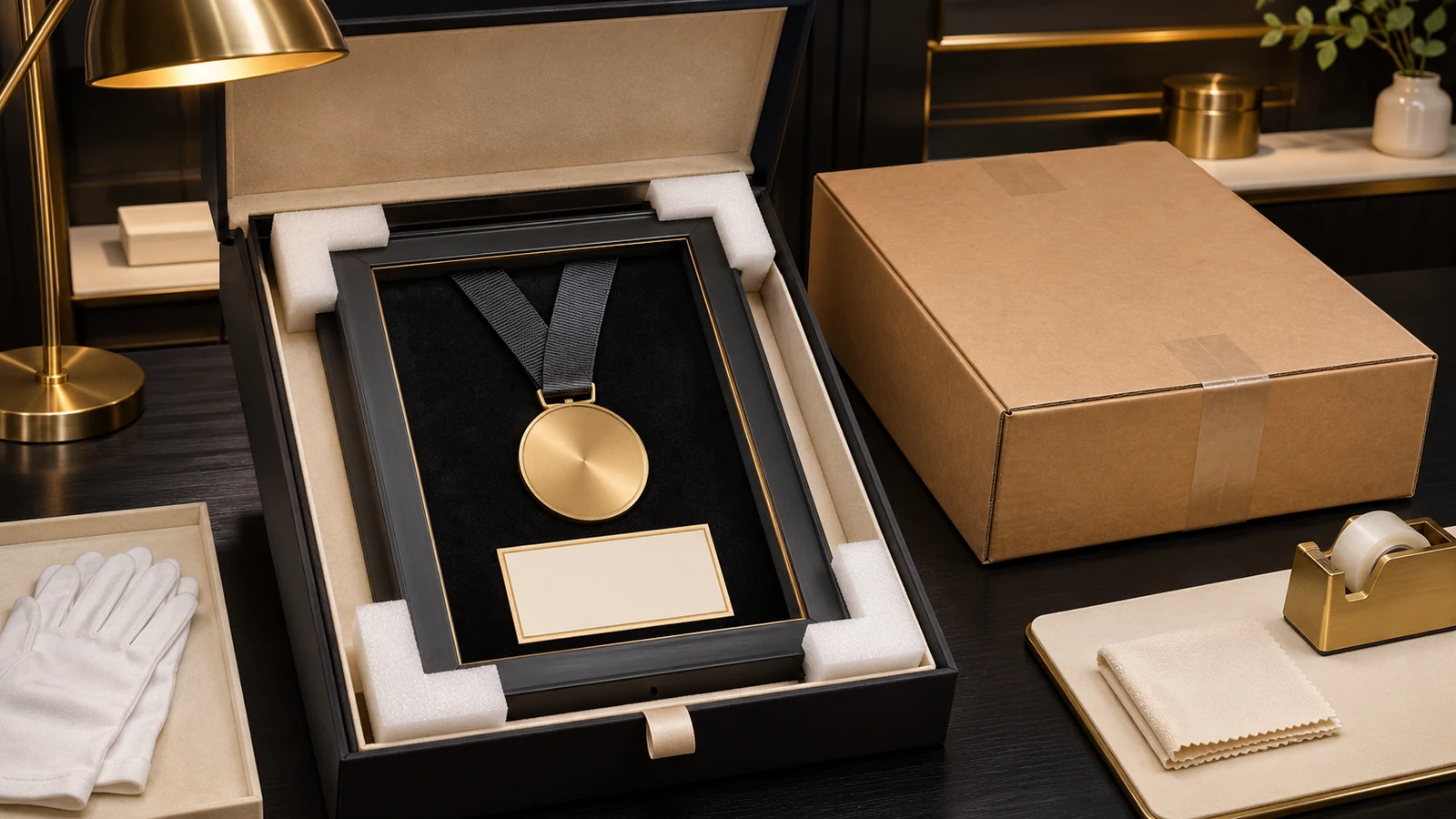
AI can help explore a generic black-and-gold composition, but it cannot prove permission, replace an approved mark or reconstruct a protected medal. Mark concept imagery as non-production and prevent it from entering the final artwork folder. Check generated scenes for accidental ring simulations, flags, pseudo-logos or athlete likenesses.
The images in this article are generic planning scenes with plain medals and ribbons. They do not depict official Olympic or Paralympic medals, marks, athletes, sponsors or event branding, and they should not be used as evidence of an approved product.
Prepare for licence expiry, cancellation and sell-off
Record the licence end date, sell-off period if any, territories, remaining-stock process, listing takedown, file return or destruction and customer-service obligations. A cloud folder containing approved art should not remain open to vendors indefinitely.
At the end of the programme, reconcile finished units, work in progress, branded components and digital assets. Keep the records required by the buyer and rights holder while removing access that no longer has a business purpose.
Licensed medal-frame checklist
- Every proposed word, symbol, image, medal and logo has an identified owner
- USOPC, Games, NGB, athlete, photographer and sponsor rights are separated
- Product, packaging, ecommerce and social uses are approved independently
- Generic construction samples contain no protected or simulated marks
- Athlete NIL and endorsement language have a documented route
- Photograph copyright and permitted edits are recorded
- Controlled artwork reaches only approved suppliers
- Concept, sample, packaging and listing gates are scheduled
- PO terms control quantities, overruns, seconds, scrap and publicity
- Personalisation data and actual medals are handled safely
- Final samples match the approved asset version
- Expiry, sell-off and file-destruction steps are owned
Experience scope and project limits
Editorial review: Jessica, Founder & Project Advisor at DOREMI Display. Updated 24 November 2026. Jessica’s practical scope covers display-frame specifications, custom layouts, material and mounting discussions, samples, packaging, OEM/ODM quotations and buyer–factory coordination. She is not presented as the USOPC, an athlete representative, licensing agent, trademark or copyright lawyer, National Governing Body, photographer or Games organising committee.
The buyer, licensee, athlete, photographer, USOPC and other rights holders must determine permissions and final use. This guide organises the manufacturing handover; it does not grant a licence, approve merchandise, waive athlete rules or establish a fair-use defence.