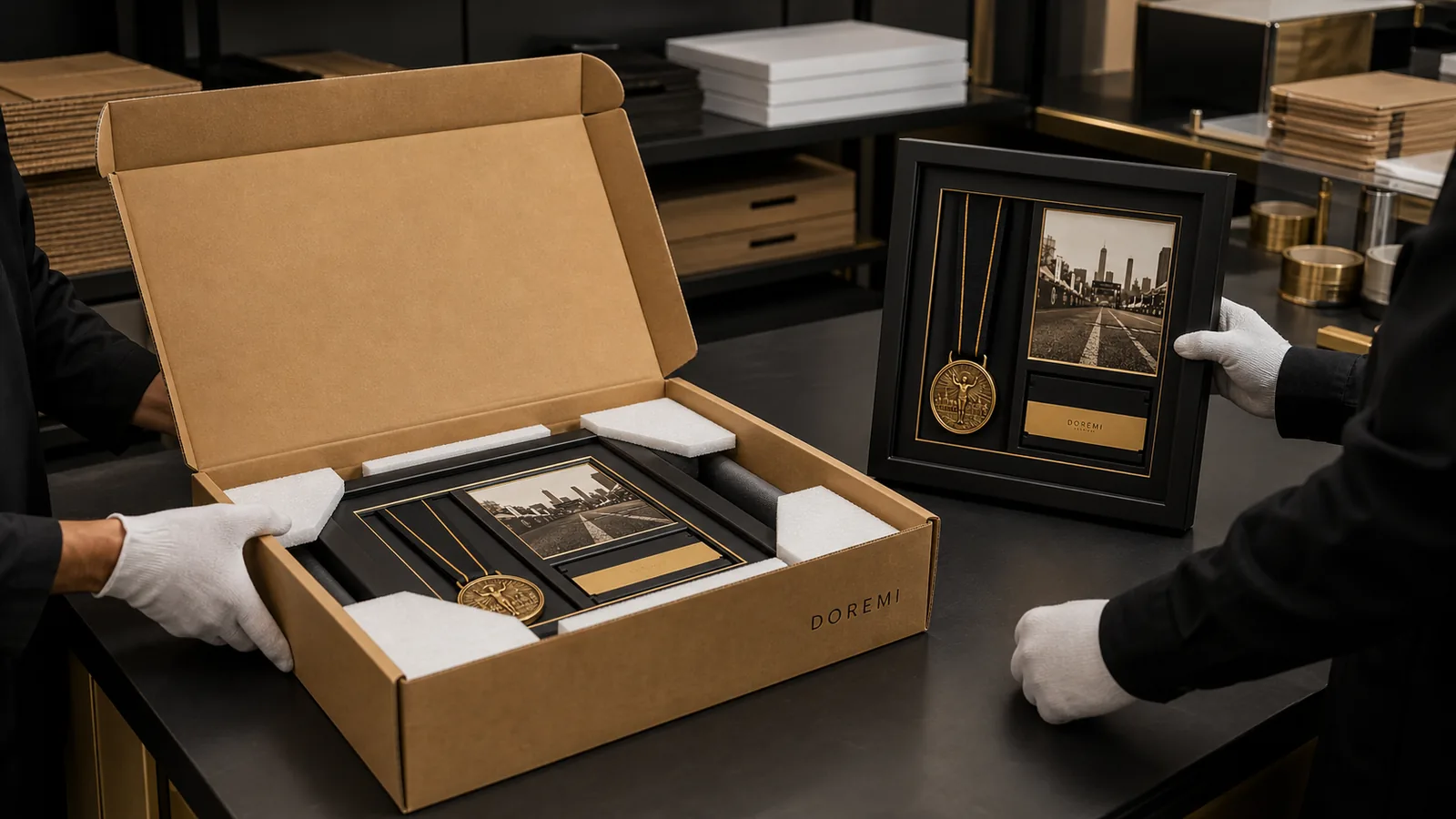
A premium display frame is not finished when the last corner is joined. It is finished when the intended recipient can open the package and find the frame, glazing, mounted object, backing and presentation surfaces in the condition the buyer approved.
That makes packaging part of the product, not a purchasing footnote. Custom frames combine rigid corners, broad glazing, visible finishes, hanging hardware and sometimes heavy three-dimensional objects. Each component responds differently to drops, vibration, compression, abrasion and moisture. This guide shows importers, brands, event teams and institutional buyers how to turn those risks into an evidence-based packaging approval.
Why “export carton” is not a specification
The phrase tells a buyer almost nothing about board grade, flute, dimensions, joint, closure, internal protection, carton quantity, orientation or the route the package was designed for. Two quotations may both say “export carton” while proposing very different protection systems. One may assume palletised freight; another may assume individual parcel delivery.
Require a packaging line in the product specification. It should identify the product wrap, glazing separator, corner and edge protection, face and back protection, inner box, master carton, unit count, closure, carton marks and packed dimensions. If a presentation box is used, state whether it is part of the protective system or sits inside a separate transit carton.
Map the route before designing the pack
Begin with a simple route map: factory packing bench, local collection, consolidation, container or air terminal, customs handling, importer warehouse, regional distribution, fulfilment centre, parcel carrier, venue or end recipient. Mark where cartons are palletised, depalletised, sorted, opened or forwarded. The number of handovers often matters more than geographic distance.
A display delivered as a full pallet to one institution sees different hazards from the same product sent one unit at a time through e-commerce fulfilment. A carton validated only in a pallet stack may be unsuitable for parcel networks. Conversely, an oversized parcel pack may waste space and cost when every unit remains on a controlled pallet.
Define what failure means for this product
Packaging cannot be evaluated without acceptance criteria. For a display frame, failure might include broken glazing, opened mitres, scratched profile, dust migration, shifted medal, creased certificate, loose hardware, compressed gift box, unreadable carton mark or a package that is unsafe to open. Decide which conditions are critical, major or cosmetic for your programme.
Record acceptable natural variation separately from transport damage. A hand-finished wood tone may vary slightly; a new gap at a corner after testing is different. A clear defect definition helps the factory, inspection company and buyer evaluate the same evidence instead of debating impressions after shipment.
Design protection from the product outward
Start with the most vulnerable surfaces. Glazing needs separation from hard accessories and enough support to avoid concentrated load. Frame corners need blocks that hold them without rubbing the visible finish. Back hardware should not press into another unit. Raised plaques, medals or deep objects need clearance so a shock does not transfer directly through the package.
Then control movement. Empty space is not automatically cushioning. If the frame can accelerate before hitting the carton wall, the pack may increase rather than reduce damage. Internal protection should restrain the product, distribute loads and maintain clearance around vulnerable areas. The selected material must also remain practical for workers to assemble consistently.
Choose materials that production can repeat
A beautiful handmade sample is not useful if a production line cannot reproduce its protection efficiently. Specify the material type, dimensions, position and orientation of every insert. Use photographs or a packing drawing to show the sequence. If foam, honeycomb board, corrugated pads, paper cushioning or moulded pulp is used, confirm availability and the allowed substitution process.
Sustainability claims also need precision. Reducing material can be worthwhile only if the product still arrives intact. A damaged frame wastes the frame, replacement pack and additional transport. Ask for the smallest repeatable system that meets the route and product need, not simply the pack with the fewest visible pieces.
What does ISTA-informed mean?
The International Safe Transit Association publishes procedures that simulate defined distribution hazards. Its public overview of Project 3L, for example, describes a generalised e-commerce retailer fulfilment test and notes that final official testing should use actual production items. A buyer can use that principle to ask better questions: Which distribution environment are we simulating? Is the sample representative? Who defines the sequence and acceptance criteria?
“ISTA-informed” in this article does not mean DOREMI or a package has passed a particular procedure. A formal test claim should identify the exact procedure, laboratory, specimen, configuration, date and report. If certification or retailer compliance is required, arrange it with a qualified laboratory and confirm the applicable protocol for the product and route.
Use production-equivalent specimens
A test result is only as useful as the specimen. A lighter empty frame, substitute glazing, hand-cut foam or stronger sample carton may not represent the production pack. Record product dimensions, unit weight, glazing, mounted contents, hardware, inner protection, carton construction and closure method for every tested specimen.
For personalised or valuable displays, a representative dummy object may be safer than the original, but it should match mass, shape and mounting behaviour. If several SKUs share one carton system, test the heaviest, largest or otherwise worst-case configurations and explain why they represent the range. Do not assume the largest item is automatically worst in every hazard.
Plan a sequence, not one dramatic drop
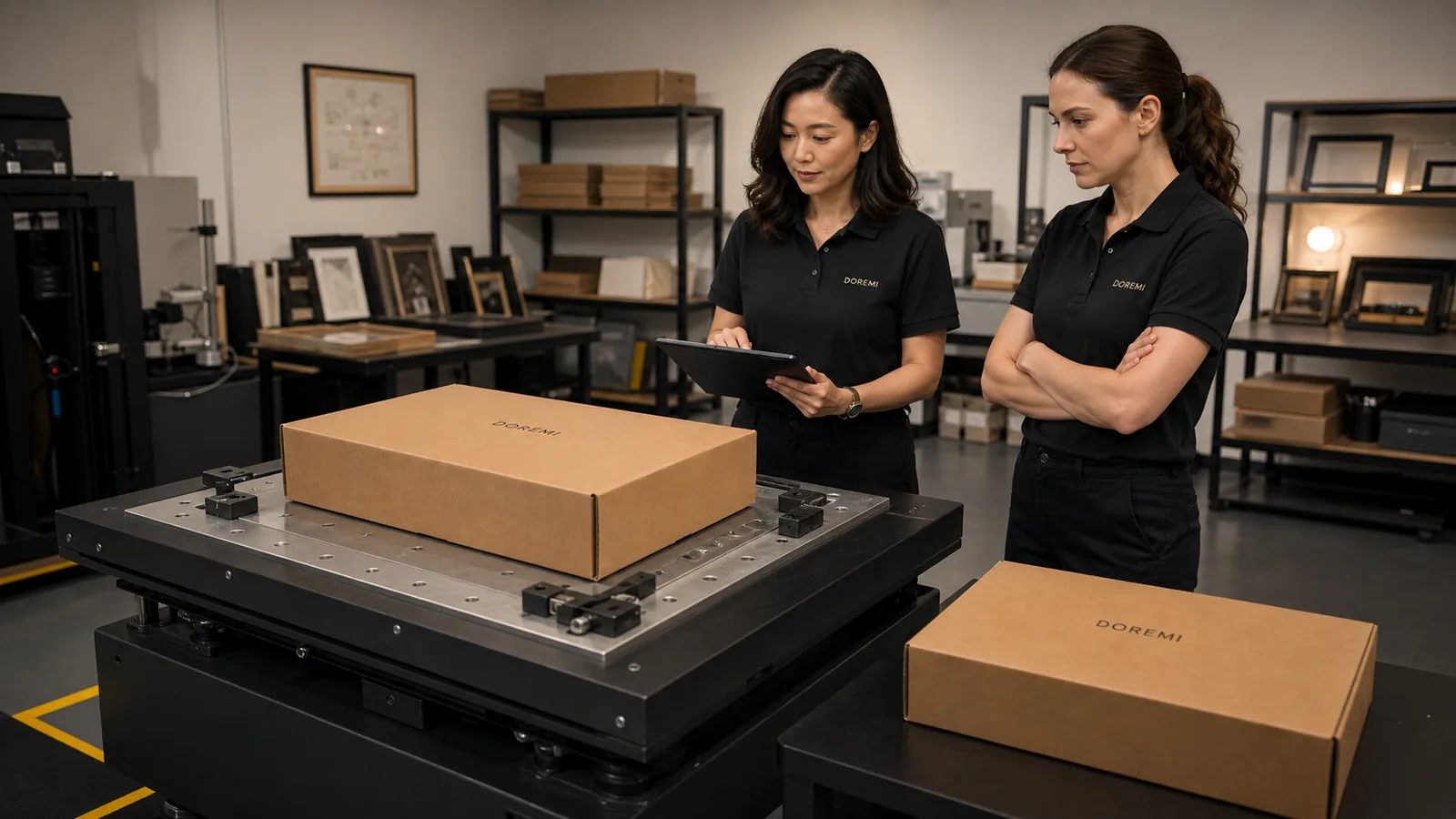
Real distribution exposes a pack to repeated handling. A useful validation may consider conditioning, compression, vibration, rotational or free-fall drops and final inspection, depending on the chosen standard and route. The order matters because earlier events can weaken a carton or loosen internal protection before a later event.
A single informal drop can reveal an obvious weakness during development, but it is not the same as a controlled laboratory procedure. Use early trials to improve the design, then validate the final production-equivalent configuration through an appropriate documented method. Avoid marketing a workshop check as a certification.
Inspect both product and package after the sequence
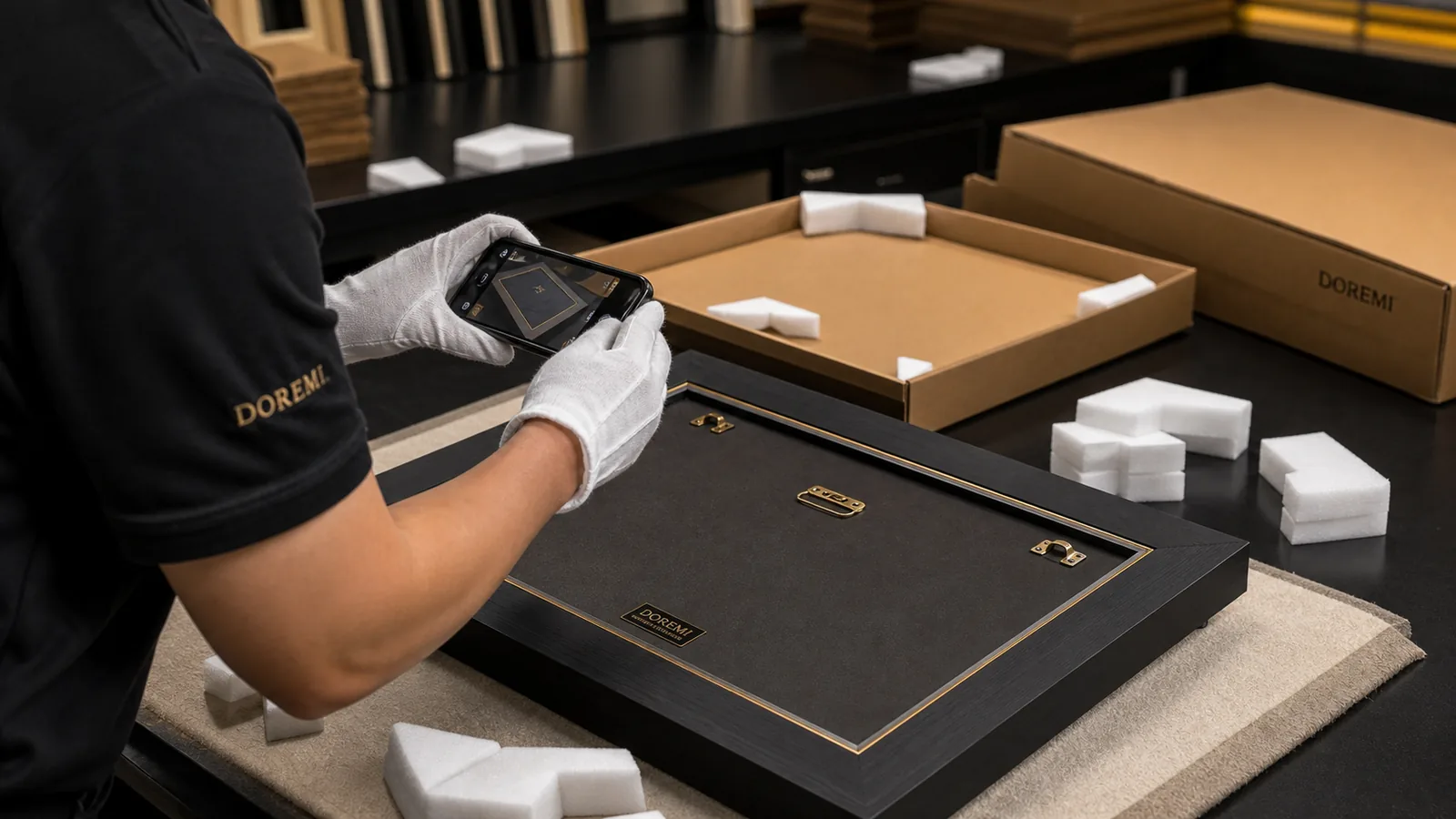
Open the pack in a controlled area and photograph each layer before moving it. Record carton deformation, insert displacement, scuffing, dust, glazing condition, frame corners, backing, hardware and mounted contents. Compare the finished product with the pre-test reference. If a defect appears, trace the likely load path rather than simply adding more material everywhere.
For example, a rubbed gold trim may point to insufficient surface separation, while a loose medal may indicate mounting design rather than carton weakness. An opened mitre can involve frame joint, corner restraint, overall pack movement or a combination. Corrective action should address the mechanism observed.
Create a packaging evidence pack for approval
The approval file should contain the dated product specification, packaging drawing, component list, specimen details, pre-test photographs, test method or development check description, post-test photographs, observations, corrective actions and final approval. If a third-party laboratory is used, retain the report and ensure it matches the shipped configuration.
Also record who approved the pack and what changes require revalidation. A change in glazing, frame size, mounted object, carton supplier, cushioning material, units per carton or fulfilment route can alter performance. A packaging specification without change control slowly becomes a historical document rather than a production control.
Connect packaging approval to the purchase order
Reference the approved packing revision in the purchase order or quality agreement. State the packed dimensions, gross weight, unit count, carton marks, palletisation requirement and evidence expected before shipment. If substitutions need buyer approval, say so. This turns the packing sample into a controlled part of the order rather than a photo attached to an old message thread.
For final inspection, ask for a sample of unopened cartons across the lot and verify that the packing sequence matches the approval. Confirm labels and variant identification before loading. If recipients will open the package, include concise instructions for lifting, film removal, wall hardware and care.
Plan for parcel, pallet and presentation routes separately
A direct-to-consumer package may need to stand alone through automated sorting and repeated transfers. A pallet shipment relies on stack stability, pallet pattern, stretch wrap, edge protection and disciplined warehouse handling. A presentation gift needs an inner experience but may still require an outer transit carton. Combining all three into one premium box often creates unnecessary cost or insufficient protection.
Where a programme uses multiple routes, define packaging levels. The same framed product might use a presentation inner box, a single-parcel overpack and a master carton for pallet movement. Give each configuration its own code and packed data so fulfilment teams do not improvise.
Use the first shipment as controlled feedback
Even a well-designed test is a model of distribution, not a guarantee that every real shipment will be perfect. Establish a simple arrival-feedback process for the first batch: carton condition, product condition, route, photographs and date. Separate carrier event, pack defect, product defect and handling error where evidence permits.
Review the pattern before changing the pack. One isolated puncture may need a carrier claim; repeated corner compression may reveal a structural issue. Save the evidence with the packaging revision so the next order begins with better information rather than memory.
Buyer checklist before shipment
- Actual route and handovers mapped
- Critical, major and cosmetic failure definitions agreed
- Production-equivalent product and packaging used for validation
- Applicable formal procedure confirmed when required
- Pre- and post-test evidence retained
- Corrective actions closed and final revision approved
- Packed dimensions, weights and carton quantities verified
- Purchase order references the approved pack
- Final inspection checks packing consistency
- First-shipment feedback route assigned
Control labels, orientation and warehouse handling
A strong internal pack can still fail operationally if the wrong variant is picked, a master carton is stacked in an unintended orientation or a fulfilment team opens the package from the product side. Define the product code, quantity, gross weight, carton dimensions, destination mark and any necessary handling information. Use only symbols and claims appropriate to the actual pack and route.
Confirm where labels are placed after palletisation and whether barcodes remain scannable. If several personalised frames share similar cartons, add a controlled identifier that can be matched to the distribution list without exposing more recipient data than necessary. A packing photograph should show the approved label face and carton closure, not only the open inner protection.
Evaluate cost with damage prevention and cube together
Packaging cost is not just the price of foam and cardboard. It affects labour, storage cube, units per pallet or container, parcel dimensional weight, disposal and the effort required to replace a damaged frame. Compare options on the completed delivery system. A thicker insert that reduces movement may also increase carton size; a stronger carton may allow a simpler internal structure. The best balance must be demonstrated, not assumed.
Ask the supplier to quote the approved pack as part of the unit and identify one-time tooling or test costs separately. If a value-engineering change is proposed later, require a revised drawing and decide whether development checks or formal revalidation are needed. Saving a small amount per unit is not a saving if the change invalidates the evidence behind the pack.
Experience scope and project limits
Editorial review: Jessica, Founder & Project Advisor at DOREMI Display. Updated 12 August 2026. Jessica’s practical scope covers custom display-frame briefing, packaging-sample coordination, buyer approval records and production handover. She is not presented as an ISTA laboratory engineer, carrier representative, dangerous-goods specialist or destination-market regulatory authority.
This article is general project guidance. Your test plan should be selected by a qualified packaging professional or laboratory against the actual product, distribution route, retailer requirements and destination rules. Do not use the article as evidence that a package has passed a named test.