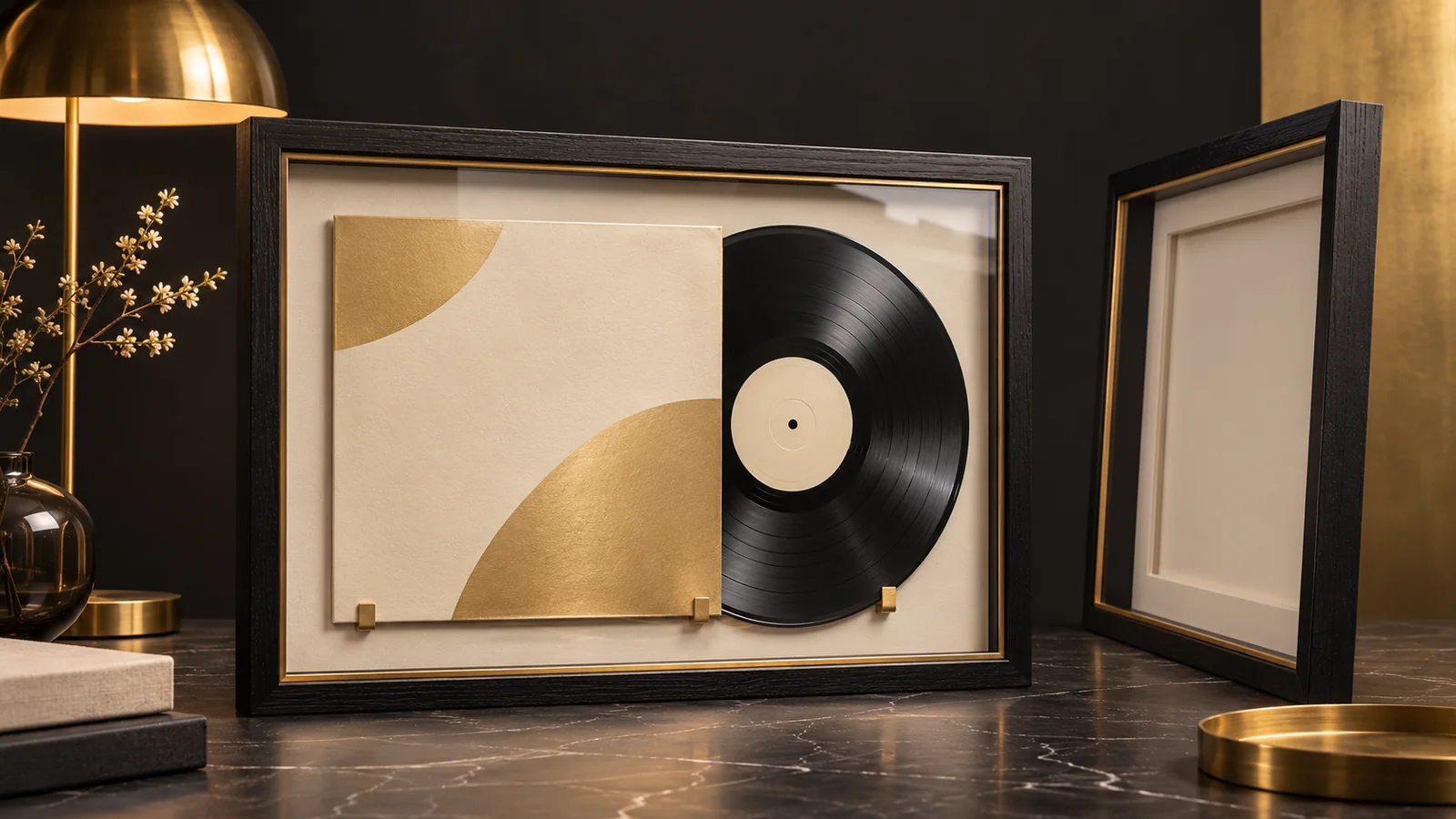
An empty vinyl record display frame is a straightforward product. The launch becomes more complicated when the listing shows a famous album cover, the carton uses an artist image, the trade-show sample includes a real record or the factory copies artwork from a buyer’s mood board. The physical record, jacket design, photograph, artist brand and product photograph can involve different rights and owners.
This guide is for vinyl-accessory brands, importers, record-store buyers, licensors, creative agencies and display-frame OEM/ODM factories. It creates a commercial rights handover for product photography, packaging and samples. It does not grant permission, decide fair use or trademark infringement, or replace qualified intellectual-property advice in each market.
Why is this a procurement question rather than only a design question?
A frame supplier may receive an album cover in the RFQ, show it in a sample, reproduce it for a catalogue and pass the file to a photographer. Each handoff can extend beyond the buyer’s original intention. If rights are unclear, finished cartons and listing images may be unusable even when the physical frame is approved.
These buyer questions are editorial inferences from U.S. Copyright Office and USPTO guidance plus ordinary private-label artwork workflows. They were not captured from Google AI Overviews or AI Mode. Google Search Central recommends original, accurate content; the practical answer is a controlled asset register, not a blanket claim that anything shown inside a frame is merely a prop.
Separate ownership of the record from copyright in the artwork
Buying a physical record transfers that particular copy, not automatically the copyright in the jacket artwork, photography or other creative material. The Copyright Office explains that owning a photo does not necessarily mean owning the copyright or the right to publish copies. The same distinction matters when a brand owns a record used in a shoot.
Record the source of the physical item and the source of every reproduced image. A photographer can take a new picture of the frame, but the picture may still capture protected album artwork. Ask counsel whether the intended commercial use requires permission or fits a legal limitation.
Treat record-jacket artwork as protected material
The Copyright Office specifically lists record jacket artwork or photography among visual-arts works. Do not assume an old cover is public domain because it lacks a visible notice, is widely shared online or is sold second-hand. Copyright status and ownership can be complex and can change through transfers.
For a rights-cleared campaign, identify the exact cover, edition, territory and material. A reissue may use different photography or typography from the original. The current owner of the exact material is the party that can grant permission when permission is required.
Distinguish the frame product from the styling prop
If the product sold is an empty display frame, make that clear in the listing, packaging and contents. A real record used only as a styling prop should not imply that the album, artist or label sponsors, supplies or bundles the frame. Clear product-contents language also reduces customer confusion.
For the safest general photography route, use an abstract, commissioned, rights-controlled sleeve and an unbranded disc. Preserve proof of who created the artwork and what uses were granted. Do not imitate the distinctive layout of a famous cover while merely changing the title.
Map every asset before asking for permission
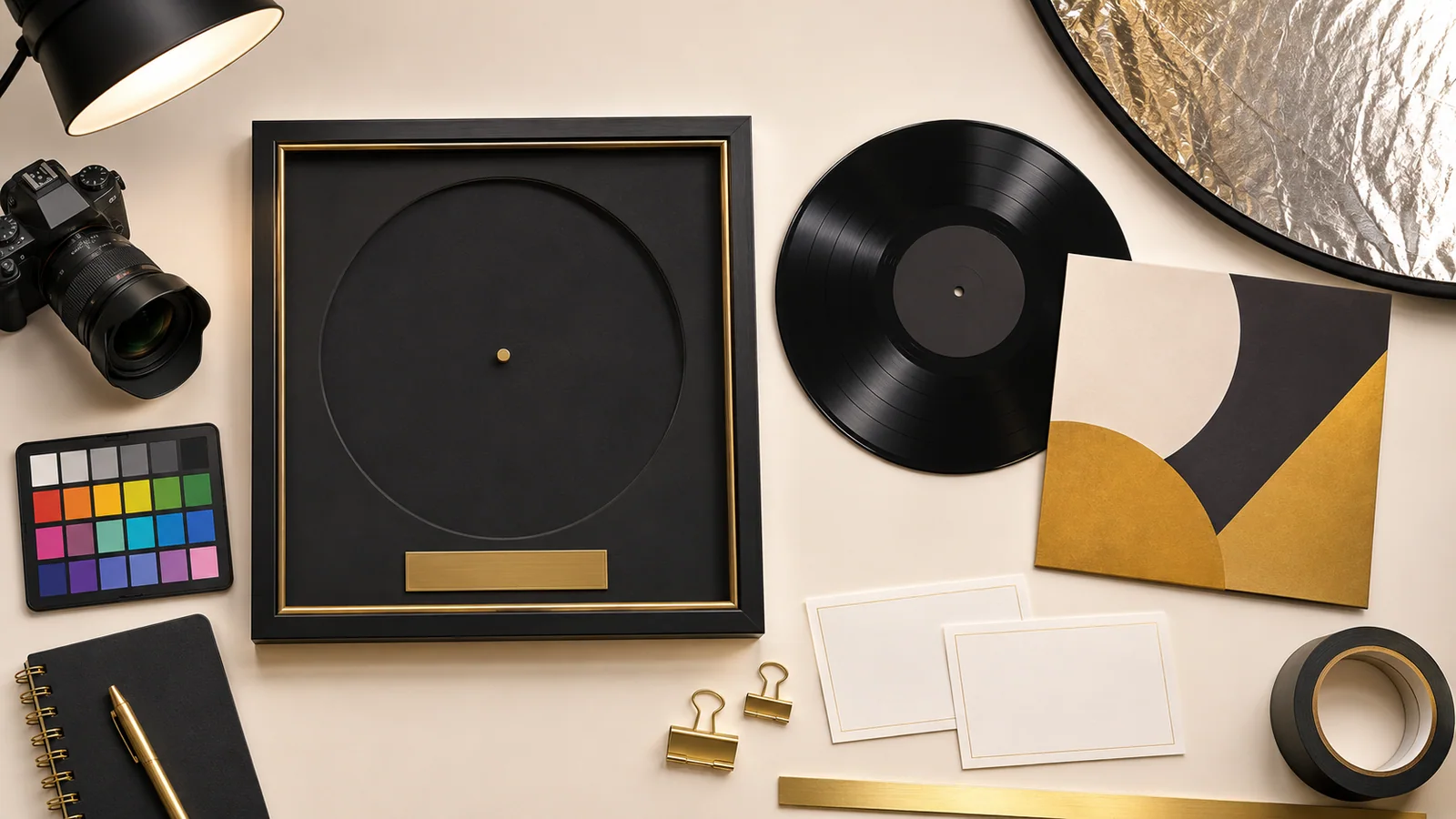
Create an asset register covering jacket artwork, photographs, logos, artist names, label marks, typography, liner-note fragments, record labels, catalogue numbers and the new product photographs. Give each asset a file name, owner, source, proposed use and status.
A single cover can contain several contributions with different owners. The Copyright Office advises requesters to identify the exact material, intended use, audience, sale context and organisation. Give the rights owner a complete request rather than asking vaguely to “use an album.”
Define the licensed uses in operational language
A useful permission record states media, territory, term, sales channels, languages, quantities, campaign, editing rights and whether agencies, factories and retailers may use the file. “Marketing use” may be too vague when the asset will appear on a carton, marketplace listing, catalogue, paid ad, trade-show wall and retailer feed.
Ask whether cropping, colour correction, background removal, animation or combination with product copy is allowed. Preserve any credit line or approval requirement. Link the permission to the exact final file so a similar but uncleared image is not substituted.
Screen trademarks and source confusion separately
Copyright and trademark are different. Artist names, label names, logos and distinctive source identifiers may create trademark questions even when the underlying product photograph is newly made. USPTO guidance explains that trademarks identify the source of goods or services and that confusion depends partly on the relationship between the marks and goods.
Review whether a buyer could believe the display frame is official, licensed or endorsed. Do not add “official,” “authentic,” a registration symbol or a label-style logo without evidence. Qualified counsel should assess nominative or descriptive use for the actual listing.
Do not use fair use as a production shortcut
Copyright law includes limitations such as fair use, but the Copyright Office notes that the analysis is fact-specific. A commercial product listing is not automatically fair because it shows an album only as an example, uses a small image or changes the crop.
If the launch depends on an unlicensed use, obtain a written legal assessment for the exact presentation. Procurement should not ask the factory or photographer to make that legal call. Where uncertainty is material, replace the asset or secure permission.
Control buyer-supplied artwork
A factory should receive only assets that the buyer is authorised to use for the stated purpose. The purchase order can require the buyer to identify approved files and the supplier to use them only for the project, protect them and delete or return superseded versions.
A buyer-supplied file is not automatically safe. Record who performed the rights review and which uses are covered. The factory should not reuse the artwork in its portfolio, online marketplace, sample room or another customer quotation without written authority.
Contract the product photographer’s rights
The person paying for photography does not automatically own every copyright. The Copyright Office explains that work-made-for-hire status has specific conditions and can be legally complex. Use a written agreement that identifies deliverables, ownership or licence, permitted edits, raw files, territories, term and third-party material.
Require the photographer to disclose props and stock assets. A studio may own the new photograph while lacking permission for the album cover within it. The rights record should address both layers.
Keep agency, factory and retailer permissions aligned
A brand may have permission to use an image on its own website but not to sublicense it to retailers, distributors or marketplaces. Before distributing a feed, confirm who may host, crop and promote the asset. Include retailers in the request where necessary.
Give the factory a production-only folder and the agency a marketing folder. Do not send a master archive containing unused artist images “for inspiration.” Controlled access reduces accidental reuse and makes withdrawal practical.
Use original abstract inserts carefully
Commissioning an abstract sleeve for product demonstration can simplify clearance, but the brand still needs rights from the creator and should avoid a design that intentionally copies a recognisable album’s composition. Save the brief, drafts, creator agreement and final artwork.
If generative tools are involved, record the tool, prompt direction, input assets and review. Do not feed third-party album art into an editing workflow and assume the output is independent. Obtain advice on ownership and platform terms relevant to the campaign.
Review artist likeness and signatures as separate assets
A portrait, silhouette, signature or distinctive stage image can create additional copyright, trademark, contract or publicity questions. The fact that an image appears on a lawfully purchased jacket does not automatically authorise its reproduction on product packaging.
Use unbranded props unless the campaign has a real licence. If a licensed artist programme is intended, include likeness, name and signature approvals explicitly rather than treating them as part of the album-cover permission by default.
Design samples that cannot become unauthorised marketing
A factory sample may need a visual insert to show the opening, mount and proportions. Use a neutral dummy sleeve marked through controlled project records, not a famous cover downloaded from the internet. Keep sample photography within the approved folder.
At trade shows, a recognisable record can attract attention and also create an endorsement impression. Approve the display with the rights owner or use original artwork. Brief staff not to describe an unlicensed sample as a collaboration.
Freeze packaging with an artwork manifest
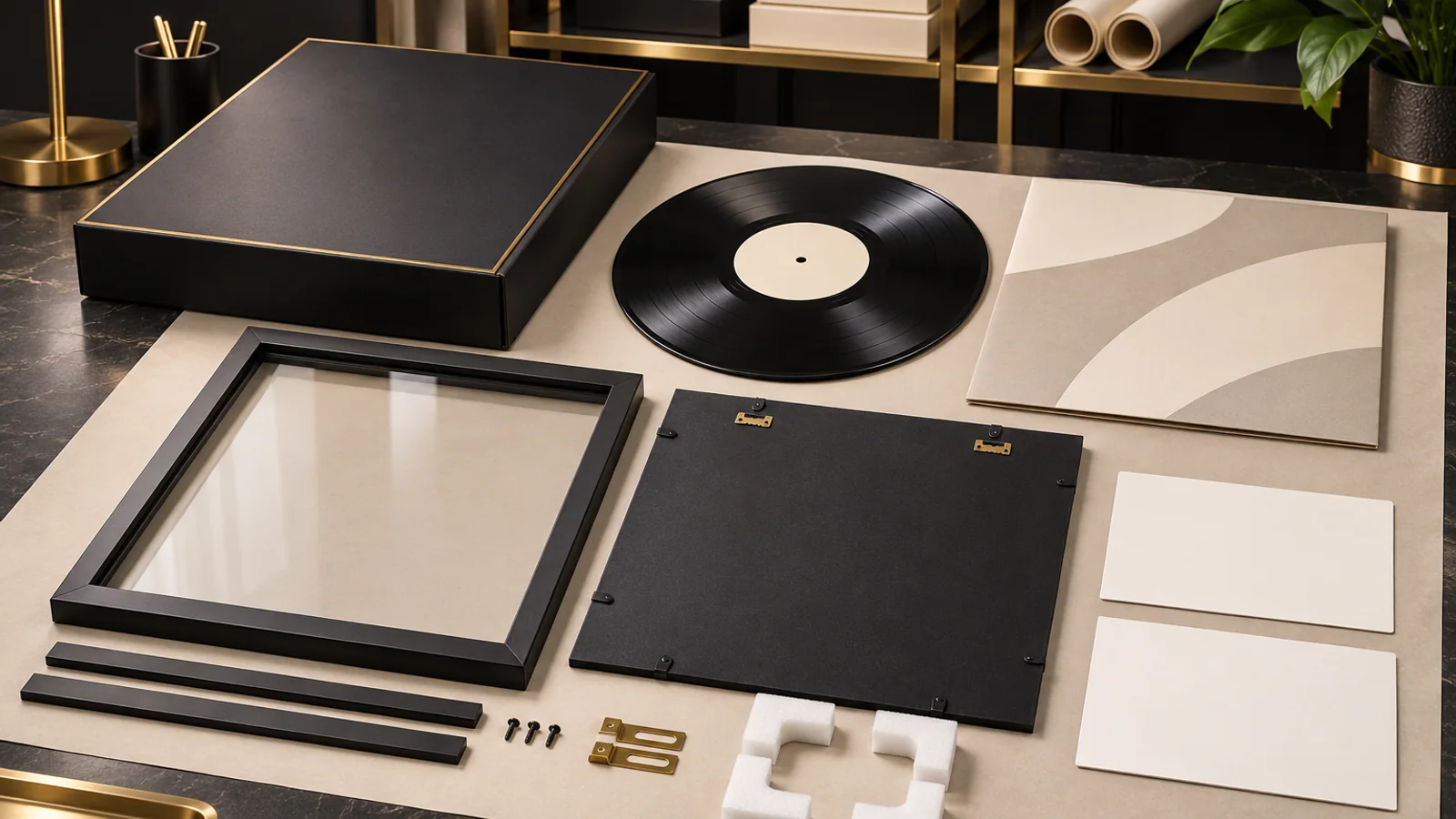
For each panel, list the source file, version, rights status, required credit, approval date and approver. Include the carton, insert, manual, label, marketplace image set and retailer feed. The manifest should show which images are for reference only and which may print.
Require a final production proof against the manifest. A packaging vendor should not replace low-resolution art from a web search or rebuild a logo from an album image. Any substitution returns to rights review.
Keep functional instructions free of third-party content
Mounting instructions can use a blank disc, outline or buyer-owned illustration. They do not need a commercial album cover to show how the frame opens. This keeps service PDFs, replacement-part sheets and retailer manuals reusable across markets.
Photograph the real product mechanics clearly: hinges, clips, mat opening, glazing and wall hardware. A useful original instruction image can reduce both rights risk and customer confusion.
Prepare marketplace and retailer evidence
Platforms or retailers may ask for licence letters, invoices, authorisation or proof that the listing does not imply a bundle. Keep rights records accessible to the brand’s legal and marketplace teams. Do not send confidential agreements more broadly than necessary.
Use accurate titles and keywords. Avoid inserting artist or album names solely to capture search traffic when the product is not licensed for that association. Counsel should review compatibility wording and comparative references.
Plan for takedowns and expired permissions
Record where every asset was published so it can be removed when a licence expires or a rights owner raises a concern. Maintain source files separately from live exports. A retailer image feed can persist after the brand website changes.
Assign an escalation owner for complaints. Preserve the notice, permission record, affected URLs and response. Do not argue rights status publicly through a supplier or customer-service account before qualified review.
Control reorders, territories and new formats
A licence for one country, campaign or carton quantity may not cover a global reorder, marketplace video or new frame size. Add a rights checkpoint when the product expands to a new territory, retailer, language, media format or customer brand.
Archive the exact artwork used with each production lot. A reorder should compare against the rights term and manifest, not merely reuse the last print file because it passed physical inspection.
Vinyl display rights-handover checklist
- The empty frame and any included record are described accurately
- Physical ownership is separated from copyright ownership
- Every cover, photograph, mark and name is in the asset register
- The current owner of exact material is researched where permission is needed
- Media, territory, term, channels and edits are documented
- Trademark and endorsement impressions receive a separate review
- Buyer, photographer, agency, factory and retailer rights align
- Original dummy artwork has a creator agreement and review trail
- Samples and trade-show displays use approved assets only
- Packaging is frozen with an artwork manifest
- Marketplace evidence and takedown ownership are assigned
- Reorders and new territories trigger rights revalidation
Experience scope and project limits
Editorial review: Jessica, Founder & Project Advisor at DOREMI Display. Updated 23 November 2026. Jessica’s practical scope covers private-label vinyl display-frame specifications, artwork handovers, samples, packaging and buyer–supplier coordination. She is not presented as a copyright owner, music licensor, trademark examiner, photographer’s agent or intellectual-property lawyer.
The buyer, rights owners, licensors, creative vendors, platforms and qualified advisers must determine ownership, permission needs, legal limitations, trademark use, publicity rights and territorial coverage. This guide organises project evidence; it is not a licence, fair-use opinion, non-infringement conclusion or endorsement authorisation.