
A wooden display frame can leave a workshop straight and arrive with a slight bow, twist or opening mitre because wood does not stop responding to its environment after machining. Moisture moves toward equilibrium with surrounding air, dimensions change, and a coating may slow that movement without preventing it. “Kiln dried” is therefore a process description, not a complete buyer specification.
This guide helps importers, frame wholesalers, home-decoration brands and quality teams turn moisture risk into measurable project controls. It does not publish one universal target. Species, solid or composite construction, profile size, finish, destination climate, service conditions, test method and buyer policy all influence the appropriate limits and evidence.
Identify what “wood frame” actually means
Separate solid wood, finger-jointed wood, veneer over a core, MDF, plywood, wrapped composite and mixed constructions. Record species or commercial material designation, profile section, grain direction where relevant, joint construction, surface system and backing materials. Different products respond differently and should not share a vague moisture clause.
Ask the supplier which parts are hygroscopic and which are dimensionally stable under the intended conditions. A walnut-look wrap does not make the core walnut; a solid-wood face does not describe the backing. The bill of materials and section drawing should match the physical sample.
Understand equilibrium instead of chasing one number
The USDA Forest Products Laboratory explains that wood tends toward equilibrium with the relative humidity of surrounding air and that correct drying, handling and storage help minimise later changes. A reading only has meaning when the team knows the material, method, location, temperature, recent storage and intended service environment.
Define the destination assumption with the buyer: indoor climate, region, seasonal range, heating or air-conditioning, warehouse conditions and installation timing. A supplier cannot guarantee one stable moisture state for every global destination. The specification should state the agreed design basis and who validates it.
Do not assume a coating stops moisture movement
The USDA handbook notes that protective coatings can retard dimensional change but do not prevent it. Record the complete finishing system, coverage, curing condition and whether cut ends, backs or hidden surfaces receive comparable protection. Uneven exposure or finishing can contribute to uneven response.
Do not use “sealed wood” as a promise of permanent dimensional stability. Ask what the coating is intended to do, which supplier data supports it and whether the sample uses the production-equivalent system. A finish change after approval should trigger a moisture and dimensional review.
Choose a measurement method before setting limits
The USDA handbook describes oven-dry and electrical methods. Oven drying is a reference method but is slow and destructive. Electrical meters provide practical non-destructive readings but can be influenced by species, temperature, meter type, grain direction, thickness, surface condition and calibration or correction settings.
Name the method, instrument category, model, calibration check, correction basis, measurement depth, profile location, temperature context and operator. If buyer and supplier use different meters or methods, run a correlation check on the same pieces. Otherwise two honest readings may still be difficult to compare.
Sample the material, not the easiest surface
Create a measurement map for the profile or component. Avoid reading only one exposed end or one convenient finished face. For long mouldings, sample multiple positions and pieces across racks, batches or processing dates according to a plan set by the quality team.
Record individual results, not only an average. Averages can hide a wet pocket or a mixed batch. The acceptable range and action rule should be product-specific and approved before production. This guide deliberately does not supply a universal percentage or sampling level.
Measure at decision points, not only before shipment
Consider readings at material receipt, after drying or conditioning, before machining, before assembly, before finishing, after curing, before packing and at pre-shipment inspection. The useful points depend on process and risk. A final reading alone cannot explain where a change entered the system.
Link records to material lot and production batch. If components wait between processes, record storage conditions and time. The objective is a traceable moisture history proportionate to the order, not a stack of numbers disconnected from the actual frames.
Control storage support and airflow
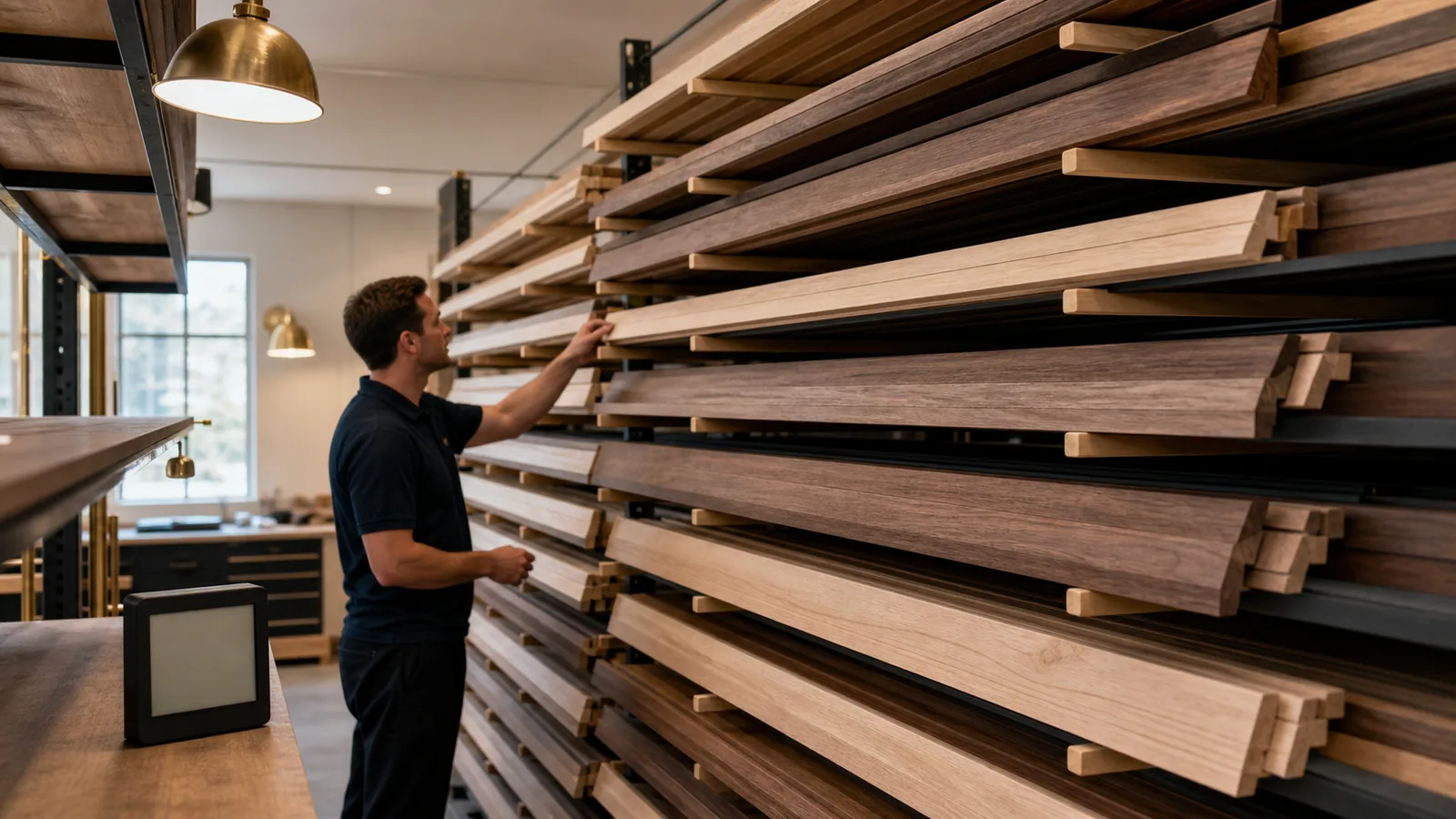
Store mouldings straight, evenly supported and separated where the process requires airflow. Protect them from direct floor moisture, exterior walls, water sources, direct sun and local heating. Avoid unsupported overhangs or uneven stacks that can introduce mechanical distortion independent of moisture.
Record workshop and storage temperature and relative humidity with instruments maintained for the purpose. A single wall display far from the material may not represent every rack. If conditions differ across zones, the quality plan should say which reading belongs to which batch.
Allow acclimation to reach a defined decision
“Acclimate for 24 hours” is not universally meaningful. Time depends on material, section, packaging, starting condition, airflow and environmental difference. Define acclimation by the process and evidence needed rather than a copied duration.
A practical record can show arrival condition, storage zone, time, periodic readings and the release decision. If production pressure shortens the planned conditioning step, record the deviation and risk owner. The buyer should know when schedule choices change the dimensional-stability basis.
Review machining and grain before blaming humidity
Moisture is not the only source of a poor frame. Grain orientation, growth characteristics, machining stress, profile geometry, joint preparation, adhesive, clamping and finish can influence bow, twist and mitre quality. Inspect material defects and process evidence alongside readings.
Ask the supplier how pieces are selected and paired for a four-sided frame. A moisture record cannot make a visibly defective, poorly machined or mismatched profile acceptable. Keep raw-material, process and final-appearance criteria as connected but distinct controls.
Make mitre construction part of the stability brief
Record cut accuracy, joint faces, adhesive system, reinforcement where used, clamping method, curing conditions and acceptable visible joint appearance. Test the production-equivalent finish because coatings and curing can affect the sequence and timing of assembly.
Do not set a joint strength or tolerance from an unrelated product. Define the completed frame use, size, mass, glazing, backing and hanging system, then ask the supplier and qualified engineer or test provider which evidence is appropriate. Visual closure at the sample stage is necessary but not the only consideration.
Define bow, twist and flatness with a common method
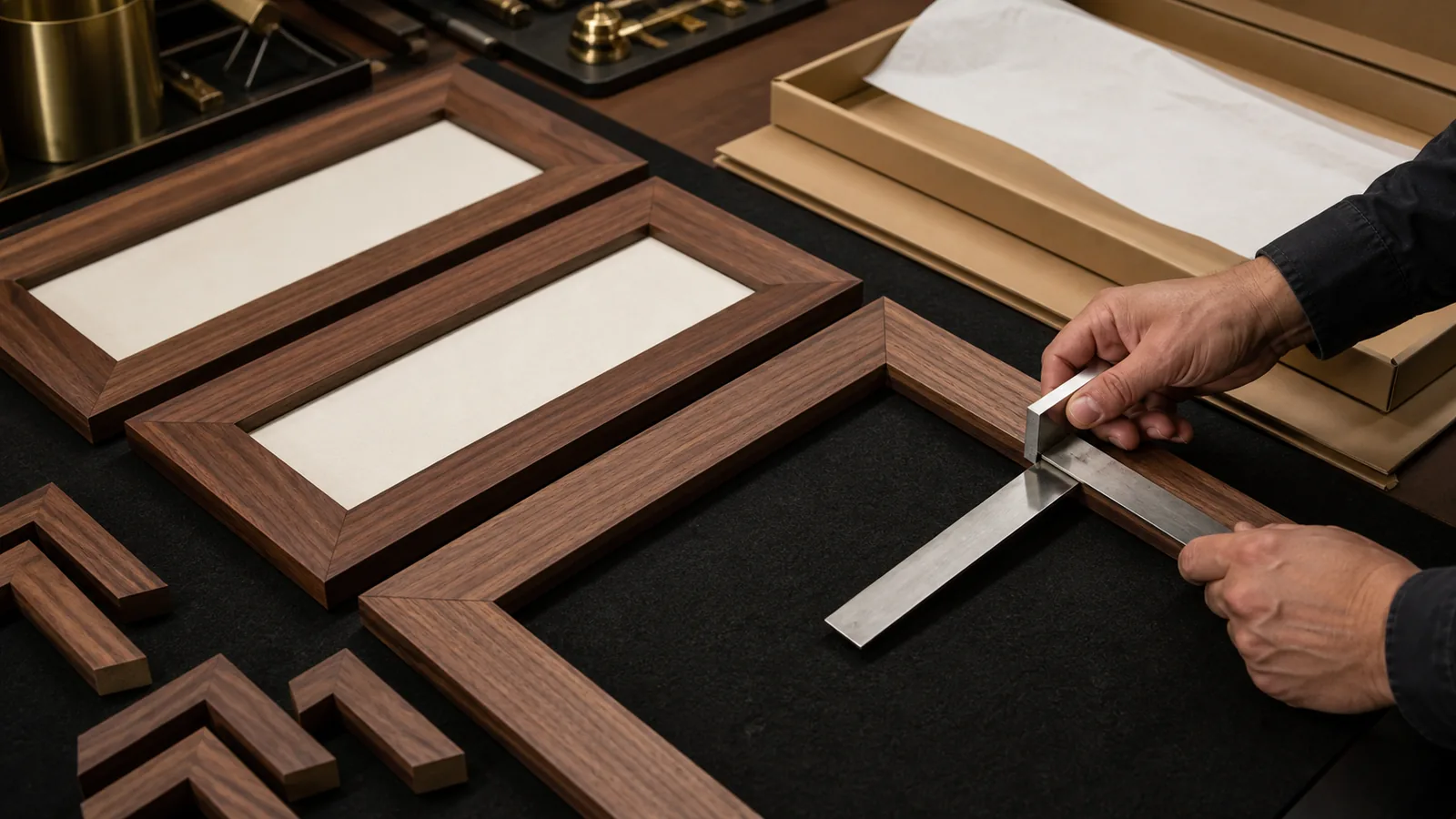
Terms such as warped, straight or acceptable are too subjective for inspection. Agree a reference surface, frame orientation, support points, measurement tool, locations, conditioning state and whether glazing and backing are installed. Use photographs or diagrams to show the method.
Set project tolerances with the buyer’s quality professional based on frame size, profile and use. A small tabletop frame and a large wall display should not inherit the same arbitrary number. Record both measurement and visual effect, because a dimension can be within a limit yet create an obvious rocking or shadow-line problem.
Check the completed frame as an assembly
Measure outside dimensions, diagonals, corner closure, plane, twist, backboard fit, glazing seating and hardware alignment. Place the frame on the agreed reference and hang it using the intended points. A rigid glazing or backing system may influence the assembly, so inspect the configuration actually sold.
Do not force a distorted frame flat for photography and call it approved. Capture side-light views that reveal plane and corner lines. The golden sample should include front, back and edge photographs plus the agreed measurement method.
Connect moisture control to adhesive and curing
Adhesive selection and curing conditions should suit the materials and process. Ask for the manufacturer’s instructions, production parameters and evidence that the approved sample follows them. Moisture or temperature outside the process window can affect the joint even when moulding readings look acceptable.
If the supplier changes adhesive, primer, topcoat or cure schedule, review the impact rather than treating it as an invisible factory substitution. Change control is especially important when the outside appearance is unchanged but the assembly or moisture path is different.
Plan for long transit and warehouse changes
The USDA handbook includes moisture control during transit and storage because dried wood can still exchange moisture. Map the route: factory hold, container or air freight, port dwell, fulfilment warehouse, retail storage and consumer interior. Note large environmental transitions and delays.
Packaging may slow moisture exchange, but it can also trap moisture if material or pack enters in the wrong condition. Desiccants, barriers or ventilation require a qualified packaging plan for the actual route; they are not universal fixes. Keep moisture controls connected to the separate export-packaging validation file.
Inspect after representative unpacking and conditioning
For a new programme, retain packed samples and observe them after a representative logistics trial or controlled simulation designed by qualified personnel. Record unpacking condition, product temperature where relevant, visible condensation, odour, finish change, corner opening and dimensional results after the agreed conditioning period.
A frame that looks straight immediately after unpacking may continue moving toward the destination environment. Conversely, a temporary response may reduce after controlled conditioning. Define when receiving inspection occurs and which condition triggers quarantine, recheck or rejection.
Use photographs as context, not measurement substitutes
Photographs can show rack storage, meter placement, joint condition and completed plane, but perspective can hide or exaggerate distortion. Include the instrument, method and individual readings in the record. Avoid photos of a meter screen on an unidentified offcut.
For remote approval, request a short, structured evidence set: batch identifier, environment record, material map, reading table, meter details, flatness method, front and side views and inspector name. This gives procurement a decision trail without asking for endless unlabelled images.
Separate natural variation from defects
Natural wood can vary in grain and colour. Approve the desired character with physical samples or a controlled reference and define excluded features. Variation does not excuse open joints, unstable geometry, damaged finish or mixed material identity.
Decide how four sides are visually matched and how darker or lighter pieces are distributed. If uniformity is the priority, a veneer or wrapped composite might suit the programme better than wide natural variation, but that is a product-positioning choice rather than a claim that one material is universally superior.
Build supplier corrective action around evidence
If frames move or mitres open, preserve samples and record batch, route, pack, warehouse, room conditions, time since unpacking and measurement method. Compare raw-material, process, final-inspection and receiving data. Do not diagnose the cause from one customer photograph.
Corrective action may involve material selection, drying, acclimation, storage, machining, joint process, finish, packing, transit or destination guidance. Assign tests and changes to qualified owners, then verify the revised sample. A lower moisture target alone may not solve an uneven process and can create different risks.
Create a reorder control plan
Archive material identity, approved profile section, finish system, supplier and component references, moisture method and limits, environment assumptions, sampling plan, dimensional method, golden sample, packaging revision and any deviations. Require the supplier to flag changes before production.
At reorder, confirm season, material source, workshop condition and destination have not changed in a way that affects the design basis. Reusing the same SKU does not guarantee identical environmental exposure. Review drift early rather than waiting for finished frames to reveal it.
Buyer quality checklist
- Solid, jointed, veneered, MDF, plywood or wrapped construction identified
- Species or commercial material, profile and finish documented
- Destination and indoor-service assumptions recorded
- Measurement method, meter, corrections and locations agreed
- Individual readings linked to material lot and production batch
- Storage support, airflow and environment evidence available
- Acclimation release rule defined
- Machining, mitre, adhesive and curing controls reviewed
- Bow, twist, plane and diagonal inspection method approved
- Transit, warehouse and unpacking conditions considered
- Golden sample and change-control triggers archived
- Qualified wood, quality or laboratory advice obtained where needed
Experience scope and project limits
Editorial review: Jessica, Founder & Project Advisor at DOREMI Display. Updated 14 August 2026. Jessica’s practical scope covers B2B display-frame briefs, material discussions, samples, manufacturing coordination, packaging and buyer handover. She is not presented as a wood scientist, structural engineer, coatings chemist, accredited testing laboratory or destination-climate authority.
This guide is a procurement and quality-planning framework, not a universal moisture specification or warranty against wood movement. Final limits and methods must be validated for the exact material, profile, construction, finish, process, destination, service environment and buyer policy by qualified technical and quality professionals.